
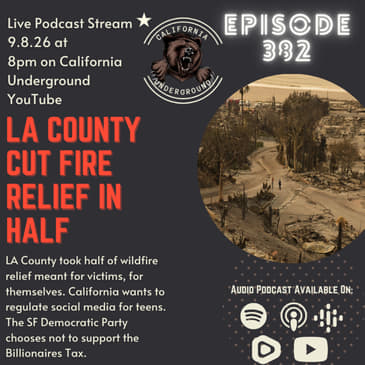
LA County set aside $10 million specifically for fire victims. A revised board motion, passed months later with little public notice, cut that fund in half — the same year the county filed a lawsuit publicly branding itself as fire survivors' defender.
This episode also covers the one Napa winery that's been paid back after a 2025 fire that destroyed dozens of others' harvests — co-founded by the governor.
California's second attempt at a law nearly identical to one already tied up in federal court.
And a San Francisco political party that voted down a billionaire tax, in the same year campaign finance filings show one of that tax's loudest opponents is among the party's biggest
donors.
Documented facts. Primary sources. No spin — just the receipts.
Phil's book "The Gilded State" is out now and available on Amazon both in Kindle and paperback.
[00:00:02] LA County has taken half of the wildfire funds that were meant for wildfire victims and didn't actually go to wildfire victims. We're gonna get into where that actually went. Also, Gavin Newsom's Winery Plump Jack Winery jumped in the front line for a wildfire settlement. Discuss that as well. California wants to regulate social media for teens and preteens. Do you want to trust the government regulating social media? Also, San Francisco Democrats are actually not in support of the billionaires tax.
[00:00:31] We'll get into probably the reason why it's not completely altruistic. All that more coming up on this episode of the California Underground starting right now. What's going on, everybody? Thanks for tuning in to another episode of the California Underground. I'm your host, Phil. We have a ton of stories to get to tonight, including a whole bunch of other stories about wildfire relief. Everyone checking in. Let us know where you're checking in from tonight. Love to hear everyone live checking in from all over California. We got people from Northern California, Southern California, even up in the state of Jefferson. Love to see all of us.
[00:01:17] All these people who are here checking in live. Always great to see you hanging out with us live on Tuesday night because we do the show live every Tuesday for that specific reason so that you can tune in, ask questions, join in the conversation. Before we get started, make sure you do the usual. If it's your first time, make sure you like, share, subscribe, review, all that stuff. If during the show, just a general reminder, I'll keep reminding you throughout the show. It helps with the algorithm. It helps more people find us.
[00:01:44] Also, the huge announcement for today that I'm very, very, very excited about is today is the day. Today is the official day that The Gilded State is now out for you to purchase. The Gilded State, I've been talking about it all summer since June, I think, I believe I dropped it, that we're going to be dropping this book.
[00:02:02] And it's finally out. The Gilded State has been a passion project of mine for about somewhere over two years. I've always wanted to write a book and all these years are doing the podcast, examining California policy.
[00:02:15] I want to write a book, put it all together into one coherent book. I hope that it does it justice in the sense that it is a book about the history of California, where we've come from, the booming gold rush years to going from a sleepy rural Western outpost on the outside of the United States to all of a sudden one of the biggest economic and technological and prosperous states in the entire country, if not the entire world, and how we went from that, which was the
[00:02:45] California dream, which I think was the American dream, basically on steroids to where we are today. So you can see the subtitles, how California went from the American dream to the American nightmare, you can now get it on Amazon, on Kindle and paperback. A lot of people asked about paperback. Yes, it is available in paperback. I have a bunch of copies headed my way right now. Because I want to have a copy. I mean, obviously, I want to have my own copy of my own book. But yes, you can go get it in paperback. Right now it is $2.99 for Kindle. It's not going to stay
[00:03:14] that price. I'm telling you right now $2.99 is the introductory price. It's the first week publishing kind of special. It's going to go up. So you know, if you want to snag it at $2.99. It'd be it'd be great. Great way to support the show. The book is $14.99. Nothing I can do there because of the cost of actually making the book and all that stuff. So thank you everyone who's already I know some people have already told me that they've dropped
[00:03:38] it into their Amazon cart and are ordering it. Awesome. Thank you so much for everybody who has been supporting this show. And this is a really great book. It's about 300 pages with 600 citations and footnotes. So it is not a cheapy book. It is not a pamphlet. It is not a quick fly by night book. I spent a lot of time researching it. Lots of public policy papers, academic research, a lot of stuff went into this lot of historical stuff. It was kind of fun diving into the historical stuff. But anyway,
[00:04:09] QR code will be available on the screen right here. You can see it right there. So if you want to scan throughout the show, if you're watching and you're like, hey, this guy's pretty good. First time tuning in. I think I'm going to check out his book. You can go ahead and check out that QR code. It's on Amazon, like I said. So, all right, before we get in tonight's first story, I want to talk about the Democrat candidate for the 48th congressional district. Her name is Marnie Vaughn Wilpert.
[00:04:35] She was running against Jim Desmond in the 48th congressional district. And she had this to say about white men and city contracts. And I thought it was pretty interesting. So let's take a look. The city of San Diego did a study on our procurement, which is procurement is the process by which our government hires outside contracts for services, good services or construction equipment and the actual building.
[00:05:01] And we found that women and minorities in veteran owned businesses and people with disabilities have a stark disparity in the amount of contracts they are awarded compared to businesses owned by white men. So I'm glad the city did this study because we're the first city of our size to do this. We have to figure out how to fix it. So I'm happy to delve into that more. But that's why I'm here.
[00:05:24] And that's why procurement is so important, because it's city services to the public, a lot of dollars on the table. And we need to figure out how to get more women into these contracts. Right. Because the first thing that's really important when you're handing out city contracts with our tax dollars is not whether or not you can actually do the job. The most important thing is whether you check a box. Obviously, it doesn't really matter whether you can actually do the job.
[00:05:48] The most important thing is whether you check a box. And again, these are politicians who love to be very generous and very charitable with your tax dollars. They're very nice with your tax dollars. They love to hand out contracts to make themselves feel good. And in this case, Marnie von Wilper is complaining that it's too many white men who are getting these contracts. And that's a shame. We need to stop letting white men get all of the contracts from the city. Because what, you know, gosh forbid, what if they actually get the job done?
[00:06:18] What if they're actually doing what they're supposed to be doing? And instead, we should really be focusing on the important things like checking a box. You know, gender, sex, minorities, all that stuff. That's the most important thing when it comes to Marnie von Wilper is whether or not you check that box. All right. First story of the night. This is the big story. L.A. is doing shady things with wildfire relief. I know you're very shocked.
[00:06:43] I know you're very shocked to hear that L.A. and L.A. County are doing very shady things with your tax dollars and wildfire relief. So let's watch this video right now. And we're going to comment. We're going to break this all down. What happened and where all this money is going, because we've got the receipts for you. This is where nearly $14 million of the state's relief money for the victims of the Palisades and Eaton fires was spent.
[00:07:11] Overtime for CHP officers sent to demonstrations in downtown L.A. where protesters marched against immigration enforcement operations. According to this memo, the Department of Finance in June 2025 used some of the fire money for law enforcement unrelated to the fires. But diverting the relief money for crowd control was pre-authorized by state lawmakers.
[00:07:35] I definitely would not want funds directed to anywhere but in the hands of the survivors who've lost everything. Zaire Calvin has been working to help the victims of the Eaton fire that claimed the life of his sister and destroyed his family's homes. You're looking at my lot, plural, which we had five homes on, lost so much.
[00:07:59] I've been an advocate since the fires, fighting for my community, rebuild everything Altadena. I had no idea $2.5 billion was designated for fire victims. Governor Newsom announced the relief fund near the Eaton fire burn zone in the days after the fires and fire victims.
[00:08:19] So I just want to point out there that right at the beginning they're talking about how some of the money did not go to wildfire victims. Instead, where it went was it actually went to law enforcement for the L.A. protests, the L.A. riots. Remember those last year because everyone was up in arms about ICE and all of that stuff? So we had the L.A. riots and protests. So it didn't actually go to wildfire victims.
[00:08:46] So wildfire money was not designated for wildfire victims. I think it should be pretty plain that if you have a catastrophe like you did in L.A. County and in Los Angeles, that if you're going to actually pass something that says this money is for wildfire victims, if you're going to slap a title on it and say this is wildfire relief,
[00:09:08] somehow it shouldn't end up paying for the law enforcement that had to try and keep the city from burning down during the L.A. protests last year. ...told us back then they needed the help. People who live in Altadena are hoping this is the beginning of more aid and more resources. I would say thank you, obviously, right, because we need it. But we need more.
[00:09:34] The bill the governor flashed at that news conference was ABX14, co-authored by Encino Assemblyman Jesse Gabriel. It directed the emergency money to protect health, protect the safety of persons or property, and expedite recovery. NBC4 Investigates has found that much of the $605 million spent from the fund went right back to state agencies.
[00:09:59] The latest figure from the state finance department shows about 75% of the relief money promised was never released by the state. I mean, $2.5 billion is a whole hell of a lot of money. And, you know, off the top of my head, I was like, no, I don't remember that at all. Nicole Vasquez is a community advocate in Altadena, helping fire survivors while also being one herself. We asked her if she remembered any fire messaging from state health officials.
[00:10:27] You feel like you got information from the state health department? From the state health department? I don't remember getting anything from them. That's because the spending records show it received $13 million from the relief fund. The department says it used some for air monitoring or testing and spent some making YouTube videos like this one. Cleaning soot, ash, and smoke damage from your home after a wildfire. It was posted nine months after the fires.
[00:10:55] It's been viewed 181 times. 181 times. 13 million went to the California Department of Public Health. Now, they don't really disclose how much went to these videos. Some of it went to these videos. But I imagine a video that gets 181 views, and believe me, I've been there. You know, when I started my YouTube journey, I had 100 views or 200 views. It was a long time. I certainly didn't start off with a budget of 13 million. That's for sure.
[00:11:23] And even if we're saying that the video's got, I don't know, a million dollars, that's still too much money for a video that got 181 views. Even a video that got 500,000 views is still too much money, or $500,000 for 181 views is still too much money for what you're spending it on, and it looks like no one even watched it. So all this money went to the California Department of Health, and I guess it went to air monitoring and making YouTube videos. Again, $13 million.
[00:11:53] This is wildfire relief for people who have lost their homes, people who have lost their lives, people who still can't rebuild in the Palisades in Los Angeles, and for some reason, it's ending up in all these different places. As you heard, so much of it went back into state agencies. State agencies. It went right back to the government. They literally signed it into law, and then they dispersed it, and then it went right back into the state apparatus. It never even went to people. These activists are saying, I never heard anything.
[00:12:23] I didn't know that there was actually money out there. $2.5 billion is a lot of money. Yet for some reason, it all, well, we all know why it went back into the state agencies, because they saw the opportunity to take the money for themselves. My name is Dr. Anish Mahajan. For comparison, L.A. County's Department of Health produced its own videos in English and Spanish within a month of the fires. Our investigation found that a... Again, the most important thing, I guess,
[00:12:51] to L.A. right now is making YouTube videos. That's the most important thing for them. Not actually helping the people get back in their homes or start rebuilding their homes. The most important thing to L.A. is, you know what, guys? We got all this money in wildfire relief. You know what we should do? We should make YouTube videos. Yeah, let's go do that. Let's spend money on making YouTube videos. A portion of the fire relief fund
[00:13:19] did benefit some employers and employees directly and provided some tax relief to homeowners. The California Department of Economic Opportunity used $3 million from the relief money to help L.A. County small business owners and their employees. And $121 million went to L.A. County for temporary tax relief as property tax payments were delayed for homes destroyed in the fires. But there were few indications that individual fire... Delayed.
[00:13:48] Again, not forgiven, not like just we're going to waive it this year. Delayed because the government always wants its pound of flesh. Right? It always wants its pound of flesh. It's never going to just accept that, you know, this is a horrible tragedy. These people have nothing. They've spent everything to just even live. We're going to delay it. We're going to delay those property taxes. We'll get back to you on those property tax. Don't worry about it. Don't worry about it, babe.
[00:14:16] You can pay those property taxes later. We'll get you later. You don't have to pay this year, but, you know, maybe later you'll have to pay those property taxes. The state can't just go, this is a catastrophe. We probably should do the nice thing and not make these people pay for property tax for a burnt out lot that we haven't helped them rebuild at all. And in fact, the government's probably gotten in their way more than actually helping them rebuild. Victims received direct aid.
[00:14:44] I 100% there should be an expectation of direct help to everyone who lost everything in Altadena, including the 19 people who lost lives to make sure that there's funding to bridge the gaps. The L.A. City and L.A. County Fire Departments received about $37 million in total from this fund to cover the costs of fighting the Palisades and Eaton fires. But there are major unanswered questions here
[00:15:13] about why more of this money hasn't reached fire victims. Governor Newsom's office declined our repeated requests for interviews, but they sent a statement late today. They said the money could only be used for projects that would later be reimbursed by FEMA. But we couldn't find language in the bill that authorized this relief fund that said anything about FEMA. And Newsom even said on social media last year there were no strings attached to the use of this money. No strings attached to the use of this money.
[00:15:43] Says it all right there. That's no strings attached to the use of this money. And boy, howdy, did the government take advantage of that? How many state agencies got paid out? How many made money to just, you know, throw up YouTube videos that got about 200 views, less than 200 views in a lot of cases? You know? No strings attached is certainly, and they also spent money assuming that they were going to get reimbursed. So it's already bad enough
[00:16:13] when you have politicians who spend taxpayer dollars because of the fact that it's not their money and they have no idea how to spend actual money. They just spend it because it's taxpayer money and they think it's never going to end. They thought that, layer on top of that, the fact that there is also FEMA. They thought FEMA was going to reimburse them. So they thought, well, yeah, whatever. Just spend $2.5 billion. FEMA's going to give us the money. There's nothing worse than giving politicians not only a bunch of taxpayer money to spend,
[00:16:42] but also tell them that it's not actually taxpayer money that they have to account for that they're going to get reimbursed for. That's how you get problems like this where they're just going to spend money on this. So this right here is a revised motion by LA County Supervisor Lindsay Horvath. This was as of last year, and I want to point this out because this was another part of this. So there's the $2.5 billion, and then here's what LA County was doing with the money. And they talk about
[00:17:10] the January 2025 Palisades eaten in other wildfires were among the most devastating, and costly in this nation's history. With more than 11,000 homes and close to 2,000 businesses destroyed, the LA County Board of Supervisors took several actions to protect LA County residents impacted by the fires, including instituting an emergency eviction protection for workers who lost their jobs, placed business. Sounds nice that they were trying to help people who were displaced. As part of the motion
[00:17:39] establishing this emergency protection, the board directed the chief executive officer and the Department of Consumer of Business Affairs to identify funding of at least $10 million and to report back on parameters to establish a fund to provide relief and support to tenants and their landlords impacted by the loss of income and the inability to pay rent due to the wildfires who may need to take advantage of the eviction protection. Sounds great. All sounds very nice. People who can't pay rent, they're struggling, they're out there, they're just trying to keep a roof over the head.
[00:18:09] Here's where it gets a little tricky, right? This is where I say that it doesn't really go to wildfire victims. Additionally, our region is bearing the brunt of volatile federal actions. Aggressive immigration enforcement in our neighborhoods and workplaces spread fear and disrupts our communities and the economy. Thousands of families have lost the primary breadwinners due to raids. Thousands more fear going to work, school, and even the grocery store for fear of being detained. Hold on. Hold up.
[00:18:38] Wait a second. Weren't we just talking about wildfire victims, people who've lost everything, who are just trying to pay rent or just keep a roof over the head? All of a sudden, L.A. County pivoted to use in this motion to kind of squeeze in anti-ICE rhetoric and all of a sudden it's about immigration. So we went from wildfire victims to now it's about protecting immigrants, right? We're now in immigration land
[00:19:07] and it's a hard right turn into something. So when you think about wildfires and you think about wildfire victims who need this relief, like that poor gentleman in that video who lost his sister, you know, he knows someone who passed away because of the wildfires and now that you're finding out that L.A. County is diverting some of this money into programs for those affected by ICE raids, now you should start to get a little angry at what is L.A. County doing with this money?
[00:19:36] So this is the priority groups, established priority group one for rent relief, countywide tenants including incorporated cities. So this is basically the wildfires. These are the wildfire people, the people who've suffered from this and these are the people who have lost employment, businesses, stuff like that because of the wildfires. You can see or rendered uninhabitable due to the wildfires and resulted in actual loss of wages, economic impact of the wildfires results in the qualifying tenants, blah, blah, blah. And then you get down here,
[00:20:05] establish priority group three. So you have three priority groups here. You have one which is the wildfires. That should be it. When you have wildfires, call me crazy, call me a simpleton, but I think when you say that you're going to set aside money for wildfire victims and those suffering from the impacts and fallout and consequences of the wildfires, maybe the money should go 100% to this one group which is people who've been affected by wildfires. And then you get down to priority group three. Tenant households
[00:20:35] countywide, including incorporated cities that face emergency conditions and other emerging economic hardship including sudden loss of income due to federal actions targeting immigrant communities to prevent housing instability and preserve tenancy. These households shall be eligible up to $5,000 in relief. So there you go. If you're part of priority group three, if the money does get down to you, you can ask for money up to $5,000 in relief. Does it have anything to do with the wildfires? No, it has nothing
[00:21:05] to do with the wildfires. This is also interesting is that it started off at 6.7, 6.8 million, allocate 6.8 million, jumped to about 9.8 million in affordable housing trust funds dollars from the fiscal year 2024-2025 carryover in treasury tax collector unclaimed funds. So, there was something else I wanted to point out to you here. Let's see if I can go find it. Do, do, do, do, do.
[00:21:34] This is priority group three. Let's see if I can find it. I didn't highlight it. So, anyway, there was priority group three. That is the one that stands out to a lot of people because it is, it's that hard right turn into something that has nothing to do with wildfires. So, this is what your county is doing right now. If you live in LA County,
[00:22:03] this is what the county is doing right now, is they are taking this money, a lot of it's going back to state agencies, a lot of it is ending up in places that it shouldn't be ending up, and a lot of it is being used for personal preferences, a lot of things that are being used for basically their own political agenda. So, it also goes on to say that priority group three is Southern Los Angeles. It talks about, this is the one thing that it said,
[00:22:33] they cannot, okay, February 2026, program grids. This is what I want to bring up. Program eligibility does not require the disclosure of household members immigration status. Just throw that out there again. That is, they're not asking about immigration status. We are taking a hard right turn from wildfire victims into protecting those people who are being picked up by ICE or being detained by these ICE raids. Again, this is their protest. So, we have, law enforcement
[00:23:03] was paid for during the LA protests by wildfire relief funds. We have state agencies that were making money and getting a lot of the money back. We have places like the California Department of Public Health, which took about $13 million and spent it on, I guess, YouTube and some monitoring. We have another agency that made more YouTube videos and how much of this is actually trickling down to the wildfire victims. And the point is,
[00:23:30] is that they are saying that they are protecting or fighting for their constituents. Now, I also want to bring up that they also have sued. This is another point that I want to bring up right now. At the same time, they're taking all this money quietly behind your back. is that they've also, they have also sued, filed a lawsuit against State Farm for allegedly mishandling wildfire survival claims.
[00:24:00] So they're going after State Farm. This is how I want to all wrap this up and why this is so crazy. And LA might be the most corrupt county in all of America at this point. I keep saying, LA, you got to get your stuff together. You're all a mess up there. But they filed this lawsuit, Los Angeles County against State Farm, saying you've allegedly mishandled wildfire survivor claims. Meanwhile, LA County is taking money that is supposed to be for wildfire victims and doling out here, giving it back to the government, giving it to the
[00:24:29] California Department of Public Health. It's going to illegal immigrants who are affected by the ICE raids. It's going to law enforcement because of the protests. It's not making its way to the wildfire victims. And the point here is is that politicians, especially like here in California, LA, they will grin through their teeth and tell you that we're fighting for you. We're going out there. We're going to go fight for you and we're going to go sue State Farm.
[00:24:58] But in the background, they're taking all this money as if they're pigs at a trough right now. They're just running away with all these millions and millions of dollars. So I didn't think, I didn't have hope that LA County would get this right. You can tell me in the comments. I know a lot of people are going nuts in the comments right now about what's happening here. But you let me know in the comments live and you let me know when you watch this later. Let me know your thoughts in the comments. Were you surprised that LA County
[00:25:28] is squandering and moving money for their own benefit and in a little bit is getting to the wildfire victims? We're now almost at two years coming up. We're closer to two years since the wildfires and to my knowledge, nothing has really been done to help these poor people. So keep an eye on that. LA County is a mess and I'm not surprised that they took this opportunity to funnel the money into their own state agencies, into the back into the government,
[00:25:57] into their own political agenda. All right, let's check some of the comments before we get on to the next story. Like I said, we have a ton of stuff to get to tonight so I don't want to take too long. Let's see, some people checking in. Let's see, people checking in from Sacramento, Orange County. What's up? Carmichael is checking in. Somebody asked, where is Carmichael? Watching in the heat of Chula Vista. I hear you, man. I'm right up the road in San Diego. Ventura County, congratulations on the book. Thank you so much. Remember the fire relief concert?
[00:26:28] Yep. Yeah, no one can still answer where that is. So you have this money that was no strings attached. Vallejo, thank you for tuning in. Old Town Vallejo, let's see, checking out. Somebody said, Phil, I know I would wait for the book on tape, but I just bought it. Thank you so much, Corbin. That's awesome. Don't know when I'll read it though as I'm not a big book reader. Well, take your time. You know, it's, you know, it's, you can take a chapter by chapter
[00:26:56] and just take your time with it. So I really appreciate it. Tax dollars from state, federal. It's from the state and they were expecting it to come back from FEMA. So that's why they were spending with absolute abandon is because at the end of the day, they thought they were going to get paid back. So, all right. Somebody, yeah, is anyone here from LA who might want to chime in about what's going on in the Palisades? Give us an on the ground report. All right. Next story
[00:27:25] that I want to get into. Speaking of wildfire settlements and claims and people getting paid out for wildfire settlements, I want to bring up this story. So, California wineries want a picket fire payout. Only one company, co-founded by Gavin Newsom, got a settlement so far. Napa Valley prosecutors on Thursday filed criminal charges in the picket fire investigation, citing with published reports that a worker had caused the blaze
[00:27:54] that burned 6,800 acres a year ago. It goes on to talk about there is a, this is a whole criminal charge, whole lawsuit going on. Only one wine company has received compensation from 100 Acre and its owner, Jason Woodbridge, and that would be Plump Jack Group, co-founded by Gavin Newsom. Lost 60 of the 129 acres of vines at the company's Oso Vineyard in the remote Pope Valley region. Managing director
[00:28:23] John Conover previously told the Chronicle. Just off the, off topic, side note, I, you know, I don't want to sound like a lush or anything, but, you know, Mrs. and I, we like our bottles of wine. We love going to Total Wine. It's like an adult toy store. We like going and walking around, checking out all the stuff. I've never, has anyone ever seen an actual bottle of Plump Jack in any liquor store or wine store? I've, I've never seen it. I've naturally never seen
[00:28:53] a bottle of Plump Jack. I wouldn't even know what it looks like. I don't even know like what their logo is. Yet somehow it's this big prosperous winery that has all this wine. I've, I've never seen it. And we live here in California. Anybody in the comments wants to comment, I, I've never actually seen a bottle of Plump Jack. Maybe it's a Northern California thing. I, I don't, doesn't stand out to me. Uh, Plump Jack did, did not disclose the sum of the settlement. So just as a disclaimer, because we like to make sure we give you the facts here, as a disclaimer,
[00:29:22] this isn't like government money. This is not taxpayers. This is part of a lawsuit. So this is a private settlement. There's nothing to do with taxes. The Plump Jack, uh, he says, quote, we are grateful to put this matter behind us. The Plump Jack group said in a statement as the only vineyard involved in this case to experience burn damage. We were not surprised to be the, among the first to reach a resolution. Uh, the connection to Newsom has raised eyebrows among other wineries. I felt really uncomfortable with that.
[00:29:51] Ed Snyder, a vineyard owner and retired winemaker said of the settlement. Snyder said he lost everything because of the fire. So, he lost everything. Plump Jack lost, what was it, 60 of how many acres? Uh, said something about 60 of 129 acres or something like that. 60 of 129 acres. So they didn't lose everything. They lost almost half, but this guy lost everything. Including his vineyard, home, and income stream. It pretty much left me penniless at 65.
[00:30:21] I don't know what connections or motivations the defendant would have, said John Cadeau, an attorney with the San Diego firm Singleton Schreiber, which is representing the 30 wines and vineyards. Quote, but certainly, I'd imagine Newsom's connection played a part. The Plump Jack group denied any speculation that Newsom was involved in the settlement process. Newsom put his ownership and he Plump Jack into a blind trust when he became governor and the company said the wineries operate without any oversight from his, him or his office. Right. So,
[00:30:53] just a, here's, a blind trust is common amongst people who are going to be high-ranking executives, politicians. It's very typical. You know, big governors, presidents, I'm sure Donald Trump has a lot of stuff in a blind trust that his sons are probably managing, which not really, you're supposed to kind of, it's supposed to be blind to the sense of like, you don't, you have no idea what's going on. But, I will say this, even with a blind trust, whoever you name
[00:31:23] as trustee still has a fiduciary duty to act in your best interest. So, whoever the trustee or whoever's running the trust and Plump Jack Winery and all of that, they still have a fiduciary duty to make sure that everything's going well and going swimmingly and that your assets that are in there are protected and they're still making money. So, I'm not saying Newsom had anything to do with this personally. I'm not saying he didn't have anything to do with it personally. But,
[00:31:54] with that said, if you are involved in a lawsuit and one of the wineries belongs to the governor of the state in which you are operating, do you think there might be a little bias in terms of, I don't know, showing some favor to the winery that is owned by the governor of the state that you currently do business in? I mean, it's no secret. It's no secret that Plump Jack, it's not like
[00:32:23] they changed the name of Plump Jack Wineries and all of a sudden you have no idea who it is. It's not like the company itself is blind in the sense of no one knows what's going on. As part of the settlement, they settled with Plump Jack Group which everybody notoriously knows is owned by Gavin Newsom, co-owned by Gavin Newsom, also started by the Getty family as well. That's a whole different story, the Getty's and the Newsom's. If you want to go check it out, I have a good video on it, done pretty well. Go check it out. It's the Royal
[00:32:53] Family's video here on YouTube. You don't think that that had any kind of sway over the settlement if the governor's company that he co-owns jumped to the front of the line as opposed to this elderly man, 65 years old, who lost literally everything. He had a vineyard, a home, everything, his whole income stream is gone, but Gavin Newsom was one of the first to, his winery was the first to get out and get a settlement out of it. It just goes to show, it's also the irony
[00:33:22] of this is that at the same time, at the same exact time, there was an announcement from Gavin Newsom that they are going after more utility companies, that they are trying to set up these funds to go after these utility companies to protect somehow
[00:33:51] wildfire victims. So, on one hand, you have this issue where Gavin Newsom put his company in a blind trust, the winery settled first, but at the same time, he is also announcing that he's going after, and this is classic Gavin Newsom style, is that he's going after all of these companies for wildfire victims, yet when he was a wildfire victim, he jumped to the front of the line.
[00:34:21] Again, not him personally, I'm saying his company that's in a blind trust, because we all know, it'd be like if Donald Trump puts Trump enterprises into a blind trust, and you're doing business with Trump enterprises, boy, I wonder who you're actually doing business with. Yeah, I'm doing business with the president of the United States company. You don't think that has a little bit of a bias at all.
[00:34:52] And again, I'm not saying he personally did anything, but I'm saying that maybe it's not a good look, all these people suffering from wildfires and losing everything, maybe as a multi-millionaire governor public servant, maybe you don't jump at the front of the line. I don't know. Crazy thought. Somebody is checking in from Los Angeles. What's up? Thank you for checking in from Los Angeles. I saw somebody say there's no internet service in the Palisades. Wow.
[00:35:23] So, crazy. They still have no internet service. Never seen an OC. I've never actually seen a bottle of Plump Jack anywhere. I'm amazed. I've never seen it on a menu. I've never seen it in stores. You figure you go through a place like Total Wine. You never see, and Total Wine has a ton of wine. I mean, that's the name, Total Wine. You never see any Plump Jack actual wines. Somebody said, nothing to see here.
[00:35:53] Just move along. Move along. Gavin Newsom's company just somehow jumped to the front of the line. Let's see. Palm Desert. What's up, Palm Desert? Is Palm Desert getting the same amount of humidity that we are out here? All right. Let's see. Next story. Ah, here's what it was. Newsom is legislating pushing to cap what wildfire victims can collect from utilities insurers.
[00:36:23] His own company already quietly and quickly collected from the party responsible for a different fire. So, different sort of compensations, and it's protecting the utilities. Just clarify that. It's protecting the utilities. All right. Next story. I told you we have a lot of stuff to get through tonight. I'm trying to keep an eye on what's going on. Also, just a friendly reminder, if you haven't already, my book, Guild Estate,
[00:36:52] out now. Go check it out. Very excited. Came out today. Scan the QR code. Tell a friend. Make it a gift. Make it a gift for people. Tell people, hey, you should check out this book. Hollister. Hollister, California. Where is Hollister, California? Outside the fact that everybody knows it as a clothing store. Where is Hollister, California? Napa Valley is rich people land. That is basically where Gavin Newsom is in Marin County in that area.
[00:37:23] All right. Next story. If you've watched this show long enough, you know that we're no fans of government regulating basically anything. We're not fans of the government regulating anything because usually the government when you give them a little bit of power, they end up running away with the power. And you don't want to, you know, when it comes to government regulation, it's kind of like if you give a mouse a cookie, they want a
[00:37:53] glass of milk. But in terms of, you know, with the government, if you give the government a cookie, they're going to want, you know, your entire house given to them for free. That's sort of the excess of how far they go. You give them a mile, give them an inch, they take 10 miles. That's the government. Now, altruistically, they have now passed a bill which is headed to Gavin Newsom's desk that they want to regulate social media.
[00:38:23] So let's watch this clip real, let's watch this news clip real quick and we're going to comment on it. California cracked down on social media aimed at children and teens. Lawmakers could pass a first in the nation ban on accounts for children under 16 and add million dollar fines on the tech industry. Supporters call it part of a parent tech lash. The device time dilemma between parents and teens is now turning into a battle
[00:38:52] between lawmakers and tech companies, including some heartbreaking testimony. Before Coco died, we watched social media take more and more from us. This mother describing the toll social media took on her daughter before her death from a fentanyl overdose, drugs she got from a man she met online. The product kept pulling her back and the parental controls just didn't work. They did not suffice. This is not a Republican or Democratic issue. Jim Steyer is the founder of Common Sense Media and sponsor of three proposed
[00:39:22] laws to crack down on social media use by children in California that would ban anyone under 16 from creating a social media account, allow social media companies to be fined up to a million dollars, and prohibit AI chatbots from producing or displaying self-harm. At the end of the day, we saw this happen with tobacco. I think we're now starting to see this with big tech. The public, in a bipartisan way, is standing up. Tech companies are pushing back against the proposed laws,
[00:39:52] issuing a statement through the Computer and Communications Industry Association. Faced with significant litigation risks and penalties of up to a million dollars per violation, platforms will be incentivized to over-restrict content, limit services for youth users, and potentially weaken privacy protections. New proposed laws would stop children under 16 from having access to addictive features like infinite scrolling and will prevent videos from playing automatically to capture teen attention. Parents are just done with it. The device
[00:40:21] debate from California living rooms to the state legislature. The lawmakers have until the end. All right. So, the bill right now, AB 1709, covered platforms age restriction. So, as you can see, this is CalMatters. We're a big fan of CalMatters here on the show. They do a lot of great work. If you want to get news, go check out CalMatters. They're very non-partisan, very interesting, well-written stuff. This is not an ad for CalMatters.
[00:40:54] But they're very interesting in the sense that they give you everything. They give you the bill author, they give you the co-authors. The bill would prohibit a covered platform as defined from providing an addictive feature as defined to a user who is under 16 years of age. And it would require a covered platform to implement reasonable measures to ensure that users under age of 16 are not offered or provided any addictive feature on the covered platform. The bill would also authorize the attorney general to adopt regulations to implement. Don't like that because you give the
[00:41:24] attorney general more power to adopt more regulations. Last thing we need here in California is more regulations. to implement and enforce the bill in order to further the purpose of protecting minors online including by altering the scope of covered platforms. The attorney general determines that doing so is necessary to ensure that covered platform applies to internet websites, internet websites, online services, online applications, or mobile applications that make addictive features. That's not just social media. Ladies and gentlemen, that is not just
[00:41:53] social media. That's basically the entire internet will be censored for those under 16. Some of you may be saying that's fine, whatever. Fine with that. I have a problem with when the government tries to regulate because it starts off one thing and it ends up being another thing. Like I said, it's one thing where you give a mouse a cookie, they're going to want a glass of milk. This might be sort of the beginning of it. The conspiracy
[00:42:23] theory in me is also saying that that have you noticed recently that ever since these platforms, X, Facebook, basically Google to some extent, have all kind of after Joe Biden left and COVID is over, they've all changed their tune when Trump got into office. All of a sudden they say, Zuckerberg is saying we're not going to have content teams anymore. It's basically a free-for-all.
[00:42:53] Go on Instagram as a wild free-for-all of what is posted on there. TikTok, which is basically QVC at this point, it's just all online shopping ads, it's absolutely awful now. TikTok is almost unwatchable now because of the fact that it's just constant ads and people selling you stuff. Facebook, all of that, they're basically all have kind of pulled back. X, same thing, Elon Musk kind of opened the gates and say you're going to be able to post. It's a free speech platform.
[00:43:22] And you notice that ever since they did that, now you're starting to see more people tuning in and finding more conservative content, more right-leaning content. So it is interesting, the timing of this isn't suspicious. Maybe it's not completely conspiracy theory tinfoil hat because if you think about it, it just coincides in the fact that before all this happened with X and Instagram and all of them kind
[00:43:52] of unleashing everything, and Donald Trump got reelected in a landslide, then all of a sudden, now you have all these Democrats who are running around talking about regulating social media. Before they had no problem with social media. When they were censoring the Hunter Biden laptop, they had no problem with what social media was doing. When they were censoring all the stuff about COVID and information, they had no problem with what all social media was doing. But now, because the shoe's on the other foot, now all of a sudden you're seeing a rush of Democrats to push for
[00:44:23] all of this censorship, right? So that may be something as well. I think that, you know, I'm not trying to really be conspiracy theorists here. You can let me know in the comments what you think in the chat, but I think there is a connection of the fact that more people are gravitating towards different right-leaning content, religious content. I see a lot more Catholic content, that's for sure, a lot more young people becoming Catholic, as you can see by my little rosary, more people are becoming Catholic. Catholic, that's cool, like that, love that.
[00:44:53] I also have my stack of Catholic Answers books back here, which you can see. I think there is a definite undertone of why they're doing this. Excuse me. So maybe it's not totally conspiracy theorists, but it seems that all of a sudden, for years and years and years, when social media was basically under the thumb and under the control of the Democratic Party and they were doing whatever they wanted, they were fine with it.
[00:45:23] And then once the yoke came off and it became more about free speech, all of a sudden, now Democrats want to clamp down on it. And they especially don't want young teens who are in their formative years watching stuff on social media that may be more right-leaning, may be anti-establishment, anti-state, stuff like that. So that's a little tangible, conspiracy theory about why they want to clamp down social media. I don't think it's completely altruistic. And I also
[00:45:53] am not going to let Republicans off the hook here too because this was passed unanimously. So Republicans in both chambers, Assembly and Senate, they all voted for this and why they're voting for this. It all sounds great. This is one of those great-intentioned, well-intentioned bills that everybody loves to get behind because it sounds so great. There was a comment in here. I want to bring this up. Let's see.
[00:46:24] I saw this while I was reading this. Angela G says, I wish parents would pay attention to more of what their kids do online and check their devices instead of handing them devices for their own babysitter. I agree. And I think I'm going to get to that in a little bit because it comes down to this idea. And I feel sorry for that mother who lost her daughter because of what was on social media. But I think there's also something about parents have to step in here and
[00:46:54] actually parent. I remember when I was a kid, my mother would always say, I liked video games. I had an N64. It was a big deal. I still like video games today. And I always remember my mother would always ask me, she'd always say, Philip, is this game violent? Is this violent? Is this a violent game? And I said, no, no, it's not violent. It's like Mario or something. Like Super Mario jumping on Goombas and stuff. Or it was Zelda or something like that. It was very, you know, Star Fox. It was very cutesy, cartoonish kind of stuff.
[00:47:24] And that was parenting. She would see, like, is this violent? I think the most violent game I had might have been WWE or something like that. But I didn't have violent games. And that was parenting because she wanted to control what I was being exposed to as a young kid. And it seems like that hasn't happened recently where a lot of kids just kind of get an iPad or a phone. And Lord knows they're on YouTube kids. Like, even stuff on YouTube kids is kind of weird. And they just kind of let
[00:47:53] their kids be babysat by these screens, which is a huge issue right now. Now, what's really interesting about this bill is this is actually not the first time California has tried this. And in fact, excuse me, my voice broke there. In fact, this is actually, as of recently, like, January 28th, 2025,
[00:48:23] Ninth Circuit blocks California law protecting kids from social media addiction. So this has been tried before. Senate Bill 976, also known as the Protecting Our Kids from Social Media Addiction Act prevents social media platforms from knowingly providing an addictive feed to minors without parental consent. The law passed in September will no longer take effect on February 1st, as previously planned. In a brief two-page order, U.S. Circuit Judges Richard Piaz, a Bill Clinton appointee, Jay Bybee, a George W. Bush appointee, and Eric D. Miller, a Donald Trump appointee, granted the injunction
[00:48:52] to NetChoice, a powerful tech logging group that sued the Golden State and prohibited to thwart the law. NetChoice is a trade association and lobbyists that represents some of the largest interests in the tech world. Companies it claims facilitate speech protected by the First Amendment. Founded in 2001, the group has steadily climbed in scope and influence over the last decade and currently has six active lawsuits over state level internet regulations. This is the exact same bill. It's almost word for word, they are the exact
[00:49:22] same bill. So California literally passed the same bill even though the bill that they had just passed has already been blocked by the Ninth Circuit. And it's pretty bad if the Ninth Circuit doesn't agree with California. We all know what comes out of the Ninth Circuit. It's pretty bad if the Ninth Circuit is like, hold on, this is an infringement on free speech. You can't do this. You can't do what you're saying it's going to be doing. So they're already wasting our time. It's either
[00:49:52] they are pretending that nobody remembers this as if, hey, don't forget about that last social media. This one's going to work. I promise this social media bill is going to work. Instead, they're just passing this again. Maybe it's going to work this time. It's going to be the same people are just going to sue it in federal court and it's probably going to get blocked again if it goes into effect. But they already passed it. So either it's one or two explanations. One, they're hoping that you don't pay attention to the fact that this bill has already been passed.
[00:50:21] And that it's already been blocked. Even though unanimously the state legislature approved this. Again, if you think it's just Democrats, it's also the Republicans joined up on this as well. And they're passing it because they hope maybe you don't remember that bill. Maybe they're being deceptive in that sense. Or two, they actually didn't remember that their old bill was held up in court and maybe they're just not that great of legislators and figured out that did not figure out that the bill they just wrote and passed is the exact same bill that
[00:50:51] got held up in court under First Amendment violations. So, I don't know, both of those are not either you're being deceptive or you're too dumb to figure out that the bill that you just passed is the same exact bill. So, Newsom publicly called, and this is about Josh Lewenthal, who was the author of the bill. He called Josh Lewenthal my legislator of the year. So, it sounds like it's going to be passed. He has about until September 30th to act. Also, a
[00:51:21] companion bill, AB 1856, would carve out an exemption for open source software makers from a separate but related digital age assurance law. Worth a one-line mention. So, there's another exemption that's already been carved out for open source software. This is also on the heels of Meta agreeing to an $18 billion supplement in more than two dozen states. They say it's the big tobacco moment. And then Josh Lewenthal, the
[00:51:50] author on the bill, said, we're not banning children from accessing social media. We're banning social media from accessing children. And I want to come back to this same point which it's altruistic and it sounds nice. It sounds nice. It sounds good. Oh, our government's doing something about this social media. And I'm going to tell you a personal story.
[00:52:22] I've actually been on a little bit of a social media detox over the past three or four weeks. And what I did was I've created a way to make my phone into a dumb phone. You can look it up online what a dumb phone is. Basically, I've made it so it only shows like messages and phone and stuff like that. It blocks all social media. You can't go on your phone for social media anymore. And I will tell you this was a personal thing. I'm not going to downplay the fact that social media is addictive and can be
[00:52:52] harmful and it screws with your dopamine levels and it gets people to be addicted to it. I certainly agree with that. I agree with that because it's absolutely true. And I've seen a definite benefit. I don't reach for my phone every two seconds. I'm watching a movie. I'm actually watching the movie. I'm not doing the two screen thing where I'm watching the movie but also I'm sitting there on my phone also watching.
[00:53:32] I'm going to reach for your phone. Especially with the algorithm the way it is you can scroll and scroll and scroll and scroll and before you know it a half an hour has gone by and you've wasted all this time and you go where did a half an hour go? I'm not going to dispute that point. I'm not going to dispute that social media is addictive and I imagine for preteens and teenagers it's even worse and Lord knows what they're getting into or what they're looking at. And I can only imagine what it would be like to have social media in high school right now. High school is hard enough. Imagine having social media on top of it.
[00:54:01] it's hard enough. With that said probably plenty of you are going wait a second Phil how do you you have a podcast and platform and all that stuff. How do you how are you off social media? Well like I said you there's apps there's schedulers there's things you can do like you don't have to be on social media on your phone to do to be on social media or to run your platform. So I'm not going to dispute that. I am going to push back back on the fact that I
[00:54:31] don't like the government getting in the way of these platforms where people can express themselves. And there's a lot of good things on social media in a sense of there's news there's influencers you like there's stuff that you're passionate about all of that. And it's a way for people to get the word out advertise their business spread news start commentary start you know
[00:55:01] it's a way of kind of community it's the the town square as you can say it's the electronic town square. And I that's why I want to come back to this point about it it sounds altruistic but the devil's in the details because if you noticed in that language it's not just social media it's all internet gaming all of this stuff that has addictive qualities and addictive is subjective addictive is subjective in a legislator's mind as to well we can say this is addictive so therefore we need to ban it.
[00:55:31] This is addictive therefore we need to ban it you know flavor tobacco and vapes is is addictive so we need to ban it for everybody because it's addictive to teens. As opposed to taking personal responsibility and parents taking personal responsibility for the kids and the kids taking personal responsibility for themselves and teaching the kids personal responsibility let's let the nanny state of California regulate social media and I think that's where it starts to become
[00:56:01] this little thread that they start to pull on bit by bit and go okay if we can get into you know legislating and regulating social media what you can see what you can't see all of a sudden that free flow of information the electronic public square goes away and there'll be other ways to you know spread information and stuff like that but right now the most popular way is social media the way to get information out it's the way people spread news it's the way people I mean we use it to get
[00:56:31] people to get news out to share news to share our thoughts to share videos and stuff like that but that's where I get a little worried because the government doesn't do all of this stuff altruistically they they don't do it they don't do it because they have some big heart I think they're doing it because they know at the end of the day once they get this little bit of power
[00:57:01] that they can start to regulate things like social media then all of a sudden what else can they regulate what else can they stop your kids from seeing what can they start this those young kids who are going to be voting age in two years what do they stop them from seeing what ideas do they prevent them from being exposed to because right now social media seems opened up wide open and that's my concern
[00:57:30] if you look it's the devil in the details of where is this going and what are they going to use this for down the line but if it's anything like their own their old bill it's probably going to get blocked in in court for free amendment first amendment violations so all right let's see looking at some of the comments before we get to our last story like I said we had a bunch of stories tonight so it's going to be over a little bit
[00:58:04] let's see Iceman says social media sports gambling vapes porn they want our kids weak lobotomized slaves addicted to vice yeah it's it's scary how I was reading an article this is off topic I was reading an article about how years ago 20 years ago when internet was becoming big the cool thing to do to show that you were skilled and
[00:58:33] sophisticated was learning how to use the internet and technology that was a cool thing to do it's kind of like a skill it's like man you know how to understand you work technology and the internet and stuff now it's going to be the skill is you can sit down for longer than five or ten minutes and read a book like an actual book like you can sit down and read a book
[00:59:00] like if you can read a book then that's going to be a cool skill being like analog is going to be a cool skill I like this idea drumroll said give the kids flip phones instead yeah give them dumb phones if the argument is well the kid needs a phone so that I can see where they are or I can communicate with them that sure give them a flip phone if that's their only thing age
[00:59:28] gate smartphones parents need to be parents stop using iPad as a babysitter yep let's see this is Angela says I don't know why I blame parents they don't need to have their kids on devices all the time when my daughter was younger she got her first phone for emergency purposes and as she got older I let her know that
[00:59:57] it was my phone and I could check it any time that way it was known so vinyl cat cat videos are the good old days if you remember YouTube cat videos were the original YouTube yeah back in the day let's see how do I get okay or a clock
[01:00:27] how are kids gonna yeah how are kids gonna understand how to use a clock all right final story of the night that I want to I want to show you guys or talk to you guys about got all these little comments all over the place I got to get rid of let's see give me one second all right
[01:00:55] final story of the night you know the billionaires tax is pretty bad when Democrats the Democratic Party of San Francisco says nah we're good we don't need prop 40 could be two things I have a hypothesis why they went this way one I think they could say this is really bad
[01:01:25] that we don't want to do this and two I think there's an ulterior motive so let's look at this story right now this is from mission local SF Dems overwhelmingly vote to oppose billionaire tax defying state party the San Francisco Democratic Party as predicted voted 17 for on Wednesday evening to oppose the upcoming California billionaire tax in doing so made the rare choice to buck the state Democratic Party which had narrowly endorsed the proposition
[01:01:53] in early August the vote fell along a neat progressive moderate divide the local chapter took the two step two months ago to alter its bylaws so they altered the bylaws they altered their own bylaws is never a good sign when the you know your political party has to change the bylaws to do something to allow itself to diverge from the state party's endorsement on California ballot measures previously the local chapters convention was allowed was to follow the state party on statewide ballot
[01:02:23] measures and candidates because remember California Democrats the whole party statewide they're in favor of it so they support the billionaires tax but San Francisco San Francisco Democrats said now we good quote my union is particularly disturbed because we feel it sets up an uneven playing field for California said Patrick below a DCCC member too many DCC's member and the political director of the operating engineers local three quote the billionaires that are going to be taxed
[01:02:52] with this measure also have the ability to vote with their feet and move out California right that's what a lot of us have been saying supervisor Matt Dorsey put it bluntly this is terrible public policy it goes on to talk about how they went ahead and voted it down they talk about there's a resolution that they are in a symbolic vote and went on to unanimously pass a non-buying resolution for a national wealth tax again this is why Gavin Newsom is
[01:03:22] not in support of the California wealth tax he's in support of the national wealth tax because he's afraid that people can move so he wants to impose a national wealth tax so no one can go anywhere that's his whole thing it's not that he's against wealth taxes it's against the fact that he doesn't want people to be able to move and go to other states where they don't have a wealth tax so let's see let's see I
[01:03:50] want to something else in here all right another story more interesting as well is our old friend Pelosi Nancy Pelosi avoids billionaire tax vote as wealth tax turns toxic in SF splintering the Democratic private party leaders opposing the wealth tax even as voters especially young voters appear eager to increase taxes on the rich San Francisco Democratic Party
[01:04:18] Michael Nguyen a candidate for the SF border supervisor said the local party's rejection of the state party's position on the tax was unprecedented he called out local Democrats for supporting the ultra wealthy my colleagues chose billionaires over patients caregivers seniors children and working parties polls show that Democrats overwhelmingly support the measure which would impose a one-time 5% wealth tax and Nancy Pelosi Queen Pelosi did not show up she
[01:04:43] didn't want any part of this and Scott Weiner good friend of the show person we love to talk about on this show Scott Weiner he's not really a friend of the show just for people he's not a friend of the show we've never spoken to Scott Weiner he did not he abstained so he didn't vote no Pelosi was not in attendance by our representative there cast a no endorsement so you have these people like Pelosi who said no endorsement Scott
[01:05:11] Weiner avoided it so a lot of these big names not chipping in or saying anything about the billionaires wealth tax so I started this story because I thought wow if the if the San Francisco Democrats San Francisco Democrats and I'm gonna give San Francisco credit because over the
[01:05:38] past couple years dare I say Cal San Francisco has edged more towards the middle right like he San Francisco has moved a little bit closer to the middle and that's saying a lot because they were really far left and now they've kind of inched you know they got rid of progressive DA's and Chesa Bodine and you know they got rid of they voted out a whole school board who was super liberal because they wanted to change Abraham Lincoln High School or something like that and they want to waste time and
[01:06:08] money on that they elected the new mayor right now Daniel Laurie who is the heir of the Levi Strauss fortune he's a businessman more moderate business friendly so they elected a mayor who's more moderate business friendly they got rid of Brooke Jennings is it Brooke Jenkins Brooke Jenkins who is the old mayor so San Francisco for what I said they've also voted down a whole bunch of things with tax measures and they push back a lot of things so San Francisco for
[01:06:37] what it's worth has moved more to the middle anyway so I'm not going to say that the I think LA has now taken the crown sorry LA anyone who's here from LA I apologize but you've taken the crown as the loony leftist city and county right now you're the you are the statist you are the headquarters of statism here in California congratulations you are the new headquarters for statism you are the where it all comes from it used to
[01:07:06] be San Francisco and now it's LA LA seems to be the statism and crony corruption capital of California so San Francisco for its credit has moved a little bit more moderate but why do I think that the San Francisco Democratic Party actually voted this down London Breed thank you Brooke Jennings is the new DA thank you got that all confused see so many people thank you so much drumroll London Breed was the
[01:07:35] former mayor this is why we do it live so I can be fact checked by my listeners and people watching live and be helped out a little bit anyway here I am I read this story and I thought to myself wow the San Francisco Democrats they're they're really getting their act together they're moving more into a sensible position they are not as crazy as you think but I'm gonna I want to point out something so they
[01:08:05] changed their bylaws changed everything just so they can say no on this why I want to point this out though why I think again never trust people for doing the reason what they're doing for altruistic reasons this is why I just don't trust government in general I just don't trust it at all whenever government does something if they want to give you something for free my first response is why what are you trying to buy from me what are you trying to buy me off
[01:08:32] for where did it come from what's the money did you how did you get this those are all my questions there's always some ulterior moment it's never they just want to do something for you because they want to do it and actually help you that's why I've gotten to the point where I just don't really trust government anymore which is why I wear this shirt you can get in our shop political affiliation Democrat Republican you see right now tear it all down and start all over it's checked I can see tear it all down and start all over it's the same as my
[01:09:00] cup which says the same thing political affiliation you can also get this this mug on our shop as well so the San Francisco DCCC raised $850,000 in donations this year as of September 1st which was the highest per capita fundraising of any local party in California more per Democrat than even the state party the majority of that money came from just three donors neighbors for a
[01:09:27] better San Francisco which is real estate tech backed group 189,000 Chris Larson the billionaire ripple co-founder 181,000 and SF believes a pack backed by Mayor Lori's wealthy allies including John Jan Coem 139,000 Chris Larson is the same person DCCC member Peter Galata named as in the record as the prop 40s loudest opponents in the very meeting where the party voted the tax down he is
[01:09:55] simultaneously one of the party's three biggest donors so here's where it gets really interesting and again never trust they're doing it for altruistic reasons I think the reason they did this was strategic Democrats knew that if they go forward with this if San Francisco Democrats who again are
[01:10:21] close to the tech industry real estate all that those big industries that make a ton of money in San Francisco if they go with this they're gonna piss off all of their biggest donors all their biggest donors who are billionaires and tech and real estate and all that stuff if you support this all of a sudden that money faucets turned off there's not gonna be any more money because they're gonna say well you
[01:10:44] want to tax me five percent one time on all my assets you support this crazy proposition so those billionaires whether they can do this like well you support this well guess what I'm not supporting you anymore and I think that's the real reason why you have the San Francisco Democratic Party who strategically went and said okay we're gonna create these bylaws we're gonna change the bylaws so we don't have to follow our old rules we don't have to follow what the state says we're gonna do
[01:11:09] this so that we can vote against this because we know and I wouldn't be surprised if old Nancy behind the scenes was sending out feelers to everybody kind of little messages of like you gotta kill this and you gotta figure out how to fix this so that we don't support this because we need that money we need all that money coming into the Democratic Party and they did this because they didn't want the funding to end they didn't want the donations and the campaign funding to end
[01:11:38] so here's the hypocrisy the hypocrisy is when push comes to shove and the rubber meets the road Democrats love to talk a big game about we got taxed the billionaires and the one percent and the rich need to pay their fair share and all of that but when it comes down to it and it comes down to actually
[01:12:01] supporting something and then their donors go well if you support this guess what we're not gonna give you money anymore all of a sudden that a whoa whoa now all of a sudden we're not we're not gonna get campaign funding anymore well now we we got to pull the plug on this as fast as possible because we can't can't do this without campaign funding we need our money that's going to be funneled into our accounts
[01:12:24] so for all the the posturing and the bloviating and big statements and the speeches and the TV spots and all that stuff about the rich need to pay their fair share and we need to tax the billionaires and we need to pay for this program and that program and this welfare program and all that stuff when it really came push to shove Democratic Party of San Francisco said we don't want to piss off our big donors
[01:12:53] and money talks that's all I'm saying is at the end of the day money talks and they caved immediately and this is probably why Democratic Socialists are actually doing very well against mainstream Democrats it's because they're tired of sort of this cronyism but you're seeing it play out on a local level where San Francisco goes we're not going to cut off our nose to spite our face we're not going to cut off these
[01:13:20] billionaires who are funding our campaigns we're giving a lot of money to Democratic Party here in San Francisco we need the money because money is power in politics and they need a lot of it so it's all great and fine and dandy easy to say tax the billionaires easy to say it but when it comes down to it's not so easy when the checks start to dry up just something to think about so when I thought
[01:13:46] the San Francisco Democrats were doing it because they actually believe that this was bad policy I thought that's pretty interesting this is a good story I want to cover it but when I thought about it more before tonight's show and before I came on I said wait a second and I saw who was behind it and the billionaires who were against it and contribute a lot of money to the San Francisco Democrats I said wait a second now it makes sense now it makes sense why they don't want to support this because they
[01:14:15] don't want the money to dry up all right let's check a couple more comments before we log off for the night uh so as the set SF politics is still crazy just not as uh LA is not America anymore let alone California sorry Dodgers fans uh San Diego here so no offense to Dodger fans uh you know we're not fans of LA down here so he's a money talks yep um basically the same thing happened with Bernie but
[01:14:44] the establishment Democrat party chose Hillary behind closed doors because Hillary brought in more money um yeah and it's funny the billionaires can do two things they can you know we talked about Sergei Brin on this this show about how he moved out and he's dumping a ton of money into the opposition for prop 40 um they could they could help out one way or the other but you know on one side or the other
[01:15:15] let's see so he's like Gavin wants money just not not just California Gavin wants everybody money but it's money just not California got it all right if this bill passed will be wound up oh absolutely the bill will absolutely if it does pass it will be wound up in courts almost instantaneously um 90 San Francisco during the Clinton era was slick willy as mayor was as capitalist as it gets and
[01:15:44] that's funny because they used to call Clinton slick willy and then they called slick willy willy brown slick willy so that's isn't that a double nickname right there slick willy for the mayor and slick willy for Bill Clinton um it's crazy to me that the Camille said it's crazy to me that the billionaires don't like Democrat policies but keep supporting the billionaires yeah it's interesting
[01:16:12] well sometimes you get a lot of people who have money and they think they're doing the altruistic thing by supporting a party that is all for statism giving your money away interesting how that happens billionaires are always big on supporting the programs and the you know the politicians who are in favor of taking money from you and regulating you to take your money away and your property away it's not going to affect them I brought this up before champagne socialists don't
[01:16:37] care it's never going to affect them um but they're they're fine with the government getting bigger and taking your money away that's how that's how some of these altruistic billionaires I think the theme of tonight's show was whatever they pretend to be altruistic and helping you just don't trust the government at all bottom line just don't trust the government um all right that's it for tonight
[01:17:06] we've gone over a little bit I do want to one more time shout out my book the gilded state which is out now on amazon you can go the qr code also you can just go if you're listening on audio go on amazon just search the gilded state and you put in the gilded state book you can see it says my name on it has a nice little cover with california and all that stuff um really appreciate if you go check it out it was
[01:17:28] a labor of love a layer of passion so uh really proud of where it it um where it it ended up where it kind of the story went and um yeah the points that are made like I said it's it may seem sad like it may seem depressing but there is an optimistic ending of how we can hopefully get back sort of like hey you know we can get back we just have to keep trying a little bit more uh let's see
[01:17:59] camille said guilty of scrolling on my phone and listening up caught you two screens it's the two screen world now everybody's got to be on two screens so all right thank you everyone for tuning in show went a little longer but we did have four stories that I did want to cover so with that uh thank you everyone for tuning in make sure that you like share subscribe review all of that stuff helps
[01:18:25] with the algorithm helps everything uh go check out the book the gilded state if you see this show within the first week also make sure you hype it that's a big thing too now if you hype the show helps get more people to be seen uh gets this in front of more people to be seen so with that we will see on the next one later