
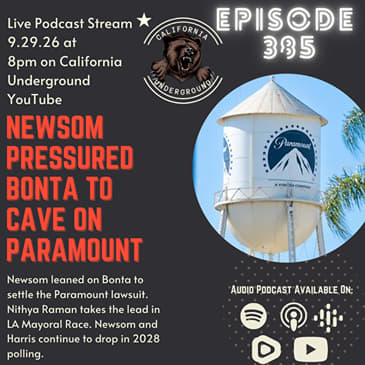
California's Attorney General sued to block a $111 billion media merger — then settled it after Newsom, Bass, and Becerra personally pushed him to fold. The deal is being sold as a win for California jobs. It doesn't actually require a single one of those jobs to be in California.
This episode: the fine print behind the Paramount-Warner Bros. settlement and what it really protects; why Nithya Raman's 11-point lead over Karen Bass sits next to a City Council vote against LAPD Olympic security funding, and why a 36-to-1 outside-money advantage hasn't been enough to save Bass; and what a new Politico/UC Berkeley poll on 2028 Democratic enthusiasm reveals about Newsom's job approval, Harris's standing, and a governor whose PAC has bought its way onto bestseller lists before.
California Underground covers the California stories the rest of the media ignores — the audits, the contracts, the budgets, and the officials responsible for outcomes that aren't matching the promises. No team. Just receipts.
Get The Gilded State, Phil's book on California political dysfunction: thegildedstate.com
[00:00:01] Tonight California sued 111 billion dollar merger to protect jobs and the deal doesn't actually protect any California jobs and it was caused by the governor and the mayor of LA picking up the phone and pressuring Bonta to cave on the deal. And then Nithya Rahman who is 11 points in the lead ahead of Karen Bass is for the police but not when the vote actually counts. We're gonna get into that as well. And why are people souring on Newsom and Harris ahead of the police.
[00:00:31] All of that and more on tonight's episode of the California Underground starting right now.
[00:00:53] What's going on everybody thanks for tuning in to another episode of the California Underground. I am your host Phil we got three great stories to get to you tonight including the Paramount Deal, the LA mayoral race and Newsom and Harris 2028. They're not going away even though Newsom is done at the end of the year. But before we get started while you're watching make sure if you enjoy this content you subscribe like share follow all that stuff helps with the algorithm helps support the
[00:01:18] people find this and also as I have been saying for the past couple weeks my book the new book the gilded state this is the actual paperback has come out. I always have to do this in the reverse it's always harder to do this way. This is the paperback it looks great came out on Amazon so you can go check it out go look for the gilded state look for this cover with my name. People have been ordering it love the people who've been sending me pictures and stuff like that love all the support and stuff like that.
[00:01:45] It's great. I love you know it's in it's available on Kindle right now as well probably going to up the price on Kindle starting next month so if you are a Kindle user it's available right now for $299. So if you want to get in on that $299 deal put it on your Kindle you can go get it now for $299. It's also included in the Kindle Unlimited so if you're part of that program as well you can just download it and read it as well that also helps support the show so we get a kickback of that as well.
[00:02:12] But the paperback did come out really really great and a lot of people have been sending me pictures of them with it so I'm very happy with how it came out. It's a real book you know it's like Pinocchio I'm a real boy now I get to pull this up and look at the beautiful pictures and all that stuff came out really good. So the gilded state go check it out it's about how California went from the American dream to the American nightmare and there's an optimistic ending about how we can get back with some policy recommendations by yours truly.
[00:02:42] All right let's get into the night's first story which is about this Paramount deal we had covered how Rob Bonta had sued as California Attorney General to slow down or stop the Paramount merger with Warner Brothers which would be an enormous merger of media companies. Of course Rob Bonta sued and stepped in and stuck his nose into the whole business.
[00:03:08] We had discussed this early on when it was announced how this would probably most likely actually almost without question would hurt California and LA. Hollywood's already dying we already know Hollywood is dying a slow painful death and Rob Bonta sticking his nose into this deal wasn't going to help anyone at all.
[00:03:28] So let's watch this video right now we're going to go over it we have some other video footage and I want to go over the deal that he actually caved on why he caved and we'll discuss all that also if you are watching live if you're tuning in live at Tuesday night at 8 p.m. As always make sure you let me know where you're tuning in from love to hear everybody where you're tuning in from up and down the state. So let's watch this first video and we'll comment.
[00:04:45] Someone asked in the chat and I was going to comment on this what does this have to do with Trump? Why is Philip DeFranco already saying this is about Trump and his crony buddies and his billionaire crony buddies? Why does everything have to be about Trump? Maybe it's just the fact that there was this huge deal going through and we're going to get to the pressure around it. It's coming from within the call is coming from within the house for those people who are out there on the picket line probably politicians that you voted for.
[00:05:15] The call is coming from within the house. That the indebtedness of the new company will guarantee job loss. But the anger wasn't just at the deal itself. I personally will make it my mission to make sure Gavin Newsom never becomes president. Opponents of the merger say they feel betrayed. I am deeply, deeply disappointed and pissed off at Rob Bonta, Gavin Newsom and Karen Bass.
[00:05:44] Shame on all three of them for caving and leaving us in the dust. Shame on all three of them. They ended up being exactly what they've always been, which is corporatist Democrats. Shame on all of them. I voted for them because I thought they were going to be something different. I thought they were going to be the progressive utopiest society that I was hoping for, that they promised me. It turned out that Gavin Newsom, Mr. Slickback Hair, American Psycho-looking Patrick Bateman guy, turned out to be a corporate Democrat.
[00:06:14] Multimillionaire Gavin Newsom. Shocker that that happened. I feel duped because I really, truly believed in our Attorney General Rob Bonta. I drank the Kool-Aid. This was California Attorney General Rob Bonta. See, the crazy thing about all this is if you're pissed off about this lady on the picket line outside of Paramount Pictures, there's an election coming up.
[00:06:43] There's an election for Attorney General coming up in less than two months at this point. And if you're this pissed off at Rob Bonta, you can change it. You can vote against Rob Bonta. Now, the question is, are you going to hold your nose and actually do it, or are you just going to fall in line and vote blue no matter who? That's the question. If you're really, really pissed off at Rob Bonta for what he did, are you going to actually vote for the other candidate, which is Michael Gates?
[00:07:13] A month ago. But we are very confident in our case. The court has found in every step of the way that we've prevailed, we've got a temporary restraining order where the court finds that we are likely to succeed on the merits when this case is all said and done. All right. So that's a little clip of that in terms of the frustration and the backlash that is happening amongst people in the Democratic circles and people who have supported Rob Bonta and Gavin Newsom and Karen Bass.
[00:07:42] And the reason is, is because Gavin Newsom and Karen Bass, according to Axios behind the scenes is per Axios by late August, Governor Gavin Newsom, LA mayor, Karen Bass and Democrat gubernatorial candidate and candidate gubernatorial candidate Xavier Becerra had all personally called Bonta to settle rather than taking the case to trial in Oakland in March of next year.
[00:08:06] Newsom played a key role in brokering settlement talks with Bonta, according to a source close to the negotiations. That's according to Axios. So he was leaned on, as they say, he was leaned on to settle this because I think we all saw the writing on the wall. Once this was announced and we talked about it on the show several weeks ago when this all happened with this lawsuit, that it was going to probably cause Paramount to leave. They could get up and leave, take the studio with them.
[00:08:34] We're talking a historical institution in California and specifically Los Angeles and Hollywood. Paramount Pictures, you know, the first one that comes to mind for me is The Godfather. Obviously, there are enormous amounts of great pictures that came out of Paramount. Historical, historical studio here in Los Angeles, not here in Los Angeles. I'm not in Los Angeles, but here in California. And they were probably going to get up and leave.
[00:09:01] And this lawsuit was likely going to push them out. And they had no qualms about saying, OK, you want to sue us and stop this? Guess what? We're going to get up and leave. So with his tail between his leg, after he was pressed upon by all these other Democrats, Rob Bonta caved. Rob Bonta, Mr. Tough Talk, Mr. I'm going to go after everybody. I'm going to sue Trump a thousand times with all of your taxpayer dollars.
[00:09:27] Remember, they requested about $50 million in taxpayer funds to be added to the budget just for suing Trump. All of our taxpayer funds are going to sue Trump. And this is Mr. Tough Talk, Rob Bonta. This was a clip from his presser about how this all went down and his thoughts about it. And we are here in Los Angeles, the beating heart of America's film and TV industry.
[00:09:53] And I'm here to announce a settlement that our coalition of attorneys general has reached with Paramount that resolves the antitrust concerns at the heart of our lawsuit against the company and Warner Brothers. This is a court enforceable settlement that addresses those concerns by providing more film production that protects Hollywood workers and their livelihoods, that places guardrails,
[00:10:20] allowing for robust cable negotiations that protects competition and creates more choice for consumers about what this merger could mean for the industry. I want to be clear about something right up front. This settlement is not a vote of support for this merger. It is not a blessing of the broader merger.
[00:10:49] Broadly speaking, we believe further consolidation in markets that are central to American economic life doesn't serve the American economy, consumers, or competition well. So why are you doing it? If you're a man of principle, Mr. Tough Talk, why are you doing this? Again, I am not here to comment on one way or another.
[00:11:17] Monopolies are not a great thing and consolidation is not a great thing because it puts all the power in one hand. But I'm a fan of the free market and how things kind of shake out as well. But why are you Mr. Tough Talk? Why are you saying, I'm not blessing this, I'm not supporting this, but I've settled with it so that it could go through. And I can understand why those picketers and those people out front of Paramount are pissed off
[00:11:43] because basically he came out all tough talk saying that he's not going to allow this, that this is consolidation, this is the rich getting richer, we have to protect the actors and the workers and the union members and all of that stuff. And then basically you come to this settlement and let Paramount do whatever they want. And basically we're going to get into the structure of the deal. It's not pretty. And it looks even worse on Robonta when you look at the actual facts of this deal and what came out.
[00:12:13] And you see, okay, yeah, he really did cave. Not only did he just drop the lawsuit and settle, he actually caved and gave Paramount a ton of stuff that they were happy to take. And I'm not sure California got anything out of this. So the attorney general who was supposed to be fighting for you didn't. And again, those picketers and those Democrats and those people who are picketing and protesting outside Paramount, I think they have a good cause to be pissed off at this.
[00:12:40] Our record addressing mergers and consolidations, market concentrations that we are currently engaged in and have been engaged in in the past, is proof positive of that. And that work will continue. But as I've said before, and I'll say again, I'm always willing to come to the table for honest, good faith negotiations. And when we can find a strong solution that protects competition and consumers,
[00:13:08] I'd rather resolve the case, the issue in the boardroom instead of the courtroom. I just want to ask this question. Since 2008, has every Democrat just copied and emulated how Barack Obama talks? Like it's been that long that we're just, as Democrats, you're still mimicking how Barack Obama talks,
[00:13:35] that kind of stuttered speech, that kind of, that kind of, what is syncopated speech where he stops on certain beats and stuff like that. And they all do the thumb and this thing. And it all sounds the same. Here he goes, to be clear, I would rather we settle this in the boardroom rather than in the courtroom. It's like a little sound bit. Like it always has that weird cadence of Barack Obama.
[00:14:05] Newsom does it. I mean, basically, you can go through any popular Democrat and watch how they speak. And they all sound exactly like Barack Obama in the sense they all do the same exact syncopated speech. I'd rather do it in the boardroom rather than the courtroom. And that's what she said. And that's all she wrote. And that's all the cookie crumbles. And that's what happened here. All right. That's what he said.
[00:14:34] Now, I do want to get into what exactly this deal is. Because if you're following along and you're saying, well, he caved and now he gave up everything. Let me pull this up real quick. Wrong tab. There we go. I was looking up something about San Diego Power. By the way, just a side note, I was researching about the San Diego Power plant. Not really anything to do with this clip specifically.
[00:15:03] But if you're in San Diego, I just want to bring this up. That San Diego Power plant is a load of garbage if you've ever heard one. Of course, they're all like, we're going to make it public. The government's going to own it. Forget the fact that it's going to cost about $10 billion for the city to actually buy the infrastructure from SDG&E. SDG&E is not going to walk away with this. They're going to get the best top dollar price they can for it. So you have to spend about $10 billion.
[00:15:31] And our city budget here in San Diego is about $6.5 billion. So it's almost twice our actual budget here. Where do you think they're going to get the money from? It doesn't fall out of the sky. They're going to borrow it through bonds and pay it back with taxpayer money. Or they're just going to raise the rates on utilities. So I see this San Diego Power. I see them at farmer's markets. I see them all over San Diego. They're campaigning. Oh, San Diego, public power is great. Let's give it all to the government. They'll make it better.
[00:15:59] But they never really truly do actually, they never really explain why, how much it's going to cost. Of course, they never do. That would be silly. Anyway, Paramount settlement terms laid out by California Attorney General Rob Bonta, who says deal is not a blessing. California Attorney General Rob Bonta has revealed the terms of settlement with Paramount allowing it to acquire Warner Brothers Discovery, stressing the agreement is not a blessing of the mega merger.
[00:16:28] Speaking at a news conference Monday, Bonta detailed a list of items to which Paramount is committed. The list ranges from stepped-up film production in the U.S. An editorial oversight board for CNN and CBS. Huh, interesting. Why would you need an editorial oversight of CNN and CBS? I thought they were basically on your side anyway. Why would you need that? Commitments to theatrical releases and more. Not on the list, surprisingly, were any structural remedies.
[00:16:53] Repeatedly, Bonta has emphasized that only structural, not behavioral remedies would be deemed acceptable by the AGs. And they didn't get it. The combined company, which Bonta said currently produces just 5% of its projects in the U.S., has pledged to spend $1.5 billion more over five years on shoots in the U.S. It will raise the share of domestic production to 20% if the U.S. overall passes an uncapped federal tax incentive plan for film and TV production.
[00:17:20] And if California or New York pass uncapped state tax plans, the number would hit 40%. Now, if you remember a couple months ago, we had Jim Agnew on, who was a lifelong career. Hollywood writer has been in the business, gave us the whole breakdown of what's happening in Hollywood. He really laid this out really well for us. So if you're interested in sort of this kind of tax structure and why Hollywood is dying and losing out to states like, you know, Georgia, New Jersey,
[00:17:49] and other states and Tennessee and all these other places, Illinois and Indiana, all these other states that are taking up all these film productions, you can go watch that episode. I can't remember what specifically episode it is, but if you go see it, it's a picture of him, Jim Agnew. He says Hollywood and all that stuff. But we talked about this idea of the tax plan. So Georgia basically gives you uncapped tax relief.
[00:18:13] Basically, you can write off as much as possible in Georgia, all production costs and everything from employees to buying stuff to studio space. All that stuff can be written off on your taxes. California caps it at $750,000, which if you know anything about movies is not really a lot of money. So that's where there's a big issue is that California is not obviously uncapped.
[00:18:38] So you go uncapped versus there's a limit on how much you can actually write off. Of course, they're going to go to the one that is uncapped. So Paramount is saying, sure, we'll send more money. We'll spend more money in these states and in the U.S. if you pass these uncapped tax plans. Now, I think that there is a bill right now passing through Congress about Hollywood and called the Hollywood bill.
[00:19:03] But it's really actually a film bill to get rid of the cap on federal tax incentives across the country. And California also has this. So if California goes back and says, OK, there's no cap on what you can write off in taxes, then we'll increase it to 40 percent. You know, still leaving a vast majority outside of the U.S. So that's a big issue.
[00:19:26] But the big issue I really want to point out here, and if you've picked up on this, you're an astute reader, is it says in the deal it has pledged it would spend $1.5 billion over five years on shoots in the U.S. Hmm. In the U.S. Meaning that it's not specifically California. California.
[00:19:53] So it doesn't protect the jobs here in California or in Los Angeles because it's just the U.S. And there are 49 other states that are happy to take that film industry business. Georgia is the perfect example. Georgia, which is vastly becoming the film industry capital of the United States. L.A. is sort of like a bygone era. Hollywood and all that's a bygone era. So there is no pledge that they're actually going to spend money in California.
[00:20:21] California, there is also this was part of it as well in The Hollywood Reporter. It says the consent decree does not include a requirement for Paramount's headquarters to stay in California because right now their headquarters are in California. Although Bonta expressed confidence, it would remain here. So it's not enforceable. It's just a hope by Bonta that, yeah, they'll stay here because why not? Because Paramount loves it here in California. We almost destroyed their huge merger that they've been working on forever. Sure.
[00:20:50] Why don't they just stay here? It doesn't mean that they can't get up and leave and go somewhere else. The other thing that they were specifically committing to, this is the only thing that helps L.A., is that the L.A. studio lots must, quote, stay open and operate for the five-year decree period. So during this five-year settlement, which is also not the same thing as staffed at pre-merger levels.
[00:21:14] So that means that they're going to keep the studios as studios at Paramount, but it doesn't mean that Paramount has to be operating them. It just means they're going to keep them open as film studios, meaning they can rent them out, they can lease them to other people, and it could have nothing to do with Paramount. They could literally just be landlords for these film studios, renting them out to other production companies, and it's not Paramount. So if you don't work for Paramount, someone comes in, rents a film studio, it's not your company. You're not going to work on that project.
[00:21:44] So you have a deal that says they're going to invest more money in California or in the U.S., but it doesn't specifically mean California. So this deal that they say is protecting jobs, and this is why Gavin Newsom and Karen Bass and Xavier Becerra leaned on Rob Bonta and said, hey, stop the litigation. Stop this. We don't want to scare them off. We don't want them to leave the state.
[00:22:13] We want to protect the jobs. We don't want to be on the hook. And we're going to get into the next story about Karen Bass and why she is probably scrambling to keep as many jobs in L.A. as possible to make herself look better. But in the end, this deal that they negotiated, you know, the deal where he goes, I'd rather settle it in the boardroom rather than the courtroom, doesn't help California really at all. There's no promise that they're going to spend money in California.
[00:22:43] There's no promise that they're going to keep the headquarters in California. And there's no promise that they're actually going to bring more production back to Los Angeles. So how does that help any of those protesters or those picketers? And again, I kind of actually sympathize or empathize with them and say, I get it. I get why you're upset because this deal doesn't benefit you at all. And in fact, you gave Paramount everything that you wanted.
[00:23:11] Also, there is a context in that I want to bring up in a congressional letter to Netflix and Paramount that says that documents on location production in greater L.A. fell 13.2% in Q3 of 2025 alone, on top of more than 42,000 motion picture industry jobs lost in L.A. County from 2022 and 2024. 2024.
[00:23:33] So again, you're losing more and more, more and more business, more and more jobs, more and more production to other states because of your tax issue, because California can't give up their precious taxes because they've got to keep that budget high and high at $350 billion. They don't want to give up any taxes. God, you know, gosh forbid, the idea of giving up tax revenue is like unfathomable to anybody in California government.
[00:24:01] So they have to figure out, they kind of have a breath of fresh air. Are they going to go ahead and pass some sort of tax plan that's uncapped? Meaning if you are a film production studio here in California, in Los Angeles, will it be uncapped in tax incentives? I mean, can you write off a lot of your production costs? And then we get into the slippery slope of, well, why does Hollywood get preferential treatment? Why do they get to write off everything and reduce everything?
[00:24:30] Why do all the other businesses not get these nice favorable tax incentives? It's a mess. And basically, basically, Rob Bonta had to take the fall. He caved because you had Newsom who negotiated the deal behind the scenes, Karen Bass who leaned on Bonta, and Xavier Becerra who leaned on Bonta. Now, keep in mind, Rob Bonta wins, and he's the attorney general, and Xavier Becerra wins, and he's the new governor. His new boss is leaning on him as well.
[00:25:00] So Mr. Tough Talk, Rob Bonta, have no problem suing Trump at any point in turn, caved almost immediately to Paramount and gave him basically everything they wanted. And none of it benefits California at all. It benefits the U.S., sure, but none of it saves any jobs here in California. So what did he actually cave for? He caved because of political pressure.
[00:25:25] And at the end of the day, that's really what matters in California is political pressure and insider connections and support from your insider buddies. All right, let's look at some of these comments. I love people chatting, checking us out. Somebody says, the vote blue no matter who mentality is nothing more than a cult. So let's see. Somebody said, I asked my liberal secretary today on what she agrees with Xavier Becerra's policies,
[00:25:54] and she said she hasn't looked into him yet, already talking about voting for him. Mm-hmm. Let's see. Somebody says, I'm near Paramount Ranch, another famous spot. Yep, there's another famous spot. Let's see where people are checking in from. People checking in. Really appreciate your... Oh, thanks. Thanks, man. Really appreciate your channel. Thank you. Hopefully the sound is fixed. I think it's fixed. It sounds like everyone's doing well with the sound.
[00:26:23] Reno. Love people checking in from Reno. Wherever everyone is checking in, make sure you let me know. All right. All right. Let's get on to how about we eliminate taxes completely. Love it. That's sort of what I'm getting at here is if you start to go down, if you start to go down
[00:26:50] that path of one industry gets preferential tax treatment, why do other businesses not get preferential tax treatment? And then it starts to go, well, why are we paying a lot of taxes on this stuff anyway? All right. Let's see. Somebody says, hello from Folsom. Apologies for my bad neighbor, Ian Chaudry. Yes, Ian Chaudry. Hello from Montebello. Oh, what's up? First live I catch... Thanks for tuning in, man. Thanks for tuning in. All right.
[00:27:18] Let's get to this next story and people who are following the LA mayoral race. And apologies. My condolences go out to everybody in LA. Okay. For a lack of anything better or a more elegant way to say or eloquent way to say this, LA, you really are choosing between a turd burger and a crap sandwich. That's a quote from South Park.
[00:27:47] Basically, you don't really have any good choice. And right now, it depends on whether you really don't like socialism or you really don't like Karen Bass, who you're kind of pulling for. And I know probably a lot of people who are tuning into the show if you're in LA probably supported Spencer Pratt. Didn't make it to the primary. You can't write him in just as a procedural thing. You cannot write in Spencer Pratt. That is not something you can do. So don't do that.
[00:28:16] I know there's a lot of people. There's an organization like Pratt voters for Bass who are like Nithya Raman is the worst. We're going to talk about her. But guess what? Nithya Raman, the Democratic Socialist, is now vaulted into the lead by 11 points, by double digits, according to a recent poll. So let's watch that clip. And we're going to comment about how Nithya Raman, how she got into the lead, even though she's talking out of both sides of her mouth.
[00:28:47] A new UC Berkeley LA Times poll shows what appears to be a significant shift in the race for LA mayor. Councilwoman Nithya Raman is now polling a sizable lead over Mayor Karen Bass. Now, you may remember, in the primary, she trailed Bass in almost every poll. NBC4's Conan Nolan joins us live in the newsroom to break down these numbers. You know, Conan, it's also important to note there are still a lot of undecided voters. How much of a difference would they make in this?
[00:29:16] I think they would be it. The election weighs on those undecideds, and it's a large number, as you pointed out. Now, remember, any kind of poll is a snapshot in time, and this one has an abnormally large number of voters who have yet to make up their mind. And that, Annabelle, that's going to be the key. And the incumbent, though, candidate still has a significant campaign finance advantage. But all that said, when it comes to the two campaigns, you'd rather be Nithya Raman's than Karen Bass's.
[00:29:45] Now, the poll was put together by the Institute for Governmental Studies at the University of California at Berkeley, sponsored by the LA Times. And it's quite dramatic in that it shows incumbent mayor Karen Bass with the support of just over a quarter of all voters at 28 percent. Councilwoman Nithya Raman at 39 percent. That's a whopping 11-point lead. That's six points better than Raman's own internal poll, which was recently released to reporters.
[00:30:09] And that 33 percent undecided, that's, we believe, most of Spencer Pratt's support, the pro-Trump candidate who lost in the primary. That will decide the election. I want to go back to that graph that they were just showing because it is important that they show these numbers of who's in the lead by 11 points. And it's 39, 28, 38. Let's go back to that real quick. I just want to. 28, 39. So Karen Bass is 28 percent. 39 percent is Nithya Raman.
[00:30:39] 33 percent is an enormous amount of voters that are undecided. So we're not talking about 5, 10 percent margin of error. We're talking about 33 percent of voters right now who've been polled are undecided on either Karen Bass or Nithya Raman. And he is in this video, he's posturing that it's all those Spencer Pratt voters. Now, I would venture to say there's either two ways Spencer Pratt voters are going to go down.
[00:31:08] Either they are going to vote for Karen Bass because they hate the idea of a democratic socialist getting into power or they sit out. So those 33 percent either may not vote or they're probably going to shift into Karen Bass's category. I would doubt maybe. I mean, of course, there's always going to be a small percentage of them who vote for sort of the candidate who the outsider is going to throw out Karen Bass because they hate Karen Bass.
[00:31:35] Remember, Spencer Pratt's whole campaign was he was going after Karen Bass, her deal with the wildfires, how she hasn't been handling homelessness, all of this stuff. Don't forget all of the homelessness fraud that we've been covering and discussing like last week's episode has all been happening under Karen Bass's watch in terms of losses, has been basically dismantled because of the fact that they lost track of two point five billion dollars. Maybe there's enough of them that support Nithya Raman to get rid of Karen Bass.
[00:32:04] But that is a huge number that is sitting out there right now. That is abnormally large before an election. Let's keep going. Who teaches political communication at USC's Annenberg School says it's more than her progressive politics, though, that's at play here. In other words, the DSA is obviously a very far left, very progressive organization with a very progressive ethos.
[00:32:30] But a lot of what drives it also is the need of so many young people in particular for generational change and an attitude that is time for their side of the political spectrum to take back more aggressively than they have in the past. And what I would say about this particular race is that Raman, while she is, of course, a DSA member, he's not running or winning this race because she's more progressive than Karen Bass.
[00:32:58] He's running because she represents dramatic change. I think that more than left right ideology is what's propelled her forward. So we'll see the undecided voters, whether or not in any case, it's back up there. It's well over a third, about a third of the voters still undecided. Whether they stay home, Nithya Raman wins. Whether they split the vote, then Nithya Raman wins.
[00:33:24] And one of the remarkable elements to this poll, it indicates that 66% of those voters, 18 to 29, 66% support Nithya Raman, 4% support Karen Bass. I've heard from some people saying that's an impossible number. But if it's true, that is definitely a generational divide in this race for mayor. Back to you. All right. So let's break this down, this whole new poll.
[00:33:52] So as we discussed, 39% to 28% amongst 2,100 likely voters. Even though she's ahead by double digits, like I said, the race is still very wide open. With 33% of voters who are undecided, that's a huge swath of voters. Again, this is not, we're not talking about 10% or 5% of independents or undecided people coming down the wire. We're talking about 33%.
[00:34:19] That is a huge amount of voters that can sway the entire election one way or the other. And of course, I don't believe Karen Bass is going after these voters. They're most likely all the disenfranchised Spencer Pratt voters because he got about 329,000 votes or over 270,000 people voted for Pratt in the primary. So this is very, very wide open. And it's interesting.
[00:34:42] It has to show you sort of the dynamics of how bad this LA mayoral race is when you have Karen Bass and how bad she's been in her first term and how her entire tenure has been marred with controversy and scandal one after another. Whether it's homelessness or the wildfires or just running the city in general, whether she can figure out how to even fix a pothole.
[00:35:10] That's how bad it's really been for Karen Bass is that the Democratic Socialist, Nithya Rahman, who is trying to be LA's Momdani, is now ahead of her by 11 points. And that's, again, the generational divide is that there's a lot of younger voters who are leaning towards Democratic Socialism. We've talked about Democratic Socialism and how you can't dismiss Democratic Socialism. It is taking root in not only California, all across the country.
[00:35:39] And it's winning over young voters. We're not going to talk about that whole theory right now. But that's basically what is happening right now. I do want to talk about how Nithya Rahman has flip-flopped in terms of this entire mayoral race and how she goes back and forth on her positions. And whether that's something that Karen Bass can grab onto and really attack her on. So this was from the LA Times, Nithya Rahman declared defund the police.
[00:36:07] Now she says LA shouldn't lose more cops. This was back in February, even before the primaries. She says we need to maintain the size of our police force and grapple with the fact that even the size of our existing police force is not enough to respond to 911 calls in timely fashion. Rahman's statements represent a considerable evolution from 2020 when she became the first person elected to the city council to support of the Democratic Socialists of America. She had said in a tweet, and this was her tweet,
[00:36:35] There is no more urgent or possible moment to end the racial, environmental, and moral crisis that is homelessness in LA. Our leaders have finally been forced to listen. The path is not complicated. Fund services. Fund housing. Fund care. Fund everything. We have a bottomless pit of money. Fund everything. Accept the police. Defund the police. That's what she said June 12, 2020. So really in the throes of COVID and everything that was happening, the George Floyd, the Summer of Love, and all that.
[00:37:05] Then she goes on to say just three weeks ago she voted against the hiring of 170 additional police officers sought by Mayor Karen Bass. And she voted for police budgets when they maintain appropriate levels of investment and are fiscally responsible, and that's what I continue to do as mayor. So on one hand, in 2020, she's saying defund the police because that was the vogue thing to say. Everybody was tweeting out about defund the police.
[00:37:29] And a lot of Democrats had to walk a lot of that back because after the, you know, the fervor of COVID and George Floyd and all of that stuff kind of subsided, and they found out that, you know what, a lot of people actually like the police because they like safe neighborhoods. So they found out getting rid of police and making neighborhoods and cities unsafe was not a very popular political issue.
[00:37:54] So that's what she said back then is she kind of flip-flopped on that. And then as of recently, this is from California Post, LA mayoral hopeful Nithya Rahman votes against $13 million for 107 LAPD officers' vehicles ahead of the Olympics.
[00:38:17] So she voted against $13 million package for 107 LAPD vehicles Wednesday as the department scrambles to build up its fleet ahead of the massive security demands of the 2028 Olympics and Paralympics. Rahman joined fellow progressives Eunice Hernandez and Yisrael Gerardo as the only three council members to vote against the package, which passed 8-3.
[00:38:39] $13 million in debt financing would pay for, again, it's not money that they have because remember LA was like in a billion dollar budget deficit, so they don't have this money, so they have to take out more money to borrow and pay back. But see the pattern here of Nithya Rahman.
[00:38:59] You see the pattern of prior to her announcing that she was going to run for mayor, she was Democrat socialist, defund the police, all the buzzwords, all the slang, all the cool slang that the kids are saying, defund the police and all of that. That was her stance. Still there. It's still a ex-post or tweet that is up today. You can still go and see it, obviously. It's still a live tweet. It wasn't a screenshot or archive or anything.
[00:39:28] That is still a live tweet that is out there from 2020 where she says, defund the police. Then she turns around and goes, actually, no, no, no. I actually do support the police after she announced her run for mayor, knowing that it's very unpopular to say you want to defund the police because the winds of politics changes. And that whole fervor around George Floyd and the summer of love was no longer a big deal. And people really actually like having safe neighborhoods.
[00:39:57] So they were like, no, no, maybe we shouldn't defund the police. And then after she said, well, actually, I'm for the police and I want to support the police and I want to increase police and make sure we have enough police. Then she quietly, as of just a couple weeks ago, while she's still on city council running for mayor, she votes against a $13 million package to increase police vehicles for the Olympics. And the Olympics is an enormous event that's coming to Los Angeles.
[00:40:22] And she says, no, no, no, we don't need that, even though, you know, I'm all for supporting the police and stuff like that. But flip-flopping back and forth. And my point is this, how bad is the mayoral race in Los Angeles that you have Karen Bass, who is scandal ridden, conspiracy ridden, and all of that stuff,
[00:40:46] is losing to Miss Flip-Flop over here who can't make up her mind whether or not she supports the police or whether she wants to defund the police. She doesn't want to fund the police. She wants to defund the police. No, she does support the police because now it's popular and it hurt her in the mayoral race. She kind of says whatever is popular to just get herself elected. Sort of like what a lot of Democratic socialists will say. They'll say whatever is really nice to get them elected. And then once they're in power, then all of a sudden it's, hey, comrade, guess what? You know that nice house you have?
[00:41:16] We want to confiscate it because we don't think the rich should have houses. But it's even more embarrassing for Karen Bass because in politics, those with the most money usually win races. And this was an article from LAist. Love LAist. They're a great news organization. If you ever want to go check them out, I think they're, yeah, they're a nonprofit news. They've done a lot of stuff about homeless fraud and everything that's going on in LA. If you live in LA, go check out LAist. We're not sponsored by them or anything.
[00:41:46] I just like to give a shout out to news organizations that are doing really great work. So money supporting Bass. This is the headline. Airbnb, the LAPD union, a landlord giant, where the money's coming from in LA's race for mayor. Money supporting Bass, whether in direct donations, public matching funds, or outside spending, has outpaced money backing city council member Nithiraman by about three to one. So she's beating her by three to one. And this was as of a month ago. So I imagine she's still beating her three to one.
[00:42:15] The disparities in the mayor's race are much starker among groups that handle the largest donations because they're not subject to contribution limits. Those money flows from independent expenditure committees have backed Bass 36 to one. So people giving money to independent expenditure committees, meaning there's no limit on how much you can give to an independent expenditure committee. There is a limit on how much you can give directly to a campaign, but independent expenditures are 36 to one. So she's clobbering her in terms of how much money she's raising.
[00:42:44] And again, she's still losing by 11 points, according to this recent poll. The largest spender so far is the LAPD officers union, which reported spending $12 million on ads against Rahman, who made the runoff, and progressive community organizer Rao Hang, who didn't. That covers what's been reported so far for the 26th election, including leading up to the June primary. So it says, going on to say, another large spender is Douglas Emmett, one of LA's largest commercial landlords.
[00:43:14] The second biggest is Airbnb, which reported giving $750,000 to a committee backing Bass. Again, you can give to these independent expenditure committees, and there's no limits on that. Again, it also came from several other large unions for workers, including $200,000 from the Laborers Local 300. Got a lot of those unions, which represents workers in construction and maintenance. And $180,000 from affiliates of SEIU, which represents most of the city government staff.
[00:43:40] Again, this is why public unions are an atrocity, because you have public unions who represent government employees, and they're basically forcing you to support the mayor in power. I don't know how that's not a conflict of interest, but whatever. Other big spenders include $100,000 to a Pro Bass Committee from the Construction Workers Group, $50,000 to Pro Bass Committee from Kaiser Permanente, CEO Gregory Adams, $50,000 to a Pro Rama Committee from Arts District Redeveloper.
[00:44:11] And then this is from, you remember, Frank McCourt, former Dodger owner. He gave $25,000. I'm sure if you're a Dodgers fan, you don't ever want to hear the name Frank McCourt ever again. Although, Mark Walters might be the new thing for Dodgers fans if you've been keeping up with that. So, basically, as bad as this race is, which again is the most shocking thing about all of this,
[00:44:38] is you have Karen Bass who is receiving 3-to-1 personal donations to her campaign. She's out being out or out raising Rama in 3-to-1. And then independent expenditures is 36-to-1. She's basically not even close. She is beating the tail off Rama when it comes to fundraising. And she's still behind by 11 points.
[00:45:04] So, once again, my eloquent phrase that I said at the top of this segment, which is, I feel bad for you, LA. You're choosing between a turd burger and a crap sandwich right now. Because if someone who's raising more money and is the incumbent usually has the odds on, is the odds on favor to win. But in this case, she's actually losing.
[00:45:27] And she's losing to someone who can't make up her mind about whether or not she actually wants to fund the cops or not fund the police. So, and as a callback to our last previous story about Rob Bonta, keep in mind that she was also the one who, she was behind the scenes lobbying for the Paramount Settlement in a city that's lost 42,000 entertainment industries since 2022.
[00:45:55] So, keep in mind her efforts to appease those in Hollywood and keep those jobs in Los Angeles and in Hollywood. And it's not helping. And she's still losing by a ton. But with all that said, the race is still wide open. With 33% of people undecided, that is an enormous amount of people who are going to go to the polls and not have an idea of who they're going to vote for.
[00:46:22] And in the end, I'm not sure either choice is actually better than the other. Basically, if you're in LA, you're not getting a great mayor one way or another. But either way, you're going to get a mayor, whether you like it or not. It's just a question of which horrible, horrible choice you're going to be stuck with. All right. Checking the chats.
[00:46:53] The DSA mentality is infiltrate our schools and indoctrinated new voters into this socialist BS. Yeah. I miss Spencer's great ads. Yeah, those are some good ads. He had some entertaining. They're both terrible, but F no to the socialist. Let's see. LA should start collecting signatures for a recall for both candidates.
[00:47:20] I was surprised that Karen Bass was actually not recalled after the wildfires. I think there was a move to try and recall her. I'm just surprised that she wasn't recalled at all. Like, there was no real significant effort to try and recall her at all. I was like, there's no way half the city burns down. And you're in Ghana for some diplomatic mission as Los Angeles mayor. And, yeah, I don't get it. But she's pretending to be a moderate.
[00:47:50] Talking about Nithya Raman. They definitely don't teach civics anymore. That's part of the reason people are so stupid. They don't know crap about politics and government. Yeah. I mean, sadly, a lot of people don't really even know the most basic things about it. I mean, if you walked around on the street and asked people about the Constitution, what's Article 1? What's Article 2? What's Article 3? Can you name the first 10 amendments to the Constitution, also known as the Bill of Rights?
[00:48:19] Can you explain to them, you know, what's the Third Amendment? What's the Fourth Amendment? What's the Sixth Amendment? L.A. will look like Portland soon. It might look worse than Portland. I think L.A. is probably the worst city on the West Coast. Because I went to Seattle not too long ago. I thought Seattle looked fine. I thought Seattle looked nice. It's right on the water. They did good. You know, the downtown area is nice and clean.
[00:48:43] I didn't think it was bad, but it's come a long way from, you know, 2020. What was that? Gosh, I can't remember the name of it. Someone in the chat can tell me. What was the no-go zone or something like that? They had that anarchy zone or whatever that they set up in downtown Seattle. I can't remember the name of it. Anyway. Yeah, Corbin agrees with me. L.A. already looks worse than Portland.
[00:49:13] All right. Let me take a sip of water here before we get into our final story. Thanks again to everybody who is tuning in live. Love everybody tuning in live for the live show, our final story of the night. All right. Also, if you haven't already or you want to check it out, make sure you check out The Gilded State. It is out now on Amazon in both beautiful, beautiful paperback. That is a book, ladies and gentlemen. That's a real book. I wrote all of this. This is a real book. This is not a pamphlet.
[00:49:40] This is not like a hundred page little, you know, California sucks. And here's my opinion why. This is a well-researched book. And you can see all of this in the back here are all footnotes to scholarly articles, studies, historical primary sources, and all that stuff. Anyway. Go check it out. You can go on the QR code right here. Boom. All right. Our last story of the night.
[00:50:08] And then I'll take some more of your chats at the end and questions. If you have any questions, generally, that's another reason I do this live. If you have any questions, generally, about California politics, it looks like we'll have some time, generally, to go over some questions and just chat a little bit more. So, all right. Speaking of choosing between a turd burger and a crap sandwich, California Democrats see
[00:50:35] Newsom as stronger 2028 contender than Harris. California voters are souring on the idea of Gavin Newsom or Kamala Harris running for president in 2028. I can't imagine why. But among the state's Democrats, the California governor has the clear advantage over the former vice president, according to a new poll by Politico and its partners. Both Harris and Newsom have lost some altitude since earlier this year with California voters overall, according to the UC Berkeley Citrin Center for Public Opinion Research political poll.
[00:51:05] The share of California registered voters excited about Newsom presidential run fell 11 points from 48% in March to just 37% in September. And for Harris, excitement fell 13 points from 41% to 28%. I mean, I'm surprised there was even 41% of excitement for Kamala Harris to run. But a strong majority of Democrats are Democrat-leaning registered voters. 61% said they would be excited for a Newsom presidential bid, according to the survey.
[00:51:34] While 39% would not, Democrats were less keen on Harris, with a 55% majority saying they would not be excited for her to run. Let's see. There's no question that Democrats see Newsom as the stronger general election prospect, even if neither he nor Harris is generating much excitement, and that shines through. Now, we're still two years away. You know, a lot changes in two years. You know, two years ago, a lot changed.
[00:52:01] I think, you know, the landslide victory by President Trump would make a lot of people think that Democrats are basically going to go the way of the dodo bird and that they were extinct. Two years later, they're crawling back. It looks like they're probably going to win the House. Senate, probably not so much, but they're probably going to win the House. Cause gridlock in Washington. It's usually, that's how it is in midterms. The incumbent usually loses Congress. Let's see.
[00:52:27] Among California independents and Republicans, Newsom and Harris generate similarly low enthusiasm in the poll. Shocker. With roughly 85% of voters with no party affiliation and around 93% of GOP voters saying they would not be excited for either politician to run. Which begs the question, unaffiliated or independent voters here in California make up about 25% of the electorate and then GOP voters make up the other 25% of the electorate.
[00:52:56] So it's almost 50% of the voting electorate have a widely overwhelming dislike of Gavin Newsom. And yet somehow we still keep ending up with clones of Gavin Newsom, cronies of Gavin Newsom, Xavier Becerra, who is just going to be a clone of Gavin Newsom. Rob Bonta, who is again, a clone of Gavin Newsom. And somehow 50% of the electorate, they're just not showing up.
[00:53:24] Somebody said in the chat, I can't believe people for, you know, I don't understand people who don't vote. Yeah, Democrats are about 49, 50% of the electorate here. But when you add up GOP and independent, they're also close to 50%. It's right down the middle. And you have this huge number of people who are really against Harris and Newsom. And for some reason, we keep ending up with the same people who are basically just carbon copies
[00:53:53] of these corporatist Democrats. Harris also did not inspire much zeal in a concurrent survey of Politico's audience of key political and policy influencers in the state, including political staffers, lobbyists, blah, blah, blah. Just 15% of those influencers said they would be excited if she ran compared to 41% for Newsom. This has been stable through all the polling that we've done from the very, very beginning. There's no really enthusiasm for Harris running at all, Citrin said.
[00:54:21] She lags well behind Newsom in terms of both interest in them running and expectations of how well they would do. Cohen goes on to say, people are pretty dour on the state. That's not reflected in taking out Democrats at the ballot, at least not at the top of the ticket. But I think his approval rating is reflective of other assessments about the direction of the state, which I think will hurt him when he runs for president. I've said this numerous times before when he does end up running for president because
[00:54:48] his ego and his people around him are definitely going to tell him he's got to run. That's going to be the tagline. That's going to be the tagline. That's going to be the ad. If he makes it through the general, I can see the ads now. Don't California my insert state. You know, don't California my Texas. Don't California my Nevada. Don't California, like just insert all of these different things and show the homelessness
[00:55:18] the wildfires, the cost of housing, the cost of gas. Just keep showing that on repeat if Gavin Newsom ends up running, when he ends up running. And yeah, you'll see that will hurt him. His history here is definitely going to hurt him. So there's a couple other things I want to talk about. I know people in the chat are probably like, I can't believe that, you know, shocker that they're actually still running. But you shouldn't be shocked that people are not really that enthusiastic about it.
[00:55:49] We talked about how it's usually their day-to-day job. This was another interesting thing. The same poll asked voters about Newsom's viral social media strategy. You know, the one where he's like pretending to be Trump, basically his press office or his lackeys or whatever are doing this on X, where they do the all caps and stuff. They pretend like they're Trump. And it got headlines in the beginning because it was kind of, I guess people thought it was funny. Oh, he's mocking Trump. He's making fun of Trump. And that was it.
[00:56:18] But he's kept going with it for like two years, or at least his press office has gone with it for two years. Mocking Trump's all cap style is looks as masculinity. Only 33% approved and 43% disapproved. So people who were polled are saying we actually don't like that. Maybe it was kitschy and a little funny in the beginning, but it's worn out. That's welcome.
[00:56:42] This was really interesting about sort of how Gavin Newsom can't really generate organic enthusiasm without dipping into his enormous war chest. Let's go back in time to when he was being recalled. The thing about being recalled here in California is when you're being recalled, there is no end to how much you can raise.
[00:57:08] So when you give someone the ability to raise a ton of money to fight off a recall, as Gavin Newsom had to do, you end up raising a ton and ton of money. I think he came out with like $25 million or something to fight it off. And he only spent like a small fraction of it to win. But he raised all that money to fight off the recall. And then what you can do is move that into another PAC or another campaign. So what he did was he moved it basically into this PAC campaign for democracy.
[00:57:38] That's the one that he's been going around the country. He was doing these tours in the South and he was kind of doing these rallies. He's going to South Carolina and all this stuff. Again, prepping for his presidential run. So FEC filings from April 2026, sitting on this huge war chest in his federal PAC. He spent about $1.5 million to buy roughly 67,000 copies of his own memoir.
[00:58:07] Young man in a hurry, about two thirds of everything the book sold nationwide. It only sold 97,400 total copies to help it land on the New York Times bestseller list ahead of presidential positioning. So again, not really generating the organic enthusiasm behind him running for president.
[00:58:29] Not only besides the fact that he inflated the number of people who were actually buying his book because two thirds of it were bought himself. He also enriched himself by spending that amount of money and buying his own book, which then goes into his pocket and helps his publishers. How is that legal? I don't know. That should be looked into. Why can you use your own campaign funds from this PAC and buy your own memoir?
[00:58:57] It would be kind of like if I had a separate PAC that people were giving money to and then all of a sudden they were buying my book, The Gilded State, and I was enriching myself. Not really the point of why you're giving money to a certain PAC. You want him to campaign for democracy, right? You want to support Gavin Newsom because you think he's doing whatever, if you're a supporter of Gavin Newsom. And then he turns out and he's just buying his own book. But the point is that he basically is not generating the organic enthusiasm.
[00:59:28] And this kind of goes back to our previous story about Karen Bass and Nithya Raman where Karen Bass is raking in all the money, but she's still losing by 11% because they're not tapping into any sort of enthusiasm in terms of what they're doing. And eventually, even in a state like California, as bad as California is and as rough as the things are going in California, that stuff still does catch up to you. You think that this never comes back to hurt anybody, but it is coming back to hurt people.
[00:59:55] And the enthusiasm around how the state is going under Gavin Newsom's tenure is souring his organic enthusiasm. Harris, obviously, she had a bad run as vice president. She wasn't that really great as vice president. I can't imagine anything. She had the border wide open as the borders are. She was supposed to close the border, never closed the border, never even visited the border. So it just goes to show you money can't buy organic grassroots enthusiasm.
[01:00:24] And that's going to make a big difference in a presidential run because, yeah, you can have all the money in the world. But if you don't have that organic grassroots support, you're not really going to go anywhere. It's like why Bernie Sanders does well every run, every time he does it before he gets bought off so he can go buy another house. Is he has that grassroots support? Maybe it's why someone like a Momdani wins in New York because he has that organic grassroots enthusiasm.
[01:00:50] Or why Anithya Rahman's doing well in Los Angeles because she has organic grassroots enthusiasm. So it's interesting to see that people are souring on both Harris and Newsom, the two probably biggest names heading into the Democratic primary. And it just came out, what, a couple weeks ago. And Polly Market, his odds of being elected president went down like 7%. So not great for Gavin Newsom.
[01:01:16] But again, I preface that with the fact that two years is a long time. Well, two years until we get to an election, probably another year, probably by next year. Sadly, we're going to start seeing people throwing their hat into the ring for president in 2027. So who knows? Who knows where politics goes?
[01:01:39] Every time you think you have a end chapter or a coda on some sort of political story or this is it, we've done it, this is it. Politics always changes and there's always another story. But as of right now, Democrats, even California Democrats, are souring on the idea of two of their own biggest names running for president. All right. Someone asked, what's going to happen in California? That's a big question.
[01:02:09] I know we have a couple more minutes and I want to answer some of your questions. I don't know. If you're still here, we'll soldier on. I would say this. If I was a betting man, here's what I would say. Probably what's going to happen is you're going to get Xavier Becerra as governor. Xavier Becerra is not a fan of going out and doing pressers.
[01:02:39] He's a shell kind of corporatist suit Democrat who's going to be in the governor's mansion. He's not going to do anything super radical. He's probably going to get allured with the idea of maybe he can run for president one day. And that's sort of the allure of being in Sacramento as the governor is that maybe one day you could be governor or president because you were the governor of California. So he'll probably be left-leaning, moderate kind of corporatist Democrat. Whether he'll actually do anything, I doubt it.
[01:03:09] I don't think he'll do a lot of stuff. I don't think he'll do anything that really makes a big change in California. I don't think he'll do anything big, bold, or brash. In fact, I don't think we even have any idea of what his policies are. They try and get him and talk to him about his policies. I did see a video of them asking about him taking money from all these different corporations. And he was like, yeah, sure. Why not? I'll take from Chevron and pharmaceutical companies and all that stuff. Looking at some other questions.
[01:03:42] Establishing Dems will probably try to shoehorn Tallarico in the White House. Well, if he wins in Texas, probably. They'll probably think that they can get him to run for president, which is scary. Because when you look at really what he is out there in Texas, and that's scary that Texas is even that close. But again, I feel like Texas is kind of like Charlie Brown in the football. Like, Democrats get close every time, and then they end up losing anyway. But it's closer than it should be.
[01:04:11] So that's kind of concerning. Newsom and Bonta are screwed after their terms, and their leftists are angry about the Paramount deal. LOL. What's going to happen in Los Angeles? I don't know. I have no idea. Isn't that illegal, paying himself from his own campaign funds? I mean, you're not really paying yourself.
[01:04:32] You're buying a book as part of, you can say it's something that you're giving out the book as part of what you're doing with Campaign for Democracy. I think book deals and art are like the two biggest money laundering schemes left in the world. Art is definitely one of those things. Like, Hunter Biden getting paid millions of dollars for his art is some of the biggest money laundering. You know, looking to who's buying Hunter Biden's art.
[01:05:04] Same thing with books. You know, books are a great way. You get a publisher. Then there's like a block order from people to buy the book from the publisher. And then you kind of enrich that person with a bunch of money for their own personal benefit. And they become a New York Times bestseller. It's all very, it's all very shady. And it's definitely to me, it's the last two legal forms of money laundering.
[01:05:40] Yeah, that's interesting. That is interesting that that is ongoing right now. What happened there? Gosh, I can't remember. We've talked about her so many times. I can't remember her name now. You also have the whole scandal about what he did, what happened with the children who were in his care. So that was the whole issue of like, where are the kids? What happened to the kids?
[01:06:09] Is J.D. Vance going to run with Erica Kirk as his VP? I hope not. I don't think that would be a good ticket at all. I think it's going to come down to J.D. Vance and Rubio, unless there's some dark horse who comes out of nowhere and runs. Wouldn't be the first time, you know. That's why it's always interesting, presidential politics, and we're far off from presidential politics right now.
[01:06:29] But it's always interesting to me, presidential politics, because two years before, you always have this idea of who's going to run and who do you think might be good. And then all of a sudden, sometimes somebody comes out of nowhere and just runs away with it. Like, you know, people thought in 2016 that it was never going to be Trump. They thought it was going to be like Ted Cruz or somebody like that. Trump came out of nowhere, ran the field.
[01:06:58] Another one I think about all the time or a lot when it comes to, like, they were overshadowed and someone came out of nowhere is Howard Dean. If you remember back then, that was, what, 2004 or so when they were running against George Bush. Howard Dean had, like, all of the momentum, and then that crazy scream got blown out of proportion. And then John Kerry became the nominee. So it's crazy how things happen in presidential politics.
[01:07:23] People that you think today are going to be presidential nominees or are a lock is not necessarily going to be who it is at the end. Someone asked, when is Newsom going to prison? I don't know. I know the FBI is investigating what his wife was doing with that nonprofit and how much money she was getting from the state. So that's an issue. In a normal year, Texas wouldn't be closed.
[01:07:52] The war is making it hard on Republican candidates and race. I would agree. I would agree, Kevin, 55125 Kevin. The war is not popular. I'm adamantly anti-war, so I'm not on the war train. I hate war of all sorts. So, you know, it's definitely turned a lot of people off. And the back and forth is not helping. And the back and forth of, do we have a deal?
[01:08:21] Do we not have a deal? We're going to have a deal. We're close to a deal. Maybe we'll get a deal. Okay, we're not going to have a deal. We're going to blow them into oblivion. I don't think people like that. At the end of the day, people don't like looking at the gas pump and seeing $6 a gallon. And yeah, I know in California it's already more expensive, but it doesn't help that the war is happening. All right. Let's see. Corbin says I'm in the wrong industry. Yeah, I don't know. Do that or become a CEO of a homeless nonprofit in Los Angeles. You'll do really well for yourself.
[01:08:51] All right. I want to thank everybody for tuning in tonight. Those are our stories for tonight. Make sure if you watch the whole video, like, share, subscribe, and review. If you watch this and you like it and you get the opportunity to hype it, that also helps a lot. Helps get us more reach for more people to find us. And, you know, obviously check out my book, The Gilded State, out on Kindle and paperback right now, $2.99.
[01:09:19] That price will go up probably next month. Not $2.99 anymore. It's probably going to go up a little bit. Not by a lot. It might go up at like $4.99 or something like that. But it's going to go up. So check it out. I'm really proud of it. And I'm really happy to see a lot of people are reading it and enjoying it. If you're into California politics and history, this actually goes all the way back to like our founding. There's a little picture in there about what San Francisco looked like way back in the day. There's nobody there.
[01:09:48] So we got a lot coming up. Elections basically a month away. So this is the Mad Dash. So thanks, everyone, for tuning in. And make sure you like, share, subscribe. The best thing you can do to support the show that is 100% free, outside of purchasing the book, which is great, is send this to someone who you think would get something out of this, especially right now with all of the elections going on.
[01:10:14] Make sure you share this with someone who will enjoy it. And we'll see you on the next one. Later.