
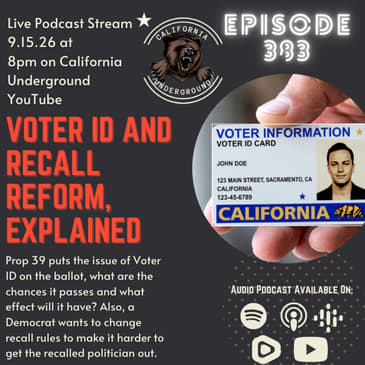
Voter ID has passed in 36 states. California could be next — and the measure on this ballot is trailing in the polls even though the same policy wins by a landslide almost everywhere else in the country. Orange County GOP Chairman Will O'Neill joins Phil and Camille to make the case for Prop 39 (voter ID and citizenship verification) and Prop 5, a recall reform written by the one state legislator who's actually lived through a successful recall himself.
We get into what Prop 39 would actually require at the polls and by mail, who's funding the campaign behind it, and why it's polling worse in California than nationally. Then we turn to Prop 5 — the mechanism problem it's solving, the irony of its authorship, and the structural objection Republicans have to how it would work in practice.
No vote recommendations here — just the documents, the money, and the mechanism, so you can decide for yourself.
Read more from Phil in The Gilded State, his book on California's political dysfunction.
[00:00:02] Prop 39, Voter ID, will it actually pass here in California? 36 other states have already passed it across the country. It polls really well nationally, but why is it not polling well here in California? We're going to discuss that as well as Prop 5, which will rewrite the rules about recall elections here in California. We're going to discuss that with my trusted co-host Camille, as well as our special guest, Will O'Neill. So let's get into that right now.
[00:00:45] What's going on, everybody? Thanks for tuning in to another episode of the California Underground. I am your host, Phil. Tonight we're going to be talking about two propositions, Prop 39, which is probably the other big popular one along with Prop 40. It's a voter ID. We're going to talk about Prop 5 as well with our special guest, Will O'Neill. First, if you haven't already during the show, make sure you subscribe, like, share, view, all that stuff. Let us know where you're checking in from if you're tuning in live.
[00:01:10] Also, just a week removed from the publication date. Everything's going very well. I'm so excited. I'm so happy to see all of you guys sending me pictures of you getting the book, ordering the book. Like, people are showing me that they have the book in their hand. You have no idea how much that means to me that you guys are supporting this and checking out the book. I hope you enjoy it. I know some of you just got it, so you're probably just diving into it right now.
[00:01:33] So if you want to, go check out The Gilded State. It is my new book right now, How California Went from the American Dream to the American Nightmare. It is over 300 pages of well-researched discussion about California issues and history and all of that stuff. So you can scan the QR code or go check it out on Amazon. All right. Let's bring in our guest for tonight. As always, my trustee coach, the best, fastest researcher in the West, Camille,
[00:01:58] and the chairman of the Orange County Republican Party, Will O'Neill. Welcome to the show, Will. You've been here before. Welcome back. Thank you. Thanks for having me back. Camille, how are you doing tonight? I'm good. I'm here. You're here. For now. Yeah. Hi, chat. And also, yes, thank you so much, Will, for joining us. It's always an honor to have you here. I feel like my lighting is so dark right now.
[00:02:27] But anyway, everyone let us know where you are checking in from all over the state. Some people are already checking in from Reno and OC. Awesome to see you. So OC, checking in, representing. Before we get started on tonight's show, there was a clip that I want to run by you two. We haven't done, like, a Gavin Newsom cringe clip in a while, and this one made the rounds. And we were discussing it before we went live, and we had some comments.
[00:02:55] So let's just watch this clip, and then we'll comment after. Yeah, it's a lot of Democrats. 31 flavors. You're not even the only Californian. No, right. You got Ro Khanna. Yeah. Kamala. Yeah. I don't know if she runs, but we'll see. I know she's called around. Yeah. But I wouldn't run if she ran. If she runs, you will not? Of course not. Why would I? I wouldn't do that to her. I wouldn't do it to me. I wouldn't do that to you. I wouldn't waste everyone's time. Who needs that? What do you mean?
[00:03:25] That doesn't even make sense to me. I just, I wouldn't. No, I wouldn't. First of all, electorally, it's a gift from God for everybody else. They enjoy the hell out of it. Mutual assured destruction. It services no greater good. I mean, you do whatever you want. I don't care. But like, but like counter-argument would be like, you know, she had a shot. Yeah. And you've never run, and she's run twice. Yeah. I mean, that would be the, that'd be the approach to the campaign, certainly. That would be the case you'd make. Pretty good one, actually.
[00:03:55] You know, that's objectively true. I just, but I know what that means. I know her base of supporters. I know her friends. The Zen diagram on that is just pure crossover. It's not, I wouldn't do that to, I wouldn't do that. Well, maybe he wouldn't do it because they're all the same donors. Maybe he's looking for a way out because his polling on places like Polymarket have dropped to like 7%. I don't know.
[00:04:25] Will, what are your thoughts? You said this was a crazy video. What are your thoughts about Gavin Newsom saying he wouldn't run if Kamala Harris ran? Well, there are a couple things. Number one, he's now given a veto to what is essentially a frenemy, right? So a lot of people in California know that Gavin Newsom and Kamala Harris do run in the same circles. They have a lot of the same donors. They have a lot of the same advisors. They have a lot of the same people around them that have been advising.
[00:04:51] And look, they are, for the most part, by all accounts, generally amicable toward one another. But when they're not, it's apparently very uncomfortable. And so the fact that he has now given veto authority to essentially a frenemy for the presidency is, number one, very surprising. And number two, kind of gives him a pretty clear out, right? Like he's already talked about how his family will have veto authority over his run in for presidency.
[00:05:17] Now I think a lot of people should probably be saying, if you don't have the fire in your belly and you're willing to give someone else veto over your ability to go run for office that's not your family, you know, maybe you're not excited about it. And that seems to be kind of the case for him, right? That's wild. Camille, what are your thoughts? Well, I agree with Will that it does seem to be Newsom's way out, basically. He knows, like you mentioned, his polling has significantly dropped.
[00:05:46] He's not the frontrunner that we all expected him to be, you know, the last year. I love that so many of our audience have said in the chat so many times, he's never going to be president. People don't like him. You guys were probably not wrong. I think that his popularity has really dropped. People are seeing the truth about how he has failed California time and time again. All that has been coming out nationally. And so now we've got him once again cosplaying like he's some normal person.
[00:06:15] And, you know, he's just out here fly fishing, if you will. Is that normal, Camille? Is that what a normal person does is fly fish? Well, I was raised by a dad who fishes. My dad doesn't actually fly fish, but we grew up camping and he would take us, you know, into the rivers and fish. But he also goes deep sea fishing all the time. Do you fish, Will? Oh, sure. But I mean, fly fishing, I love, I've never fly fished. I would love to.
[00:06:45] But all my friends who do it kind of. Like, do you know about fly fishing, though? I mean, well, obviously you're aware of it. But because they're standing there as if they're letting their line out. I thought fly fishing was that you're continuously casting trying to catch something. Am I wrong? Anyone feel free to correct me. Because they're literally standing there as though they're, it's a, I mean, they're holding fly fishing poles.
[00:07:07] But they're acting like they have a reel and they're letting their lines drift downstream, which of course there's in this scenario, there's no downstream. Wearing his, you know, designer clothing with a microphone clipped to him, like, you know, just another day of fly fishing. It's, oh, he just makes me. That's not a shirt I usually see when people are fly fishing. Yeah, that's not, that looks like too much like he's going out for a night out at one of his vineyards or his winery.
[00:07:36] It's not something, like usually you're wearing a vest or like a nice like fishing shirt that helps you reflect off the sun and stuff like that. So you have all your, your fishing gear in front of you, but it's just like, you know, it's almost like with Kamala Harris, she has all her different accents. Gavin Newsom has like all his different costumes and his cosplays of like, here I am helping people like clean up after homeless people. And then here I am working on the railroad and hammering in spikes and stuff like that. And here I am fly fishing.
[00:08:06] Like next we're going to see like Gavin Newsom, like out hunting somewhere in California. Like that's going to be the next thing is like him. He's going to invite Timble. Tim and Tim. Tim and Tim are going to go out hiking or hunting somewhere. And they'll be in like designer gear, like, you know, some trendy tennis shoes or something. Yeah, this isn't quite as bad as John Kerry going kite surfing, but it does look ridiculous.
[00:08:31] I'm just interested in the fact that, like you said, he's giving a veto to somebody else to make it so he can't run. And that is interesting that he's already given himself an out for 2028 and something that we all thought was basically guaranteed he was going to run in 2028. But I guess he's figuring out that he's not that popular around the country. And maybe it's the rise of Democrat socialism. Maybe it's the history of California and him as governor. I don't know.
[00:09:00] But it seems like he's slowly trying to inch towards the exit. Any final thoughts before we hop into our first topic for tonight from anyone? Yes, I'm telling you, Katie Porter is going to run for president. Oh, please. Oh, why would you do that to us? She just won't be able to help herself. Why would you do that to us? I am so glad that her candidacy for governor flamed out because there's a decent chance that I would have had to have moved out of the state.
[00:09:28] Because little known fact, I was actually the last Republican to debate her before she started running for governor. And I talked about a bunch of the things that came up during the race. And I was at UCI, so the audience booed me. But I've caught the clip. There's a still of the way she was looking at me while I was talking about some of the things that were going to be coming up if she ran for governor. And let's just say she did not send me a Christmas card.
[00:09:58] At least you didn't start boiling hot potatoes on your head. That's at least an improvement. All right. First story of the night, voter ID coming to California, possibly. Like this is the closest we've ever come to getting voter ID in California. If I remember correctly, I don't know. Well, maybe there was another chance. But I feel like this is the closest we've ever gotten with an actual ballot proposition. And it's going to be on your ballot in November.
[00:10:29] A little bit background about in order election. Sorry, I just think I muted there. Anyway, or require government ID such as driver's license number,
[00:10:54] California currently requires residents to provide an identification card and social security number to register a vote, but does not request it at polling places. Supporters argue that ID requirements at voting sites will strengthen voters' trust in California's election process, and that most states require voters to show some form of identification to vote. And the opposition says opponents say requiring ID will make it harder for eligible voters who don't have a driver's license or other supporting documents to vote.
[00:11:20] They say this will disproportionately affect those with disabilities who are low income or have recently moved. And for the endorsements, California Republican Party, Reform California, Uline CEO, Richard Uline, and then oppose ACLU, Common Cause League of Women Voters, and, of course, California Democrats. All right. So voter ID. Very contentious, I imagine.
[00:11:46] I haven't really seen a lot of ads yet about voter ID. I feel like they're probably coming. Will, you're more in tune with, like, how this works and why are we seeing so much Prop 40 right now? I feel like that's the only one I see now is, like, opposing Prop 40. Is the polling good or bad in your mind or in your knowledge for voter ID in California?
[00:12:17] Yeah. So Prop 39 is very similar to Prop 50 last year. So Prop 50 was the gerrymandering bill or election where the Democrats redrew lines so that they could win six to seven more congressional races.
[00:12:32] And so the reason I say they're kind of similar is because people were very opposed across the board to gerrymandering until they started hearing that Republicans hated it and Donald Trump hated it. And so it was a stick it to Trump approach in Prop 50. You are starting to see the Democrats do the exact same playbook with Prop 39 on the voter ID side. So voter ID in general is extremely popular.
[00:13:01] Every time they go ahead and talk about voter ID in the polls, it is a bipartisan popular approach. People generally believe that, yeah, you should probably have to do the same thing to get on a plane as to vote or to go to a state park as to vote. Like all these things that you're already required to do in California. People say, hey, look, that seems reasonable to me that we want voter integrity.
[00:13:26] But then when people started hearing, oh, the Republicans are pushing this or, oh, Donald Trump likes voter ID, people automatically kind of reflectively say, oh, well, never mind. Maybe I'm going to change my opinion. So you can actually see this in polling where they ask people about it. But then they start asking the questions. OK, well, if you found out the Republicans are really pushing this, how would you vote? People change their vote. And so we've seen polling over the last six months or so.
[00:13:55] So exactly what I just said. So once people are, you know, they hear the stick it to Trump line or the Republican line or whatever, it's actually losing. And so it's winning. And then they do the partisan side and then it's losing. And so the losing is still, you know, it's still very tight. But it's still a it's going to be an uphill battle for us to make sure that we have enough messaging out there to talk to people about voter integrity,
[00:14:19] to talk to people about getting out and supporting Prop 39 and making sure that people understand what this really is. But I can I can tell you because it happened last week. The top Democrats in the state of California, minus Gavin Newsom, were at a rally and literally every other word was Trump, Trump, Trump, Trump, Trump. So that's that's their message. It's not even the you remember. Last thing I'll say on this last.
[00:14:44] You remember when Joe Biden, President Biden, was speaking about Georgia and he called it Jim Crow 2.0. You know, people were hard on the racism side of that argument. And it turned out that's that next election. They saw more people vote. They saw more people who are black vote. They saw more people who are not white vote. Like all these things that they're saying, oh, it's going to be too hard for people who are minorities to vote. Well, first off, that's incredibly racist. The second, you know, they the facts just don't bear it out. Mm hmm.
[00:15:14] Just for for our sake, the numbers that I have here that Berkeley IGS as of last month, August 2026, likely voters is 51 percent opposed. So 42 percent in favor. That's to your point. That is really close in a state such as California. And previously in March, it was almost even 44. Yes. 45. No. April went ahead a little bit. 56. Yes. 39 percent. No.
[00:15:41] So it's interesting that it leapt out to its biggest lead in April. And now it's closing the gap again. And we haven't really started a lot of the campaigning. It also says here voter ID polls at roughly 80 plus percent support nationally. And this is from Fox News, Pew and other national surveys. So this is kind of across the board that 80 percent of people across the country are saying, yeah, voter ID makes sense.
[00:16:08] But in California, leave it to California to be a partisan issue. And to your point, yeah, I think they're absolutely going to make this about Trump and that it's backed by Trump and his billionaire buddies against California. How do you combat that sort of language, I guess, is the question? Because it seems like we've heard all these arguments before. You know, it's minorities can't figure out how to get driver's license. They can't get the documentation. It's all about Trump and it's MAGA and stuff like that.
[00:16:38] But how does the Republican Party or those who are supporting it, how do they get the message in favor of Prop 39? Well, first off, it's going to take money. And so some of the supporters that you just referenced have been really large financial supporters as well. So Uline has been a big supporter. And then Julie Luckey, who really has led the effort on finance side.
[00:17:05] She has been phenomenal on this. And so there's some big donors that have come in and said, look, we care a lot about this, not because it's a partisan issue, but because it's an election integrity issue. And so people are going to be spending big on this. On the Democratic side, they'll probably have this same amount of money, maybe more, depending on how things kind of play out here.
[00:17:28] But you haven't seen massive advertising on Prop 39 like you're going to see in Prop 40 yet because there's going to be a lot more money on Prop 40. And so that's why if you have a massive budget, you can start earlier. If you don't have a massive budget, you need to be more targeted. And so in this case, the discussion about, okay, how do we make sure that we are communicating this? It's going to require money to just be able to talk to people. But, you know, kudos to the effort already made, right?
[00:17:56] So there were 1.3 million people who signed forms to even put this on to the ballot in the first place. So you've got to credit, you know, the money side. So you've got to credit Julie Luckey really pushing hard on the fundraising side. You've got to credit Carl DeMaio at Reform California for a lot of the work he's been doing to get this on the ballot. Tony Strickland, state senator up here in Orange County. They pushed really hard to make sure that those 1.3 million signatures got in and were verified and qualified this on the ballot. So you start with kind of a base of support.
[00:18:26] And then I can tell you for sure, because, you know, we've got a lot of people coming in and gathering trays of letters to send to people. So they're handwriting it on and, you know, Reform California, Carl's been doing great on this. You know, a lot of volunteers are doing a lot of work to make sure that people actually know what Prop 39 is. It's not just, you know, it's not Trump, Trump, Trump. He had nothing to do with voter ID in California. Just because he agrees with this does not make it his thing.
[00:18:54] And so we need to just talk about election integrity and why it matters. Can we flip it on the Democrats? Sorry. No, no, I was actually going to say, Camille, I didn't want to hog it and give you the floor to ask a question. So go right ahead. No, it's fine. You know I always interrupt. You know, because they're saying, oh, it's racist to require this. Can we say it's racist to not? I mean, for example, not to make this about me, but two things.
[00:19:19] So one, I, you know, it's no secret that I have had my share of health issues and I'm at the doctor at least once a week at this point or some specialist or something. And, you know, I get the constant text reminders. Bring your ID. Bring a photo ID. Bring a photo ID. And then I, so I've always homeschooled my four kids. The oldest three have graduated. And my youngest is in high school. And she recently asked me if she could try public school. So we're maybe going down that road. And I've started the process.
[00:19:46] And, you know, they require for public school, you need to bring in a birth certificate. Plus, you know, my ID, my husband's ID form of, you know, where you live to like two forms to show proof of residency, all this stuff. And it's just like, okay, it's easier to vote than to go to the doctors and prove who you are. And, you know, or to, it's easier to vote than to get your kid into a public school here.
[00:20:14] It's easier to vote than to buy a home. It's like, it's easier to vote than to buy alcohol, to buy a lottery ticket, all these things. And it's just like, to even imply that it's racist, can we start using their words against them? Like, it's just. Yeah, 100%. I mean, one of the things that I've been pointing out is, okay, so if you actually believe that proving your identity is racist, then there are a lot of things in California that the Democrats in Sacramento have set up that's incredibly racist. Right?
[00:20:42] So, like, you need to prove the following, like, you, to do the following things in California, you would need to be able to prove your identity. Get a marriage certificate. Get a certified copy of birth, death, or marriage certificates. Go get a California driver's license. You at least have to prove who you are. You need most professional and occupational licenses. CalFresh food stamps. Medi-Cal benefits. Notarized state documents. These are, some of them are kind of entertaining.
[00:21:09] So, for example, to go to a state, to get a state park pass or a disabled discount pass, you have to prove who you are. So, I mean, are you just saying, hey, look, we don't want certain kinds of people to go there? I mean, it's wild the way the Democrats have talked about this issue in ways that are clearly at odds with, one, facts, but realistically, political reality. So, yeah, I mean, most people, the reason it's so popular is because we have to show our ID constantly.
[00:21:38] Like, it's normal. So, the fact that we're even trying to talk about this and say, well, it's totally normal for all these other things, but not for voting? That's insane. It's so racist to imply that these people are incapable, to even say that a specific race is incapable of acquiring some form of ID. Speaking of, I wonder if Gavin Newsom had a phishing license for his little phishing stint,
[00:22:06] which I'm sure to get that phishing license he would have had to show his ID. I mean, you remember the Sean Ryan story, right, where he went on a podcast last year with, you know, the conservative podcaster, and the first thing out of the gate was Sean Ryan gives him a gun and, you know, and says, hey, this is a gift to you. We'll figure out how to get it to you. And Gavin Newsom says, oh, this is great. I'm not anti-gun. You know, I've never owned one, but this will be my first one. Isn't that great?
[00:22:33] He never took possession of it because he couldn't get it licensed in California. Like, that's how, I mean, it's just, but he's all showcased. So, but I mean, this is, to your point, actually, just real quickly, on the gun side of things, you need to prove who you are to get a license to own a gun or have a concealed carry permit in California. That is a right under the Constitution, under a Second Amendment.
[00:22:59] So we're talking about needing an ID to exercise a constitutional amendment or a constitutional right, but no ID for voting. This is, it's just lunacy. Yeah. There was that one video that went, like, super, uber, mega viral. Somebody from Fox, and he went from, like, college campus where they were, like, all these kids, all these white kids, like, upper middle class white kids, and they were, like, well, do you think voter ID is racist? And he's, like, and all these kids are, like, yeah, I think it's totally racist.
[00:23:28] It's wrong, blah, blah, blah. And then he's, like, okay, and now we're in Harlem, New York, and we're going to walk around. He started talking to different people in Harlem. And he said, do you think it's hard for you to get a license or, like, know where to get a license? And I'm, like, yeah, it's the DMV. It's up at, like, 32nd and something or other. Like, we, of course we know where it is. He's, like, that's a weird, and he's, like, do you know this is what people say about you? And they were, like, shocked at that. People say that about minorities, that they can't figure out how to get a DMV, go to the DMV to get a license.
[00:23:59] I want to bring this page back up because we're talking a lot about money. So here so far right now what has been raised. Proposition committees, you can see right now the total is in favor of support is $28.2 million. And oppose is only $3.7 million. Now, of course, money doesn't mean anything. I mean, there could be money coming in later. It could be coming in next to closer to next month when they need all the money and they just need to start raising money. But that's a pretty big head start.
[00:24:29] And Richard Ullian, who we were talking about, I think that's how you pronounce this, Ullian, $17 million. He's already, but he, as far as I know, actually has never actually voted in California. I think he's just a Wisconsin businessman. But I guess he's just really interested in what's going on in California. Here's the ballot text. Someone else brought it up in the chat, how they switch the voter, this language.
[00:24:56] Prohibit citizens from voting unless they present government-issued identification initiative constitutional amendment. This was another Rob Bonta special where he took it upon himself to rewrite it and they sued over it. And, of course, the court sided with Rob Bonta over it. This one was actually pretty egregious. I think the California attorney generals get away with a lot when it comes to renaming ballot titles.
[00:25:25] Sometimes they're like, eh, it's balls and strikes. But this one I feel like was really, really bad. What was your reaction, Will, when you saw the updated ballot title of the voter ID? Yeah. So let's take a step back because it's actually worse than you just described. Because Rob Bonta, as the attorney general, actually initially creates the title and summary.
[00:25:49] So when you want to do a, if you want to go gather signatures on a petition, you need to first submit your, the language of what you're trying to do. And then the attorney general gets to set the language or gets to title it. So the title and summary. And sometimes it breaks, frankly, whether you can even advance. And so originally he actually created his own, like he created one.
[00:26:18] It wasn't great, but he created one. And that original one was establish additional voter identification and citizenship verification requirements. Okay. I could have written it in a more favorable way, but that's actually moderately fair. Then they gather the signatures. They qualify it. They go through the arguments. And then Rob Bonta actually changed his own title that he had originally created.
[00:26:45] So it wasn't even like he had, you know, a blank slate. He was actually changing his own. And so when he changed it, he changed the title to prohibits citizens from voting unless they present government issued verification. And then, so now the first three words, the first four words you're going to read are prohibits citizens from voting. I mean, it's ridiculous. And, and so that's what he did. I mean, I can tell you how all of this works.
[00:27:14] They do, they do poll testing. They do, they do testing and focus groups to kind of see, okay, what makes it less likely for someone to vote for this? And then they feed it to Bonta and Bonta says, okay, I'll do this. And that's exactly what he did. And so a judge upheld it, which is frankly, probably not that surprising. Judges are going to defer to the attorney general more often than not. But he changed his own ballot title.
[00:27:39] And by the way, one of the most egregious abusers of this privilege is actually Becerra when he was attorney general of California. And now, you know, he's running to be the next governor. He abused this like crazy when he was attorney general of California. And so the fact, the idea of having both of them in office at the same time is a nightmare scenario for most California residents.
[00:28:04] Yeah, when we originally talked about this a couple weeks back, it seemed so intentional. And the way he tried to explain a way that all ballot titles get switched or changed during. But this one seemed so much more intentional in terms of the language of prohibits citizens from voting. Those like three words right there. If you know nothing about this proposition and what the purpose of it is.
[00:28:32] Those three words, if you're like a low information voter or as Camille calls them, like stupid voters. I do not. I think you called them stupid voters once. I think I said, it's close. I think I said ignorant or something like that. Ignorant voters. I said, I think they're called low information voters. They don't, you know, they don't do their homework. They don't research it like we do. And they see that and they go, oh, well, I'm not going to vote for that. Why would I prohibit citizens from voting? That sounds like a horrible idea. Yeah.
[00:29:01] So it did seem like intentional to change it rather than just keep it the way it was, which was requiring voter ID, which I guess if you phrased it as require voter ID to vote in an election. I think that sounds pretty neutral. I think a lot of people will get behind and say, yeah, sure, whatever. That doesn't sound too horrible. But once you add in that negative connotation of prohibit citizens, that becomes really the big issue.
[00:29:31] I think the legislative analyst office should be the one making up these ballot titles. I don't think someone who's part of a party should be doing this, but that's just my opinion. Do you think there's still a path forward? I sure have been. Yeah. I think there's no reason that the attorney general who is part of a party who has their own political agenda should be naming these ballot titles.
[00:29:55] Because, you know, as with anything, if someone's on the other side, if the shoe were on the other foot and they were doing the same thing, people would be crying foul. Do you think there's still a path forward for people, even though this ballot title is negative in connotation? I do. I do. Because I'm seeing what the work is going on behind the scenes right now and what's about to be unleashed to help.
[00:30:21] And, look, I think at the end of the day, one of the things that this does is not only move us forward on a policy level, but it also makes sure that Republicans are going to get out and vote. You know, this is an issue that actually galvanizes people that they care about. Because one thing that I know a lot of people don't talk about is not only does this proposition do voter ID, but it also requires the state and county to audit their voter rolls to make sure that only registered people are actually on them. And so they can clean it up.
[00:30:51] Like, one of the worst offenders of this is Los Angeles County. And it has been for years. And requiring them constitutionally to actually try to clean up their rolls would be huge. And, look, this happens all the time. I mean, we know that there are people on these rolls that should not be on them. But the problem is, because they're on there, they get mailed ballots. Like, this is what happens every cycle is people say, wait, why am I getting a mailed ballot to this person who hasn't lived here in years? Well, it's because they haven't cleaned up the voter rolls.
[00:31:19] But some of the worst examples, I mean, here in Orange County, I think we all kind of know this story that happened over the last couple years where a woman actually registered her dog to vote. And he did. And it was counted. I mean, it's wild. And so she got prosecuted for this. And the only reason she got prosecuted was she outed herself. She actually told people and called the city attorney in Huntington Beach and, you know, got reported over the Orange County Registrar voters.
[00:31:47] But when this got brought forward, I mean, this sounds made up that a dog actually was able to vote in California. But it did. And then in Orange County, we have our Orange County Board of Supervisors, which right now is three Democrats and two Republicans. And we're trying really hard to change that. But at a meeting, Don Wagner, who's a Republican who is also running for secretary of state, brought forward a motion.
[00:32:12] And he said, I would like to direct our Orange County Registrar voters to go through and remove all non-humans from the voter rolls. And his fellow Republican, Janet Nguyen, said, I do too. They couldn't get a third. They could not get a third. What? Which is completely wild. That seems like a no-brainer. It does. But of course, the dog wouldn't have an ID. So anyway, I...
[00:32:42] Well, was the dog even old enough to vote? I mean, that's, you know... In dog years or like normal years? Yeah, true. True way. How do you determine how old the dog is to vote? So this lady, by the way, just on a side note, she was a Republican. And I know Democrats like to make a point of this. So I'm just going to say this right out. She was doing this as a protest to show how absurd the California system was. And she did. And she got prosecuted for it again. Like, I don't want to dismiss that. But I mean, my goodness.
[00:33:12] Like, the fact that a dog could register in California, vote, and then at the end of the day, Board of Supervisors couldn't get a third at the meeting to remove all non-humans from the voter rolls tells you this is really important. And the fact that we have to bring this forward instead of having it come from Sacramento legislators themselves, tells you everything you need to know about the system they've created. And the fact that she had to out herself, meaning no one would have ever discovered it,
[00:33:41] outside of her outing it herself is probably the craziest part of that. Final question that I want to talk about before we move on to Prop 5. So the LAO, again, we were just talking about the LAO, Legislative Analyst's Office, says this could cost tens of millions to low hundreds of millions of dollars a year. All told, we're looking at a $350 billion budget here in California.
[00:34:08] It sounds like a lot of money, but in reality, it's like 0.25 of the entire budget in terms of like actually implementing this, sending out actual voter IDs, like actual physical voter IDs. Do you think that's a small price to pay for election integrity compared to everything else that California spends money on?
[00:34:34] Well, first off, I think that California, our leadership right now loves to claim that they are the party of democracy. But at the end of the day, what they're really showing is they're just an oligarchy. Like they want to keep the power to themselves. I know we're about to talk about Prop 5, which is a great example of that. But in this case, I'm not convinced it's going to cost as much as the LAO is kind of projected. My suspicion is that it won't even come close, frankly.
[00:35:00] But in California, if they're willing to spend the money on a special election to go run through gerrymandering and disenfranchise hundreds of thousands, if not millions of Californians, I suspect that making sure that people feel confident in their voting system is a small price to pay. And I would also point out real quickly, one of the reasons, and there's been a lot of studies on this,
[00:35:23] one of the reasons why states and localities really need to implement voter ID laws is it actually increases people's trust in the system. And you see an increased number of voters every time a voter ID law is passed. You saw it in Georgia. You see it all over the place because people suddenly say, you know what? I actually trust the system. I believe that votes are going to be real and cast properly and counted properly. And because of that, I'm going to go vote.
[00:35:50] I mean, how many times, Camille, have you heard someone say, look, I don't trust the system. I'm not voting. And they're engaged. They're engaged voters. But they won't vote because they don't trust it. We practically hear it here almost weekly on this podcast with our comments or chats. And it's sad. It's really disappointing. But yeah, we've seen plenty of comments, too.
[00:36:13] And any, you could just spend a couple minutes on X and you'll hear people, you'll see people saying, I'm not going to vote until there's voter ID. I don't trust the system. You know, until there's voter ID, you can't trust the elections. Like, you're just all the time. Before we finish this subject, I do have a question for both of you. My fear is, if this passes, that they're going to treat it just as they did.
[00:36:41] Now I can't remember the prop number from a couple years ago that overwhelmingly passed. Yeah. And, you know, they've completely dismissed that. They just, oh, we don't have the money. We can't do it. I'm worried that that will happen here. Thoughts? I know. If it passes and they just don't do anything. Yeah. So, so two quick notes on that. Prop 36 was statutory, not California constitution.
[00:37:11] And it didn't have a funding mechanism. And so in this case, these are going to be mandatory requirements. And also I should point out, creates a civil right of action for citizens to sue the state or localities. In this case, it would be counties to force them to actually audit and move forward with the requirements. So this actually took some of the concerns of Prop 36, to your point, and addressed them.
[00:37:38] And so we're not going to have the same scenario that we saw with Prop 36, where it passes overwhelmingly. And then Newsom says, you know, that's nice, but we're not going to fund that. Okay. That's really smart. I assume that was DeMaio. Credit where credit is due. Good job, Carl DeMaio, getting this on the ballot. And I'm glad for all the thought that went into actually getting, you know, all these warnings to make sure that once it passes, it gets implemented. So that's wonderful.
[00:38:07] Yeah, I think Will just answered my question, but I was just looking at the chat and somebody said, the dog probably would have likely solved homelessness crisis. Faster than Karen Bass. Yeah. Someone said the dog probably made better choices than some humans when it came to voting. So comments about the dog that had voted in California. I love how everyone favors the dog. Well, dogs are inherently good creatures.
[00:38:36] So, you know, they just want the best for all of us humans. They're not selfish at all. Maybe they want some of their own treats or something like that. All right. Next topic. Let me pull this up real quick. So this is Prop 5. And this one was pretty interesting where we were going over some propositions to go over when Will was on the show. And I had not really dived into this one. I was just kind of looking at him and saying, which ones haven't we covered yet? We try to hit every single one before the election.
[00:39:06] So Proposition 5 is delay replacing recalled state officials. And under current law, after choosing whether to recall an elected official, voters are asked who should replace them. This constitutional amendment placed on the ballot by state lawmakers would delay the election of a successor until a separate election. The recalled officer would be allowed to run in that election. If the governor is recalled, the lieutenant governor would take over their duties until a new governor is elected.
[00:39:35] Basically, this is the summary. Basically, Secretary of State Shirley Weber told lawmakers her office felt a recall election should focus on whether the elect officials should be recalled, not whether other potential candidates would be in the better role. And the author of this, which is really interesting, is Democrat Josh Newman, who was successfully recalled from his state Senate seat in 2018. So he has a personal stake in this.
[00:39:58] Author of the measure saying it would reduce the political gamesmanship that elevates candidates who otherwise wouldn't receive a majority of votes. Opponents, including the opposed side, the California Republican Party election integrity, which advocates for voter ID, argue that allowing the lieutenant governor to assume the governor's position if the governor were recalled would dissuade people from participating in a recall election. Again, almost all legislative Republicans are opposed to Republicans are opposed to it, arguing it would dilute the power of voters while protecting incumbents.
[00:40:27] So you can see some of the endorsements, California Democrats, California Republicans on the other side, Reform of California. Literally no money raised for this, so that's how important this is. And the ballot text, not as provocative as the voter ID, changes recall election process for statewide officers. That's it. So with that all said, Will, do you want to take it away and explain what the heck they're talking about here?
[00:40:56] We can kind of discuss a little bit more. I do. By the way, I was clapping when you mentioned the recall of Josh Newman because that was an Orange County-led effort, and we were awfully proud of that. Nice. So, yeah, so Josh Newman, by the way, for those of you who can't remember, he was the guy who used to campaign in bear suits, and like literally a full bear suit. If you have not searched Josh Newman bear suit, please do. Well, now I'm going to while you're talking. Yeah, I might screw up your algorithm, but it's fun.
[00:41:23] So anyway, so two things to know about this one that are really important. Number one, we just talked about Prop 39, where it was an initiative that was brought forward with signature gathering efforts by citizens. This was put on by the legislature. So anytime you see the state legislature trying to change electoral processes through the ballot, be really careful and be really wary.
[00:41:49] So what they're really trying to do, I kind of call this the Kamala Harris-Joe Biden approach to life, where a lot of people think that one of the reasons Joe Biden chose Kamala Harris was to remind people that it could be worse. And so what you end up in this situation is they're trying to do that exact same thing where they're saying, hey, look, remember, actually, let me take the listeners back real quickly to the Gavin Newsom recall. So everyone remembers what that was like.
[00:42:19] Tons of effort, a lot of signature gathering. A lot of it actually was run out of Orange County in an office that I used to go to to help sort. And so there were a lot of volunteer effort to get that done. It gets on the ballot and you have two questions. One is, do you want to recall the governor? And the second is, if he's recalled, who do you want to vote for? That's it. That's how the recall process worked. It's very simple. It's very straightforward. And there's a lot of strategy that comes along with that.
[00:42:47] If you're Newsom, you basically said, hey, we don't want anyone thinking about anything on that second question. So he blocked any serious Democrat from running so that there wasn't even a nascent challenge to him. And so they put all of their chips on the table telling people, vote no on the recall. We don't even want to give you a second option. And then the second thing he did was he went out and attacked Larry Elder.
[00:43:13] And because Larry Elder was kind of the leading Republican that was on that. And so he was basically trying to say, on the one hand, vote no because it's wrong to vote yes. And number two, the worst case scenario is you get Larry Elder. Isn't he terrible kind of discussion? And he had all sorts of publications like the LA Times going out and saying, you kind of remember the LA Times actually running an editorial saying that Larry Elder was the black face of white supremacy.
[00:43:42] Like, welcome to the LA Times. Anyway, so coming back around on this. That's how our recall system works now. What the state legislators want to do is change it so that if there is a recall petition and it qualifies, the only thing in front of voters will be, do you want to recall this person? They would not give you an option to switch. So in this case, if the governor is recalled, you're going to go to the lieutenant governor.
[00:44:10] Well, in our state, lieutenant governor is also a Democrat. And so if you're a Republican, you're kind of saying, well, wait a second. So I'm going to recall Newsom so I can get Eleni Kunilakis? That doesn't sound like a great idea. And so that's what they're trying to do is they're basically trying to say, we're going to try to diminish the ability for people to be excited about trying to recall people because they could get stuck with someone worse. And so this is, this is a, it's kind of, it's super cynical.
[00:44:40] I mean, they're just trying to game the system out to protect themselves in power. And that's exactly what this is trying to do. So again, coming back around, if you stay, if you see the state legislature is actually trying to change elections through the ballot box, be really wary because what it really means is they're trying to protect themselves and the power that they wield. Well, also it's, it's okay to be cynical because Josh Newman is behind this, a victim of the recall election.
[00:45:07] So of course he's going to have a little bit of a stake and a little personal vendetta against the recall election. Um, it is, it takes away that, and yeah, recall is rare, but it is also extreme in the sense that it completely removes that politician from office. And it definitely penalizes them of like, Hey, we're going to get rid of this governor because he's been horrible. They're gone. Now we get to put someone else new in. And that's how I think it should be.
[00:45:37] It should be more of an extreme. Um, like we wouldn't have Arnold Schwarzenegger if it wasn't for the recall process of Gray Davis and Gray Davis who mishandled all of the electric problems and the blackouts back then in the early 2000s. Um, imagine if like Gray Davis's Lieutenant Governor just took over for Gray Davis after all of that. And he just continued with the same policy. It's like, it wouldn't really have changed and people wouldn't really care. Um, on a separate note, I don't think I've ever heard the Lieutenant Governor's name actually pronounced correctly.
[00:46:06] I have no idea how to pronounce it because I've never talked about it that much. I pronounced, I pronounced it right. I'll just tell you. I actually practiced that one a few years ago. No, I, I did. You said it was such authority that I was like, this must be how it, like, this must be how it's presented. So, um. I know, I, I'm so bad with names and I, I never mean to be disrespectful. And when you said that, I was just like, I'm gonna have to replay this a few times and like memorize that. I, just so you know, I didn't practice it for this.
[00:46:33] I was actually going on a program that I needed to know how to pronounce her last name. And so, um, I, I did. Yeah. It's Eleni Kunalakis. Is that how you pronounce it? Eleni Kunalakis. Okay. Yeah. And she actually was, she, you know, she's, she's a funny one because she's got, uh, big, big, big shipping money. Um, and so her, her dad has been very helpful to her, uh, on getting, uh, getting the right, you know, the right money put in the right places for her to be in a position of power like she is.
[00:47:00] And she had every, she was trying so hard to become our next governor and, um, she, uh, kind of got pushed out and ultimately is, uh, what is she running for now? I think it's treasure. Anyway. So yeah, I think she's running for something else, but, uh, look on this recall thing. Let me, let me at least, so there's, there's straw manning, which is that's, you know, everyone kind of knows what straw man is. You just kind of throw up an argument and say, oh, I'm going to go beat it down because it's an easy one. Let me steel man this one. Cause actually I think it's worth people understanding why Democrats are actually making the argument for this.
[00:47:29] I don't agree with that, but it's at least worth it. Their argument is basically this. If you have a situation where you're trying to recall the governor or someone else, and it only takes 50, it takes not only, it takes over 50% to recall that person, but you have a slate of 20 candidates, 30 candidates, 40 candidates. The winner might only get 21% of the vote or some, some number like that. And the argument there is basically like, it's undemocratic to require 50% to remove someone,
[00:47:57] but then replace them with someone who only got 21% of the vote. Um, again, I don't buy it, but that's their argument. And so I don't want you, I don't want people listening to this to think that this is just some garbage, um, issue where they don't have a justification. They do. But again, I just don't buy it. I think that what they're really trying to do is, is play massive politics again with politics, but still, uh, when you're starting, when you're trying to be the party of democracy and you keep doing stuff like this, it, you know, kind of shows who you are.
[00:48:28] Full disclosure. I did, I did not understand this. And I actually said, like I texted Phil when we were talking about an additional topic for tonight. And I said, I think I like the idea of prop five passing. And I referenced the, uh, recall election of the governor and said, remember how many clowns we had running in that election? And, um, but, but you just explained it and now I understand it. And now I'm, I'm definitely not, not for prop five, but, um, but just, I wanted to be
[00:48:58] honest with that. Cause especially cause Phil, Phil knows he has that text. It's like proof of me saying that, you know, not that Phil was going to share it, but just, uh, I mean, this is, this is the, you're right. I mean, Camille, this is, they, they rely on people kind of saying, wait, then I don't, I don't really fully get what they're trying to do here. And so that's why I keep saying like the first, the first warning sign should be the state legislature put this on for a constitutional change that would affect their own jobs.
[00:49:28] Me being ignorant on the subject. And we were, Phil and I were extremely involved in that recall election. And like, we were really paying attention to those candidates at the time. And I know this isn't just about governor recalls, but yeah, we, and so that's why, I mean, you guys all know the stories, but, um, when you, when you just look at like the slate of clowns that were on, not that to say that nobody was good on that ballot, but it was just like the majority of these people, I mean, we got to interview so many of them.
[00:49:58] I did individually, I know Phil did here, got sued by some of them, you know, whatever. Like, yeah. When you look at the list, there are a lot of people who are like, you probably shouldn't be running for any political office. I have an issue with the fact that they can run again in this special election. That seems kind of like counterintuitive to a recall is that like you recall someone, they said a special election and the person who just had the seat can go back and run again. Yeah.
[00:50:26] That kind of seems to defeat the whole purpose because then you set a special election, the fervor around recalling this person may go away, party alliances, stuff like that. All of a sudden they're somehow back in office. Like they lose what, like six months of like being in office and then they get to go back to being in office. This is, this is assuming for like legislative members who get recalled because as I said, with the succession order at the governor's office or at the executive branch, it just
[00:50:55] kind of keeps moving up and down. Um, but I, I'm not a big fan of that. I think like you're, to your point, Will, that sounds like they're protecting themselves. Like, oh yeah, you can recall us. We'll just run again. Like we're probably already sitting on enough money in the campaign war chest and we'll go ahead and just raise more money and get back into office again. Like we already know how to do this. So we'll just be back in office again. Um, and before I let you answer, I did want to show this real quick for everybody.
[00:51:23] You brought this up about, uh, Josh Newman in the bear suit. This is a, this is a legit picture. It's from the OC register. So it's not like, this is not AI. This is literally Josh Newman in a, in a bear costume. This is the guy who wrote this bill just to, for everyone who was tuning in, everyone in the chat, who's watching like everyone. This is the guy who wrote prop five. So just to keep that in line. I just want to give up props for being more humane than John Cox with the real bear. Yeah.
[00:51:53] Excellent point. At least he's not campaigning with a bear. He's actually campaigning as a bear. What was his whole thing with being a bear? Was it just to catch people's attention? I don't remember. That's a good question. I mean, I'm sure it did, but I don't remember that. Yeah. Yeah. That's a weird, that's a weird gimmick. And somehow he won. I mean, I mean, yeah, that was just not really quite sure. Yeah.
[00:52:21] But anyway, to my point, I was asking. I know we're really low on time. Yeah. Go ahead. Sorry. I just, before we hang up, I want to ask a little important question. You know, ballots are, with mail-in ballots are going to drop in probably less than a month, right? Because November, whatever. So ballots are coming out really soon. Oh my gosh. Okay. So ballots are dropping very soon.
[00:52:49] Any, I know we don't have time to really get into the weeds of it, but are there any seats that maybe aren't being talked about enough that people should be paying attention to, whether it's, you know, local to, whether it's like state legislator or something? Do you have any seats that you want to shout out that people, names that people really should be paying attention to that maybe aren't getting enough attention? Yeah, I'd love to. So two, actually, I could probably name through a lot more. I mean, Orange County is huge. It's 3.2 million people.
[00:53:19] We've got hundreds of people running and they're all great. I love the Republicans that we get to work with and help them move along. But two of them, I really want to, actually, I'll do three because they're kind of overlapping. Diane Dixon, who's an assembly member right now running to replace a far left supervisor in Orange County named Katrina Foley. And the only reason Katrina is in office in the first place is because Republicans were the stupid party and kept running multiple Republicans while she was running by herself and winning with 41% of the vote.
[00:53:47] So we have one-on-one. We have Diane, who's great, running against Katrina Foley. So that one matters a great deal. We also have, overlapping with that, we have Tony Strickland, who is one of the key architects for the voter ID initiative with Carl DeMaio. He's running in the state senate. Remember, folks, in California, a state senator represents almost a million people. So that matters a great deal. And Tony's a real leader. And so he's been doing great.
[00:54:12] And then someone he had recruited in to run for city council in Huntington Beach, Gracie Vandermark, is now running to replace Diane on the state assembly. Gracie is, I mean, she fights for moms. She fights for families. She's a big fighter for kids. And so she's running to go take those same values up to Sacramento. She's running against a guy named Chris Cluey. And Chris Cluey is an absolute socialist nut job. But he is getting a ton of Democrat money coming in. And so it's going to be a fight on our hands.
[00:54:40] And so I would love for more folks to get to know who Gracie Vandermark is, you know, the fight that she's been putting forward at the, you know, in Huntington Beach, and really trying to push forward, especially tonight while we're talking about voter ID, I would just remind people, Huntington Beach actually passed through a citizen, through a city initiative process where they let people vote on it. They actually passed their own voter ID at the city level. And in response to that, a local state senator who's now a congressman named Dave Minn
[00:55:10] immediately introduced legislation prohibiting cities from doing that. And so at the very beginning of this, you made a comment that this is probably the closest we've ever gotten to voter ID. Yes, statewide. But we actually had it in Huntington Beach right up until the state legislature prohibited it. So those are probably three people I just want to shout out right now. Diane Dixon for supervisor, Tony Strickland for senator, and Gracie Vandermark for assembly. Look these folks up, figure out how to support them, walk, knock, you know, go fundraise,
[00:55:40] but volunteer for them. They're people who can hold that bulwark against that socialist creep that we're seeing across the state. We actually got to have Diane Dixon on here a couple years ago. She's a firecracker. She really is. Yeah. I'm in North Orange County, so I can't personally vote for any of them. But I do. I'm personally familiar with all of them. I've gotten to go to events with Gracie and Tony.
[00:56:07] And I actually somehow was seated next to Tony when I was a delegate. And we were at, you know, the convention and I was seated next to him. And so I knew who he was. And I got to introduce myself and, you know, thank him for what he's done and everything. But yeah, I'm, you know, I know you're Newport area and I'm North Orange County. So kind of two separate places. But for everyone else, because I know we do have an Orange County audience. So, but again, you all, I just want to remind everybody, you don't have to be in the district
[00:56:37] to make phone calls for somebody. You don't have to be in the district to donate money to somebody. So these, like he mentioned, a state senator represents over a million people. So, you know, support these seats. They're important. It's a lot of work to do. A lot of stuff going on between now and then, as we were talking about before the show. Last question I want to end with this for you, Will.
[00:57:07] This is sort of a, sorry if I catch you off guard here. This might be a tougher question. If a frustrated voter of either party is deciding how to vote on these two measures with two weeks left, what's the one question they should be asking themselves on each? On Prop 39, the question is how much do you believe in voter integrity?
[00:57:31] You know, and do you believe that the proper role of elections is to make it easy to vote and hard to cheat? If you believe that, then you should want voter ID because it satisfies both. It makes it harder to cheat and it's still pretty easy to vote. So, I mean, that's probably the question. On the recall initiative, it is this.
[00:57:55] Do you trust legislators to change the rules to benefit them? If you say yes, vote yes. If you say no, vote no. Those are the two questions. Good answers. Like those. All right. We're coming up. We're actually at 9 o'clock right now. I want to thank everybody who's tuned in live. Anybody who's on audio, make sure you like, share, subscribe, review, all that stuff.
[00:58:22] Will, thank you so much for coming on. Love having you on a second time now. I know you got a busy election coming up right now in Orange County. Where can people follow you? I know you put out a lot of information, some daily updates and stuff like that. So where can people follow you and interact with you? Yeah. Social media across the board. It's real Will O'Neill. O-N-E-I-L-L. It's real because I actually had a bunch of people creating fake accounts. So I just figured what the heck.
[00:58:52] We'll just call it the real one. So real Will O'Neill. And then we'd love to have more information. If you want to help volunteer, go to ocgop.org. You can sign up for our newsletter, learn a little bit more about all the events going on. And we also have a volunteer page there as well. So ocgop.org would be fantastic to learn more about how to get involved with the conservative cause here in Orange County. Great. Well, thank you again for coming on.
[00:59:18] For everyone who tuned in, the best thing you can do to support the show that is 100% free is share it with somebody else who needs to learn about Prop 39 and Prop 50. Also, if you want to, just throwing that out again, if you want to go get a copy of my book, The Gilded State, which is now out on Amazon, go check out The Gilded State Book. You can just search it and see my name. It's the one with the pretty cover about California falling apart. And thank you everyone for tuning in and we'll see you on the next one. Later.