
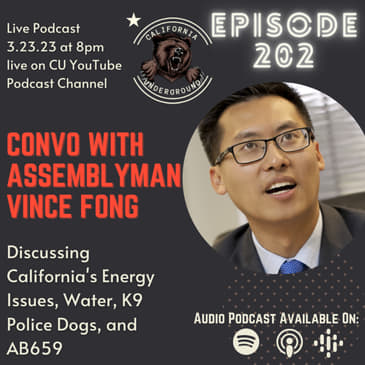
On this episode we are joined by Assemblyman Vince Fong to discuss several issues facing California including what to do with all this rain and water, issues with energy, why the legislature is attempting to ban K9 dogs from the police force, and his opposition to AB659 which mandates the HPV vaccine.
You can learn more about Assemblyman Vince Fong by going to his site at https://ad32.asmrc.org/
*The California Underground Podcast is dedicated to discussing California politics from a place of sanity and rationality.*
Support California Underground on Patreon at www.patreon.com/CaliforniaUnderground
Follow California Underground on Social Media Instagram: www.instagram.com/californiaunderground
YouTube: https://www.youtube.com/channel/UCj8SabIcF4AKqEVFsLmo1jA
Substack: https://substack.com/profile/72986149-ca_underground
Shop California Underground Merchandise: https://california-underground.creator-spring.com
Review the Anchor.Fm Privacy Policy: Anchor - The easiest way to make a podcast
00:00:01
What's going on everybody? Thanks for tuning in to another
00:00:03
episode of the California underground tonight.
00:00:05
We have a very special guest assemblyman from the 32nd.
00:00:09
Assembly District. Assemblyman fins, Fang.
00:00:12
Welcome to the show. Vince Vaughn.
00:00:13
How are you tonight? Thank you for coming on.
00:00:16
Thanks for having me. I'm doing well.
00:00:17
We're just trying to stay dry here in the Central Valley.
00:00:20
As we are down here in San Diego.
00:00:23
I keep feeling like I look out the window, and it's raining
00:00:26
again. And I'm like, where are we
00:00:28
putting all this rain? We're going to talk about.
00:00:30
That in a little bit. But before we get into that,
00:00:32
also Camille, how are you doing tonight, the best and fastest,
00:00:35
legal researcher in the west, at this point?
00:00:49
I at first, I was like, this is great for the water and the
00:00:54
reservoirs and stuff like that. At this point though, I'm
00:00:57
starting to see news stories about how It's not doing
00:01:01
anything at this point, where basically, there's nowhere else
00:01:04
to put the water. Most of, it's just running off.
00:01:06
So why don't we just jump in? Like, right there?
00:01:09
Assembly men. I know you want to talk about
00:01:11
this, where the heck is all this water going?
00:01:14
Are we holding on to any of it or is most of it just running
00:01:18
off? Well, our reservoirs are filling
00:01:20
up, and, and a capacity. And, you know, you look at some
00:01:24
of the, like, site's Reservoir size what we needed.
00:01:27
But if you look at Oroville, you look at Lake Success, the like,
00:01:30
like, we can Tulare County. I mean, we are a queer busting
00:01:34
at the seams, the challenge is that, what were, what did we do
00:01:38
to prepare for this moment? You see the, the what's
00:01:42
happening? And I flew to Sacramento today,
00:01:44
I drove back on the five, you see, flooding in Tulare County,
00:01:49
it's Ground Zero. In the Central, Valley levees
00:01:52
are breaking their fragile, you've got farmers and good.
00:01:59
Is like taking excavators and and trying to shore up these
00:02:03
these, you know, these these weak points and the
00:02:06
infrastructure of the throughout the state of California when it
00:02:10
comes to water, and that's the frustrating part.
00:02:12
Imagine if we had built site's Reservoir, imagine if we had
00:02:16
built more raise, the dams. Imagine if we had fixed a lot of
00:02:23
these conveyance systems, we would be moving more water.
00:02:26
We be storing more water. We be putting for Nia on a
00:02:30
better path when it comes to our water supply.
00:02:34
You know, everyone kind of is trying to remember the drought
00:02:38
from from the past three years and, you know, we're coming out
00:02:42
of it now. But we have such massive
00:02:45
snowpack and when that when it starts to get warm and it starts
00:02:48
melting made, that's even more water coming into these creeks
00:02:53
and tributaries that haven't seen water in five to seven
00:02:56
years. And so, we are now testing our
00:02:59
levees. System in our, in our flood
00:03:01
Protection Systems. Yeah, and I think it's, it's one
00:03:07
of those things that nobody ever thought about we'd get this much
00:03:10
rain, or this much water. And now it's not only an issue
00:03:14
of it's a lot of rain. It's where do we put it?
00:03:16
It's now we have snow packs as I read that, we've had like two
00:03:20
Winter's worth of snow in the Sierra Nevadas.
00:03:24
Just this winter alone and now you have rain on top of that
00:03:28
snow. But that sounds just like that
00:03:31
mean, California. If you look at our history, And
00:03:33
you know, we have wet years and we have dry years.
00:03:36
And now, our our our system, our water system was when it was
00:03:41
originally designed, when the, when the state water project was
00:03:45
designed was supposed to withstand, you know, three or
00:03:48
four years of drought. And now, you know, we have all
00:03:51
these weather events atmospheric rivers and in because of extreme
00:03:57
environmental laws, we haven't built any reservoirs or pushing
00:04:00
water out of the ocean, even during the drought.
00:04:03
We were still pushing water out to the ocean.
00:04:05
People don't realize that and now we have all this water and
00:04:10
we should be capturing more of it, but we didn't build the
00:04:12
infrastructure, we need to do that and so we should be moving
00:04:15
the water. Now as quickly as possible
00:04:17
throughout the system to the communities, I need it.
00:04:20
But then it's like Aesop's Fable right?
00:04:21
You know you know pair for the winter 24 for the summer but we
00:04:26
didn't the city California in because of the administration
00:04:30
that's currently in there that just refuse to invest in Water
00:04:33
for structure. We missed that opportunity.
00:04:36
And now as we debate the budget, you know, all eyes are on, are
00:04:40
we going to invest in water infrastructure at this very
00:04:42
moment? We see the flooding, we see the
00:04:44
storms, we see the water flowing.
00:04:46
Are we going to learn the proper lessons?
00:04:49
Yeah, funny, you took the words right?
00:04:52
Out of my mouth, I was actually thinking that Aesop's, Fable,
00:04:54
it's the grasshopper and the something else.
00:04:57
I can't think of what the I don't care.
00:04:59
But anyway, it's the and grasshopper what we and the
00:05:03
grasshopper The Ant and the grasshopper, the ant budgets and
00:05:06
the grasshopper doesn't is there an issue of because these this
00:05:12
is such abnormal weather for us in like California.
00:05:15
Is there an issue that sort of the horse is already out of The
00:05:19
Barn at this? Where we kind of missed this
00:05:21
opportunity. Like we, you can't build
00:05:24
reservoirs overnight and you can't build them super super
00:05:28
fast. So did we already miss our
00:05:31
opportunity to kind of try and capture this water?
00:05:33
Or is it just we should be prepared for the next time this
00:05:37
atmospheric weather system moves in?
00:05:40
Well, we certainly I mean we would be better off of.
00:05:43
We had the infrastructure and then certainly, it's unfortunate
00:05:47
that we are missing this, this current Window.
00:05:50
You know, right now because we have so much water, we should be
00:05:53
moving and it B, we should be more flexible in the way that we
00:05:57
move water through the state system, and the federal system
00:06:00
is, it gets a little complicated, but there's the
00:06:02
federal water system, and that's a water system.
00:06:04
And if all flows throughout the state of California and so
00:06:08
trying to move water when we have it, that's critical.
00:06:11
And that's like I mean, no pun intended that's like the first
00:06:13
bucket right? When we have water.
00:06:15
How do we move that water through the state and then the
00:06:18
second bucket or the second? That we need to focus on is
00:06:21
actually building stuff preparing for the future, for
00:06:24
the long term. So short term, long term.
00:06:25
How do we, you know, how do we manage our water system?
00:06:29
And that's the frustrating thing.
00:06:31
As the vice chair of the budget Committee in a we're in the
00:06:33
throes of another budget debate and the last three budgets,
00:06:40
right? The governor hasn't invested.
00:06:42
One additional Dollar in water storage or water infrastructure,
00:06:45
which is very frustrating and shopping for a lot of
00:06:47
Californians because the That's what we should be doing as a
00:06:51
state is preparing our infrastructure and improving it.
00:06:54
And then, of course, the second question I get the most is a
00:06:57
well, what happens to that, water Bond, what happens to that
00:07:00
water bond that, that, that we passed in to, for all these
00:07:04
water projects that were supposed to be done in 2014 and
00:07:07
not one of those projects that was slated to be built under the
00:07:11
other under that bond has been completed.
00:07:14
Not what? Wow.
00:07:15
And it's because it's been stuck in a regulatory board text.
00:07:18
Now, the governor You read his water plans like well, we need
00:07:21
more water storage. And, and of course, any
00:07:23
complains he's like you shocked at how long, it takes to approve
00:07:28
a permits for these water source projects.
00:07:30
Well, who's in charge. He's basically blaming his own
00:07:34
Administration without saying it.
00:07:36
So now he's creating all these strike teams and task forces to
00:07:40
like, you know, streamline these permits.
00:07:43
Well, well we should have done that as you said, six years ago,
00:07:48
you know, when we actually Really have the resources, you
00:07:51
know, we had a 98 billion dollar Surplus, you know, last up
00:07:55
that's budget year and he didn't, he didn't want to put
00:07:58
any money into water storage. And so now we're in the
00:08:02
situation that we're at. It's first truth is this is not
00:08:05
new to California, because I've lived here my entire life, every
00:08:09
five to seven years. We go through this, I think 2019
00:08:13
is last night we got, we're not this much rain, but we got a lot
00:08:15
of, right? I was making our jokes back
00:08:17
then, you know, because we were having the constant ring and
00:08:20
then I, in 2015, I was talking about, I don't mind my tax
00:08:24
dollars, going to infrastructure to store, this water.
00:08:27
It will literally save us down the road.
00:08:29
It will save us money. It will save our crops.
00:08:31
It will save us a whole lot of stress, like, it's It and and
00:08:35
like you said, we were to pass the ball and I don't know if we
00:08:37
paid into that at all and if there's things have been passed
00:08:40
there since been put in place and then nothing happens.
00:08:43
And yes Gavin won't take responsibility that his
00:08:46
administration is not getting the work done and it's like
00:08:50
bullet train to know where the water going into the ocean.
00:08:54
I mean, that's what I mean. That's what's so frustrating is
00:08:57
that, that money is still there. I mean, we still need to be
00:08:59
investing it time value of money.
00:09:01
Imagine that we had built all those projects, six years, Ago.
00:09:05
Now, you know, look at interest, you look at inflation.
00:09:07
You look at the supply chain challenges, you know, these
00:09:09
projects are going to be more expensive and but we still have
00:09:13
to we sell to do it, you bring up the high-speed rail system,
00:09:16
you know. Imagine if we just took the four
00:09:18
billion dollars, I mean to do the projects that I think we
00:09:22
need to do whether it's the Frank current canal and
00:09:24
modernizing it. Site's Reservoir, a number of
00:09:28
other raising Vaccaro, and other other water projects across the
00:09:32
state. I mean that That can all be done
00:09:35
with three billion dollars which is a lot of money.
00:09:37
Don't know. Him, wrong Three, Billy has a
00:09:39
lot of zeros but but four billion dollars is being spent
00:09:43
on High-Speed Rail. So imagine if we just took three
00:09:46
billion dollars from that project and put it to water
00:09:50
storage, we would have completed and fast-tracked all those
00:09:53
projects in had the money ready to go.
00:09:56
We do the ground breakings and we would just, we would save
00:10:00
money over time and it saves lives water, save lives.
00:10:04
The bullet train does not, that's yours.
00:10:07
You really should be with. You have these levees and flood
00:10:09
protection, is another aspect that we need that with.
00:10:11
As now, the storms have put front center.
00:10:13
I mean, You see, you have levees breaking all across the state,
00:10:19
you know, you look at Monterey County, they whole Farm, worker
00:10:22
Community has been flooded. So, Larry County, the county
00:10:26
that I represent has a tremendous amount of flooding.
00:10:29
I mean, right now they've they probably assess, you know, in
00:10:32
the 20s of 20 to 30 million millions of dollars of damage
00:10:37
because of of levees that aren't holding or could potentially
00:10:42
fail in the future. So we're actually Physically
00:10:45
going and looking at these levees one-by-one, to make sure
00:10:49
that if they need to be fixed to fix them right away.
00:10:54
And on top of that, if there's flooding in, this was my been
00:10:59
the same article I was reading today. 200 people had to be
00:11:02
evacuated from a flood, an area that the reservoir had broken
00:11:06
over. And you think about not only,
00:11:09
it's the humanitarian aspect of it, it's the property damage.
00:11:13
It's the economic value of businesses being lost.
00:11:16
So that's an emergency right there of California citizens,
00:11:20
who are being displaced, are being put out because of the
00:11:23
Floods which then impacts it costs even more because the
00:11:27
state has to come in maybe a we get FEMA to come in like it just
00:11:30
becomes more of a mess and to your point we did not prepare
00:11:35
for this and now it's going to end up costing us.
00:11:38
Probably I'm saying conservatively 10 times more
00:11:42
than if we had just invested in the reservoirs in these systems
00:11:46
six to seven years ago. Right?
00:11:48
Exactly I mean so much could have been done you you see
00:11:50
videos now of farmers driving? Trucks into canals to try to
00:11:56
create barriers and burying them with with dirt, that's being
00:12:00
done. Because, you know, they have to
00:12:03
they, if they're trying to preserve lives and, and
00:12:06
livestock and property, and that's being done because, you
00:12:09
know, we should have been building modernizing and
00:12:11
building these and improving these levees in the past.
00:12:15
You have debris in these creeks and Creeks River beds that
00:12:19
should have been removed, you know, over the past six.
00:12:23
Ten years because and the in the drought, we had no water in
00:12:25
there. So now you've got all this
00:12:28
debris, you know, these water districts have been begging
00:12:31
state agencies. Let us go in and clear all this
00:12:34
stuff out and and they were the agencies in the within the
00:12:38
ministration had resisted because of all these extreme
00:12:43
environmental groups. Well now when all those water is
00:12:45
flowing through where does the debris go these different.
00:12:49
This debris is flowing through these.
00:12:51
These communities and Breaking the levees and they're breaking
00:12:56
the infrastructure and and you know, you have you, you know,
00:12:59
this is this is more than frustrating.
00:13:02
And you know as you talk to these families who are
00:13:04
evacuating these areas, you know, what do you tell them?
00:13:08
You know, this is the lack of preparation from the state.
00:13:16
Yeah, and it always seems that Newsome always seems to show up
00:13:20
to these sites of disaster. And he always seems dumbfounded
00:13:25
at how all this stuff happens and he always seems to act like
00:13:29
well, how did I'm going to get to the bottom of this?
00:13:31
And I'm going to be a leader on this and I think most
00:13:34
Californians are probably looking at him going.
00:13:37
Well, aren't you the governor shouldn't, you know, what's
00:13:39
going on here? Like why are these things not
00:13:42
happening? Why are we not fixing these
00:13:43
regulations? Say this that that you know, Cal
00:13:46
OES to office, emergency services are law enforcement?
00:13:48
Our first farmers are doing a tremendous job, they're going in
00:13:51
there, repairing the dams are repairing.
00:13:54
The levees are evacuating these communities.
00:13:57
So, you know, the, for all of those individuals that are going
00:13:59
in going door-to-door to these neighborhoods in evacuating
00:14:02
people and and in monitoring the mudslide possibilities and
00:14:05
everything else, all of that. Work is being done but you know,
00:14:08
we shouldn't have gotten. I mean, we should have been more
00:14:11
prepared for this point now that we now that we are where we are,
00:14:15
we have to learn the right lessons.
00:14:17
No, we cannot, you know, five years from now.
00:14:20
If we are going to go through this again then you know, shame
00:14:23
on us, for what we, what we should have done, we need to be
00:14:26
investing in flood protection. We have to be building more
00:14:29
water infrastructure. We have to be prepared to store
00:14:33
the water for a future droughts. I mean, right at this Very
00:14:37
moment, our fear and is not only right now, but three months from
00:14:40
now, when it does get warmer and all that snow, that you talked
00:14:44
about begins to melt right alcohol.
00:14:47
Is that water is coming back down Downstream and into our
00:14:52
creeks and into our reservoirs. And we're going to have Anna
00:14:54
similar situation. It feels like we're not going to
00:14:58
learn now. Maybe I just like with the
00:15:00
fires, you know, we talked about, we have these really bad
00:15:03
fires and then it's like, okay, well we need to be prepared.
00:15:06
We need to prepare and then nothing happens and and in a
00:15:09
couple years were probably getting to have these really bad
00:15:11
fires again. Oh, well back then, we should
00:15:13
have learned our lesson, and done XY and z.
00:15:15
And if we didn't we didn't and then we're gonna be the same
00:15:18
place again. I feel like if you years were
00:15:19
going to be the same place again with the water.
00:15:21
Well, I'm somewhat of an optimist.
00:15:23
I do believe that we are going to make.
00:15:26
We Going to make incremental improvements, I think.
00:15:29
And the Wildfire space, I think there is a consensus now on
00:15:33
Wildfire management and making sure that we removed the dead
00:15:36
and dying trees. Now are we still we still
00:15:39
getting a resistance from from folks that don't want it.
00:15:43
Absolutely. But when I started my career in
00:15:46
public policy you know 18 years ago right Wildfire management
00:15:51
was not the consensus you know we were we were going to court
00:15:55
and going through litigation Ation trying to get firebreaks
00:15:58
done and everything else. Now the fight is, how fast can
00:16:02
we get these projects done? Can we can we streamline the
00:16:05
process? It's a whole different debate.
00:16:07
Now, I don't want to go to another 18 years, to finish all
00:16:11
these these projects. We, the time is of the essence
00:16:15
and that to your point can be a, we need to exercise the
00:16:18
political will some of us do, but we are.
00:16:21
But the governor and others have to be able to take on some of
00:16:25
the folks that, you know, No Agro that don't agree with them
00:16:30
and and and kind of, you know, move work with us on that.
00:16:35
Does it feel like in your in the assembly, met your in the
00:16:39
assembly? And you see this day in and day
00:16:41
out? I wonder if have you seen it
00:16:44
like the, the chickens have come home to roost on a lot of these
00:16:48
extreme policies where idealistically it seems like a
00:16:52
great idea to a lot of environmental issue.
00:16:54
Believe we're going to cut back on this.
00:16:56
We're going to put these regulations all because of this
00:17:00
Pie in the Sky idea of we're going to save the planet.
00:17:04
And I'm not against environmentalism.
00:17:06
I'm not against protecting our natural wonders here in
00:17:09
California, but sort of these, I would say almost extreme
00:17:14
out-of-touch ideologies. Now, you're starting to see the
00:17:18
realities of what happens when those ideologies get in the way
00:17:22
of plain Common Sense Solutions and I think water is definitely
00:17:26
one example and we could talk about energy next after that.
00:17:30
But are you starting to see Democrats coming around to?
00:17:33
And maybe we went Little too far in One Direction.
00:17:35
Maybe some of us need to start coming back.
00:17:37
Do you see that amongst your colleagues in the assembly?
00:17:39
A number of my friends on the other side of the aisle are
00:17:42
beginning to wake up to the fact that in the past, everyone's
00:17:47
been given false choices, like it's either one or the other,
00:17:50
and it's not, it's not true. You can protect the environment
00:17:52
and still invest in water infrastructure.
00:17:54
You can protect the environment and and and, and still have
00:17:59
affordable, reliable energy. You know, you can, you know, you
00:18:03
we need all of All of it. So those are the things they
00:18:05
okay, well, if you do, if you can only do this and only this.
00:18:09
And, and that's not pragmatic. And so, for some of us, it's
00:18:13
like the left has gone. So extreme that everyone's like,
00:18:16
wait a minute, like, the way we are going off the cliff with you
00:18:20
on that, because that makes no sense.
00:18:23
And I think that's where we were the public is with us.
00:18:27
I think that right now the legislature is still out of
00:18:30
balance and and I think that's where the public has.
00:18:34
The come in and send us an external, you know, message to
00:18:38
say, look, you've gone too far. We are expecting you to be the
00:18:43
adults in the room right now along.
00:18:45
Don't cater to your to the extreme, you know, we want clean
00:18:49
water. We want reliable water.
00:18:51
We want to turn the lights on, and for the lights to come on.
00:18:55
We want all these things to, we want law enforcement to protect
00:18:58
us. You want good schools.
00:18:59
I mean, these are the basics that the public is expecting us
00:19:03
to deliver, and Now, we have to deliver.
00:19:07
And not every Bill comes from the bay area, which it always
00:19:10
seems like some of the most extreme bills.
00:19:13
Always if you see a crazy bill in Sacramento I can guarantee
00:19:18
you there's a handful of names. I can guess who they would be
00:19:22
and I'm usually right. 90% of the time.
00:19:25
I can pick the names of who it's going to be.
00:19:28
It's really you don't want to. I don't want to name them here
00:19:31
on anybody, but we know who you're talking to, we know who
00:19:33
we're talking about. So you talked about turning on
00:19:35
the lights Energy is definitely a big issue as well.
00:19:39
I mean forget the fact that we need water very important, but
00:19:43
energy is crucially important. These are all tenants of what I
00:19:47
call kitchen table politics. You're right, if we can't turn
00:19:50
the lights on in California, we brag where the fifth largest
00:19:53
economy in the world yet it feels more like a third world
00:19:56
country. If we can't even turn the lights
00:19:58
on, or it gets hot and all of a sudden, everything Browns out,
00:20:04
how talk to us. Us about energy and your kind of
00:20:10
view on it because you've been on a number of programs, I watch
00:20:14
the number of your interviews about energy and sort of your
00:20:17
approach to energy in California.
00:20:20
So yeah. So right now as we debate and it
00:20:22
was as we look out to the future, I mean water and energy
00:20:24
are the two big issues that are confronting us and so energy is
00:20:29
click. It covers a whole gamut but at
00:20:31
the end of the day we need affordable.
00:20:33
Energy supplies. We need reliable energy supplies
00:20:36
and we need to Available to everybody.
00:20:38
And so you know, clearly what we went through the flex alerts in
00:20:42
the summer, you know, they're like well how come we don't have
00:20:45
reliable electricity grid? Well, it's because we have not
00:20:49
invested in the infrastructure. We forced the utilities to buy
00:20:55
more expensive energy and so what does that mean to the
00:20:59
average person? You will all of those costs go
00:21:01
somewhere and so that's why our electricity rates are going
00:21:05
through the roof. We talked about Out, you know,
00:21:08
when the last big debate last session was the extension of
00:21:13
Diablo Canyon, the nuclear power plant on the central coast and
00:21:18
the and the governor actually three years ago wanted to close
00:21:22
it. And so, what happened, what
00:21:25
happened between the those three years to have them.
00:21:28
Do a complete 180 and say, wait a minute, instead of closing the
00:21:32
nuclear power plant. I want to extend it for five
00:21:35
years? Well, he Is that when eight
00:21:38
percent of the electricity production base load, so 24
00:21:42
hours a day, 365 days a year that that is always going
00:21:49
Daytime Nighttime, right? If eight to ten percent of our
00:21:52
electricity goes away because that nuclear power plant closes
00:21:56
what happens. Its a math problem.
00:21:58
What makes how do you make up? 10% of the base load?
00:22:02
When you can't with with with, with Renewables, at this very
00:22:06
moment? Ain't so that's it.
00:22:08
So he he was with when he was felt when he was faced with that
00:22:12
choice. He's like well I've got to
00:22:13
extend the nuclear power plant. Now I'm also very Pro renewable
00:22:18
so not only encourage County. The other counties that I
00:22:21
represent. We right here in Kern County, we
00:22:26
produce 70% of the oil production in the state of
00:22:29
California right here in this one County, right?
00:22:33
We as a county also produce 60% of the state's renewable.
00:22:37
Solar wind geothermal. There is no energy goal that can
00:22:42
be met without us in the Central Valley, but the governor just as
00:22:47
well, we want to all just we want everyone to go One
00:22:50
Direction and ignore everything else.
00:22:51
Well last time I checked we have to make policies and economic
00:22:55
reality. People drive people fly right
00:22:59
now. If you go to the independent Cal
00:23:03
ISO, which manages our grid, I would venture ER to positive
00:23:08
guest right now that over 52, maybe close to 60 percent of our
00:23:13
electricity being generated right now to keep the lights on
00:23:16
comes from natural gas. Mom, right?
00:23:20
So so how do you figure? I thought I mean this is the
00:23:24
question. Yeah, Diablo Canyon is
00:23:29
definitely interesting to me. I believe that there could be a
00:23:34
lot more nuclear energy used in California.
00:23:37
I think it's definitely. It's gotten a bad rep and when
00:23:41
the more people look into it, I think if you're looking for that
00:23:46
combination of a powerful energy source, Plus it's zero carbon
00:23:50
Obama's own former Energy. Secretary said it is, the only
00:23:55
zero-carbon energy source, it's the most efficient energy source
00:23:59
you can get that zero-carbon. I always think that if
00:24:04
California, just embraced all of the energy sources it has
00:24:09
between natural gas, and oil, and nuclear, and wind, and solar
00:24:14
and all of these ideas. It could be the energy Hub of
00:24:20
the West Coast where were selling energy to Arizona to
00:24:24
Colorado, and Washington. And instead, California for as
00:24:29
much grandstanding, as it does that we live on these renewable
00:24:32
energies. We're so we're, we were so
00:24:36
environmentally sound but we buy so much energy that we that they
00:24:43
say is bad for us is imported and bought from Other states and
00:24:47
in from foreign countries like we buy a good amount of our oil
00:24:52
comes from third world countries.
00:24:54
When it could be produced right there in your District.
00:24:58
Correct. Absolutely you.
00:25:00
So you hit the nail on the head, we need to be making energy
00:25:03
policy under the framework of abundance.
00:25:06
How do we create more energy and, and how can we do it right
00:25:11
here in California? But the way that it appears that
00:25:15
the And his allies make policy in especially when it comes to
00:25:19
energy is based on scarcity. So when we have scarce amounts
00:25:24
of energy or then we need people to sacrifice and so that's what
00:25:28
the governor's asking people to do.
00:25:30
Flex alerts, don't use your appliances.
00:25:32
Don't Charger car, don't do this, don't do that.
00:25:35
Turn down your thermostat, everything else, right?
00:25:38
He's forcing every single Californian to sacrifice because
00:25:42
he won't create, he won't make policies to generate more
00:25:46
energy. She and oh, by the way, not only
00:25:49
are California and sacrificing and getting less energy.
00:25:53
They're also paying more for it. So this is a very bad formula.
00:25:57
That Californians are paying more for energy and getting less
00:26:01
of it. And so, that's, that's the Crux
00:26:04
of the problem. If we were to say, hey, we need
00:26:07
more Supply. Well then, yeah, let's look at
00:26:10
producing more nuclear. Let's look at producing more
00:26:13
wind and solar when it makes sense.
00:26:15
And develop the We sort but we also need transmission lines to
00:26:18
do that. Let's let's produce more natural
00:26:21
gas. That's approved the permits to
00:26:24
produce more oil so that we have more gasoline Supply and that's
00:26:28
a whole different debate, we talked about electricity, but
00:26:30
when we talk about gas prices on the gasoline side and natural
00:26:34
gas prices at spiking across the state San Diego, specially saw a
00:26:39
tremendous Spike. We had committed in Central
00:26:42
Valley, it means everywhere, right?
00:26:44
Well, why did we have y is why are you Gas prices and natural.
00:26:48
And why are natural gas prices also higher than other parts of
00:26:51
the of the of the United States is because of the policies
00:26:55
coming from Sacramento. We don't, we don't produce it
00:26:58
enough of it. We don't, we don't store it and
00:27:03
we don't have enough Supply. And that's the problem, you
00:27:06
know, you know, with the governor, now to deal with gas
00:27:09
prices, he wants to know I'm power a political appointed body
00:27:15
to now Intervene and monitor that the energy Market in
00:27:21
California. And if they see something bad,
00:27:24
that is going to penalize, or make it more costly to produce
00:27:30
gasoline, this is the egg, this is the exact opposite of what we
00:27:34
should be doing. I mean, imagine California and a
00:27:37
bunch of political point. He's trying to micromanage the
00:27:41
energy Market in California. Like this does not end well.
00:27:47
This was actually as go ahead Camille Phil here has a pack and
00:27:53
you basically just wrote his energy.
00:27:55
What? He's broken.
00:27:56
The path? Or you basically just said it
00:27:58
word for word. I think he stole it from me or
00:28:02
maybe I stole it from the same language.
00:28:05
Great minds. Great minds.
00:28:07
Do think alike. I was going to say that I was
00:28:09
actually at work and I was watching CNBC and this was a big
00:28:13
story on. CNBC this bill that Gavin Newsom
00:28:17
Been pushing through or this, this new agency, explain what's
00:28:21
going on there because it's gotten a lot of national
00:28:24
attention exactly what he's trying to do.
00:28:27
And I think there's even been pushback from his own party on
00:28:31
what he can possibly do. And so there was this compromise
00:28:35
that they've now moved forward. Can you talk about that a little
00:28:37
bit more? So, a few months ago, well, a
00:28:41
few months ago, last summer, it was a significant spike in gas,
00:28:45
prices in California and Across the country, driven by the
00:28:49
uncertainty in the disruption that happened with the Russia
00:28:52
Ukraine conflict and and it created a whole lot of Chaos in
00:28:55
the energy Market California, extremely vulnerable to those
00:28:59
price swings because we're an energy Island as you talked
00:29:03
about. So what I mean by that is that
00:29:06
we are dependent on other states and countries for our energy
00:29:11
because we don't produce enough of it, you know.
00:29:14
California has a very unique blend of gasoline.
00:29:17
We can only we have, it's so specific to California.
00:29:21
So if we have a shortage it doesn't it.
00:29:24
We just can't go to Texas and say, hey Texas, can you send us
00:29:26
some gasoline? Because it's because it's not
00:29:28
allowed to be sent here and used here.
00:29:31
So so all of this creates a very, you know, unfortunate
00:29:36
situation where we're so unique, so dependent, we're isolated.
00:29:40
And so you know, the governor was was shocked, right?
00:29:44
That all of a sudden Supply demands that a wag, but
00:29:47
Someone's the blame for gas prices and it's not my policy.
00:29:49
It's something else, right? Well so he his solution is well,
00:29:55
I'm going to demonize the the industry.
00:29:58
I don't like even though I'm relying on it to power and power
00:30:03
our economy. So, his solution to gas prices
00:30:06
being too high, is that he wants to basically tax refineries with
00:30:12
a windfall profits tax. Which is, you know, is Asinine
00:30:17
because if you tax refineries and you force them out of
00:30:21
California, right? Where do we how do we?
00:30:24
How do we actually have gasoline made right?
00:30:27
And this has happened over time that we used to have over 20
00:30:30
refineries in California. Now we're about 11 and in maybe
00:30:36
four or five years we're going to be down to nine.
00:30:39
Well what happens when you have less refining capacity?
00:30:43
Well it's more expensive to make gasoline in it.
00:30:47
In the state and we're more dependent.
00:30:49
So, he realized that as he put as he, as he imposed or Heap, as
00:30:56
he proposed the windfall profits tax that people realize, wait,
00:30:59
we've heard of this idea before it was tried under Jimmy, Carter
00:31:04
in the end and it failed. So, there was an attempt and it
00:31:07
was actually imposed, it wouldn't fall profits tax was
00:31:09
imposed under Jimmy Carter, and what did it do?
00:31:13
It increase the price of gasoline and it actually created
00:31:18
shortages. You read in the history books of
00:31:21
how people had to like get in line and wait, do you couldn't
00:31:25
go to the to the gas station on particular days because you had
00:31:29
to wait for your license plate. Number to be called because
00:31:32
there was a shortage of gasoline, all driven, because of
00:31:35
this, this policy. So as Democrats began to do some
00:31:39
research, so they wait a minute, this windfall profits tax has
00:31:42
empirically failed. It is never worked in any place
00:31:45
has been tried. So the governor pivots And says,
00:31:49
wait, while I won't do the windfall profits penalty, I'm
00:31:52
actually going to create a politically appointed body
00:31:56
within the California energy commission and they're going to
00:31:59
monitor the energy energy market and that they see something at a
00:32:04
whack. Well, I'm going to have them tax
00:32:07
energy production so he's basically kicking it to another
00:32:11
entity. At the end of the day, the
00:32:14
result is still the same. It's going to increase the price
00:32:17
of the cost of production of energy in Bonilla.
00:32:19
It's going to lead to less investment in refining capacity
00:32:23
and it's going to potentially lead to energy shortages.
00:32:27
And oh, by the way, he did this all in the last 72 hours.
00:32:30
So, so he's right. He drops his, he drops his quote
00:32:33
unquote. You know Democrat deal and says,
00:32:36
you know what, we're going to do this massive change energy
00:32:39
policy in California and I'm going to give you 72 hours to
00:32:43
review it and we're going to just go.
00:32:45
It isn't the worst policy and it's also the worst process when
00:32:49
it comes to actually trying to make good public policy.
00:32:53
He is very good at coming out, strong and then kind of behind
00:32:58
closed doors backing off a lot of his big policies, but I mean
00:33:01
he's good at grabbing the headlines, he's great at making
00:33:04
spicy headlines, it's not. But the policies, the results
00:33:08
they go up, Californians expect. That's why they're getting so
00:33:11
mad is because you know, the the results don't match the
00:33:15
headlights, it's just like the egg shortage.
00:33:18
We did this to ourselves. Eggs were, you know, all of our,
00:33:24
our unique eggs are all of our policies on eggs and that all of
00:33:28
a sudden we had a shortage of eggs and we couldn't just bring
00:33:30
them in from anywhere else because they didn't fit the
00:33:32
California policy. I just read this morning.
00:33:35
The a report that was done on gasoline Supply under an
00:33:41
attorney, general named Bill lockyer back in the day and if
00:33:45
you read the report, it outlined the same problems that we have.
00:33:49
Today we are To see a higher energy prices, if we don't
00:33:53
invest in more refining, capacity, if we, don't increase
00:33:56
gas things, apply. And if we don't create a more
00:34:00
stable supply of energy in California, and of course we
00:34:05
didn't do that for we did they so your point can be home from
00:34:09
you know your previous point of water right.
00:34:11
Those lessons were written in paper on paper in a report you
00:34:16
know over a decade ago and now because those those issues were
00:34:21
addressed all the gas prices, the gas price issue is
00:34:24
intensified And they were complaining about three dollar
00:34:28
gasoline in San Francisco, that was in the report.
00:34:32
Could you imagine that we have your father's resting right now?
00:34:34
Yeah, through dollar gasoline, in San Francisco, they be lining
00:34:37
around the corner to get it right now.
00:34:40
One thing about the refineries and sort of it's ironic, he
00:34:45
demonizes the oil and gas industry when one of his best
00:34:49
friends. Jason Kenney, who he was
00:34:52
partying with at the French Laundry during covid is a oil
00:34:55
and gas lobbyists. That's a whole different story.
00:35:00
When in reality, it could be turned into a positive for
00:35:03
California and I go back to this point about how much oil we
00:35:06
import from other countries. California we get enormous
00:35:10
amount from like Ecuador and while Democrats always talk
00:35:14
about workers rights and standing up for the Working Man
00:35:17
and we want to pay a living wage and all that stuff.
00:35:20
They're fine with getting oil from third world countries where
00:35:24
you have no idea what the working conditions are, you have
00:35:26
no idea what the wages are you have no idea the It'll impact in
00:35:30
Ecuador on the oil. When I think to myself, if you
00:35:34
have oil here in California, you could do it in your own backyard
00:35:41
and ensure that people are getting paid.
00:35:43
Well, that there's worker safety that there's no environment.
00:35:47
There's a minimalized environmental impact.
00:35:49
I don't want to say, no, because nothing is has no environmental
00:35:51
impact, but minimize the environmental impact.
00:35:55
So, it could fit all these boxes and benefit California.
00:35:59
Where the working class of California, don't have to worry
00:36:02
about. Am I putting food on the table
00:36:05
this week or am? I filling up my car and I feel
00:36:08
like that's just a win-win and absolute lot of ideologues in
00:36:11
California. Just missed that point
00:36:13
completely because they're so obsessed with this.
00:36:15
So everyone who does business in California?
00:36:19
Understands how strict we are in California where the most
00:36:24
regulated probably State and in the United States, right?
00:36:28
So we Reduce energy, especially the oil under the most rigid
00:36:33
environmental and labor standards in the world.
00:36:36
And we do that here right now. And so, why we don't continue to
00:36:40
do that. When we have one of the large,
00:36:42
some of the largest reserves of oil in California is very
00:36:46
frustrating. And and to your point, if you
00:36:49
look at the numbers every single day to power, the state of
00:36:52
California Californians, consume 1.5 to 1.8 million barrels of
00:36:58
oil a day. And we produce in California,
00:37:03
340 thousand barrels a day and that number has gone down
00:37:07
because the new cement raishin doesn't want to approve any
00:37:10
in-state production, right? So where does that difference
00:37:13
come from? Where does that 800 900 thousand
00:37:16
Barrel difference come from. As you said it comes from
00:37:19
Ecuador, it comes from Saudi Arabia, he comes from a rock all
00:37:23
shipped. Across the ocean on burning
00:37:29
bunker fuel to the port of LA and Long Beach where they sit
00:37:34
idle waiting for a spot to come in and then they and they unload
00:37:38
that oil into the California, we could be producing, we wouldn't
00:37:44
need to be producing or importing that oil from other
00:37:46
countries. We could do it right here and
00:37:49
and utilize the oil that we have in the cleanest environmental
00:37:53
produced in the clean. This environment of a possible
00:37:56
and we can be employing Californians at a higher wage
00:38:00
giving them benefits. It mean, you look at this is
00:38:03
where the the the trades in the labor unions.
00:38:07
And and and and all of us align this is if you're looking for
00:38:12
creating a path upward Mobility to buying a home and career,
00:38:17
make a lot of of Californians who may have never graduated
00:38:22
high school, who just, you know, didn't Like they wanted to go to
00:38:26
college or they were second chancers made some mistakes and
00:38:30
earlier in their life, but then wanted a career, the oil
00:38:34
industry. Get gave them the opportunity to
00:38:36
support themselves and their families.
00:38:40
And think about the bun for a place like Kern County
00:38:44
economically. If you had all these oil jobs
00:38:48
and it's not just the people who are drilling, is the people who
00:38:52
have to be involved with the logistics and the The accounting
00:38:55
and the, the entire economic infrastructure that would then
00:38:59
grow out of that and, and boost these, I guess the Inland Empire
00:39:04
Central Valley, all these areas and Kern County and create
00:39:09
thriving neighborhoods, full of affordable housing in places
00:39:13
where people could live and send their kids to school and, and
00:39:16
create that American Dream back in California, again, rather
00:39:20
than kind of shoving everybody. Like, oh, you have to be closer
00:39:23
to the cities. You have to be Go to La, I have
00:39:25
to be kosher San Francisco and San Diego.
00:39:27
Like it would be, it's like a whole sector of California.
00:39:31
Geographically that shared enjoy an economic boom.
00:39:35
Just from this. And let me throw this out there
00:39:37
to the one of the biggest Advanced Technologies that could
00:39:43
develop is, is carbon capture technology.
00:39:46
We could actually capture the carbon out of the air and, and
00:39:49
re-inject it into the ground and Andre and utilize it.
00:39:53
Not only for The energy production of read any other
00:39:57
need possible to. So if carbon is the problem if
00:40:00
the in the if the environmental groups a carbon is a problem.
00:40:03
Imagine if we could capture it just take it out of the air and
00:40:07
who what industry is investing the largest amounts to make that
00:40:11
make that technology Bible. It's the oil and gas industry,
00:40:16
right? Imagine that we could produce
00:40:18
oil and natural gas in California, completely
00:40:22
carbon-free. Every single barrel that was
00:40:26
produced in California. Imagine if there was no carbon
00:40:29
emissions, right? And you would think that in that
00:40:32
situation, and that's the narrow, right?
00:40:34
Everyone be like, okay, the problem, you know, it's you've
00:40:37
now even made your actually now are producing carbon or you
00:40:40
producing oil in the even the most environmentally productive
00:40:44
way, right? You're just like you, there's no
00:40:46
emissions, there's no carpet and the environmental groups say no.
00:40:52
We don't we don't want that. Well it's another example and
00:40:57
I'm sure you deal with this on a daily basis in terms of sort of
00:41:01
the lunacy that goes on in Sacramento this is going to be
00:41:04
sort of a hard pivot. I was trying to think I had to
00:41:06
do this smoothly. I want to move from energy now
00:41:08
to talk about Camille knows, I try to do this as smoothly as
00:41:11
possible, this one was not as much as I try.
00:41:14
I was trying to make the connection on like oil oil
00:41:18
production K9 dogs, K9 dogs. I was the night.
00:41:23
I was like, I don't know. Know how to maybe the economic
00:41:27
boom, and all those affordable housing can take in all those
00:41:30
retired, police, dogs or whatever.
00:41:34
But this, this new bill, a b 742, right?
00:41:37
Is that the one where they want to ban canines for police?
00:41:43
Well, let's talk about that. Why are we Banning canines for
00:41:46
police? Now, why is this the new thing
00:41:49
we're not? I hope we haven't.
00:41:50
We haven't done it yet, and I don't think we, I don't think we
00:41:52
should. And I we're doing our best to
00:41:54
stop this bill. And let me just say when it
00:41:56
comes to water, when it comes to energy when it comes to Public
00:41:59
Safety. And, and, and the, and the use
00:42:01
of giving police the tools and tactics to protect themselves in
00:42:05
the community. Right, there are a lot of a
00:42:07
common-sense ideas and Common Sense, things that it's Common
00:42:11
Sense Solutions. I would say that.
00:42:13
Common Sense isn't very common in Sacramento and this is a, and
00:42:17
this bill. And this bill is the clearest
00:42:19
example, we have a legislator that literally wants to ban the
00:42:24
use of canines in California for to apprehend criminals, is that
00:42:31
you had all this email focus in the last two years about how we
00:42:35
need to give law enforcement the ability a deescalate to not use,
00:42:41
lethal force to be able to To interact with in very intense
00:42:46
situations, without having what protecting themselves and in the
00:42:51
neighboring Community, right? Well, canine Partners were was
00:42:55
one of the best ways to do that. They were, he was in this
00:42:58
endless in the data shows like the best way to deescalate a
00:43:02
situation where if you're ever trying to apprehend a criminal
00:43:06
most of the time 90% of the time a criminal will give up if
00:43:10
they're being chased by canine so it's For the criminal, it's
00:43:14
safer for the the law enforcement Community is safer
00:43:18
for the the neighborhoods that you're interacting with.
00:43:20
And for some reason, we have the liberal answer to Public Safety
00:43:25
and the rising crime rate is, you know what, we're going to
00:43:27
take away. K9 dogs from law enforcement
00:43:30
because we don't like them and that makes no sense.
00:43:33
And that's it is the most egregious idea you could
00:43:36
possibly imagine in the throes of a public safety crisis.
00:43:40
We have in California that this is the, this is their priority.
00:43:43
Tea and it makes no sense. I was thinking into that one
00:43:46
today and doing a little background research on it and
00:43:49
the data doesn't really match up with why there's even a bill on
00:43:52
it. Like, till the texted you about
00:43:55
this today. We see, there is actually no
00:43:58
explanation of how this bill right now is moving forward.
00:44:02
I mean, really, I believe no idea how this bill is moving to
00:44:04
the legislature. Yes, clu is, you know, behind it
00:44:09
and some forms and they cited a Study that was done by.
00:44:17
Was it the police assessment Resource Center, Parc?
00:44:22
Which was a nonprofit that was The Franchise Tax Board,
00:44:29
suspended them back in like 2018 and so the study had to have
00:44:33
been old. And then I did some further
00:44:35
digging on the actual use of force and out of I think 660
00:44:41
injuries when there was use of force in 2021.
00:44:44
I want to say seventy seven of them involved a canine and then
00:44:50
like it's just they cite in this bill.
00:44:52
It's because black people have been historically, attacked The
00:44:57
use of canines back bhupathi back to slavery and whatnot.
00:45:00
But when I broke down all the numbers it was nine people had
00:45:05
injuries and or died from canine attacks.
00:45:09
So of all the things somehow they're demonizing.
00:45:12
The canines that weren't really hurting it.
00:45:16
Many people to begin with. I mean this is I think this bill
00:45:21
not only frustrates you know, our side of the aisle, it
00:45:26
actually. So fresh rates the Democrats to
00:45:29
because that what we're what we want is that we want to give law
00:45:33
enforcement the build ability to be more effective in policing
00:45:37
and to deescalate very dangerous situations, you know?
00:45:41
And so all all the as we and we all want to do that.
00:45:45
I mean someone who is an Ardent defender of all our faults with
00:45:49
law enforcement mean you have to make split-second decisions, you
00:45:53
know? And and the outcomes could be.
00:45:55
I mean you you in sir Hurt. You know, a law enforcement
00:45:59
officer and there are responding to either domestic violence
00:46:01
situation there. There's a robbery or something.
00:46:04
There's so many different variables you know, we need to
00:46:07
give every every tool possible to have a safe outcome in that
00:46:14
situation. And so to somehow say, well we
00:46:17
don't want canines to be used because for the date and because
00:46:22
we think that it's this and it but the data doesn't conform
00:46:26
with What that what what what the rationale is I mean it's
00:46:31
just very, it's shocking to Californians to who are
00:46:34
listening, like wait a minute of all the things like if I went to
00:46:38
the nearest Starbucks and talking to you 10 Californians
00:46:41
and said, give me your top ten issues that you want the
00:46:45
legislature to deal with, right? They would probably like the
00:46:48
moment. It's probably the storms and
00:46:51
rebuilding maybe it's gas prices.
00:46:53
It's your school's it's keeping the Let me get making sure their
00:46:59
hospitals are staying open, you know, keeping their neighborhood
00:47:02
Safe Way, want good schools? No one no one has ever said.
00:47:07
You know what, I really don't want canines to be being used
00:47:13
right now to support law enforcement.
00:47:15
Like no one's saying that. It seems like and I don't want
00:47:20
to make this again. I don't want to make this about
00:47:24
race, but the fact that they sort of lean heavily into that,
00:47:31
Seems kind of odd because I don't think the dogs are
00:47:35
necessarily racist, maybe, but it is, and they play with these
00:47:40
numbers like Camille had pointed out.
00:47:44
I learned in law school, we learn this, this class called
00:47:46
risk management. They're very people politicians
00:47:49
to press or very good at like taking numbers and saying, oh,
00:47:53
this is like three times more than this.
00:47:56
Well, if the number is 1 and the number that you're talking Is
00:48:00
three then, yes, it's three times more.
00:48:03
So it seems like they like to play with these numbers and then
00:48:05
lean into the issue of race to kind of get something across the
00:48:11
finish line and say, this is we're doing something we're
00:48:15
doing this in the name of social justice or Racial equality as
00:48:19
opposed to looking at it and saying is this really an issue
00:48:22
that's going to keep us safer? Like you're saying, is it over
00:48:26
all going to keep us safer? Is it going to keep California
00:48:28
and safer? And I mean we've seen, I feel
00:48:34
like they haven't learned their lesson from 2020.
00:48:36
We're even in San Francisco, mayor, London breed, who was one
00:48:40
of the biggest proponents of defund the police.
00:48:44
They now can't get police back in San Francisco.
00:48:49
They've done such a, they did such, I guess they were
00:48:51
successful in 2020 in defunding the police enough.
00:48:55
They lost enough police officers.
00:48:57
They are now trying to get as many police officers back on.
00:49:00
The street and they can't get police officers back on the
00:49:02
street citizens are going nuts for it.
00:49:05
So I feel like this, they haven't really learned their
00:49:06
lesson of, maybe take a step back and look at Public Safety.
00:49:11
And more of an objective light rather than this ideological
00:49:15
light. Does that sound correct?
00:49:17
But we all have to take a step back.
00:49:19
I mean, this is the this is the, the message that mean we will
00:49:22
bring up to Sacramento both of you and you can talk to some of
00:49:25
these legislators as well and say we we are trying to get them
00:49:29
all to like to Like the, we have to, we, we have to legislate in
00:49:34
reality. We have people right now in
00:49:38
every Community, there are that the stories I hear about people,
00:49:42
who are victims of crime, you know, the smash and grabs in the
00:49:46
stores, you know, being assaulted in a park, you know,
00:49:52
you name your, the, the behavior and the current behavior that's
00:49:58
out there right now. I mean, we have to Begin to wrap
00:50:02
your hands around the fact that we are gone too far.
00:50:05
California has gone so far to one extreme that there are no
00:50:10
consequences there is no accountability when it comes to
00:50:13
those who want to break the law. Yeah.
00:50:16
And so we have to bring back not only the rule of law enforcing
00:50:22
that and the consequences associated with that.
00:50:24
But we also have to give law enforcement the tools to
00:50:27
maintain You know, safety in our communities and to say that.
00:50:34
And so both of those to do both of those things have to go
00:50:36
together. It felt to your point about
00:50:39
race. I know you don't want to make
00:50:40
this bill about race but they did, they did that in.
00:50:45
I copied a section to earlier that said the, you know, the use
00:50:47
of police K-9. So that is abusive black
00:50:50
Americans. But what's interesting is the
00:50:52
study one of the studies that they cite the use of force, it
00:50:56
was on Hispanics 50.6% and on black 16.7% and in the building,
00:51:02
actually crossed out the text where they talk about Hispanic
00:51:05
people. Mmm.
00:51:07
Yeah. Yeah, I mean this bill has
00:51:10
gotten I mean, it's just it's not it's just not ready for
00:51:13
prime time. I mean here, is it actually
00:51:18
shockingly passed out of the Public Safety Committee on a
00:51:22
party line on a party line vote. And it's now moving to to the
00:51:28
next committee. So, I mean, this is the thing.
00:51:31
This is how out of touch the legislature has become is that
00:51:34
something like this, which the average person would say, No
00:51:38
sense. Right now is actually progress
00:51:42
is actually moving forward. I think what you really break it
00:51:45
down, it's like none of it adds up.
00:51:47
It's Common Core math. Yeah, actually I usually check
00:51:52
in with what's going on in the legislator every day, but ever
00:51:56
since the GOP convention I kind of take a break like he did just
00:52:00
that we will be better. I've actually made this argument
00:52:04
we be better off if we limited the number of bills.
00:52:07
It's even further that every legislator could carry and
00:52:11
introduce. I mean, right now, I think every
00:52:13
legislator gets the bills for the two-year session, so it's 25
00:52:18
you even listening. We could go we could probably go
00:52:20
down to like ten to Fifteen / / legislator and we would be okay,
00:52:25
you know lesson. That's what I said, we need to
00:52:29
limit this. Yeah, yeah, less is more.
00:52:33
You should not be incentivized to produce as many bills?
00:52:37
Possible it, you should be incentivized to only tackle, the
00:52:42
most essential issues. And I feel like there's just so
00:52:46
many bills that get introduced in the legislature every year.
00:52:49
I don't know how you guys honestly, keep track of it are
00:52:51
just too many refills. There are bills looking for a
00:52:54
problem. I mean, that's, that's the
00:52:57
issue. I mean, we just gotta read this
00:53:00
guy, get back to the basics. That's what we gotta do.
00:53:02
The problem speaking of Health Public Safety, can we talk about
00:53:05
86 59th BBB? Vaccine.
00:53:09
Well, as I mean we got to empower parents and this bill
00:53:12
goes too far. I mean I think we we're trying
00:53:17
to talk to the author. There's a lot of parents and
00:53:20
that have now engaged in this process.
00:53:22
I think parents have woken up to the fact that Sacramento has or
00:53:26
making a lot of decisions that are putting, you know, them, so
00:53:32
they government in between the relationship between them and
00:53:35
their child. And so, you know, we are going
00:53:38
to, I think all of that with that relationship is being
00:53:41
rebalance. I think parents are begun to
00:53:43
engage in school board issues. They've been certain engage in
00:53:46
like school choice issues and and taking the power back and
00:53:51
this is just another example of Sacramento going too far.
00:53:56
They really do love that. Try to be the parent.
00:53:59
I mean you are going to be voting no I'm opposed to that
00:54:03
bill Okay, good to hear someone in the chat actually.
00:54:08
Brought this up. They asking the assemblymember
00:54:11
opine re a be 659 which was recently amended.
00:54:15
To require HPV HPV vaccine for students enroll and CSU, UC and
00:54:20
California community colleges for any new College enrollees,
00:54:24
26 and or younger it envelope. That bill is being a mentor.
00:54:29
I mean that bill was supposed to have been heard last week and
00:54:31
then it I think it's being it's going through some amendments.
00:54:34
So we have to wait to see what the amendments are.
00:54:36
I think it's going to come up in a future health, health
00:54:39
committee discussion. So, you know, we have to look at
00:54:43
mean, I, we read the bills. We should have all of us should
00:54:46
read the bills. And so, we have to read the
00:54:48
bills before we vote, but made on its face.
00:54:51
The original bill was was, was clearly not a good, good bill.
00:54:57
And now I don't know if it's getting better or worse, but
00:54:59
we're going to have to look closely at what those changes
00:55:02
are. How many of these bills the last
00:55:07
bill? We're talking about the canines
00:55:09
and a bill like this? How many it seems like they get
00:55:12
a lot of media attention. We try and do like a legislative
00:55:16
round up twice a year like halfway through the year and
00:55:19
then sort of when the legislative session ends like as
00:55:21
it's coming down to the wire, how many just die out because
00:55:26
behind closed doors, it make win political points for a certain
00:55:30
assembly, Mentor, Senator and but behind closed doors, a lot
00:55:34
of people get mad. I'm not going to back this bill.
00:55:36
I'm kind of back off that. It all depends on the bill.
00:55:41
I mean, like we I think right now we are preparing to review
00:55:46
about 2600 bills in the assembly.
00:55:52
I want to make about 40 to 50 percent of them were spot bills
00:55:56
and that's language that it means that are Place holders,
00:55:59
right? They're going to they're going
00:56:00
to sell. There was someone needed more
00:56:02
time to populate you know what they want to do?
00:56:04
Because it Ready. But that's the opening.
00:56:07
There's just think about that. You mean, then those those forty
00:56:10
fifty percent of those files that shouldn't be there.
00:56:13
You know, we should just focus on again.
00:56:16
There's too many bills and there's not that many good ideas
00:56:19
out there at the very at this moment.
00:56:21
So, you know, if we should, we need to be kind of structure,
00:56:25
dictates Behavior. We need to change the structure
00:56:28
of how the legislature operates limit the number of bills, you
00:56:31
know, allow more input and committees.
00:56:34
I Come from, from the Congressional World, in my
00:56:38
previous career. And, you know, there were
00:56:41
markups like we had that that type of so committee every
00:56:46
member on both sides could make amendments to bills and have it.
00:56:50
Be voted on in the committee and so before the committee finish,
00:56:55
we would, you know, we can make changes to the bill and and
00:56:59
improve it and have votes up or down.
00:57:03
I've been in the legislature for seven years clean up.
00:57:06
Clean up bills or cleanup language was not in my
00:57:08
vernacular seven years ago. Somehow say like I'm going to
00:57:12
pass a bill very quickly and then after it gets signed a law
00:57:16
realize that it didn't work or something went wrong and they,
00:57:18
oh, I got it. I'm going to clean it up.
00:57:20
I'm going to actually pass another bill to clean to undo
00:57:23
the bill that I just passed. Right?
00:57:25
Well, instead of rushing bills through, maybe we should pump
00:57:29
the brakes a little bit and actually, Use a deliberative
00:57:34
process and actually bring everyone together and try to
00:57:37
make the best public policy and you know, speed is not our
00:57:40
friend, you know in a lot of these issues.
00:57:43
Let's see if we're Focus about, you know, HPV and increasing
00:57:48
awareness. Well, there are other ways to do
00:57:50
it. There are better ways to do it
00:57:52
than try to mandate something that that, that on parents and
00:57:57
kids, you know, maybe it's better education process and
00:58:02
informing. Parents about what those options
00:58:04
are and allowing parents to talk to their kids about it.
00:58:07
That maybe the better approach when it comes to Public Safety.
00:58:10
When it comes to water, when it comes to energy, when it comes
00:58:12
to, you know, a homelessness, you know, all of these things,
00:58:16
you know, we probably do need to take a step back and see, like,
00:58:19
are these programs working? You know, have has the 24
00:58:23
billion dollars. We've spent as a state on
00:58:26
homelessness in the last three years, has it worked And oh
00:58:30
maybe it happened and maybe we should take a step back and say,
00:58:33
if the program isn't working, maybe we shouldn't give it any
00:58:36
money. You're speaking of way too much
00:58:39
common sense right now. I mean, just the I mean I'm a
00:58:41
budget nerd, right? But and I'm on the budget
00:58:44
Committee in the over there in 2015.
00:58:48
If my numbers are correct, the state budget was about 160
00:58:53
billion dollars, plus or minus. The budget that the governor has
00:58:57
proposed this year, in his first draft is 297 billion dollars.
00:59:02
The state budget has more than doubled over the past seven to
00:59:06
eight years. Ears.
00:59:07
And as any of the problems in our in City, California have
00:59:10
they gotten better. No, so that's the question.
00:59:15
It's not a money issue. It's a Results issue and it's so
00:59:20
you can't define success based on the amount of money you
00:59:23
spend. It has to be, are we achieving
00:59:25
something another question out of the chat for you assemblyman
00:59:31
out of all the assembly Democrats.
00:59:34
What percentage would you consider our moderate versus far
00:59:38
left leaning? That's a good question.
00:59:42
It depends, sometimes it depends on the issue.
00:59:44
So there are probably moderates when it comes to energy.
00:59:47
There's moderates, when it comes to housing, there's moderates.
00:59:50
When it comes to more fiscal taxes and tax credits and tax
00:59:57
policy, you know, the progressive caucus.
01:00:00
I will say this the progressive caucus in the assembly starts at
01:00:05
20 votes, there's 20 people, 20 members, probably even a little
01:00:08
higher some members. They are progressive but don't
01:00:12
identify as Progressive but don't join because they don't
01:00:14
want to be labeled as that. But I would say by 20 to 30
01:00:20
members of the legislature or probably Progressive so that you
01:00:23
know so and then I was hit on the moderate side.
01:00:28
I would say maybe there's like 9 to 10 true mods and then when it
01:00:33
comes to specific issues, it grows a little bit now.
01:00:39
I feel like yeah because I always feel like sometimes when
01:00:43
I have done like solo shows or something, I try to tell most of
01:00:49
our listeners are Republican or right-leaning or libertarian or
01:00:53
something like that. And I've tried to say in With
01:00:57
the jungle primary. Sometimes it's not a bad idea to
01:01:02
support the moderate, over the far left lane and sometimes
01:01:06
Republicans and conservatives, and right-leaning affiliation
01:01:10
exit, the race when it becomes two, Democrats as opposed to
01:01:14
stick in the race and maybe get more moderate Democrats to
01:01:18
Sacramento who could help like get some of these more common
01:01:22
sense issues across the Finish Line.
01:01:26
I mean that's II. See it?
01:01:28
That way. I don't think a lot of people
01:01:29
see it. That way they say like I'm never
01:01:31
going to vote for a Democrat. I'm never going to support a
01:01:33
Democrat. So well the hard thing is that,
01:01:36
you know, we need more balance in the legislature and and, you
01:01:41
know, for us the moderate Coalition, you know, we all of
01:01:46
course, some of us all want ever the moderate, the too, modest to
01:01:49
be Joe manchin and be able to kind of Swing, you know,
01:01:52
everything back to the center. The thing is another, the the Is
01:01:57
so out of balance that, you know, it's kind of a, its a
01:02:01
math. It's a math situation, right?
01:02:03
There's 18. Republicans, we have to get to
01:02:06
41. So now I have to get 23,
01:02:08
Democrats to align with us and they're at times, you could get
01:02:14
23, except for politics, gets in the way, right?
01:02:17
The speaker decides to to, to engage in something.
01:02:21
The governor engages in something and so our 23 begins
01:02:24
to shrink. So in reality, T, we probably
01:02:27
need 25 to 26, because we're going to, we know, we're going
01:02:31
to lose some votes when the, when the pressure starts to
01:02:35
build. And so, that's a dynamic.
01:02:37
Imagine if they were 32, 32 Republicans, right?
01:02:41
Well then I only need 9 to 10 Democrats that could.
01:02:45
And that was the case. You know, maybe 10, 12 years
01:02:51
ago, it was about 32 Republicans.
01:02:53
So are not to talk like that. Her politics.
01:02:57
But at the end of the day, the way to change the state of
01:03:00
California is that we actually have to bring more balance to
01:03:03
the legislature. I swear you you must be reading
01:03:08
my mind because I say that all the time to our listeners I try
01:03:11
and tell I have been drumming that sentiment for years now
01:03:16
where I tell people. If you want the craziness to
01:03:19
stop in California, you have to balance out the state
01:03:23
legislature. You're not going to win it
01:03:24
overnight, we're not going to win a majority overnight but
01:03:28
man, if you get an extra 15, Republicans 15 to 20, all of a
01:03:33
sudden, the whole State changes, all of a sudden.
01:03:36
He's and and that's the thing a lot of these bills, you know,
01:03:39
that that are getting through the mean they're getting through
01:03:42
with one or two votes. So, you know, if we were 18 and
01:03:45
we get the 21, that's still a big move 21 to 23, 23 to 27.
01:03:50
I mean, every little bit is going to move the needle.
01:03:54
And, of course, if you and I talked about this before the
01:03:56
show began, right? All these issues that are like,
01:04:00
get that are confronting every day Californians and what we're
01:04:03
really focused. I know what's really impacting
01:04:05
us, they're out of Sacramento. I mean these issues that are
01:04:10
that are confronting us in our everyday lives.
01:04:12
It's not. I mean what's happening in
01:04:14
Washington? DC is important of course and
01:04:16
what's going around the world. But when we talk about like
01:04:18
homelessness and Public Safety and Supply Chain and wild fires
01:04:23
and drought, and water storage and gasoline prices, and, you
01:04:26
know, all of that is driven by what's happening in the state
01:04:30
legislature and the governor and what's happening in schools.
01:04:34
What's Being in the classroom. That's not d.c., that's actually
01:04:39
Sacramento and getting more people.
01:04:42
And as more people focus on what's going on Sacramento, the
01:04:45
more. They're like they're more
01:04:46
alarms, they become and the more they engaged to become to want
01:04:50
to change it. And I think that is our mission
01:04:53
is to get more people engaged in what's going on in Sacramento.
01:04:57
And that's why I appreciate your attention to all these these
01:05:00
issues. Well, we try.
01:05:03
So I think more and more people are starting to pay attention to
01:05:06
it. So and it definitely helps that
01:05:09
we have assemblyman like you who want to come on and talk about
01:05:11
it because I think people need to hear your voice.
01:05:13
And I think people need to learn more about what goes on in
01:05:17
Sacramento specifically and start to.
01:05:20
It's sad that you could walk down the street and probably ask
01:05:23
someone, you know who's your assembly member.
01:05:26
A lot of people want know, they have no idea who they're
01:05:28
assemblymember, is, they have no idea who their state senator is.
01:05:32
They might just say, whoever they think, is their
01:05:34
congressional representative. So, we definitely appreciate you
01:05:38
coming on. It's been an incredible
01:05:40
conversation. I don't want to keep you.
01:05:42
I know you're very busy, you got those 2 bills to review.
01:05:47
I mean, I'm an attorney, and I don't even want to read that
01:05:50
much long. So, it's it's too much for me to
01:05:53
even, think about twenty six bills, but Assemblyman, thank
01:05:57
you so much for coming on. I feel like we could have talked
01:05:59
for like, probably another two hours, so I also only come back
01:06:03
on and you're welcome to come down to the center Valeo, come
01:06:05
up to the Central Valley and hang out with us here.
01:06:09
Absolutely. Yeah, I was just going to say
01:06:11
open invitation whenever you want to come back.
01:06:13
Let us know if you have a topic be more than happy to have you
01:06:16
come back on talk, more about it.
01:06:18
Where can people come find you and support you?
01:06:21
Well, I'm I'm on Instagram. I'm on Facebook, I'm on Twitter.
01:06:25
And then in, of course, if I try to make myself as accessible as
01:06:29
possible. So, look me up.
01:06:32
It's Vince Vaughn 661 on Instagram at V, Fang on Twitter.
01:06:37
I'm on Facebook. So definitely reach out.
01:06:39
Check out what we are. You know, we're not household
01:06:41
names per se but I hopefully one day we will in a good way.
01:06:46
Excellent. So what Yeah, I think they have
01:06:54
an okay. Grab it wants me.
01:06:56
Yeah, and thank you everyone who had tuned in as I like to say.
01:07:00
At the end of every episode, make sure you subscribe, like,
01:07:02
share review. And the best way to support the
01:07:04
show, for free is to just share this with a friend, send it to
01:07:09
them, by message, by Facebook Messenger, text email, I don't
01:07:13
care, however, you want to send it to somebody, just send them
01:07:16
this show and say, hey, I think you'd really get a lot out of
01:07:18
this. So that's the best way to
01:07:19
support the show. So with that.
01:07:22
Thanks everybody and have a good night later.
01:07:25
Thank you. So with that.
01:07:22
Thanks everybody and have a good night later.
01:07:25
Thank you.