
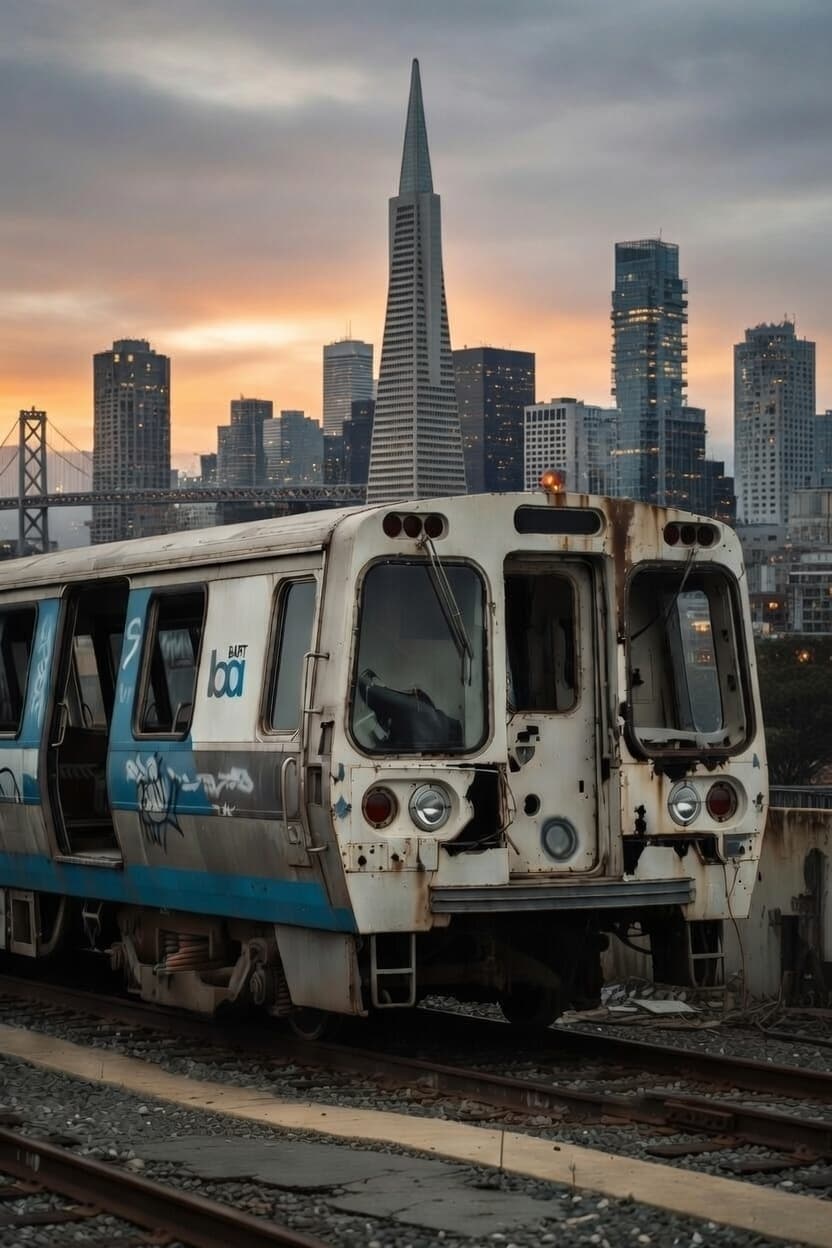
A government-run transit monopoly with a $375 million deficit, rampant fraud, and political capture. Sound familiar? Meet BART — the blueprint for everything wrong with publicly managed infrastructure.
Imagine running a business where your customer base was cut in half, your labor costs spiraled out of control, employees were caught clocking hundreds of phantom hours, and managers were steering contracts to their own family members — and yet, instead of a reckoning, you were handed nearly $2 billion in emergency funds and told to keep going.
That's not a thought experiment. That's BART. And California taxpayers are on the hook for every penny of it.
The Bay Area Rapid Transit system has become one of the most instructive case studies in what happens when government insulates a public agency from the basic accountability that any private enterprise would face. No competition. No bankruptcy risk. No real consequences for failure. Just an endless line of bailouts, approved by Sacramento politicians, funded by people who may never ride a single BART train.
The Numbers Don't Lie
Let's start with the financial reality — because it's staggering.
Before the pandemic, BART was a fare-dependent system, with passenger revenue covering nearly 70% of its operating costs. That figure has since collapsed to around 30%. Weekday ridership, which topped 400,000 trips daily in 2019, sits at roughly 45% of pre-pandemic levels — and while ridership has been gradually recovering, closing the gap through fares alone would require more than doubling current ridership. That isn't happening.
The result: a structural deficit of $350 million to $400 million per year, projected to hit like a freight train in fiscal year 2027. To bridge the gap, BART has burned through $1.9 billion in federal and state emergency pandemic relief — funds that are now nearly exhausted. A $590 million state bailout was approved. A regional ballot measure seeking at least $750 million annually is being positioned for 2026 voters across nine Bay Area counties.
That's not a rescue plan. That's a funding treadmill with no off switch.
A History of Fraud the Politicians Would Rather You Forget
The financial crisis would be easier to swallow if BART had a clean record of responsible stewardship. It does not.
The agency's original construction in the 1960s was projected to cost $76 million. Final costs exceeded $180 million — a more than doubling before the first train ever ran. That pattern of cost explosion has never stopped.
In 1996, BART's own Board President was investigated by the FBI. His predecessor had already been fined for concealing campaign contributions. By the mid-2000s, the FBI was running sting operations on BART managers for accepting kickbacks from contractors.
In 2015, a BART janitor made national headlines for pulling in nearly $276,000 in a single year, almost entirely through overtime. A City Journal investigation found that labor costs consume over $830 million of BART's roughly $1.2 billion operating budget — a figure driven upward by runaway overtime, union agreements that prioritize seniority over efficiency, and a culture where questioning the pay structure is treated as an attack on workers rather than on management.
The fraud didn't stop there. Multiple employees were found to have clocked over 100 hours in a single pay period without actually working — sometimes leaving early, running personal errands, or simply not showing up, while the clock kept running. One manager steered lucrative contracts to a firm connected to her own husband, then signed off on the deal as fair and reasonable.
These are not isolated incidents. They are symptoms of a system that has never faced a genuine accountability moment.
Safety and Reliability: The Other Broken Promise
If BART were at least running reliably, the financial argument might look different. It isn't.
In recent years, BART riders have endured:
All 50 stations shutting down simultaneously during rush hour after a system-wide failure left no information on train locations
Smoke filling the Transbay Tube
Major computer system failures that cascaded across operations
Meanwhile, BART's own safety environment has deteriorated badly enough that it became a 2022 campaign issue. After years of underinvestment in transit policing and an ideologically-driven move to defund its transit police force, ridership surveys showed that safety concerns — not cost — had become the primary reason people avoided BART. Drug use, assaults, and fare evasion became routine features of the rider experience that the agency struggled to address.
Fare evasion alone costs BART an estimated $25 million annually — a figure that, in a system fighting for every dollar, is simply indefensible.
The Political Capture Problem
Here's the question that doesn't get asked loudly enough: why does this keep happening?
Part of the answer is structural. BART operates as a government monopoly. It faces no market competition. Riders who need public transit have no alternative. And because it serves as a major employer in the Bay Area — with powerful unions that are deeply embedded in Bay Area Democratic politics — it enjoys extraordinary protection from the kind of scrutiny that might actually force change.
Union contracts at BART are notoriously generous, and not just in pay. Work rules restrict management's ability to reassign workers, restructure operations, or respond nimbly to changing ridership patterns. When BART has needed to cut costs, it's found that cutting service by 65% to 85% would save only 20% to 40% on operating expenses — because so much of the cost structure is fixed and contractually locked in.
The political dynamic is equally entrenched. Every few years, as a funding cliff approaches, BART and its political allies frame the conversation as a binary choice: approve the bailout, or face mass service cuts. There's never a serious public discussion of what structural reforms should be conditions of any new funding. There's rarely a genuine independent audit of where the money actually goes. And Sacramento's response — invariably — is to write another check.
When a private company mismanages itself into a $375 million annual deficit, creditors take over, executives lose their jobs, and operations get restructured. When a government monopoly does the same, politicians call a press conference and announce new funding.
The $300 Million Question for 2027
BART leadership is now openly warning that without a successful 2026 regional ballot measure, the agency may not be able to sustain even reduced service for more than a year or two past 2026. A $349 million deficit in fiscal 2027 looms, with no existing mechanism to close it.
Sacramento lawmakers have proposed SB 1031, which would allow a multi-county funding measure and also study the consolidation of the Bay Area's 27 separate transit agencies — a long-overdue acknowledgment that the fragmented system is expensive and inefficient. That study alone is welcome. But consolidation on its own doesn't fix the underlying accountability failures.
The real problem isn't the funding model. It's that every past infusion of public money has arrived without meaningful conditions. No transparency requirements. No performance benchmarks with teeth. No genuine audit authority with the power to refer cases for prosecution. No structural changes to the labor cost problem.
More money without reform doesn't fix BART. It just delays the next crisis by a few years — at a cost of hundreds of millions more in taxpayer dollars.
What Accountability Would Actually Look Like
A serious reform agenda for BART would include at minimum:
Full, independent forensic audits of labor costs, overtime practices, and contractor relationships — conducted by auditors with no ties to Bay Area political infrastructure.
Performance-linked funding that ties any new state or regional dollars to measurable outcomes: on-time performance, safety metrics, cost per rider, and fare recovery ratios — with automatic clawback provisions if benchmarks are missed.
Fare evasion enforcement with real consequences — because a system losing $25 million annually to unpaid fares while pleading poverty is not a serious institution.
Transparency on every dollar of labor cost, including overtime, benefits, and pension liabilities — published in plain language, not buried in budget documents.
Genuine competition analysis — an honest public assessment of whether any portion of BART's operations could be contracted to private operators under performance agreements, as transit systems in other countries have done successfully.
None of this is punitive. It's basic stewardship. The kind that any private enterprise is held to by its creditors, shareholders, and customers — none of which BART has to answer to in any meaningful way.
The Bigger Picture
BART's story isn't just about Bay Area transit. It's about the structural incentives built into government monopolies — and the predictable outcomes those incentives produce.
When failure carries no consequences, failure continues. When management knows a bailout is always coming, the hard choices never get made. When unions hold effective veto power over operational reforms, operations don't get reformed. And when politicians are more concerned with keeping powerful constituencies happy than with demanding accountability, accountability never arrives.
California is facing multiple versions of this story simultaneously — in its pension systems, its high-speed rail project, its homelessness programs. BART is just the most visible example of the pattern: institutions that are too politically embedded to fail, too structurally dysfunctional to succeed, and too expensive for taxpayers to keep subsidizing indefinitely.
The 2026 ballot measure will likely pass. Bay Area voters have consistently supported transit funding, and BART will campaign hard on the threat of service collapse. The question isn't whether money will flow. The question is whether this time — for once — the money will come with meaningful strings attached.
Because if it doesn't, we'll be having this same conversation again in 2030. With a bigger deficit. And another check from Sacramento.
What do you think? Should new BART funding be tied to specific reforms — or is that just an excuse to let the system collapse? Share your take in the comments.