
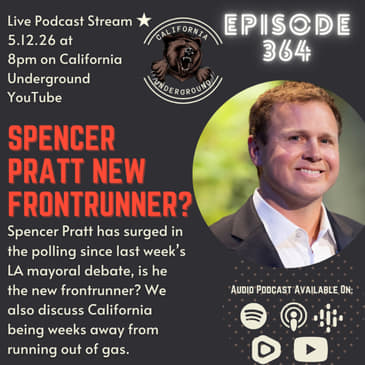
Karen Bass just pulled out of tonight's Los Angeles mayoral forum. The primary is in three weeks. The last debate she showed up to, 88% of viewers said Spencer Pratt won.
Tonight on California Underground, Phil is asking the question the incumbent doesn't want asked — and the one Sacramento doesn't have a good answer for either.
On the Los Angeles mayor's race: Pratt lost his home in the Palisades Fire and turned it into a campaign. He's polling second in a city that hasn't elected a Republican mayor since 2001, with 40% of voters still undecided and a primary on June 2nd. We break down the debate, the numbers, and what Bass skipping tonight's forum actually signals.
On California's gas crisis: the state confirmed four to six weeks of gasoline supply on hand. Three major refineries have closed in under a year — Phillips 66 Wilmington, Valero Benicia, PBF Martinez — removing 18% of total refining capacity. California has no pipeline connections to other states and imports 20% of its gasoline from overseas. Average price at the pump: $6.13 a gallon. The Iran war closed the Strait of Hormuz and exposed a supply chain California spent years making fragile.
Both stories. One show. Every week.
California Underground is available on Apple Podcasts, Spotify, and wherever you get your podcasts.
Subscribe to the California Underground newsletter: https://caunderground.substack.com/
Follow the show: @californiaunderground on Instagram and TikTok | @ca_underground on X
Phil is writing a book about California — sign up for early updates at www.thegildedstate.com
[00:00:01] Spencer Pratt crushed the Los Angeles mayoral debate so badly and crushed his opponents that both of them have dodged and canceled the current debate. Also, we're going to talk about the fact that the last oil tanker has reached the United States and California is about six weeks away from running out of gas. We're going to be talking about that as well and what could happen and why this is happening to us in California. We're going to get into that right now on this episode of the California Underground starting right now.
[00:00:46] What's going on, everybody? Thanks for tuning into another episode of the California Underground. I am your host, Phil. I'm riding solo tonight. Camille's a little under the weather. So wish everyone everyone wish Camille to get better soon. We miss her and we hope she's back soon. So tonight we have two big stories I want to talk about. First is what is going on in Los Angeles with Spencer Pratt. It is quite a turn of fortune that's going on in Los Angeles.
[00:01:11] I think after last week's debate with Spencer Pratt and the way he held himself out there, I think that changed a lot of people's feelings about Spencer Pratt and the prospect of him actually winning mayor of Los Angeles, which would be an enormous upset. The fact that he crushed his opponents so badly and embarrassed them so badly on TV that they actually backed out of this debate.
[00:01:33] We're going to get into that. Also, the issue with gas here in California, we are about six weeks away from California, basically running out of gas because twofold because of the issue going on with Iran. The last oil tanker coming from the Stray for Moose has just arrived in the United States. Not good for anyone here in the United States, but for California, especially, it's really going to be an issue. We're going to talk more about that. We're going to get into that.
[00:01:59] But first, if you haven't already, make sure you like, share, subscribe, review if you've ever tuned into this show before. If you're watching live, as we love everybody to do, please make sure that you let us know where you're chatting in from. People are already saying hello, OC, two OCs. So somebody already asked, did they pull out of the debate? Yes. Yeah. Karen Bass backed out of the debate. She said she had to go to Sacramento. We're going to get into that in a little bit. Also, big announcement really quick before we get into the show.
[00:02:28] I know people don't like me dilly-dallying. Is that, you know, is that an old person word, dilly-dallying? If you say dilly-dallying. Big announcement that I want to tell you guys about. We brought up the fact that I am releasing a book coming up this summer and around August, September, probably late August of this year. It's called The Gilded State, which will be about California, basically the history of California. How we went from the, basically the personification of the American dream to the American nightmare.
[00:02:59] It's been a long work. I've been working on this for over probably about two years now. So if you want to sign up and get updates about the book and also get free previews of chapters as we get closer to the actual publication date and when the release happens, go to thegildedstate.com. Let me put that into the chat right now. Thegildedstate.com. Go to thegildedstate.com. Put in your email.
[00:03:29] I won't spam you with a whole bunch of things. It'll just be about the book. And I'll let you know what's going on and when it's going to be coming out, when you can get first notification when it's coming out, probably some, maybe some giveaways. Maybe you'll get a free copy of the book. Maybe you'll get a signed copy of the book. Who knows? There could be a whole bunch of things. But if you're interested, I'm very excited about this book. It's coming out later. We're putting the finishing touches on it right now. We're editing it. We're working with people who are designing it, formatting it, all of that stuff. It's very exciting.
[00:03:58] So it's exciting to see it come alive from putting words to pages and actually end up getting a full book out of it. So, all right. Let's get into this first story tonight, which is what everyone's talking about right now, which is Spencer Pratt. Spencer Pratt is shocking a lot of people. Because at first it looked like people were saying, oh, this looks like a joke. He's a reality TV star. He was a guy on the hills a long time ago. He was the villain. Nobody liked him.
[00:04:26] And then it started to percolate his idea of running for mayor. And people were laughing at him. Oh, this is a joke. This is kind of like a sideshow. People are not taking this as a sideshow anymore. I can tell you that after last week's debate, you had Spencer Pratt, Nithya Rahman, and Karen Bass. And out of the three, you have Karen Bass, who we all know is the incumbent, Democratic mayor, mayor during the wildfires, mayor during the LA riots, all of this stuff. Nithya Rahman has been on the city council.
[00:04:53] She is an avowed Democratic socialist. So she is an out and about Democratic socialist who lives in a $3 million house in a beautiful part of Los Angeles, far away from the homeless and Skid Row and all of that stuff. I want to watch some of the highlights right now and we'll comment on them about some of the highlights that Spencer Pratt, his takedowns of Nithya Rahman and Karen Bass.
[00:05:18] I don't think they were expecting Spencer Pratt to do so well, to be completely honest. You know, he went to school, poli sci degree, which is actually my degree in undergrad. I was a poli sci pre-law minor, which probably explains why I'm into politics right now. So he held his own. And he did not go up there. He actually had facts and figures and arguments. So it shocked a lot of people. And there was a poll done afterwards, which we'll get into the results.
[00:05:46] I'm sure you already know what the results are, but we'll talk about those right after this video. But let's get into that video right now. I want to watch some of these highlights. We'll comment on them. I'll watch your chat to see what you guys think. Let's get into that. All this money, when we stop her useless open bed plans that actually doesn't put drug addicts, in these housing that we're spending billions of dollars. And we're going to actually start checking where this money is going.
[00:06:12] Not to mention, when you get rid of all the drug addicts off the street, the police won't be responding to the drug addicts all day long. Thank you, Councilwoman. Now, getting off the street is voluntary. Should that change if a bed or a shelter is available? Mr. Pratt, we're going to start with you. Yes or no? It's illegal to live on the street. So, yes, everyone needs to go inside. Mayor Bass. Everybody needs to go inside. Making it illegal and arresting people is not the way to solve this problem. Ms. Rahman.
[00:06:41] Yes, people need to go inside. When they're offered shelter, they go inside. You don't get an opportunity to say no. So it's unanimous here. Next question. Do you support the ordinance that restricts? Damn. These moderators, I don't know if you've been following a lot of these debates. These moderators are not putting up with any crap. They have been in the last gubernatorial debate. There was one where they were really pushing back on a lot of the candidates and saying, like, we're not accepting your talking points answers. So get to the point.
[00:07:11] Tell us yes or no. So she was not taking it from Nithya Rahman. It's encampments in front of schools or daycare centers. Mayor Bass, I'm going to start with you. Yes or no? Ms. Rahman, yes or no? I, you know, I, I support keeping our streets safe. I did vote against the structure of this particular ordinance. And it is because at its best. It's a yes or no? It does not, the way this ordinance was structured. It's a yes or no? It does not keep our children safe.
[00:07:40] It does not keep our children safe. No, I. What I was saying is she's fighting because she doesn't think there's a difference between one foot or 500 feet for kids safety with drug addicts with machetes in front of schools. Again, we'll take that yes or no? Of course. We do not want encampments in front of schools, parks, daycare. I don't want vehicles. Mayor, you talked about inside safe. Let's go into that a little bit. You advocate for what some. Nithya Rahman. Nithya Rahman. I'm not sure why she got into this race.
[00:08:10] She's not as skilled of a politician as she thinks she is. And this debate clearly showed it because we'll get to the odds in the predicting markets and the gambling markets and all that, how they viewed Nithya Rahman. But man, she is not good at this. Like her being on the debate stage with a first time political debater in Spencer Pratt. And she looks like she is way out of her element.
[00:08:34] She looks like she is so far out of her depth that she doesn't even know where she is. And she's trying to give these word salads. And even the moderators are kind of like, no, no, no. Give us an answer. Give us an answer. You can't dance around this topic. Some have called get help or get out of the way. What is that? And how do you do it? I don't know who made up that name. First off, let's I just want to say Councilwoman Robin acts like she doesn't have any authority with this homelessness. She was the third most powerful person in city council.
[00:09:05] She runs the homeless housing thing. She acts like this is just Mayor Bass. First off, inside safe. I like to say inside safe makes all of us outside unsafe. The reality is no matter how many beds you give these people, they are on super meth. They are on fentanyl. The DEA statistics says 93% of this is a drug addiction problem. Nithya Councilman Robin's plan for treatment first.
[00:09:29] I will go below the Harbor Freeway tomorrow with her and we can find some of these people she's going to offer treatment for. She's going to get stabbed in the neck. These people do not want a bed. They want. That might have been one of the lines that I first saw when this came out of it. It may sound hyperbolic, but I think it taps into something that a lot of people are too afraid to say and Spencer Pratchett said it.
[00:09:58] We all have these compassionate wishes to help those who are homeless. We do. If you are someone who has empathy and compassion, you want to help these people who are homeless. The issue is I think a lot of people are starting to get frustrated with in California is the fact that it's almost too much compassion and too much carrot, not enough stick. If you've heard that saying before, too much carrot, not enough stick. In the sense that it's treatment, treatment, treatment. We keep throwing money at it.
[00:10:28] But if you decide to live on the street and you are completely drugged out and you are completely out of your mind. I mean, today I was walking back to the office after lunch and this woman was outside our office building in downtown San Diego, just taking her clothes off and swinging them around. Just swinging them around, shouting gobbledygook at whatever. And you could see the uneasiness of people on that corner who were looking at her going, is this lady going to attack me?
[00:10:57] Is this lady going to bum rush me? Like, what do I do in this situation? And I think Spencer Pratt taps into that. And that's sort of his entire campaign. I think he's tapped into something that before was sort of he's mad because he lost his home. So he's going to run for mayor. And that's sort of how it started.
[00:11:16] But I think he's really channeled in a interesting and new way the frustration of Angelenos and Californians in general in terms of their frustration with homelessness, with wildfires, with budgets, with how cities are run, sort of the elitism that goes on in democratic institutions where it's one party rule and there's nobody held accountable. He's tapped into that. He's really, really tapped into that.
[00:11:46] And I think that's what's resonating. So, yeah, it may sound a little jarring, this idea of, well, yeah, we'll go under this highway and you might get stabbed in the neck. It's very illustrative. It's very descriptive of what could happen. And maybe it gets people to come back. But I think there's a lot of Californians who literally who actually do think that.
[00:12:08] And I think there's a lot of people who struggle with that every day who live in a city where they look at it and go, yeah, like I worry about if I'm walking downtown San Diego or L.A. or San Francisco or Sacramento or any of these cities and I run into someone who is on super meth or drugs or fentanyl or something that they worry about their own public safety. And if they're with their family, it's even scarier. What do you do? You don't know.
[00:12:38] So I think he's tapping into it and he's saying it like it is. He's kind of saying it like just a mad citizen, like angry citizen, not mad like crazy, but he's mad. He's mad and he's angry about what's going on. And he's tapped into that in a really interesting and kind of it looks like successful way. He's starting to surge in the polls and it looks more and more like it's going to be a runoff between him and Karen Bass. Nithya Rama is fading really fast and there's not enough time. I don't believe for her to make up any ground.
[00:13:06] The primary is two weeks away. Reminder, two weeks away, two or three weeks away, three weeks away, two weeks away, two weeks, three weeks away. Okay, weeks away and what day is it? Okay, we're like three weeks away from the primary. I'm sorry, I lose track of the time when I'm so busy. So we're like three weeks away. There's not enough time, I think, for her to make up any ground with Spencer Pratt surging and seeing this momentum right at the finish line right before the primary.
[00:13:31] It'll get interesting if it's Spencer Pratt versus Karen Bass because I think that's who he wants to go up against as Karen Bass because he will just lambast her about everything she did during the wildfires and just really tap into a lot of people. Fentanyl or super meth, these ideas cost us over $400 million to house 3,000 people for $400 million. This is an absolute failure for both of them. They're a team.
[00:13:59] I want to just say to everybody who's watching today, you're going to watch today as Mayor Bass and Spencer Pratt attack me because they want to run against each other in the general election. Each of them thinks that running against each other is what's going to help them win, and they don't want to run against me because my ideas, which are based on real results in my district, which are based on real data. First off, Mayor Bass and I are definitely not working together.
[00:14:28] I blame this person for burning my house and my parents' house and my town and all my neighbors down. I am not working with Mayor Bass. Second off, if I wanted to run against anybody, it would be the council member who is terrible. Mayor Bass has at least been a mayor for almost four years and has, as she talked about earlier, the unions, all the unions endorse Mayor Bass. You think it's easier to run against the incumbent mayor with all the unions or a random city council member who's been a failure for six years?
[00:14:59] I mean, come on. Like, he's just, for a first-time political debater. I'm not trying to gush over Spencer Pratt here. What we're witnessing is something pretty incredible going on here in California. You know, yeah, he has the name notoriety, sort of. I mean, we all know who Spencer Pratt is. He's been a reality star a long, long, long time ago. It was like 20-plus years ago. And he even admitted that they were, like, house poor by the time that their house burned down
[00:15:29] because what were they doing for work? It's interesting to see. It's interesting to see because he is an angry citizen. And he is stepping up and he's fighting and he's calling it like it is. And this is something that I don't want to get off topic here because Spencer Pratt is running as an independent. And even though he's a registered Republican, he's running as an independent. And maybe there's something to it that we can talk about in a little bit.
[00:15:56] Let me know your thoughts in the comments of Republicans running as independent in deep blue places like this. It's interesting because this is something if you've listened to this show, there's one thing that I always criticize the California Republican Party for. And Camille and I have talked about it for a long time. The Republican Party here does not take big enough swings if they're going to be a true opposition party.
[00:16:19] There are too many Republicans who try to play cutesy and not call out what's happening in California. We've got like they've gotten better. I say they've gotten better. They've gotten much better, the Republican Party. There are younger, more energetic candidates. David Tongupas is one. Kate Sanchez is another one. You're starting to see these Republicans who are calling out people and being a little bit more bold about how they're calling out people.
[00:16:48] But this is something interesting to see because he's he's not holding back. And again, I think that does tap into a lot of the frustration of Californians and Angelenos. And that's why it's working right now. And I think there's just the problem with the Republicans now as the only viable opposition party that there is right now. And not to mention there are I think there are more registered independents than there are Republicans.
[00:17:17] Someone can fact check me on that, but it's very, very close. I think there's more independents than there are Republicans. Either way, you need candidates like this who are not afraid to make a splash. Right. And too many times candidates run. They're forgotten. No one knows. John Cox ran against Gavin Newsom a thousand times. He lost all of them because he was kind of a boring milquetoast Republican. And he tried to act tough and it didn't work.
[00:17:43] I always go back to like Travis Allen back in 2018 when he ran against Gavin Newsom. And he was this bold, brash Republican who had one of the best debate lines against Gavin Newsom ever. I say this all the time. Probably you can go look it up on YouTube or TikTok or whatever. Go look up Travis Allen Gavin Newsom debate. There's a line where he says, if you can't trust Gavin Newsom with your friend's wife, then how can you trust him with the state? That's the sort of stuff that like we're way past in California trying to play nice.
[00:18:14] Like we're in dire straits here. And that's what I'm trying to tell people is if you're going to run, you better run like. Like your life depends on it. Like you better run and swing for the fences because you know what? Even if you don't win, but you land some tough blows against this one party rule here in California, it makes it easier for the next person. It's a ripple effect.
[00:18:41] It's a cumulative effect of when you land blows against the establishment and they are memorable blows and hits and all of this. It's a cumulative effect. It emboldens people to get up and start to stand up for themselves. It emboldens people to run in whatever race they can run in, whether it's city council districts, school districts, county supervisor, anything like that.
[00:19:06] That emboldens people when they see that this strategy works to be bold and to take these big swings. And that's what's interesting to me about this is that you see a guy who's never been a politician before getting up there saying it like it is. And the results speak for themselves. The polls were surging. He's now in second place in terms of odds on to be in primary or win the primary. It's getting close. Like it's actually getting close.
[00:19:34] I actually saw a video of him at David Foster and Catherine McPhee's house. I would have never thought David Foster and Catherine McPhee would host a fundraiser for Spencer Pratt. But anyway, let's keep going with the video. I'm going to check the chat while this is going. Cheers. I would much rather run against Councilwoman Rahman. Thank you very much. Thank you very much. We have all these empty buildings. So we will have so much high density.
[00:20:03] I'll have so many bike lanes for Mayor or excuse me, Councilwoman Rahman to have all her bike lanes. We're going to have all that. We have plenty of places to build. We don't need to put a seven story cement structure in a single family neighborhood with no parking. I actually lived the consequences of high density on small streets. And it's people can burn alive in an emergency or an earthquake or any type of evacuation situation. Adding these high density buildings on these teeny tiny streets doesn't make sense.
[00:20:33] Of course, I'm fine with building where they make sense. I love building. I think it's great. I think they should look a little better than what Councilwoman Rahman wants, like prison-like boxes. But I think they should have some style. Not to mention the fact that Councilwoman Rahman is fighting Mayor Bass on Sacramento. She just was telling me, this is L.A. Where's her L.A. pride? Okay, Mr. Pratt. Listen, you can answer this next question because it relates to it. But downtown Los Angeles seems to be in a state of crisis. What is your plan for downtown?
[00:21:03] Can we afford to let it die? Would you agree to bring city workers back full time to the office in order to help some of the businesses? What's your plan? Thank you, sir. Well, first off, I was just talking to my friend Rachel who works in downtown L.A. Downtown is so unsafe now that they have to serve the food. All the employees have to eat inside. They can't risk going out. That's why all these beautiful restaurants are closing because it's so unsafe.
[00:21:31] So before we require city workers to go back into any buildings, we need to enforce the laws on the street. Councilwoman Rahman is talking about safety yet. When animal rescue activist Rebecca Corey came in and said the dogs are being tortured and abused on the streets of Dunham, she walked out of the hearing. She doesn't care about safety. She doesn't care about anything she's talking about. At least Mayor Bass pretends to care. Again, it's a great line.
[00:22:00] It's a great line. And it's the anger. It's the anger and the frustration. And in terms of downtown, I mean, that's civics 101. It's civics 101 where if you're going to have a thriving downtown, it better be safe. Okay? It better be safe.
[00:22:22] One, because businesses want to operate and not think that their business is going to get broken into and they're going to lose everything because everyone always says, oh, business owners, they have insurance. Like whenever you saw the riots during LA or the Summer of Love, you always saw the same stupid arguments from status and leftists, which is, oh, they have insurance. It's okay. But people don't realize small business owners, a lot of them are living month to month. And a lot of these, insurance doesn't cover everything.
[00:22:53] Insurance doesn't magically just give you your business back. That's not how it works. Sometimes you have to fight with insurance for months before you even get a dollar back from insurance. And as we know, anyone who has had to deal with insurance, they don't like to pay out. They love you to pay them, but they don't necessarily like to pay out. So that's number one.
[00:23:15] Businesses need to know that they're safe, that they can actually open up downtown and have nice restaurants or have the capacity and the safety to know that they can operate without people breaking in, without somebody who's on meth breaking in, thinking that they're going to find some money or some food or something like that. So that's number one that you have to worry about with downtown and public safety. Two, it needs to be safe so people want to go downtown. That's the other thing. It has to be safe so people want to go downtown.
[00:23:43] Because right now, if you want to go to downtown LA, I don't know why you'd want to go to that. Maybe you just want to go to the Staples Center and watch the Lakers who just got swept by OKC. Whatever. I'm a Knicks fan, so no love lost for the Lakers. Sorry, anybody in the chat or anybody who's listening who's a Lakers fan. Apologies. I'm a Knicks fan. Sorry to see them go. Not really. But that might be the only reason you're going to downtown LA is to go to the Staples Center for a concert or go see the Lakers.
[00:24:13] That's basically it. You're not going to downtown because of the restaurants or anything like that. So people have to feel safe. They may feel safe around the Staples Center because it is so monitored with police. And if you go down there, there's so much police and there's so much safety because they know these huge places. They need the, you know, the Kings are there as well. They need to make sure that people feel safe going down there. Otherwise, people aren't going to go see the Lakers or the Kings. That's another thing. There needs to be safety so that the people actually want to go to downtown.
[00:24:43] And you saw this happen with San Francisco. San Francisco's downtown completely died. And it's slowly starting to come back, slowly starting to come back because Daniel Lurie got in there. He's more of a moderate Democrat who's business friendly. He's the, you know, the heir of the Levi Strauss fortune. And it's starting to slowly come back. But you saw under the prior mayor, London Breed, that things got so bad in downtown San Francisco that all the businesses left. They said, we're out of here.
[00:25:12] You know, all the flagships, Union Square, dead. All of these places that people used to love to go to in downtown were dead because it was unsafe, because smashing grabs, because of the homeless, because of all that stuff. People were not going downtown. It's uncomfortable. They don't want to go downtown. So if you're going to revitalize downtown, public safety is number one. Okay. Public safety is probably, again, it's civics 101.
[00:25:37] It's your job as the government to make sure that these streets are safe so that people can actually conduct commerce. I know a lot of people don't think this in California because it's not a very popular idea. But really, the job of the government, it should be limited to helping businesses conduct commerce. That's really it. And maybe protecting some property rights. Like, that's basically what the government should be doing.
[00:26:02] But for some reason, in California, we've gotten into this status nanny state mentality where the government has to literally do everything for you. That's not. And they're not doing the basic things well at all because they're trying to do everything. They end up not doing the basic things like public safety well at all.
[00:26:47] We have a long way to go. Post-production tax cuts. And Councilman Rahman will tell you, my husband's a producer, blah, blah, blah. The reality is she's been in power for five years. Now, all of a sudden, she has these tweets and these posts and she's doing sub-stacks. Both of these people have been the reason why there's no more Hollywood. Not to mention, even if they do these things, we're still going to have drug addicts all over the street because they're treatment first. Open beds, not mandatory treatment. Do you know I talk to producers?
[00:27:15] They have to pay gang members right now to keep the streets safe, to go film anything on the streets of L.A. So absolutely no, these two politicians have failed Hollywood times a thousand. Yeah, we had Jim Agnew on a couple weeks ago. Really interesting episode, kind of stepped out of our comfort zone of politics. And Jim came on. He wanted to come on and talk about Hollywood. You can go check out that video. We did it several weeks, probably a month or so ago.
[00:27:43] But you can go back and look at it and watch it if you're interested. He talks about Hollywood. You know, he's a producer and screenwriter. He's been working at Hollywood for many decades. And he details exactly why Hollywood is failing. And part of it has to do with because of the state. Like the state has not been kind to Hollywood. The city has not been kind to Hollywood. They kind of took advantage of the fact that this was the goose that laid the golden egg.
[00:28:12] And they took advantage of it for too long. And then eventually they believed that they could suck Hollywood dry for tax revenue and all of that. And other states decided along the way, wait a second, we can offer way better compensation to a lot of these film producers and these companies, these production companies, and bring them here. I mean, that's why Georgia is like the new Hollywood. It's because Georgia, the way they do it now with their tax credits is like there's no limit on tax credits.
[00:28:42] Right? There's like a no limit on tax credits. Here in California, they were happy to be like, oh, we raised it from like $750 to like a million dollars. Like this is one of the most aggressive tax credits. Like, no, no, no. You're still way behind the eight ball in terms of what Georgia, New York, Indiana, New Jersey. New Jersey is actually taking out like a good chunk of production. Like Netflix just opened in New Jersey, like a big headquarters over there.
[00:29:08] So there's a lot of states that are doing way better than California. And it's crazy that we let or that the politicians basically scared off Hollywood and made it unhabitable, unprofitable, and that people are just gone. Like it used to be, I don't know, it's just crazy that you could scare off Hollywood. What is California known for if you're not from California? Right? If you ask someone outside of California on the East Coast in a Midwest state, what's California known for?
[00:29:38] Hollywood's definitely in the top three, right? Like let me know in the comments in the chat, what do you think? Like what are some of the top three things that people think about when it comes to California? Don't say like homelessness and all that stuff or like Gavin Newsom. I'm saying like the stuff that people think about when they think of like Golden Gate Bridge, Hollywood, the hills, beach, surfing, stuff like that. That's what people think about when they think about California. And they scared off Hollywood.
[00:30:05] And you have politicians who just can't accept defeat and accept that they scared off Hollywood. And the only way to bring Hollywood back is to be more competitive than those other states. That if they're more competitive, they'll come back. Those production companies, they are incentivized. You know, they're motivated by obviously profits and making revenue and making money on their films, which why not? They're making films and spending a lot of money. Investors spend a lot of money on these films.
[00:30:33] So incentivize them to come back. You have to be more competitive than Georgia and New Jersey and all those places. So those are some of the highlights from the debate. Again, I think watching that, here's some of my thoughts about all of this. Again, I kind of said Spencer Pratt has tapped into this anger that's going on, not with only with Angelinos, but with Californians in general.
[00:31:03] And maybe it's because it's coming from a real place for him. Maybe because it is personal to him. It's something that he is dealing with. He lives literally in an airstream on his property, which was ironic that they tried to now attack Spencer Pratt for not being a resident and being able to run for mayor of Los Angeles because he wasn't a resident. And then he released a campaign ad showing him in his airstream being like, no, this is where I live.
[00:31:30] I live in this airstream like it's in L.A. So I think it's really interesting. Again, it's that bravado. It's to me, it's the bravado. It's kind of taking the filter off. It's talking about it and talking and attacking these institutions that have ruined the state,
[00:31:56] that have put so many people either, you know, either economically on their rears where they can't afford paycheck to paycheck. One reason why I think there is so many homeless here in California is because it is so hard to live here. It's really unaffordable to live here. And not just because people say, well, it's the sunshine tax and whatever. And I think it's just unaffordable to live here. And when people live paycheck to paycheck and they can't afford to put money away for savings for an emergency,
[00:32:26] it's this is what happens. People end up homeless and then either they use drugs to cope with the fact that they're homeless. So there's a lot of anger that he's tapping into. And he tapped into it in a pretty decent way. It wasn't just him going up there screaming and yelling, hooting and hollering, making fun and being vulgar or anything like that. He actually tapped into it and had and backed up. But he kind of called them out on their bluff and he said, here, here are the programs that you guys instituted and that you did. And these are the effects of it.
[00:32:57] And I'm here to fight back on that. So there's another video I want to get into really quick. Again, somebody said he has the best ads. That's the next thing we're going to watch is one of his ads. I want to get to some of these chats because you guys are blowing up the chats. Thank you, everyone, for tuning in live as always. Love when we have all these people live here on the show. It's always Tuesday, 8 p.m. We're always here Tuesday at 8 p.m. We're also going to be rolling out something else on this channel next week. So stay tuned.
[00:33:27] It won't be another live show, but we'll be doing more deep dives starting next week into California topics. So if you enjoy that sort of more deep dive, well-researched, evidence-backed deep dives into different topics, we're going to be doing more of those, and those will be on Thursday nights. Those are going to come live on Thursday nights. So stay tuned for those. Make sure, again, subscribe. Hit that notification bell so you know whenever something is happening. All right. I'm going to go through some of these comments. Somebody said mountains and beaches.
[00:33:56] Right? Yeah, mountains and beaches. Beautiful. People said San Francisco. Let's see. Somebody said small business owner Chino Yang, a rapper, blasted London Breed for her failed duties as mayor, and she tried to get the left-wing mob against him. Yeah? LA has a big fabric zone. Is that like a – oh, yeah, like downtown. Yeah, where you want to go buy fabrics. A lot of people go down for fashion. That's a big thing. SF was becoming a ghost town downtown.
[00:34:26] Nearly all the small businesses here in Vallejo, Richmond, Oakland, and San Francisco have left due to failed Democratic policies. That don't hold criminals accountable. Make it safe again. Small business people are not all wealthy. This is often not understood. I agree with you, Jason Sparadaro. Thank you very much. Yeah, it's true. Most business owners are not wealthy.
[00:34:50] This idea of people who own businesses are sitting on like these big fat cats who are sitting on tons of money is not true. Go talk to any small business owner, restaurant owner, stuff like that. They're struggling. It's not easy to run a business. Since Pratt's party identification won't actually be listed on the ballot, I think they'll work in his favor. City offices do not stay party identification. Yeah? Okay. Yeah, I mean, no more milquetoast candidates. That should be the slogan.
[00:35:20] That should be the slogan is no more milquetoast candidates. Love it. All right. Let's see. Showing his RV on his burped down homes lot. Really connected with the lower to middle class like myself. I think, again, it is that tapping into the frustration. So let's watch this next ad because this is an ad that went super viral that was made with AI. A lot of his stuff is being made with AI, but why not? Like, everyone's doing stuff with AI now. It's here. AI is here.
[00:35:50] Like, we just have to all get used to AI. So here's an ad that he ran that went super viral. I'm begging you. There's homeless drug addicts in front of the schools. My children aren't safe. Look, if you were a transgender migrant, I could get you a free pussy. Let's move the drug addicts closer. Back.
[00:36:21] Okay. So this is actually, for an AI video, there's a lot of Easter eggs in here that I, on the first watch, I didn't pick up until right now. There was a puppet that looks like Nithya Raman. So I guess he's saying that Nithya Raman is a puppet. I guess she's a puppet of the Democratic Socialists of America. So you got Kamala Harris here who's chugging wine. She's eating cake. So. Bass already solved crime. I endorse her.
[00:36:52] I didn't. I also didn't notice she was drinking it out of an entire bottle and she has bloodshot eyes. A lot of little Easter eggs for AI. I don't know who did this for him. Some company probably did this for him, but it's pretty good AI. Joe Rogan. I just want to rebuild my home.
[00:37:21] It's a little bit. I don't know if this is what he was going for, but that looks like Hugh Jackman. Did Hugh Jackman's house burn down in LA? Let me know in the chat if you know if Hugh Jackman's house burned down and that's why there's Hugh Jackman in this video. Surprised he hasn't. It is Hugh Jackman. I'm surprised he hasn't said anything. But I guess you can say it's just kind of a likeness of him. At home, it's been over a year.
[00:37:59] Also, the guards have DSA on him, which I imagine stands for the Democratic Socialists of America, which is a party that's growing. It's growing faster than most people would like to admit. I think we talked about it once before, how Democratic Socialists are starting to reach in the hundreds of thousands. So, I mean, we're seeing it in New York. It's happening. So you don't want it to happen in LA. This is a machine.
[00:38:26] If we want to burn this town to the ground, I feel so close. You can do it, Spencer!
[00:38:35] It's worth saving. California is worth saving.
[00:39:04] California is worth saving. LA is worth saving. San Francisco is worth saving. The whole state, every city, everything is worth saving in this entire state. That's what I say to that. Everything is worth saving. Good ad. And you know what? People are saying it's childish. Some people are saying it's not professional. Again, who cares? Right? Like, it's almost like they, and by they, I mean the one-party rule, the one-state kind of party rule.
[00:39:35] They don't want you running like this. Excuse me. They don't want you running like this because it's effective. They want you to play by their rules. They want you to make these cutesy little campaign ads. They want you to do the things and try and, you know, play on their field.
[00:39:56] And the thing is, if you play outside of their field, and this is something interesting, maybe it's not entirely being copied. But if you go back to 2015 with Donald Trump, the reason Donald Trump in his first run was so, such an earthquake to politics was because he didn't run and play by the rules. Right?
[00:40:25] He tweeted. He was brash. He was honest. He touched into the American, the anger of the American people. Memes, which he didn't really do. The memes kind of took over. Memes, I would think, were a big part of Donald Trump getting elected in his first term. It kind of changed the playing field.
[00:40:45] And when you play, when you set the ground rules and the playing field and people like Karen Bass and Nithya Rahman who are used to playing by their set rules. They can't keep up. Now, like if Karen Bass issued an AI video of Spencer Pratt, it would backfire. It'd probably be cringe. It'd probably be stupid. It would probably be tone deaf or something like that. Like, is this funny?
[00:41:15] Yes. It's funny because they're obviously mocking Gavin Newsom, Kamala Harris and Karen Bass and Nithya Rahman to one effect where she's a puppet. And it works because it gets people to share it and it gets people to look at it and go like, who is this guy? You know, I'm angry as hell. I want a guy who's angry like me to run for L.A. mayor. And that's what's happening. I want to show this and then we can get into our next topic for tonight.
[00:41:44] Let me pull this up real quick. And then I'll get to your chats. After this, I'll get to your chats because people are blowing up the chat. Love it. Love people being here. Lots of people showing up. So this is Kalshi right now. L.A., Los Angeles. You can actually watch this as this show's been going on. I've been watching like the numbers go up and down. So it's actually pretty interesting to watch. This is like in real time what you're watching.
[00:42:12] So if you see, here's the breakdown. 56% believe Karen Bass is going to win. But Spencer Pratt has gone up to 33%. And, you know, Spencer Pratt started way down here at 13% when he entered. Right. And Karen Bass was 53%. It looked like it was. That's why a lot of people back then were looking at this like this is a joke. Like there's no way that Spencer Pratt is actually going to win this. That's where he started. Right. That's where he started.
[00:42:42] And Nithya Raman came in and she shot up. And Karen Bass sunk down. So I imagine Nithya Raman pulled some of the support from Karen Bass. Now, this is prediction markets. This is not polling or anything like that. But prediction markets seem to be more accurate because people are actually betting with their real money who they think. And Spencer Pratt was way down here, got way down to 8%. And then look where he is. Now he's going up. He's going up.
[00:43:05] And then as of this month, in this past week, you see him surge from all the way down here around 17%. He's now all the way up here at 33.4%. And it's still going up. And Nithya Raman, it's interesting. Look at, I'm pointing to it like you guys can see where my finger is. If you look at where Nithya Raman was, she actually overtook in Kalshi.
[00:43:31] And this was something that Elizabeth from California posted on her Instagram. That she was ahead by like 60%. She was 60%. And that Spencer Pratt was climbing and passing Karen Bass. And then all of a sudden, cratered. And imagine that's probably have to do with the debate and her bad debate performance. Now she's all the way down at 13%. So again, we have a couple more weeks before the primary. And this is the situation.
[00:44:00] You know, Spencer Pratt is rallying. Nithya Raman has collapsed. It looks like it's coming down to a two-horse race between Spencer Pratt and Karen Bass. Again, I think he wants to run against Karen Bass. I think his campaign makes more sense against Karen Bass. He's been mad at Karen Bass. I think he can tap into that a little bit more. And I'm surprised. I'm still surprised Karen Bass did not get recalled during this whole time.
[00:44:28] Because of how poorly she actually handled the wildfires. So that's the update on that. So let me know. What do you guys think in the comments about where this is going to be? Do you think it's going to be Spencer Pratt and Karen Bass duking it out for the general election? It sure looks like that. It sure looks like it's going to be that coming up in just a couple weeks. It's going to be Spencer Pratt versus Karen Bass. And who knows?
[00:44:58] Who knows? I think he's doing better with independents in Los Angeles. Way better than Karen Bass is doing. So who knows? All right. Let's check some of these. Let me take a drink first. All right. Puppet of the Democratic Socialists. Yep. I think that's what they were going for. He's a puppet. She was a puppet. I hear the left is demanding DC Comics to stop this as it portrays Batman. I find it hilarious they haven't.
[00:45:26] I mean, if we were to go back in history and look at all the things that mimic or copy Batman or Superman or Spider-Man or anything like that, like there's so many things out there, culturally commercials and stuff like that, that use likenesses of Batman. ACLU, pretty much socialist. They are behind No Kings. They're one of the people behind No Kings. Yeah. ACLU, Democratic Socialists of America. They're another one. Someone says amazing campaign ad.
[00:45:55] Childlike, not childish. Yeah. I think that's a good way to put it. Childlike, not childish. I think it's, you know, it's basically an AI realistic kind of cartoon. These politicians have been given a pass for way too long. I 100% agree. And I think, again, it comes back to that brashness. Be bold. Be bold. What are you going to lose? I say this about Republicans all the time.
[00:46:21] In this state, you are the only legitimate opposition party we have in this state. The only kind of operational organization that has any power or influence or money to push back against this one state. Not discounting independents or libertarians or any other parties by any means. But you're the opposition party.
[00:46:47] I think they're too worried about Republicans that run in California are too worried about playing nice. Like, don't play nice right now. Like, this is, we're in dire straits here. We're talking about people who can't afford to pay their electric bills or pay their mortgage or send their kids to a good school or save to send their kids to a good school or paycheck to paycheck. They're one paycheck away from being homeless and on the street. I think it's time to get serious here.
[00:47:13] Like, it's time to stop pretending like we can just run cutesy little ads and move the needle. You know, oh, if we just move the needle a little bit this way, things will get better. Or if we move the needle a little bit this way, move it a little bit more to the left and it'll be better. Move it a little bit more to the right and it'll be better. No. No, no, no. It has to be drastic change. We need drastic change in California ASAP. Like, this is a five alarm fire. We need drastic change.
[00:47:40] And if you're taking that big swing, they can't run on their records. Yep. Yeah, that's why a lot of them just, you know, they can't be called to the mat. That's why Karen Bass didn't show up for a debate. Spencer's ad are more entertaining than Kevin Hart's roast. I didn't watch it, but I heard really good things about it. It makes me feel like I want a superhero to save California. We all want a superhero to save California. There are no superheroes who are going to save California. It's a collective effort.
[00:48:10] We all have to push back, right? There's not going to be one figure who's going to save it. I wish there was. I wish this was like a movie where we get person elected and roll credits, happy music and all that. I believe Spencer will win. Basura means trash and spent. Yep. Yeah. There was another ad where he talked about taking out the trash. In terms of what happened to Karen Bass as of recently, because I guess she doesn't want to debate Spencer Pratt anymore.
[00:48:40] So this came out just yesterday. Spencer Pratt or Karen Bass cancels next debate after Spencer Pratt's smackdown. Los Angeles Mayor Bass has decided to skip out on the upcoming mayoral debate scheduled for Wednesday, according to debate organizers who posted on social media over the weekend. Campaign spokesman Alex Stack said Bass will instead travel to Sacramento, where she'll be fighting for critical state funding for housing, homelessness, and Palisade recovery. And we'll also discuss the city and state partnership on the Olympics and the World Cup, according to news service.
[00:49:10] It's time to move past the debate, Stack said, on why the mayor pulled out of a scheduled debate with the primary election less than a month away. Time to move past debates. That's it. You peasants. That's it. That's all you get. I did one debate and that's enough. That's all you get is one debate. Mayor Bass's withdrawals, disappoint public forums such as this are cornerstone of democratic accountability. These forums provide voters with the opportunity to hear candidates, share their perspectives, respond to questions, engage with one another on issues facing Los Angeles.
[00:49:41] Bass has signed papers agreeing to the debate on April 22nd. However, on May 9th, just three days after a debate against fellow candidates, Ben Spratt and Nithi Rahman, Bass changed her mind. Comment to New York Post. Bonin said Bass team told reporters she would be in Sacramento, but at no point did the mayor's campaign indicate they had a conflict on the date that they chose and confirmed. So I guess he wasn't scheduled to be a part of that debate anyway.
[00:50:07] So that's even crazier that he wasn't scheduled to attend the upcoming debate anyway. And she still she she still skipped out. You would think if Spencer Press not going to be there, you'd want to be at this debate. I mean, I think I think you if you are running for office, I hate this idea of you get to pick and choose what debates you get to be a part of. I hate that. Like, I think if you're going to run for office.
[00:50:36] You got a debate like there. No questions about that comes with running. That's part of your job to be accountable to the people. You have to show up for a debate. There is no ifs, ands or buts. You don't get to reschedule or say I don't want to do it. If you are running for office, you are required to debate. End of story. I don't care if it's a Republican or Democrat. You should show up to debate all the time. Because I think it is incumbent that you go in front of the people and explain your position.
[00:51:06] There is no reason that you should not show up to a debate. But she backed out anyway, even though he wasn't even supposed to show up at this debate. Crazy. But all right. Got a couple more minutes left. I do want to get to this final story today. I knew that Spencer Pratt was going to take a little bit longer because there's a lot going on with the Spencer Pratt in Los Angeles. It's a very interesting race. We're going to keep an eye on it, obviously. Coming down to the wire. Also, May 26.
[00:51:37] Make sure you mark it down. We're going to have a roundtable. We're going to have several people joining us as a primary episode. We're going to have, I believe, Kyle Campbell is going to come back. Susan Collins, who was on our last roundtable. We're going to have Tess from California Conversation. She's a new YouTuber talking about California politics. She's going to be joining us as well. We're going to be doing a whole roundtable. We're going to get out our handy dandy little primary election ballots that are sitting on my desk right now.
[00:52:05] And we're going to go over a lot of things. And this is kind of like an open forum. And we're going to be talking about the primary. We're going to talk about measures. Talk about what's going on. We'll take your questions. If you don't know, this is the episode you want to mark down. If you don't know what's going on and you're like, I haven't looked at anything yet. May 26, we're going to be doing a roundtable. All right. Last story of the night.
[00:52:29] California has enough gas for six more weeks. Let me say that again. California has enough gas for six more weeks. After that, we're not really quite sure what's going to happen. Why? It's a whole host of things. Most of it is self-inflicted, but there's other issues that have caused it. But let's watch that story right now and we'll comment and discuss why is California in the
[00:52:58] state it is and why are we running out of gas basically by 4th of July. By 4th of July, it looks like we might be out of gas. Well, we have an update on California's oil and gas situation as state leaders get ready for prices to go up even more. And California is relying on more imported fuel than ever right now, a situation made worse by the war in Iran. Governor Gavin Newsom's administration says it's working on a plan in the event of gas shortages. Now, this was at the center of a hearing at the state capitol today.
[00:53:25] And KCRA 3 political director Ashley Zavala joins us now. Ashley, what's the plan here? Yeah, this was kind of a last-minute hearing that was organized this week. State energy officials said California basically has enough supply to meet demand for the next six weeks if the Strait of Hormuz stays closed. Beyond that, there are a lot of questions. This hearing was in the Assembly's Energy and Utilities Committee. In fact, it's still going on right now. It included Governor Gavin Newsom's top officials who monitor the oil and gas industry, notably
[00:53:53] California Energy Commission Vice Chairman Siva Gunda. Western State Petroleum Association President Jody Muller was there, along with the UC Berkeley energy expert Severin Borenstein. Everyone agreed the war in Iran is making the state's gas price situation worse, while also agreeing California is relying way more on foreign countries for oil, which makes the state vulnerable to price spikes. Gunda specifically was asked what happens if the Strait of Hormuz stays closed for another 60 days.
[00:54:21] He said the state's oil supply is stable in the short term, but beyond that, if the Strait stays closed, prices will likely go up. Here's what that conversation was like. I do not see, presently, at least up to six weeks, you know, a shortfall or a supply shortfall. Beyond that, I think based on what we're hearing from the industry and what we have observed, the pricing will move molecules towards California, but it will come at a price.
[00:54:51] And that's something that we need to closely watch. For six weeks, at least, there seems to be some certainty, but almost as certain is that if this situation continues after six weeks, we would likely see more price increases for gasoline. More exposure. Yes, absolutely. What should California consumers be expecting in terms of price if this conflict continues for?
[00:55:18] Well, I don't need to be an expert or a UC Berkeley professor, Assemblywoman Cote Patrice Norris. What can Californians expect if we run out of gas? And what kind of prices can they see? Astronomical prices. That's what they're going to see. They're going to see astronomically high prices. Could be $10.
[00:55:43] We could be looking at $10 a gallon gasoline in California in 60 days or six weeks. Again, I don't need to be a UC Berkeley professor of economics or gas or geology or whatever. I can tell you that sitting in my office in San Diego, streaming right now. That's what I can tell you. Or three months, six months.
[00:56:07] If the prices continue to go beyond $6.625, you will really see demand coming down. So we would expect the prices to stabilize under $7. More like $6.50. I could certainly see the... Okay. I don't know who this gentleman is. I imagine they're experts that the Assembly called in because they have to have hearings about what's going to happen if we run out of gas.
[00:56:37] Because that's what politicians are good at. Again, I don't think we need a full-time legislature to have hearings with experts about common sense things. What happens when you run out of gas and there's not enough gas for everybody? Well, when supply goes down and demand remains the same, prices go up. That's just basic economics 101. And this gentleman's whole point is, well, if prices go up, people will just stop buying gas.
[00:57:06] Oh, okay. That's kind of like saying, well, if the price of donuts go up to a point where it's too prohibitive for you to buy donuts, people will just stop buying donuts because they're too expensive. There's a difference between donuts and gasoline, right? Donuts, you don't need to live. You don't need a donut to live. I'm just going to go ahead and say, you don't need a donut to live. I love a donut. Good donuts are great.
[00:57:34] I will say you need gasoline to live. Most people need it to put in their car to go to work to earn a paycheck and pay for the things that they need to pay for. So, yes, I don't think demand will slow down just because prices go up because people still need to travel and people still need to go places, right? There's only so much remote work out there. And even place, there's a lot of businesses that don't allow remote work.
[00:58:04] And if they do allow remote work, it's a hybrid situation where it's, you know, more, maybe you could do two days a week or one day a week. But we want you in the office because we like having you here in the office. I don't see the idea where demand is all of a sudden going to slow down because prices go up. I think people are already probably cutting back as much as they can on gas. Maybe they're not taking that road trip that they want.
[00:58:33] Maybe they're not going as many places. But people still need to get to work. They still need to go to work, earn a paycheck and live. Those are non-negotiables. Those are not things where they can say, well, you know what? I'm not feeling paying $7 a gallon for gas. So I'll just not drive. That is not a solution for a lot of people. You can't remote work if you're a construction worker. You can't remote work if you work in a restaurant. You can't remote work if you're an electrician.
[00:59:02] You can't remote work if there's something that you have to be there in person to actually do. And I think it's kind of short-sighted of whoever this expert is to say demand will just go down. That's not how it works. We see the price of crude oil going up another $40 or $80 a barrel if we really went 60 more days. And I use those two numbers because they translate to another dollar or two per gallon.
[00:59:31] I don't think that's implausible at all. Unfortunately, I think that would be a crisis. And it would be completely out of control of the state of California. Severin Borenstein, who you just heard there, he is a researcher and economist who has been studying the oil and gas industry in California for decades. He did float the suggestion of a possible gas tax holiday here in California. Governor Gavin Newsom has shut down the idea of suspending the gas taxes recently as a couple of weeks ago.
[01:00:01] Did the governor say why he was shutting that idea down? It just, I mean, it's the... He just said no. Yeah, he basically said no. So is there an emergency plan in place? So that was actually another question that lawmakers asked Gunda in this hearing. Gunda essentially said he's working on it. There is some proprietary information, some trade secrets from the oil industry that he legally cannot make public about what the near-term supply could look like when it comes to oil and gas.
[01:00:26] Gunda said he is in negotiations right now to try to ensure stability in California if the situation in Iran persists another three to six months. But he did not give a timeline on when exactly a public update on that would be coming. So again, a lot of questions tonight on what the future looks like. And Californians are drowning in these gas prices. Yeah. Significant. Thank you. To answer your question, no. Doesn't sound like they have a plan at all. They don't have a plan.
[01:00:55] I doubt they have a plan. I doubt the assembly has a plan. The issue is, which I want to talk about, is how we've gotten to this point where it is, yes, there's some exterior or external factors that have caused this, but the system we've built has not been prepared for external black swan events. If you're not aware what black swan event means,
[01:01:22] it means it's sort of a cataclysmic event that you're not really predicting. It's kind of rare. So the war in Iran is one thing. The closing of the Strait of Hamuz, I guess you could say it's a black swan event that you're not planning for that there's going to be a war in Iran. That is a shock to the system that California is not prepared. Our system is not ready to deal with something like that. We haven't planned for that. There are plans.
[01:01:51] A lot of California's plans and policies rely on the fact that nothing bad ever happens. And kind of going back to what we were just talking about with Los Angeles and the wildfires, the LA wildfires are a perfect example of what happens when you neglect and create bad systems that don't work and then a black swan event happens and all the systems fail because you've set them up that way. Not expecting that a black swan event would happen. But that's not to say that it's not completely California's fault.
[01:02:18] It is wholly California's fault for the way that we've set these things up. I want to go to this article right now. Let me pull this article right now. Hold on. Bear with me. All right. This is from the International Business Times. Four-week countdown begins as California officials warn of imminent gasoline shortages after last oil tanker arrives.
[01:02:46] The California Energy Commission confirmed it is working closely with refiners and is aware they are identifying and using alternate routes and sources of crude, but also acknowledge that inventories are being drawn down rapidly. No further tankers from the Persian Gulf are currently en route to California. The Strait of Hormuz, which Iran closed in late February 2026, has remained functionally shut to commercial traffic despite a brief ceasefire in April. As UCLA professor Michael Ross told ABCLA,
[01:03:15] the war in Iran and the closing of the Strait of Hormuz has actually been buffered by the fact that all these tankers were at sea at the time. The Strait of Hormuz closed. This is the last shipment of that supply that was keeping prices relatively stable. So that should worry us. Why? Because California has shot itself in the foot in terms of refining capacity. And this is not something that should shock anybody.
[01:03:43] I want to talk about... First, let's talk about the fact that there is so much oil. There is so much oil in California that we could drill for. And I know that... I think it is Steve Hilton who said at a recent debate that it's not feasible for us to actually drill for more oil. One of the Republican candidates said it's not feasible for us to drill for more oil. I've talked to people. It's not feasible to drill for more oil. That sounds like kind of a defeatist attitude. I think we can do anything we want.
[01:04:13] Why not drill for more oil? Again, big, bold swings. We got to do big, bold swings. And a little plug, those are things that I talk about in my upcoming book, The Gilded State. So make sure you go to thegildedstate.com and check it out. Attempts to quantify just how much heavy oil is recoverable in California is not easy. According to Britannica, California accounts for most of the thermally recovered heavy oil in the United States. The largest of the California heavy oil fields is Midway Sunset with an ultimate recovery estimated at more than 3 billion barrels.
[01:04:41] Almost as large as the Wilmington Field in Long Beach with about 3 billion barrels. The Kern River field projected to ultimately produce slightly more than 2 billion barrels at the South Belridge. On the other hand, to the U.S. Energy Information Administration, California's proven reserves are only 1.7 billion. That wide range of estimates can partially be explained. The fact that California's oil companies only report proven reserves if there's a possibility they will acquire a drilling permit.
[01:05:09] So basically, they write off whether or not they think there's oil or calculate whether there's oil based on the fact of whether they're going to get a permit. And here in California, you're likely not going to get a permit. So why worry about how much oil is in California? You can't get to it. So why are these companies even going to worry about estimating it? This is interesting. Taking into account offshore and onshore reserves, a 2014 study by petroleum geologist Tim Considine,
[01:05:37] I think I know that's how you name it, for the California Policy Center estimated California's total crude oil reserves at 30 billion barrels. Let me say that again. California Policy Center estimated California's total crude oil reserves at 30 billion barrels. This figure is corroborated by a 2025 report issued by Californians for Energy and Science, an industry group promoting oil and gas development in the state. One thing is certain, California has abundant reserves of crude oil.
[01:06:05] And for some reason, we import it from all over the world because that's the environmentally sound thing to do. We take it from all over the world. We get it from Argentina. We get it from the Bahamas. We get it from China. We get it from the Middle East. We get it from Iran. Meanwhile, we are sitting on likely 30 billion barrels of oil that we could drill here responsibly
[01:06:34] under control, create good paying jobs, make sure that it's not polluting anything. And it could be a booming business for California. But again, they are so worried about these policies that they are so wedded to the Church of Climate Change that they have to bow at the altar of the Church of Climate Change that they can't pull their heads up and go, wait a second, we have oil here. Why don't we start doing it here?
[01:07:01] And maybe there's going to be people who say, oh, you can't do it that fast. Sure, you can't do it that fast. I'm not saying you're going to wake up tomorrow and start drilling for oil and all of a sudden our gas prices are going to go down to like $2 a barrel or $2 a gallon. But start, start. I mean, that's kind of like saying like, oh, you know, I noticed that the top of my roof is on fire. But you know what?
[01:07:28] It's going to take a long time before it burns down the entire house. So I'm just going to wait. I'll just wait until it gets to really bad and then I'll start doing something. No, you start doing something now and it may take a little bit, but you start doing it now. You don't wait. You start doing it because you need to do it. This is a perfect example. And the reason that California is in this position right now is because of a number of things. Obviously, California has this car blend.
[01:07:57] It has this car blend that is the low carbon fuel standard. LCFS is the name for it. The low carbon fuel standard, which is supposed to admit less carbon emissions into the air. It is a special blend that only California can use.
[01:08:15] Our only California uses, meaning that when we start to run low on gasoline, we can't import it from Arizona or Nevada or Texas or Louisiana or places like that because their gasoline that they produce and that they refine in those states. We can't use in our own state. So that's one thing. The carb restrictions on gasoline make it incredibly hard to go get gasoline from other places when this happens.
[01:08:44] So we're on a fuel island. There are no pipelines that come into California because, again, we're on a fuel island where they want to get rid of gasoline. There are a whole host of issues in terms of all of this. We have the refineries that we all know about. Phillips 66 in Wilmington is closed, has closed down. That was producing 139,000 barrels a day at capacity. Valero Benicia shut down April 2026.
[01:09:11] Just recently, as of last month, 145,000 barrels a day were taken off. PBF Martinez taken offline by a fire in February 2025. Still not back online. Approximately 18% of California's total refining capacity has gone in under a year. And this is from Chevron in March of 26. They said, quote, California lost 18% of its refining capacity in just the past eight months because the state made those operations uncompetitive.
[01:09:40] Now California imports as much as 25% of gasoline and 20% of its jet fuel from overseas refineries that are more leveraged to Mideast crude than American refineries are. However, we have California, not we, I had nothing to do with it. California painted itself into a corner based on ideology and the strict adherence to this ideology.
[01:10:04] And now they're scrambling because they may be facing a doomsday effect with gasoline. And I will tell you one thing. There is nothing that motivates voters more. And right now you are facing a gubernatorial election where it is very volatile. There is no clear front runner in terms of Democrats. There's no clear heir to the throne like there was with Gavin Newsom from Jerry Brown.
[01:10:33] Nothing motivates voters more than the price of gasoline. Nothing really looks customers or voters in the eye every single day like the price of gasoline.
[01:10:50] And that could be a Gray Davis kind of blackout issue where if people are seeing $10 a gallon gas and you have a governor who is the de facto presumptive Democratic nominee for 2028, one of the leaders of the party looks at you and goes, nah, we're not going to do it. We're not going to cut the gas tax. We're not going to even do a pause on it. We're not cutting it. It's not even a discussion. We're not talking about it. It's wide open.
[01:11:21] Again, we're coming full circle about this episode. I'm going to jump off in a couple of minutes. I want to get to your chats before I jump off. We're kind of coming full circle here. It's the anger. And there's a lot of anger in California and frustration of people living here that they just look at stuff and go, enough is enough. I can't take this anymore. And I need someone, anybody to punch back. That is what people are looking for.
[01:11:51] And I think if gas gets to in the next six weeks, I don't want it to get to this price. I don't want it to see this price because it hurts Californians. I don't want people to struggle with the price of gas doubling in just a couple months. I don't want that. And they're going to blame Trump. They're going to say it's the Iran war. But again, you set up the system that was not prepared for this black swan event. You could have been prepared. You could have said, hey, you know what? We got plenty of oil. We got our own refining capacity. We're making our own oil.
[01:12:21] We're good. We got our low carbon fuel standard going on here. Great. You know, we got this great industry set up where we're producing clean burning gasoline for cars. We have a ton of it. We're never going to run out in like centuries. We're good. We got 30 billion barrels. It's amazing. Who cares what happens in Iran? California is good. That should be the prerogative that California looks at and goes, we could be self-sustaining. We don't have to worry about this.
[01:12:46] But you created a system that is clearly anti-fragile. Let me reverse that. You created a system that is completely fragile in terms of it can't weather any shock to its system and any little shock breaks the whole thing. And that's the issue with California. They're going to blame President Trump and say it's Iran. They're going to say it's the war in Iran.
[01:13:13] Sure, there is an issue of I will say that there is absolutely some credence to the fact that it is the war in Iran is causing this. But if the system was different and you had a system that could withstand these sorts of shocks, it wouldn't be an issue. But instead, you've created a system where you never expected something like this to happen. And now you're scrambling with six weeks to go and no answer.
[01:13:42] No plan. In Californians, everyday Californians are going to get hurt in really, really bad ways. It's really going to hurt a lot of people. Millions of Californians are going to get hurt if it's seven, eight, nine, $10 a gallon gas. It's going to hurt all of us. It's absolutely going to hurt all of us. Price of diesel goes up. It's going to hurt all of us and how much we pay for food and everything else. It all is connected. And California was just not ready for it.
[01:14:11] And they don't want to admit that they're wrong. When the actual solution is staring them in the face, they just want to admit it. Again, it's like that video that we showed before Spencer Pratt and the elites sitting in their palace eating cake, whatever. We're having a great time. We're partying. You know, the poor people coming in. I just want to rebuild my house. I don't want homeless people outside my kid's school. And the people are laughing. I'm going, oh, it's cute. That's funny. Who cares? Get out of here, peasant. We don't care about you. That's exactly what's happening now. You have Gavin Newsom who doesn't care.
[01:14:40] He doesn't want to cut the gas tax. They don't care about working with refineries or oil fields or stuff like that. They don't look at this and go, hey, guys, we should fix this so that the next time this never happens again. They don't look at it like that because it doesn't affect them. And that's the thing with elites and aristocracy and one-party rule that has no accountability. They don't care. $10 gas doesn't hurt Gavin Newsom.
[01:15:09] It doesn't hurt the people in charge. That's why he doesn't care. Bottom line, he doesn't care because it doesn't affect him. You know who pays for his gas in his SUV that drives him around? We do. So you and I, the taxpayers, as if we don't pay enough at the pump, now we're paying for taxes to fill Gavin Newsom's gas tank so he can drive him and his family around. He doesn't care. It doesn't cost him anything. So as long as he doesn't have to admit he was wrong.
[01:15:40] All right. Last, I want to look at some of these chats. Thank you again, everybody, for tuning in. Great show tonight. Love when everybody shows up live at 8 p.m. on Tuesday. If you're listening to this audio, also thank you for tuning in. But we love our live audience, people who show up. Busy chat. Makes it even tougher when I'm doing this by myself because I'm trying to keep up with the chat while running the show. So let's see. Other states complain about $4 a gallon gas.
[01:16:08] We haven't had $4 a gallon gas in years. What will happen to our power grid if everyone buys electric cars? Yeah, our electric system can't withhold that many electric cars. Not when they're telling people to turn off their ACs in August or something. Let's see. Gavin Newsom said he will not partake in Trump's no tax on OT because California will lose billions for his progressive policies. Yeah.
[01:16:37] I mean, that's one reason why he doesn't want to do it because they're going to lose out on billions of dollars. And they're already facing an $18 billion budget deficit. So again, they can't do it. They can't do it because they built the system. They built the system where the spending is absolutely out of control. And if they get rid of the gas tax, then they're losing even billions more. So the state's already overspending. They're already in a deficit. They can't afford to lose more billions.
[01:17:06] But they've built that system. They've built it that way where they just spend and spend and spend and spend. Again, let's see. Somebody says, how is LA ever going to be ready to host the Olympics? I don't know. If anyone's up in LA, I'd love to hear any commentary on whether they see anything being ready for the Olympics in a couple of years. Politics versus people's lives. Wow, Gavin. Yep.
[01:17:38] Thank you again, everybody, for tuning in. Yeah. All these problems in California, but I bet Gavin is sitting back peacefully in his $9 million Marin home right now. Yeah. He doesn't care. He doesn't care because it doesn't affect him. I thought they started drilling off the coast in Southern California. They did. I saw there was a fire. Something happened to it. But again, it's not enough. It's not enough for California.
[01:18:08] It helps, but it's not enough to make a big dent. And that's my point is you've got to make a big swing and just fix this whole issue with drilling for oil and refining here. I believe California leaders put a lawsuit against that. Yeah, I'm sure they did. Somebody fought it. Benicia is next to me. They've completely shut down. Yeah. So, all right. I want to thank everybody for tuning in tonight.
[01:18:36] As I was saying, keep your eyes on next week. We're rolling out some new kind of content on this channel, the California Underground main channel. Some more deep dives, evidence-based deep dive, stuff like that. So, if you're listening to the audio podcast, make sure you check out our California Underground YouTube. We're going to be doing more deep dives on big topics. Also, a look at stuff that is in my upcoming book, The Gilded State, which go to thegildedstate.com. Enter your email.
[01:19:05] Again, I'm not going to spam you. I'm not going to overspam you. I will send you updates, maybe preview chapters, stuff like that to give you an idea of what's going to be in the book. Maybe a preview table of contents, stuff like that. Little sneak peeks as we run up to the book launch. So, make sure you go check that out as well. May 26th, we're going to have our primary roundtable. So, make sure you set your calendars for that. That's going to be a great episode where we all sit around and talk about what's going on. Thank you, Leslie, for tuning in. Yes, get better, Camille.
[01:19:35] See you. Hopefully, she's back next week. Again, it's a lot to do all by myself. So, with that, I want to make sure I thank everyone who tuned in and make sure you like, share, subscribe, review. All of that stuff helps with the algorithm. And the best thing that you can do that is 100% free to share or to support this show is share it with somebody else. And we will see you on the next one. Later.