
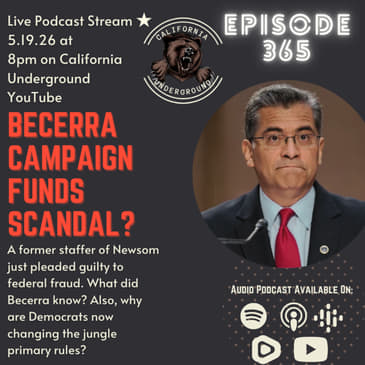
Newsom's former chief of staff just pleaded guilty to federal fraud — FBI wiretaps, a $225,000 scheme run through the frontrunner for governor's own campaign account — and Xavier Becerra still won't answer whether he knew. This week Phil and Camille break down everything Sacramento hoped you'd miss before the June 2nd primary.
In the first story, they walk through the guilty plea of Dana Williamson — Newsom's chief of staff from 2022 to 2024 — who conspired with Becerra's own chief of staff Sean McCluskie to drain $225,000 from Becerra's dormant campaign account. The investigation involved FBI wiretaps. Federal prosecutors originally came to Williamson seeking information about Newsom. And at the final governor's debate, Becerra still couldn't guarantee she couldn't connect him to the case.
Then: California Democrats built the jungle primary system. They benefited from it for years — two Democrats on the same Senate ballot in 2016, two Democrats again in 2018. Now that the system might lock them out of the November governor's race, they've filed an initiative to tear it down — and found Republican allies to help. Phil and Camille get into what ranked choice voting and other alternatives actually look like, and whether any electoral reform rushed through two weeks before a primary deserves to be taken seriously.
No team. No tribe. Just the receipts.
🎙️ California Underground drops every week. Subscribe so you don't miss an episode.
📖 Phil is also writing a book — The Gilded State. Early signup at www.thegildedstate.com
📬 Substack: https://caunderground.substack.com/📸 Instagram: @californiaunderground🎵 TikTok: @californiaunderground🐦 X: @ca_underground
[00:00:00] Gavin Newsom's former aide just pleaded guilty to federal fraud and the front-runner for the Democrats in the gubernatorial race for California still won't answer questions about whether he knew or not. And also we're going to be talking about how now because there's a threat that they might be locked out of the gubernatorial election, there's a push to get rid of the jungle primary just conveniently. We're going to get into that and all more on this episode of the California Underground starting right now.
[00:00:44] What's going on everybody? Thanks for tuning into another episode of the California Underground. I am your host Phil. We have two big stories to get to tonight plus a bonus story if we have time for it, but we're going to be focusing on this whole scandal with Becerra and Newsom's former aide Dana Williamson. We're also going to be talking about the hypocrisy of now trying to get rid of the jungle primary because it doesn't benefit Democrats and how it's creating strange bedfellows in California politics. But first I'm going to bring in my trusted co-host, the best of fastest reader.
[00:01:13] Researcher in the West back from last week. What's going on Camille? How are you? Good. I'm back. I'm alive. She's back. People were worried about you. There were prayers in the comments. People hoping that you got better. I missed you all. Well, I was in the chat. Yes, yes. You were there. You were here hanging out in the chat and stuff like that. So, um, all right. So we got two big stories tonight. Usually we have three, but tonight we're going with these two stories because I think there's a lot to unpack with both of them.
[00:01:41] And I want to give enough time to talk about both of them. Uh, this first story we, and I, again, I, we like to pat ourselves on the back for doing this, but we reported on this and talked about this.
[00:01:55] So six months ago in November, we talked about how Dana Williamson, who was the former aide of Gavin Newsom. She was like the top aide to Gavin Newsom for a while, got arrested or indicted for federal fraud, basically campaign finance fraud, because she was stealing money from Becerra's dormant account. And now she just pled guilty to a whole bunch of charges.
[00:02:21] We're going to watch a video and then we're going to break down what is exactly happening because now it's implicating the gubernatorial election. And so let's watch that video right now. If it looks. We begin at six o'clock with news from around the state and new at six. Governor Gavin Newsom's former chief of staff and Javier Becerra's former advisor, Dana Williamson, has pleaded guilty in the federal corruption case that rocked Sacramento.
[00:02:46] Seventeen's Capitol correspondent, Eitan Wallace, was in the courtroom today with Williamson and has a closer look at the penalties she could face. This is Williamson. Dana Williamson, walking out of court Thursday after she pled guilty to three counts in the federal corruption case that rocked Sacramento. Williamson, a longtime political consultant who served as chief of staff to Governor Gavin Newsom from 2022 to 2024,
[00:03:14] was accused of conspiring to fraudulently divert $225,000 from a dormant campaign account belonging to former U.S. Health and Human Services secretary and former California attorney general Javier Becerra and then working with lobbyist Greg Campbell to help funnel that money to Becerra's former chief of staff, Sean McCluskey. Mr. McCluskey, any comment? McCluskey and Campbell previously pled guilty in the case, and as of Thursday morning, so has Williamson.
[00:03:41] As part of her plea deal, 20 of the 23 original charges against her will be dismissed. She pled guilty to the three remaining counts. They are conspiracy to commit bank and wire fraud, filing a false tax return, and making false statements to the FBI during their investigation. Williamson's attorney, McGregor Scott. She's accepted responsibility today for what she did by pleading guilty. She's now a felon.
[00:04:05] As for why Williamson took part in the scheme to get the funds from Becerra's dormant campaign account to McCluskey, her attorney says Williamson was trying to help McCluskey, a longtime friend of hers who was struggling financially. She was trying to help a friend in a hard time. Mr. McCluskey was living on a government salary. Her wife was all with her kids, so he didn't have enough money. And that's where this all originated. And she was simply trying to help a friend in a pinch as best she could. Becerra.
[00:04:33] I've got to pause there because that might be the biggest pile of horse manure as an excuse for committing wire fraud or federal fraud or federal crimes. She was just trying to help a friend. I mean, the poor guy. It's a bit hard. I mean, her heart was in the right place. So, you know, she was just trying to help a guy on a government salary. And he wasn't making enough money. And he had a wife and kids at home.
[00:05:02] And he had to support them. And that's why, you know, that's why they had to commit these crimes. That's why they had to steal. Let me talk about that for a second. Well, you, sorry. Let me interrupt you. No, go ahead. I was just ranting about how it's kind of absurd that they're trying to use that as an excuse. But go ahead. But let's talk about the government salary part. So, I'm sorry. What was his official job title? What position? What was he?
[00:05:30] He was one of the chief of staff. Let me pull this up right now. A longtime chief of staff of Becerra. So, Becerra, who was the attorney general, he was the chief of staff for the attorney general's office in California. Right. But he was working in D.C., right? Wasn't that the thing? He was kind of like back. So, what was he doing in D.C.? The chief of staff to attorney general in California works in D.C.? It's possible.
[00:06:00] It doesn't say what he was doing. It just says he was his longtime chief of staff. He followed Becerra from California, Washington, when he became HHS secretary. So, I imagine he was a staffer, maybe a top aide, something like that. But he wasn't chief of staff. So, the facts are saying that he made more money as a chief of staff for the attorney general than he did when he went to Washington and worked for the HHS secretary. Okay. Okay. So, I know we're not going to get into this. I should have looked up his salary.
[00:06:28] I mean, if he's a federal employee or a state employee, it would be somewhere public. But there's a big argument here. And this is totally not tonight's topic. But if he can't afford to live on that salary while his family is living in California, then California, obviously, which I mean, we all talk about it, has an affordability crisis. But that should be acknowledged anyway. Again, not the point. But if he allegedly can't. So, sorry.
[00:07:00] Hold on. I'm looking this up because how do you spell this guy's name? I got to copy and paste. McCluskey. That's a lot of C's in the middle there. Gee. I'm looking this up right now. Let's see. Chief Deputy Attorney General. Woof. Yeah. As of 2020, he made in total pay $210,000. Total pay $300,000. That includes all the benefits of $90,000.
[00:07:29] And when he was first hired as Chief Deputy to the Attorney General, he was making $156,000 plus benefits, which came out to be about $212,000. So, he's making good money. That's not a shady salary. I mean, depending on where you live and how many kids you have, there's a budgeting here. Okay. Sorry. We're just getting into the weeds of that. And I know that's not what we intended.
[00:07:57] But I just feel like, oh, I was helping a friend who just couldn't budget, just like all of California. It's not an affordability problem there. His salary was good. Am I still here or did I just get kicked off? Phil disappeared. What's going on? Let me check the chat. Tell me, you guys. Am I here? Yes. Sorry. I'm checking the chat. Who's here? I'm on.
[00:08:27] But Phil's not here. Phil is gone. I don't know. Apparently, he's having an internet issue. Sorry. I always say my eyes are bad. And so I like zoom in. I'm going to get them fixed. I swear. So again, that was not the point of that whole story, because we're going to get into the fact that it was an inactive account that she was using to pay her friend from an inactive. The Syria account.
[00:08:56] And I have questions about that, too, because there's there's separate accounts. Like if he. OK, wait, is Phil back? I'm back. I don't know. That was weird. Something just completely. You here? Yeah, I'm here. I'm still here. OK. Sorry. I don't know why it kicked me off again. Anyway, where were we? Let's pull this back up and we'll keep going. We begin at six o'clock. We were about halfway through and.
[00:09:20] To McCluskey, her attorney says Williamson was trying to help McCluskey, a longtime friend of hers who was struggling financially. She was trying to help a friend in a hard time. Mr. McCluskey was living on a government salary. Her wife was all with her kids. They didn't have enough money. And that's where this all originated. And she was simply trying to help a friend in a pinch as best she could. Becerra, now one of the leading Democrats in the race for governor, has not been charged in the case and maintains he knew nothing about the scheme.
[00:09:47] In a statement Thursday, he wrote this, quote, as I said from day one, I was not involved. I did nothing wrong. And now the record confirms it. We can close the book on this. Any reaction to Javier Becerra's remarks in this case? Governor Newsom, also not implicated in the case, said he, too, knew nothing of the scheme. He reacted to the plea deal Thursday. It's hard. You know, I just think of her daughter. But also mindful of accountability. We're all going to be held to a letter of the law.
[00:10:17] Now the question turns to what consequences Williamson could face. First, she, McCluskey, and Campbell will be required to pay a combined $225,000 in restitution. Williamson could also face more than $1 million in fines. And under federal sentencing guidelines, she could be sentenced to a range between two and a half and three years in prison. However, her attorney says he will ask the judge to allow Williamson to serve her sentence in home confinement instead of jail.
[00:10:46] McGeorge School of Law adjunct professor Chris McKayley, who is not involved in the case, says by accepting a plea deal instead of taking the case to trial, Williamson likely avoided a much harsher sentence. Oh, of course it could be far worse because, remember, she would be ultimately tried on all 23 counts as opposed to the three that she's pleading guilty of.
[00:11:06] So if found guilty of all 23 counts by a jury, then obviously the punishment would be vastly in excess of what she might be subject to under the plea agreement. And Williamson's sentencing hearing is technically set for July 9th, but both the defense and the prosecution are moving to change that. Williamson's attorney tells me it's much more likely she'll be sentenced sometime in the fall. Reporting outside the federal courthouse in downtown Sacramento, I'm Etan Wallace.
[00:11:36] Now back to you. Good for her, I guess you could say. Okay, I have a question. Go ahead. And I was kind of starting to get to this. So a campaign account is what she used. It was an inactive account. There were still funds in it. So Baseria has multiple campaign accounts. Like, obviously, right now he's got the government, the governor 2026 account.
[00:12:07] And how did she access this? Like, he just gave her access? That's because different accounts, you're going to have different people working for you. I mean, if you hire the same person, because they did a great job last time, great. But it's like bizarre to me that she had access to this inactive account and was using funds.
[00:12:30] Um, well, I think it's because she worked together with, um, so it says, I'm looking at the SF standard right now. Let me pull this up because it has a little bit more information. Oh, I had a, um, a paywall. I couldn't read this one. Oh, did you run out of free articles on the SF standard? Apparently. Uh, prosecutors allege the money was funneled through consulting invoices for work that was not performed with payments directed to the wife of Sean McCluskey, who was Becerra's chief of staff in his cabinet role.
[00:12:59] They also say Williamson filed years of fraudulent tax returns, claiming deductions for handbags, jewelry, a luxury resort stay and private jet flights. McCluskey has pleaded guilty to conspiracy to commit fraud and is cooperating with prosecutors as part of a plea agreement. Lobbyist Greg Campbell also pleaded guilty. According to McCluskey's plea agreement, the scheme began after he took the chief of staff job under Becerra, which resulted in a major pay cut. Uh, so this is where it gets into about Becerra.
[00:13:26] This is why we're trying to tie it all into Becerra and what's going on with the gubernatorial election that's happening. Well, the primary is happening in two weeks. Remember two weeks next week, we're going to have our primary, uh, round table kind of final show about the primary in case you have any questions. It can be like a round table. We're going to have Kyle, Susan, going to be back. Um, we're gonna have our little round table talking about what's going on with the primary, uh, any thoughts, any questions. So if you have any questions, this is the time to do it. Can't promise we'll answer everything, but we'll try and do our best.
[00:13:56] Anyway, what did the fed say Becerra knew? He was public official number one, the owner of the account from the money, which was allegedly taken. Following the indictments released, Becerra confirmed that he was public official number one and said, news was a gut punch. But then he goes on to say, quote, if I had been involved, the U S attorney would have had me an indictment in that indictment already. I was not involved. Becerra said that's the tricky language.
[00:14:20] Um, so first to answer your question, it looks like they had this scheme where they were doing consulting invoices that were being funneled, I guess, to McCluskey's wife. Where they were saying that they were consulting the Becerra campaign, the dormant campaign, sending those invoices to that campaign, paying out through the campaign funds. And then sending it to McCluskey's wife.
[00:14:46] And then she was also somehow taking money out because she was buying, I guess she was using the campaign funds to buy all these luxury goods, private jet flights. Like those aren't cheap. How much money did Becerra probably have left over? That's the big question that he had. Yeah. They were buying private jets and luxury bags and all these trips and everything like that. Um, so that's the answer to your question.
[00:15:09] Uh, the other thing that's tricky about this with Becerra, and this is where language of politicians is very, very tricky because people like Becerra, who's been in politics. I didn't realize he'd been in politics for like 20 years. Like he's been in Congress for like ever. Um, so he's been around forever. He knows how to spin stuff and change it.
[00:15:36] He's saying I was not charged, which is not the same as I didn't know. Because he could say I wasn't charged. They didn't wrap me up in this. Doesn't mean he didn't know that this fraud was going on and that he was okay with it. Um, that's the really interesting thing here. And whenever they try to ask him about it, I know Steve Hilton pressed him on the last debate about it. What's going on?
[00:16:04] Uh, what, why don't you answer any of these questions? He won't answer questions about this because he's saying, uh, I wasn't indicted. There's nothing there to it. So it's tricky language on that part for him to do so. Uh, what are your thoughts? Yeah, somebody, I don't remember if it was McCluskey or Williamson, but one of them claimed he knew like he, they had permission or something.
[00:16:31] And so it is, it is obviously like a, his word versus her word kind of situation. I don't remember who it was. I watched a YouTube video on it earlier today and that's what they, they claimed. Um, and he's saying he didn't know anything about it. And now it, it is possible just not to defend him, but it is possible that he do nothing about it because he's not watching his accounts. He's, he's not paying attention.
[00:16:59] It's like, he's probably paying attention to the current government account campaign. But as far as like what's going on with another account that's inactive, I'm sure he like quit paying attention to that to a while ago. And it's just sitting there for him to transfer to his, you know, government campaign or something else if he wants or donate or whatever. So I'm sure if he wasn't aware, then he really wasn't aware because he just wasn't watching the finances on those accounts.
[00:17:29] Mm-hmm. I mean, it's a lot. Uh, someone asked in the chat, what, what happened to the funds if she hadn't stolen it? That's an excellent question because what happens with campaign funds? So you raise campaign funds and there's a couple of things you can do with them. This is why you always see people and politicians suspend their account or suspend their campaign
[00:17:56] instead of just ending their campaign because if they suspend it, it means it lives on forever and they just stop doing anything with it and it becomes dormant. Like what happened here with Becerra? That also means they get to hold on to the money. Um, my favorite example to use is Bernie Sanders. Bernie Sanders two times was notorious for running for president, raising millions and millions and millions of millions of dollars, suspending his campaign.
[00:18:22] Once the democratic establishment got to him and said, okay, that's enough fun for you. Like you're out. And then he was able to then transfer that money into any future Senate bids. So he can move that money around. Once you've suspended a campaign, you can take that money from a campaign and funnel it into a different campaign. Um, I believe you can also take campaign funds and funnel them into a pack as well. So a lot of people who suspend their campaign, uh, who was the other, another politician,
[00:18:52] one of our favorite politicians that we were part of exposing way back in the day was Kimberly Klasick. Um, she suspended her campaign for Congress out in Baltimore and then funneled all that money into a pack. After it goes into a pack, we have no idea what really happens to it. Uh, so that's what happens with this money. So if it wasn't stolen, it's not like the money just sits there forever. They could do something with it. You could refund people. So there's a couple options you can do. You move it to another campaign.
[00:19:20] You can move it to a pack, donate it to somebody else's campaign that you believe in. Um, or you can return money. I mean, that's basically the only things you can do with it. So you can't use it for luxury items and private jets and all of that. You can't use it to pay your wife because you're making one of our old cock off. Yeah. You can't use it to, um, pay your wife, buy these private jets, all this stuff. But those are the three things you can do with it.
[00:19:50] Um, it's, I'd like to say this is, I don't want people to think, all right, how do I phrase this? It's kind of a sweetheart deal that the feds gave her. And I wonder if, because they originally approached Williamson months ago, when they first approached her, they were asking questions about Becerra and Newsom. And if you know anything about common practice with law enforcement or the feds, when they
[00:20:19] have to take down cartels or mafia members or stuff like that, they go after the low level guys and try and work out some sort of plea deal and kind of put the pressure on them so that they start to squeal or rat on everybody else. I wonder if this was part of a bigger probe to get at Becerra or Newsom, um, because that they originally approached Williamson based on, did you know, did Newsom anything? Do you have anything on Newsom?
[00:20:49] And she said she didn't, which again, the fact that she says she didn't doesn't mean Newsom is not somehow implicated in this. I'm not saying he is. I'm not saying that he could like, he could be. I'm not saying that he is. What I'm saying is that because she said, I don't know, it doesn't mean that Newsom didn't know. Same thing with Becerra. Becerra saying I wasn't part of the indictment. I wasn't charged. It doesn't mean he didn't know. It just means he wasn't charged.
[00:21:16] And maybe they're trying to build by going after these three other, uh, co-conspirators and go after them and get them to plead and say, okay, you have to plead out and we're going to give you immunity. If you start to give us more information, are they starting to build a bigger case towards going after Becerra or a Gavin Newsom? Um, so they may act shocked. Becerra and Newsom are going to act shocked because they have to act shocked.
[00:21:45] They have to pretend like, how dare anybody do any sort of impropriety under my watch? I'm such an upstanding person. Um, coming from Gavin Newsom, that's kind of rich for him to think that there'll be no such thing as impropriety in his life. But yeah, that's basically sort of why this is so crucial or could be impactful on this gubernatorial race right now because she pled guilty just a couple of days ago.
[00:22:13] This was, I think the 14th is when she, she pled guilty. We're now at the 15th. So five days ago, she pled guilty. Um, I don't think this is going away that quickly. And if I'm going to rope in one more story and I want to get your thoughts, Camille. I want to rope in one more story that again, we talked about a long time ago that's probably still going on in the background is what's going on with the case with the Duongs and Rob
[00:22:40] Bonta, which may be why Rob Bonta didn't run for governor again or again, or he didn't want to run for governor is because he was under federal investigation or this is happening. And he spent something like tens of thousands of dollars on defense attorneys when he supposedly didn't do anything. He spent like $25,000 of his campaign funds on it. Was it that much? I thought it was like, I'll have to look that up. Uh, yeah. Let me look that up real quick.
[00:23:09] Let me get your thoughts on what you think about them, uh, about them maybe getting more information on Newsom and, uh, to answer your question, you were right. It is $468,000. That's a lot of money. He, from his two 2026 reelection campaign on legal services, after authorities question about federal bribery investigation involving Oakland businessman, David Truong Duong and Andy Hung Duong payments were sent to Silicon Valley law firm, Wilson, Sonsini, Goodrich and
[00:23:39] Rosati logged in campaign finance records as professional services, legal slash accounting. When asked about the rates, Bonte acknowledged attorneys were billing at 1000, 2000 and $3,000 an hour and said he may have had an audible gasp when he saw the final bill. Yeah, I, I, it's not even my legal bill. Um, I, I would, I'm having an audible gasp just looking at the fact that you paid 468,000
[00:24:08] on a supposed crime or, or case that you're not even involved in. So just questions. They just want to question you. So where $468,000 went, I guess when you have someone on the ropes, like a Rob Bonta and his whole political career might fall down around him, you can charge one, two, $3,000 an hour for these legal fees. Um, the other point I want to kind of come back to about this story outside of the fact
[00:24:36] that yes, Becerra is somewhat in the middle of this entire controversy. Newsom also in the middle of this entire controversy was his former top eight. Dana Williamson was often quoted as one of the most powerful people in Sacramento under Gavin Newsom, because she was kind of like a bully. And she just, she was just like a bulldog when it came to getting what she wanted. Obviously.
[00:25:02] I mean, she just got so brazen, um, that she just felt like she could do whatever she wants and she would never get caught doing it. Again, problem with a one party state is you get so emboldened by the fact that you, that nobody's holding you accountable. You can feel like you can do anything and get away with anything. I want to come back to this point about McCluskey said that he found it hard to live on a government salary for what he was doing. All right.
[00:25:31] So yeah, $200,000, $220,000 in pay, yearly pay in 2020. That's a lot of money. And I think a lot of people would do just fine living off $220,000, even in California. I think living off $220,000, you could live in California off $220,000. I know it's expensive to live in California, but $220,000, you should be able to live. I'd like to see what his salary was in Washington, which I'd find it hard to believe it was that
[00:26:00] much less for him to live in Washington. But maybe it comes up with this, this sort of resentment and anger after I saw Mike Johnson go to the podium and have this press conference. It's trying the blues about how they have to increase the pay of congressmen because they can't live off $174,000. It's just unfathomable. We can't live on $174,000. What do you expect of us? We can't live on $174,000. And I might be getting on my soapbox a little bit here.
[00:26:32] First off, $174,000 in most parts of the country is a lot of money to be making. It's a very comfortable lifestyle if you're bringing in $174,000. Maybe in California, it's not as much. But still, $174,000 in a lot of parts of the country. If you're a congressman, all of your expenses are paid for. Your flights, all that stuff is paid for. You get flown around the country. All of that's paid for. Best health care in the world.
[00:26:59] I mean, you get the golden double platinum Congress, pension, all that stuff. And they're crying the blues about that. They can't make it on $174,000. When everything that's going on in the world between inflation and gas prices and the economy, people are struggling out there. And for you to say like, we can't live on $174,000 sounds so incredibly tone deaf to Americans
[00:27:23] right now and to cry that you need to get $220,000 on top of everything else you're getting. Also, he advocated that, yes, they should be allowed to do insider trading as well. They should be able to make $220,000. They should be able to make $220,000 and also do insider trading because why not? They should be able to wet their beaks a little bit and do some insider trading and make some money.
[00:27:48] And that's why a lot of these politicians end up being worth millions and millions and millions of dollars after they leave office, even though they're on $174,000 salary. So it's kind of this tone deaf idea of like, we're on this guy. Oh, poor us. We can't live on these cushy government salaries. Those are good salaries. A lot of the country is struggling right now with affordability. And you're crying about making $174,000.
[00:28:15] Also, also, this is not supposed to be a career position. You're not supposed to. I don't think the founders intended that people in Congress were supposed to sit around and do this forever and ever and ever. This was not supposed to be your professional job where you're a congressman or a senator in office for 60 years. I mean, Nancy Pelosi has been in office for, what, 40, 40 plus years?
[00:28:41] And then you have people who are dying in office, who are senators, who literally will just like die in Feinstein. Just they won't give up power and they will die in office. So. If their argument and that attorney, I mean, he's got to do what he's got to do. He's out there in the front of the press trying to do his best to defend his client. Yeah, I think it's like if you serve 10 years, because that was the whole thing about Marjorie Taylor Greene stepping down.
[00:29:05] She waited until like the absolute deadline for her to get her benefits for the rest of her life. So she waited like a certain amount. I forget how long. I guess it's got to be 10 years. She was in Congress for 10 years. I don't know. It seems like a short time, but 10 years is still a long time to be in Congress. Yeah, they get benefits for the rest of their lives. They get a pension. You're getting a sweet gig. You're supposed to be a public servant.
[00:29:34] You're not supposed to be someone who lives there forever and gets this cushy salary and also is allowed to do insider trading. I don't know. It just it sounds so tone deaf to me that that's their excuse. It's this poor guy who was, you know, going from chief of staff of the attorney general in California to working in Washington under the health and human services secretary as his right hand man. Poor him that he can't live off of the money that he's making.
[00:30:04] I don't know. What are your thoughts? This is why people hate politicians because they're just so tone deaf right now. And this is why they have like the lowest. I think they're like 19 percent approval rating. I don't even know the people 19 percent. I'd like to ask the people who are 19 percent actually approving of Congress would be pretty interesting. Oh, let's see. Somebody said I just want to get to the comments. I'm from Oakland and currently make good money boarding up small businesses. That's probably a good business right now. So.
[00:30:35] Yeah. Somebody said don't forget me a Bonta in the stop Nick Shirley act. Yep. Yeah. We talked about that before. Whose money taxpayer? Yeah, this is all our money. So they're crying the blues about the salaries that are good salaries in a lot of the country. A lot of people would probably kill to have one hundred and seventy four thousand dollar salary. And they're just thumbing their nose at it because it's so expensive. Hey, it's not our fault that D.C. is expensive.
[00:31:05] That's that sounds like a D.C. problem. Maybe you should live outside of D.C. Maybe you shouldn't live in D.C. Maybe you should live outside of D.C.
[00:31:39] tonight's episode. So I'll definitely have to look into it because there's an interesting story about the lady who is also. I saw something breaking about Fiona Ma was also in contact with the CCP. Have you seen that story? I have to look that. So that's maybe we could do a whole episode on like Chinese spies in California. That would be a good episode. Maybe that should be the first episode after the primary because we have the primary roundtable next week.
[00:32:05] We're going to be doing the live primary results night on that Tuesday. So maybe we'll do the Chinese spies episode and kind of do a deep dive into how many Chinese spies are in California. All right. How many know Chinese spies there are in California? All right. Any other comments on Becerra? Okay. Final question. For the chat and for you, Camille.
[00:32:30] Do you think this has any effect on the gubernatorial race coming down to the wire? Yeah. I think unless there's something splashy like he's indicted, nothing will really happen. I think there's too much. There's a lot of smoke. They haven't found the fire yet in this story. But the reason we bring this story up is like why we brought it up back in November is because we want to talk about it now.
[00:32:59] So when this story does resurface, not just so we can pat ourselves on the back, but also so our listeners are informed and are like, oh, yeah, they talked about this on California Underground. They talked about Dana Williamson and Javier Becerra and Newsom and all this stuff because these stories have a way of evolving a little bit more. It was kind of like the Duong story. Like we had reported on the Oakland mayor being raided by the FBI.
[00:33:27] And then months later, it became like a story about Rob Bonta as well. So these stories like they have a way of they don't go away just because it's one news cycle. They'll come back. So that's why we do these. Will it have any effect unless there's a big indictment and he's kind of frog walked out of his house and there's video of him being frog walked? Is that was a frog walked out of the house? Then I don't think it'll make a big difference right now.
[00:33:55] We'll talk plenty about the primary and what our predictions are coming up next week. All right. Maybe that'd be great. Somebody said I haven't received a ballot yet. Has everyone else got one? Actually, do I have a ballot? Now that I think about it. I should have gotten my ballot already. Oh, yeah. My ballot's right here. Yeah. Ooh. Awesome. That's not good. All right. All right.
[00:34:25] Next story that I want to talk about because I found this story really fascinating because it just shows the political hypocrisy of how much people want to stay in power and will basically give up on principles or ideas. Once it doesn't benefit them anymore. What I'm talking about is the jungle primary. And if you don't know what the jungle primary is, I'm sure if you're engaged in politics here in California, you know.
[00:34:53] The jungle primary is an open primary. You can vote. It's the top two. Go on to the general election. This was put into place back in 2010, I'd like to say. Part of Prop. Yeah. It was part of Prop 14, which was a ballot measure. And they sold it. We're going to get into an old video. I dug into the archives to get this old video of their arguments.
[00:35:22] I wonder if we should just go to that video first instead of, well, actually, let's watch a little bit of the video that's reporting on this. And then we'll watch the video from the Wayback Machine. So we'll do that first. Let's see. 17 News is your local election headquarters. There is a new push to repeal California's so-called top two jungle primary system.
[00:35:48] Under the current rules, all candidates share one primary ballot regardless of party, and the top two vote-getters advance to the general election. Opponents say that can lead to same-party match-ups and potentially lock one party out. But now a bipartisan effort is underway to undo the system and return to a traditional primary where each party advances its own nominee.
[00:36:12] 17's Capitol correspondent Eitan Wallace spoke to proponents behind the repeal effort and shares their message. Primary ballots are out. And if you've received yours, you may have noticed it's a long one. For governor alone, there are more than 60 candidates from a range of parties, including these eight major candidates from the Democratic and Republican parties.
[00:36:35] Under California's current system, often described as the jungle primary, only the top two vote-getters, regardless of party, advance to the general election. That means the November election could feature a Republican versus Republican or Democrat versus Democrat, potentially leaving one major party out of the final race. You have to choose between two members of a party you don't believe in, and I think that's fundamentally unfair.
[00:36:58] That's why Democratic consultant Steven Maviglio says he's now pushing to repeal California's top two jungle primary system and return to the old format, where each party, including third parties, would send their nominee to compete against the other party's nominee in the November general election. That all changed, though, in 2010, when California voters narrowly approved the jungle primary system we have today.
[00:37:24] This has been an experiment that was supposed to moderate our electorate. It hasn't done that at all, and it's time to get rid of it so voters can feel good about going to the polls in November and voting for a candidate for a party of their choice. People want to have more choices. Former California Republican Party chair Ron Nehring is working with Maviglio on his efforts. Nehring says California has seen many legislative and congressional races where the November general election featured just two candidates from the same party,
[00:37:52] including the 2018 U.S. Senate race between then-Democratic incumbent Dianne Feinstein and Democratic challenger Kevin DeLeon. When many voters go to vote and they realize, I only have two Republicans or I only have two Democrats, people wonder, what type of crazy system is this? And where's my ability to vote for a different candidate of a party that I want? Still, the effort does face opposition. GOP Rancho Santa Margarita Assemblymember Kate Sanchez writing this in part, quote, this is not election reform.
[00:38:22] It's a power grab by insiders terrified of losing control. And Maviglio says the goal is to get this proposal before voters in November 2028, so we still have a while. Even so, it will not be easy. Backers of the proposal will need to gather hundreds of thousands of valid signatures to qualify it for the ballot. All right. I think that was the same reporter we had in the last story. Just goes to show you how small the local news media is. I think he worked for like three different news stations.
[00:38:52] Hardest working man in local California news. So, that gives you a little bit of background. I was going to read a little bit. Carl DeMaio also jumped in saying that he is going to help get signatures. I don't know how much that's worth, whether or not Carl DeMaio says he's going to pledge getting signatures. He's also, get this, another one of our favorites.
[00:39:18] He is working together or he is in agreement with Lorena Gonzalez. And if you know anything about Lorena Gonzalez, she's the president of the California Federation of Labor Unions, one of the state's most influential Democratic labor leaders. So, now she's also aligned as well with this effort. So, you have Carl DeMaio, Ron Noren, Steve Maglio, Maglio, Maglio, I should know how to say that. I'm Italian.
[00:39:44] And Lorena Gonzalez and all them who are aligning to get rid of this jungle primary, open primary kind of system. And the argument for it was, back in the day, that you wanted to increase more ballot access for different candidates. Because if you had an open primary, then the open primary allows people to vote for who they really want,
[00:40:10] whether it's across party lines, whether it's two Republicans or two Republican, Democrat, Independent, or whatever. But it hasn't done what it's supposed to do. So, yes, Carl DeMaio did get voter ID on the ballot. We've given him flowers for that and given him praise for that. So, good job on him for getting voter ID on the ballot. There's a lot of other things he's gotten signatures for, didn't get on the ballot. So, it looks like they're trying to get this for 2028, not anytime soon.
[00:40:39] So, it's not something that they're going to do now between now and the primary. There's nothing they really can do. Gavin Newsom did say something about he is planning on in case there is two Republicans that he has a break glass measure. I'm concerned what his break in case of emergency kind of measure is. Why he said something like that is kind of ominous.
[00:41:06] But, needless to say, you have prominent Republicans and prominent Democrats who are aligning to get rid of the jungle primary. Now, there's obviously two sides to this coin. One is I think Democrats got scared because there is a real potential that maybe they get locked out of this gubernatorial election. There's a real possibility. Corbyn asked, what is the break glass measure? I don't know. That's what's so ominous about it.
[00:41:36] It's kind of mysterious. I have no idea what the break glass measure is. So, I think it's one Democrats see the writing on the wall that maybe this is going to backfire in one way. It could backfire in terms of the gubernatorial. It could backfire in a whole different bunch of ways. I think Republicans see it as an opportunity to get back in the race where they've been locked out of so many races because of this jungle primary and the inability to even be on the ballot for the general.
[00:42:04] So, they couldn't even make like a good case or argument to be elected to some of these seats and try and flip these seats. It's hard to flip a lot of seats when it's always Democrat versus Democrat and you never get a Republican in there anyway. So, I could see why both sides are doing this. It's not because they're being altruistic in my opinion. By no means I think they're just doing it because they believe in democracy and access to the ballot. It's mostly because they're protecting themselves.
[00:42:33] I lost you there for a second, Camille. Do you have any thoughts? Yes. Well, unfortunately, I missed part of that. So, I hope that I don't repeat anything you said. But you raised accent points that I hadn't considered because I was very against this. And to me, this kind of felt like reminiscent of Prop 50 of we don't want Congress to, you know, be controlled by the right.
[00:42:57] And therefore, we're going to redistrict to make sure that California does its part to get rid of the Republicans. And so, that's where it's like now this is coming because they're afraid of the Bianco versus Hilton in the general. And therefore, they're like, oh, well, we need to change it because we can't have Republicans taken over. And it is kind of ridiculous because I do like the jungle primary, but you said some excellent points.
[00:43:26] And that does make me think, well, yeah, there are some districts where the only options that aren't two Democrats or two Republicans. However, if that's how the district votes. Yeah, it's. I was thinking about this a lot today and kind of brainstorming about it because there's a lot of arguments for both sides of why there was a jungle primary.
[00:43:49] And I want to show this clip from a long time ago about why they were arguing for and why they were arguing against this idea of jungle primary. I guess you could say, yes, an open primary opens it up because then it's just the top two vote getters and whoever's most popular.
[00:44:06] And yeah, if it's a red district, then they're going to get two Republicans and they'll get to decide between two Republicans, whoever they think, you know, then they don't have to feel like I just have to vote for this Republican or this Democrat because it's my party and I'm not really that excited about them.
[00:44:25] Um, yeah, it's I mean, that's one of the arguments of why there's parties is because, well, it makes it easy for people who are part of a party and then they don't really have to research that much because they just go, oh, well, when the party, when the election rolls around, I'll just vote for my party. Democrat or Republican makes it easy because it just categorizes everything.
[00:44:50] Um, the problem here in California is really if you got to show up in the primary and if you're not someone who's really that engaged in politics and you just want to show up in vote party, you could be surprised when you come around general election and it's just all Democrats all the way down or vice versa. It's all Republicans all the way down. Um, so it means you almost have to show up and do your research before the general. And that's the point of the primary. And that's why primaries are so important.
[00:45:18] We keep saying it over and over and over again, why primaries are so important. Um, yeah, I mean, yeah, it's not like it's done in secrecy. They spent a lot of money on the primary. Uh, all right. I want to show this video from about 14 years ago of them arguing over prop 14. Welcome back to news conference. Proposition 14 on the June ballot is a talker. It's about an open primary and will change the way you vote and could change the way Sacramento governs.
[00:45:48] With us two individuals to talk about it with the yes side on the left. Janine English. She's the president of the California, uh, AARP American association of retired persons. She's the co-chair in the SM 14 open primary campaign. And also with us is Keith Carlson, the treasurer of the California Republican party and no on 14th. Thanks very much for joining us. Um, thanks. Thank you for joining us. Uh, give us the rundown as to why you think this should, uh, A, it's on the ballot and why you think it should be passed.
[00:46:18] Well, uh, on behalf of the 3.2 million AARP members in California, we've recognized for a long time that politicians in, uh, Sacramento just are not listening to our needs and the concerns of the citizens. Um, we have a dismal, dismal, uh, approval rating of the legislature in the single digits at this point. And what this will do is it will give voters choices.
[00:46:45] It will give voters choices in who they elect and who they bring to Sacramento. How does it work? Basically what it does is it lets everyone that's going to be, uh, on the ballot be on the primary. And the voters get to, uh, vote for the person that most represents them. So instead of having the party bosses, the far right and the far left picking who gets to be on the ballot and there's basically no choice by the time you get to, uh, the general election.
[00:47:13] Right now, the voters will be able to look, they'll be able to choose the person, and then the top two will go to the general election. So Keith Carlson, the top. I'm not sure why AARP had to be on this panel, but her points are why they want to have the jungle primaries.
[00:47:35] There's more choices, but now you end up with something like we have now, which is you have a primary where there's 64 candidates for governor and you sort of end up with the same people anyway. It's not necessary. This idea, this pie in the sky idea of, oh, you get your choices. Sure. You get your choices. You can pick any of the 64 candidates that are on the ballot right now. Does it mean that they're going to move on to the general election? Not necessarily.
[00:48:03] As we've seen, there have been people like Elaine Collati, who was an independent who was on the show and she was blocked out of all debates. And yes, she's on the ballot, but does it give people more access? It seems like people are still in this two-party system. I appreciate that they are thinking about we want to give people more choices outside of the red team, blue team. But in reality, what you've done is you've kind of split it open and made it completely.
[00:48:31] I guess that's why they call it jungle primary because it's just kind of out in the wild. They've split it open. So now it's almost more confusing for people and they end up just voting for their parties anyway. So again, I'm not sure why AARP is on this, why her 3.2 million people that she represents are so concerned about it.
[00:48:53] Because now you've almost got a Sacramento legislature that really doesn't pay attention to people because they are in blue districts that will always have Democrats running and they will always have a Democrat there. They won't have anyone really challenging them for or pushing any ideas. Again, this argument goes back and forth because there's good points on one side and there's good points on others. Camila, do you have any thoughts about this AARP lady? Yeah.
[00:49:23] No. Before we go on to Mr. California Republican? No. Okay. The top two in the primary go on to the general regardless of party. So in a heavily Democratic district, you could have two Democrats, heavily Republican district, two Republicans. What's wrong with that? Well, if the idea is that we're getting choice, why would we end up in something where you have to vote for one of two people from the same party? And at the same time, it eliminates all write-in candidates. That's elimination of choice, not creation of choice.
[00:49:50] Yeah, you can vote for a million different people in the primary and whoever the two most heavily funded people are are going to move on to the final ballot. But in the final ballot, all of your third parties, all of your independents, they're all eliminated because you don't have the right anymore to have a place on that general election ballot. The general election is where we elect people to go to Sacramento, not the primary. So to say it's creating choice is an illusion. You're limiting the final ballot to two people, no write-ins.
[00:50:17] And in parts of Los Angeles and parts of San Francisco, you'll only have two Democrats to choose from. In parts of the conservative areas of the states, you might only have two Republicans. That's not increasing choice. But right now, the way it stands, the campaigns are waged in the primary, that you have extremely low turnover in the general election because the districts have been reapportioned so that one party dominates. If you had two Democrats, say, in San Francisco, you would conceivably have an establishment party Democrat and maybe a renegade Democrat.
[00:50:47] Would you not have a choice there? No, not if you don't want to vote for a Democrat, first of all. Second of all, they implemented this exact same system in the state of Washington. Guess how much turnover they had? Zero. You didn't lose any incumbents. Make some good points. Make some really good points. And that was something I also hadn't thought about as well is our current system, the primary, the way it works is it's the top two.
[00:51:14] So whoever wins this primary for gubernatorial election moves on to the next to the general election. And that's it. Those are the only two people you get to choose from. In a traditional election, you have the ability to nominate your people or people can win or they win this or this guy wins in the primary. For a Republican, this guy wins in the or gal wins for the Democrats.
[00:51:40] This person who's running on a post for the Libertarians or for Independence, they're running on. So you get more choices in the general because of the fact that it's just by party and whoever is on the ballot. It's not the top two people who are just going on. Now it's OK. It's the people who were nominated or got voted in by that party are going on to the general and you get to select at the end of it.
[00:52:05] And I think he makes perfect sense because it's almost like he saw 14, 16, 20 years in the future. Gosh, I can't believe that this video is almost like 14 years old. It looks like it's from the 90s. I still think the 90s is 10 years ago, but it isn't. It's 10 years ago. It'll always be 10 years ago in my mind.
[00:52:28] Yeah, he makes an excellent point that when you get to the general, what if you're a Libertarian and you get to the general and you go, well, I want to vote for a Libertarian candidate. There is no Libertarian candidate. Screw you. You have to vote for a Democrat like that's not choice like that's you're getting force fed to candidates you don't want. That's not more choice. And to your point, Camille, most people show up at the general.
[00:52:53] They don't pay attention to the primary and they show up at the general because of their and then they just vote for their party and they don't see their party on the ballot. They're just like, OK, well, I'm not going to vote. I'm not going to be a participant. No, no. What are your thoughts of these arguments from 14, 16 years ago? I honestly think that they both make excellent points.
[00:53:13] I know this was passed by Democrats majority back when it passed and Republicans were opposed to it. And now I feel like a lot of Republicans are opposed to changing it.
[00:53:30] But I do see both sides, you know, but then at the same time doing the with the top, the top two that still eliminates like the Libertarian Party. Like, why not the top three?
[00:53:49] And then if you're not if you don't like that, say you're a Democrat, but you don't like the person that went on to the general, then you have the opportunity to look at the Libertarian candidate. But I know we have too many third parties and like then that's just a whole other mess when it comes to the general. But it I feel like it does eliminate the opportunity for the Libertarians and other third parties.
[00:54:14] Yeah, I there's other parties in California that have relevance outside of Republicans and Democrats. Libertarians are one. I think of like the Green Party is another one that's very prominent in certain areas of California. And they're just they're blocked off. They just don't have access to being in the general. Now, does that mean they're necessarily going to win? Probably not.
[00:54:39] But it does at least put them on the ballot and it does at least make them a contender. Maybe going into debates, maybe if there's someone who gets a little bit of steam behind them, a Green Party or a Libertarian, and all of a sudden they're able to be a part of that debate going up to the general election makes a difference.
[00:55:00] But right now, and I think when he asked about, well, in San Francisco, you're going to get a lot of you're going to get establishment Democrats and you're going to get like more radical Democrats. OK, but these districts, even though they're super, super blue. Doesn't mean that everybody in that district is a Democrat. There are plenty. Who is that that one lady we liked in that video that that Asian woman in San Francisco with the MAGA hat? Winky Winky. Yes.
[00:55:30] Was that her name? Yes. She was like, she was a big MAGA supporter and she was in Chinatown. And like, just to go show you, there's like, there's people who are just not Democrats and they want to vote for who they want to vote for. They don't get that choice. So I think the, to put it bluntly, I don't think the choice argument really works anymore for the jungle primary.
[00:55:55] It, it definitely failed in that terms of giving you, it gives you a choice in the primary because you can choose whoever you want. It doesn't work at the end when it really matters, when you want to go to the polls and actually cast your ballot for someone who is going to be a part of that. Um, it'll be interesting if they get rid of it because they'll have to, Democrats will then have to.
[00:56:46] They'll have to do their arguments and actually defeat opponents. So, um. Wait, they can actually make this a federal, uh, law in California? Yeah. So that's how it is right. Like, it can affect. That's how it is right now. It's top two. That's why when it was, uh, Schiff versus, uh, gosh, oh my gosh, I can't remember his name now. He ran for. Garvey? Yes. Steve Garvey.
[00:57:12] That's why Katie Porter was whining about the fact that they were promoting Steve Garvey because they wanted it to be Porter versus Schiff. Because states, when it comes to federal elections, states have the power to run their own federal elections. So a lot of these federal races, you do end up with the same two top people. So they're going to have to accept that, that that's sort of the trade-off is now you're going to actually have to face off against Republicans.
[00:57:40] A lot of these, these districts or these races, whether they win, that's the other part. But it does mean that you will now have head-to-head Democrat versus Republican races going forward. And it won't just be, oh, it's just Democrats, Democrat, Democrat, Democrat, Democrat, Democrat. So, um. So this is, they're trying to get it on the November ballot? Uh, they're trying to get it.
[00:58:08] I think, I don't think they'll have for November. I think they're, the guy said 2028. So it won't be likely upcoming at any time soon. Um. Because they still have to get it. Yeah, the time to pass to get it on this ballot has passed. So I imagine they'll probably try and get it on 2028. I don't know why they don't. You can get it on 2027. There's elections every single year. You can have it as a proposition next year. Yeah, I mean, they can call a special election.
[00:58:39] Yeah, you can call a special election. I don't know if people in the legislature are going to want to vote for this or support it because they're, they're pretty comfortable with the way it is. There's a couple other things I wanted to bring up about Jungle Primary. We were a couple minutes over. This is why I said we had a bonus story, but we were going to see if we can get to it. Uh.
[00:59:01] So the arguments against Jungle Primary that I wrote down brought this up about party primaries, which helps because people don't necessarily always do their research. So they just kind of vote for their party. Uh. It does suppress general election turnout, which you've brought up on a previous show about what happens if two Republicans get through through the gubernatorial election. What happens if it's two Republicans?
[00:59:25] It's going to be a general election low turnout for Democrats because they're just not going to show up and vote for a Republican governor. So that opens the door for a lot of down ticket ballots, which affects a lot of other races. And that's there's a lot of other things outside of your gubernatorial race that's happening in your local elections that you have to pay attention to. Um. So. It forces candidates towards. Like as a Republican this year, that would be the dream. But. Yeah.
[00:59:54] I get how, you know, in a few years, the next election, if it's if that's a Democrat, then I'm like, wait, no. So. So, yeah, I do, again, see both sides. Well, people like you and me who are political nerds, even if it's two Democrats, we're going to show up and vote because we know there's so much other stuff. I mean, there's the billionaire's tax. There's the voter ID. There's a lot of things that are coming up here in San Diego. We've measure a where they're trying to tax second homes. There's a lot of stuff going on.
[01:00:23] But if you're just kind of a casual voter and you see there's two people running who are not your party, then you're going to go. Well, I'm not just going to show up. I'm just I don't care. But people need that vote. So. It's kind of hard to kind of get people from your party out. There's something else I want to say, but I completely forgot. Oh, I was looking at other alternative forms. Ranked choice voting, which is another idea.
[01:00:52] But that sounds way too complicated for me. And everywhere I've seen rank choice, rank choice voting doesn't really work. There's something else in Alaska they were trying called a final four voting. A nonpartisan primary where the top four or five candidates advanced. Then rank choice voting is used in the general. Alaska adopted this in 2020. It combines the open primary with a rank general. Theoretically capturing the benefits of both is the most intellectually serious.
[01:01:21] Interesting. Yeah, I don't think there's any really perfect solution to it other than parties. Just yeah, if you want to be on the general ballot, like a third party, like a libertarian green party, you just got to do better and just show up. That's just that's just sort of the the how the game is played. Let me hear your final thoughts while I check these chats and everyone. Thank you, everyone, for being in the chat. As always, we do this live 8 p.m. every Tuesday.
[01:01:50] We love people in the chat because it gives us gives us a ton of stuff to talk about. And we love seeing you guys chat and have your own conversation. So let me check the chat real quick while Camille gives me her final thoughts on the jungle primary. I kind of like what what Alaska is doing. But at the same time, I feel like that will still be too much because people will combine like how the primary versus general will work.
[01:02:15] They'll get they'll get confused about like, wait, how why are there now four people? Why? And yet there was 60 people last time kind of thing. Like, I don't know. I just feel like trending people who because, again, I think that most people are what what was the term? It's not below average voters, as I called them. But low, low information voters, low information voters, because I think the majority of people are low information voters. I could be wrong on that.
[01:02:43] But so when you have the primary and OK, so obviously, California is a huge and very diverse state, very populated. So I feel like if the primary and the general are run two different ways, people will just be confused. Like you would think that they'd eventually get the hang of it. But I don't know. Yeah. So again, I will see the benefits and the downsides of both of these things. Yeah, it's I don't know if there's any perfect.
[01:03:12] Perfect solution that opens more access to other. You just got to vote for different people. I mean, that's that's the thing. It's tough because the two parties have such a stranglehold on our elections right now that it is what it is for right now. But people who run these other parties have to do better and start registering and growing their parties. And well, this is where now that we're speaking to high intelligence voters, because we know
[01:03:41] our audience is that's why they tune in. You if you're whatever party you are, get involved with your candidates, donate, phone bang, door knock, you know, do your part to help promote that candidate and why you believe that they're the better candidate. Yeah. If you believe in a party, get involved with it. Media should profile all candidates, not just those with funds over the average man. Yeah.
[01:04:11] Yes. Yeah. I will. I'll give you some inside baseball of at least here on the show. Uh, we get a lot of people out of 64 candidates. We get a lot of people who want to be on the show. Um, and no offense to those people. A lot of people email us and email me and say, we'd love to be on the show. We want to talk about our gubernatorial race. And honestly, I look at their name and I go, I have no idea who you are, man.
[01:04:38] And like, maybe I'm part of the problem because I'm not allowing these people to speak. But, um, you know, you pay attention to politics and if they had gotten their name out there, had better messaging, whatever, then you would know their name. Like, yes, 60 names is a lot to memorize, but when they, you know, cause yes, we've had that reaction to some of these emails. Like, I'm sorry, who are you? What? Um, and you would at least have some sort of name recognition of it.
[01:05:08] But if they had some, if they had communicated better, got their messaging out there, got their name out, you, you would like, you know, which I mean, I guess that's how they're trying to do it. But also we've had these requests in the last week or two. And it's like, bro, seriously, you've had months to do this. People were declaring, I mean, Bianco declared back in February of last year, like you're just now trying to get on a podcast. You're just now trying to get your name out three weeks before the primary.
[01:05:38] There's not a shot. And so, yeah, like you said, they just, they need to do more messaging or whatever needs to do better. Well, it's kind of like why we had Elaine on, um, because even though she's independent, she got her name out there and she did a good job getting her name out there. And like, we research everybody. Oh, okay. So, you know, she was on Tim pool and she was on the Adam Carolla show and like, she was on these different shows.
[01:06:06] So we're like, okay, like she's got traction and that's why she was on the show. Um, we can't have everybody on there. There's, there's not enough time. We do a weekly show and there's 64 candidates. We wouldn't be able to, we'd have to do like round tables and have everybody on. Um, there's just no way. Mm hmm. Mm hmm. Yeah. You have to, you have to platform me. So, uh, someone said it in the chat. You got to make your name known because people have to associate with your message. Yeah. I think you got to get out there and make, make some noise and get some.
[01:06:35] And that's why they have polling. And that's why, that's why they don't allow all 64 people on the debate stage, because it would just be a, it'd be a cluster to have all those people on the debate stage. Um, and they have to kind of cut it off somewhere and being like, okay, you have to meet like this amount, like you have to do something. Um, so it's, uh, it's not a perfect system, but it is interesting that they are now trying to get rid of this because they came so close and it could happen.
[01:07:05] It still could happen where we have two Republicans running in the gubernatorial election. And if that happens, I'll definitely speed this up to try and get rid of the jungle primary. And it's interesting that they were such fans of it for almost 20 years. Now, all of a sudden, because it doesn't benefit them, they are totally against it and want to get rid of it. Uh, and speaking of moderate and radical Democrats in San Francisco, last comment before we have to hop off for the night, cause we're running out of time here.
[01:07:32] Uh, Nancy Pelosi, uh, or back someone that I didn't even know before she said who she was, she was pulling behind two candidates. Um, she was like the third place polling candidate and that's who Nancy Pelosi, she didn't endorse Scott Wiener, which Scott Wieners, someone should probably do a wellness check on him because he was probably thinking that he had this all sewn up at this point.
[01:07:57] So, um, but that's an example of the jungle primary is there are going to be two Democrats running for Congress in that district. And now one of them has Nancy Pelosi support, which means she's going to have all the money and power behind her. So you won't get to see a Republican face off against them. All right. Uh, someone said, will it be on tape? Oh, are you asking about, are you asking about the book?
[01:08:23] Uh, yeah, I, I don't know if it'll be on tape yet. That's a lot of work to make it on audio book for people who don't know. Big announcement was that my book, the gilded state is coming out this summer, probably late August. We're putting the finishing touches on it, editing, formatting, all of that stuff. Um, if you want to keep up with the updates, get some previews of free chapter previews and stuff like that, be, you know, let, uh, you be informed when it's going to be coming
[01:08:51] out, go to the gilded state.com, put your, in your email. I won't spam you with anything else. It's literally just for the book. So, um, go check that out. Uh, any final thoughts before we hop off for the night, Camille? Okay. Yeah. Thanks everyone for hanging out. Um, next week we will have our round table, our primary round tables to tune in. That one will probably go a little bit longer because we have a lot to cover and talk about, um, right before the primary.
[01:09:18] And then the week after we'll be doing the primary election results on that Tuesday night. And with that, make sure you like, share, subscribe, review. All of that stuff helps with the algorithm. And as always, the best thing you can do to support the show that is 100% free is share it with someone else who you think will enjoy. And with that, we will see you on the next one. Later.