
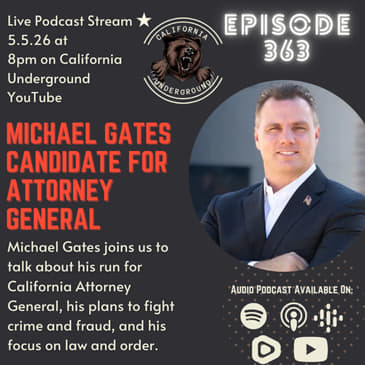
California's Attorney General race is four weeks from a primary — and most voters don't know what the office actually does.
In this episode, we sit down with Republican candidate Michael Gates, the former Huntington Beach City Attorney who spent a decade battling Sacramento in court and is now running to replace Rob Bonta as California's top law enforcement officer.
Gates made his name as an elected city attorney — not appointed, elected — who launched a criminal prosecution program that drove downtown crime down 11.5%, claimed a 60% reduction in homelessness on his watch, and won a $38 million court verdict against the State of California. He then joined the Trump DOJ as Deputy Assistant Attorney General before returning to run statewide.
We ask the questions every frustrated Californian should be asking: What has the AG's office actually been doing on fraud, fentanyl, and government accountability? Where has enforcement been missing?
California Underground airs every Tuesday at 8PM PST on YouTube.
🔔 Subscribe and hit the bell so you don't miss next week's show.
📌 Sources:
- CalMatters — 2026 AG Race Voter Guide: https://calmatters.org/california-voter-guide-2026/attorney-general/
- Ballotpedia — Michael Gates: https://ballotpedia.org/Michael_Gates_(California)
- Gates Campaign Site: https://www.gates4ag.com/
- AgNet West Interview (April 28, 2026): https://agnetwest.com/michael-gates-california-attorney-general-fraud-reform/
- LAist — DOJ Departure Story: https://laist.com/news/huntington-beachs-michael-gates-produces-letter-he-says-confirms-he-resigned-from-doj
Are you a Californian who feels isolated and alone in your political views in a deep blue state? Feel like you can’t talk about insane taxes, an overbearing government, and radical social experiments without getting a side eye? Then join us on the California Underground Podcast, the most trusted podcast on all things California politics.
Original air date 5.5.26
*The California Underground Podcast is dedicated to discussing California politics from a place of sanity and rationality.*
Check out our full site for more information about the show at www.californiaunderground.live
Join the Members Only California Underground Telegram —> https://im.page/7c0306da
For more in depth California political news coverage, make sure to subscribe to our Substack at https://caunderground.substack.com
Check out our sponsor for this episode, StopBox, by going to www.stopbox.com/californiaunderground to get 10% off your order
Follow California Underground on Social Media
Instagram: www.instagram.com/californiaunderground
X: https://twitter.com/CAUndergound
Tik Tok: https://www.tiktok.com/@californiaunderground?_t=8o6HWHcJ1CM&_r=1
YouTube: https://www.youtube.com/channel/UCj8SabIcF4AKqEVFsLmo1jA
Read about our Privacy Policy: https://www.spotify.com/us/legal/privacy-policy/
[00:00:14] Our guest as well as my trusted co-host, the best and fastest researcher in the West, Camille. Michael, how are you? Welcome to the show. Thank you for having me. So, before we get into this, why don't you give us a little bit of background about who you are and where you come from, stuff like that. Just introduce yourself to our listeners before we hop into our discussion.
[00:00:39] Yeah, thank you. So, a lifelong resident of California. I've actually lived in Huntington Beach nearly my entire life. Married almost 30 years, five kids, four grandkids. So, nice big family, very blessed. Ben, actually, I will tell you because we have a little bit of time in this program. I will tell you that I've been a lawyer for a number of years and I'll get into that in a second.
[00:01:01] But before I was a lawyer, actually, I was a professional artist for 10 years and a lot of people don't know that. So, I'm throwing that in today for your program as a special feature. I was a professional artist for 10 years. I did three-dimensional graphics and animation for various media, including TV commercials and video games.
[00:01:19] I did work for the original Xbox on Indiana Jones, Silent Hill, PlayStation, a variety of different programs and different content for different media. So, I did that for 10 years and then I decided to go back to law school. I first went into private practice here in Orange County, California, which is in Southern California. And that's where I cut my teeth as a trial attorney. And I became partner at that firm and then in 2014, I decided to run for city attorney of Huntington Beach.
[00:01:49] It's an elected position. So, I ran a campaign, got elected in 14. I got re-elected in 18, re-elected in 22. And then in 2025, I resigned from my post midterm in order to take a position with the administration back in Washington, D.C. And that's where I worked as the deputy assistant attorney general for the United States Department of Justice in the Civil Rights Division. So, I did that for nearly a year. And then I resigned from that post, came home to jump in this race to fight for California.
[00:02:18] So, that's basically it in a nutshell, although I have a whole host of experiences as an attorney. Actually, I tell people on the campaign trail that California has an opportunity now after years of not having a real attorney as the Attorney General of California to actually elect a real attorney for the state of California.
[00:02:39] I have tried many multi-million dollar cases at trial. I have a winning record of over 95% in court in my trials. I have argued cases in federal district court, the Ninth Circuit Court of Appeal, the State Court of Appeal. And I'm even admitted to the United States Bar. So, if called upon to argue before the United States Supreme Court in Washington, D.C. tomorrow, I could show up up here.
[00:03:07] I'm admitted and certified to make argument before the Supreme Court. So, I actually am a real lawyer. I've got plenty of credentials, have plenty of experience. And while my opponent, Rob Bonta, who's the incumbent, has spent years and years as a career politician before he was appointed as Attorney General, I was in court trying cases and practicing real law in court while he was a politician.
[00:03:32] So, there's a really stark contrast between his experience and his ambitions and my experience and my ambitions. And I think I'm very equipped to solve many of the problems that we're seeing in California. As the city attorney of Huntington Beach, for instance, we reduced crime by double digits by prosecuting aggressively. And now, Huntington Beach is considered in the top 10 safest cities in the entire state of California out of nearly 500 cities.
[00:04:00] So, it's a very elite, exclusive group of safest cities in California out of nearly 500 cities. And Huntington Beach is in the top 10 because we were tough on crime and we fought crime aggressively. So, it's a very, very safe city. Huntington Beach, excuse me, sorry. Huntington Beach is a, it's a very large city. It's the 23rd largest city in the state of California, again, out of nearly 500 cities. And so, there's a lot of potential for crime. There's a lot of issues.
[00:04:29] There's 200,000 residents and 15 million visitors a year. So, to fight crime and reduce homelessness too, like we did in Huntington Beach by over 60% is quite a feat. And we were able to do it by rolling up our sleeves and doing the hard work. We upheld and defend the rule of law and we maintained Huntington Beach is a law and order city in the state of California. So, very, very good marks on fighting crime and maintaining order in Huntington Beach. As you know too, we also have voter ID at Huntington Beach.
[00:04:57] We are a non-sanctuary city in Huntington Beach. We fought state overreach over and over. So, we have quite a record of fighting for everyday Californians and that's what I've done in Huntington Beach. So, my record speaks for itself and I'm ready for this fight and I'm looking forward to being the next Attorney General. I think your point about being an actual attorney is very important because I guess you don't have to be an attorney to be the Attorney General, right? Which seems kind of odd.
[00:05:26] Is that true or am I just… Well, it's a California constitutional reality that the Attorney General in California does not actually have to be a lawyer. Having said that, we haven't really had experienced lawyers as attorneys in recent memory. You go back to Kamala Harris, not an experienced seasoned attorney. She was a career prosecutor but she never spent really much time in court at all. And then you look at Becerra who is also a political appointment. So, Becerra was a career politician as well.
[00:05:54] He was appointed as AG and then he went and worked for the Biden administration. And then Bonta was appointed to succeed Becerra in 2021 and he, too, was a career politician. So, they may have JDs but they never really practiced law. And so, I've practiced a wide variety of law, constitutional law at the federal level, state constitution, First Amendment, Second Amendment. I've done housing, land use.
[00:06:21] I've done parental rights, elections laws, all kinds of law, environmental law, police use of force cases, defending police officers in court when they were sued for doing their job. So, a wide, wide variety of cases and I actually did that work myself. Even as city attorney, as an elected city attorney, I could have delegated or outsourced but I didn't. I rolled up my sleeves and I went to court myself and tried those cases myself.
[00:06:48] And so, I have a really good reputation in court and a great record on winning these trials. And I think it's important for people to understand before we really dive into your campaign and what your policies are. Or for people to really understand what the Attorney General, I mean, we all know the Attorney General is the top attorney. He does a whole bunch of things. What are like the top issues that the Attorney General tackles regularly?
[00:07:15] Maybe there's some stuff that people don't even know the Attorney General actually tackles. Right. So, it's the top law enforcement officer in the state of California. And that comes with a wide range of responsibilities. Specifically, I think people think that the Attorney General is just simply the lawyer for the governor. And that's not true at all. That's not true at all. Especially in California, the Attorney General has independent authority. I have purview. So, there's 58 counties in the state of California. 58 counties. That means there's 58 district attorneys and 58 sheriffs.
[00:07:44] And so, I have purview over all of them. And so, I will be working on a daily and regular basis with all 58 district attorneys and their departments, their agencies, as well as the sheriffs and their departments to make sure that we're tough on crime. That we reduce crime. California experiences a high level of crime. And you won't hear this from the incumbent Attorney General Rob Bonta, who's our current Attorney General. He likes to try to mince words or play games with the numbers and say that crime is not so bad.
[00:08:12] But California is ranked number 6th in the highest crime states among all 50. So, there's 50 states, obviously, in the nation. California is number 6th in highest crime. Which means we are a crime-ridden state. And we're one of the worst states when it comes to the rate of crime, particularly violent crime, against our communities and everyday Californians. And so, it's the job of the AG to fight crime and reduce crime.
[00:08:40] So, the reason we have high crime in California isn't because, well, it's just a difficult problem to solve. That's not it at all. I reduced crime in Huntington Beach by double digits. And now, as of 2017, when I was aggressively prosecuting crime at the city level, Huntington Beach is now in the top 10 safest cities in the state. So, we can take those methods and those approaches to the Attorney General's office. And we can make every city in the state among the top 10 safest. I know mathematically that's impossible.
[00:09:09] But every other city in the state of California can experience the same type of safety, security, low crime, and law and order that we had in Huntington Beach or that we have in Huntington Beach. And we just need a new leader in Sacramento as the Attorney General. But in addition to that, I would counsel the governor. I would call state agencies out for not complying with federal law. So, our schools, our education system, and our sports programs are not compliant with Title IX, for instance.
[00:09:38] In fact, our Sacramento leaders are encouraging little boys to enter girls' sports and young men to enter young women's sports. And that's going to come to an end when I'm Attorney General. On day one, I'm going to be writing an opinion and direction to all school boards and school districts and sports programs, notifying them of what Title IX is and what Title IX looks like and what compliance looks like specifically.
[00:10:04] And so, we are going to ensure that all of our sports and education systems throughout the state of California are compliant with Title IX and that we protect our young girls. So, we're going to get boys out of girls' sports, young men out of young women's sports. But in addition to that fighting the waste, fraud, and abuse that we're hearing about, you know, we're hearing nearly $500 billion of lost taxpayer money to waste, fraud, and abuse over the past five years. Well, that's up to the Attorney General to be investigating and to be prosecuting, to be putting people behind bars. I am going to do that on day one. I'm going to hold people accountable.
[00:10:34] Justice in my mind on this issue does not look like protracted investigations that lead to nowhere. What it looks like is swift and diligent investigations, putting people behind bars, and then clawing the money back. That $500 billion, claw that money back. So, find the islands, find the bank accounts, find the yachts and the mansions. Liquidate all that through the criminal justice system, through the process. Liquidate all that and then return it to the taxpayer. Now, we're never going to find 100 cents on the dollar, but even if we found 20 cents on the dollar,
[00:11:05] imagine how many thousands of dollars that would mean per taxpayer when we can get that back to the criminal justice system. But we're also going to be compliant with federal elections law, federal immigration law. We're going to be Second Amendment compliant. Every sheriff in the state of California is going to get a letter from me on day one, notifying them that they have to issue CCWs or concealed carry weapons permits within 90 days, or I will deem them in violation of the Second Amendment. So, I'm going to be very, very serious about the rule of law when I'm Attorney General.
[00:11:34] We are going to comply with all federal law, like I said, like Second Amendment, Title IX, Title VI, Title VII, First Amendment. You know, federal immigration law, the gamut. We're going to be compliant with all of those. We're not going to be fighting the federal government over whose rights as it relates or concerns federal law. The feds are going to be entitled to enforce the federal law, and the state has an obligation to comply with federal law, and we're going to enforce state law.
[00:12:01] So, the Attorney General, as you can probably gather from what I've said so far, and this is just a scratch on the surface. There's a lot of responsibility there. There's a lot of authority there. I'm also able to evaluate all of the regulations that are promulgated by administrative and regulatory agencies throughout the state of California, like AQMD, Coastal Commission.
[00:12:22] And if these agencies have promulgated regulations that are outside the prescriptions of law, outside of the strictures of law, that go beyond what the legislature has designated them to do, I get to be umpire and call balls and strikes.
[00:12:35] And if they're coloring outside the lines, if these agencies are going beyond the strictures of law and coloring outside the lines, I get to declare those regulations that they're enforcing against our everyday Californians, our everyday businesses, as void, as null and void, and that they cannot be enforced. So, that's the kind of thing, as Attorney General, I get to ensure that all state agencies, including regulatory and administrative agencies, are complying with all laws, and I'm going to do that. So, I'm just scratching the surface.
[00:13:06] There's a whole list of things that I'm going to work on. Reduce homelessness, reduce crime, compliance with federal law, election integrity, fighting corruption, the waste, fraud, and abuse, the list goes on and on and on. Mm-hmm. Can I ask your specific plan about reducing homelessness? Yes. So, in Huntington Beach, what we did in order to reduce homelessness by over 60% is we simply enforced the laws that are on the books.
[00:13:32] What we find coming from Sacramento is a bunch of excuses and exceptions, like, well, we can't really do this or we can't really do that because, and they basically hoodwink the public into believing that certain problems cannot be solved. What they're doing, though, is they're denying that the solutions are already on the books.
[00:13:53] We already have criminal laws, anti-vigrancy laws, anti-camping laws, anti-loitering laws, anti-public intoxication laws, a whole host of laws already in the books under state law, the state penal code that can be enforced and will be enforced on day one when I'm Attorney General. And I'm going to work with the Sheriff's Department. Remember, I said I have purview of all 58 sheriffs. They're going to get direction from me that we're going to go out and enforce all homeless laws, homelessness laws.
[00:14:18] We're going to get people up off the street because, look, no matter how you cut it, it's inhumane to lead people to die out on the street. They're not living out on the street. They're dying out on the street. You know, people like to say, well, you've got to let them live. You know, they're whatever. They can't live in a shelter or they've got addiction. Look, they're not living. They're dying. They're dying on the street. It's a slow death. We need to get them off of the street and get them into county services. There are 58 counties in the state of California.
[00:14:44] Every county has plenty of services and resources to fund the needs or to provide services for the needs of these people, whether it's mental health, food, shelter, even legal services, VA services. All of that exists at the county level. So you get people off the street into county services. And then just like we did in Huntington Beach in many cases, you actually end up getting them back home.
[00:15:10] There were often times where we were helping people get off of the street into county services and then ultimately back home where they came from. So it's very, very effective. But the thing is, is you don't throw millions or billions at it. You simply do the work. You have to roll up your sleeves and do the hard work to get people off of the street in the services and back home. Yeah. I saw that there was a 60% decline in Huntington Beach.
[00:15:37] You also back in 2017, you is, you started a criminal prosecution division, which helped lower crime in Huntington Beach. Can you describe how you spearheaded that and how you saw that? So that came after the passage of Prop 47 and 57.
[00:15:56] So in 2014, when every city throughout the state of California saw an increase in crime because of the passage of Prop 47 and 57, which were props that basically made crime legal, right? Things that people were doing. There wasn't really a punishment for, and there wasn't prosecution for. So every city around the state of California saw a massive uptick in crime levels in their city. And we saw that in Huntington Beach, too. Remember, we have 200,000 residents, 15 million visitors a year.
[00:16:25] So there's a tremendous potential for increase in crime in Huntington Beach because of the number of people and how big the city is. Well, we saw an increase in crime, too. And as city attorney, I was city attorney at the time. I didn't want to manage this crisis like other cities did. I wanted to attack the problem. I wanted to be proactive and actually have a real solution for the problem.
[00:16:47] And so I started in 2017, three years later, the city's first criminal prosecutor program, which means in the city attorney's office, we have a prosecutor who's actually prosecuting crime, quality of life crimes, dedicated to quality of life crimes. Now, in Orange County, there are 34 cities. Huntington Beach is only the second city in the entire county of Orange to then have a criminal prosecutor at the city level.
[00:17:14] So with that second layer of prosecution, because other cities and Huntington Beach, too, before 2017 was simply referring all of the arrests, all of the cases to the county district attorney for prosecution. But with the additional layer of prosecution at the city level, with the city level criminal prosecutor, we actually saw an enhancement in fighting crime. So like I said, in the first year alone, we reduced crime by double digits and then crime dropped precipitously thereafter.
[00:17:42] And now Huntington Beach is in the top 10 safest. So to your point, it's a long way of saying that one solution that I have as AG is in addition to, again, being tough on crime again throughout the entire system, all my 58 district attorneys and all my 58 sheriffs, is to also work with every city in the state of California so that they, too, can start their own city level criminal prosecutor program.
[00:18:06] Because when other cities, too, like our neighboring cities, if Newport Beach had a city level criminal prosecutor or Fountain Valley or Garden Grove or Westminster, if they, too, had city level prosecutors at the city level, then working with the district attorney to fight crime and reduce crime, we're going to reduce crime everywhere in the state of California. So there's a lot of different angles that we can attack this crime problem. And we can do this, you know, like I said, on day one, we can get this started on day one.
[00:18:35] That seems to be a big issue. And it's become more popular in the past several years, especially with Prop 36 and recalling Chesa Bodine. It seems like the soft on crime attitude has really it's passe now in California, which is crazy. I think it's passe California. But I think Californians are getting tired of this soft on crime. They want law and order. Are you seeing that out on the campaign trail when you talk to people like we just want our cities to be safe?
[00:19:02] We want those who are committing crimes to be held accountable. Is that what you're seeing out on the campaign trail? A hundred percent. And it's in the context of the violent crime that everybody's seeing on the street, including like the smashing grabs, the smashing grabs in our businesses, but the assaults on the street. But then also the corruption, sort of the what I guess what you could call is like the white collar crime. People want law and order in the state of California. They are absolutely thirsty for law and order in the state of California. So this comes up a lot. And we know this, too. There's proof.
[00:19:33] Proof of what the public sentiment is on this crime issue. One is Prop 36. Prop 36 was on the ballot in 2024 and it passed by 70%. That shocked everybody in Sacramento. Sacramento had no idea that it would be that popular.
[00:19:49] Prop 36 would be that popular, which essentially attempts to reverse a little bit of Prop 47 and 57 from 2014 by attempting to make crime illegal again in some ways, by adding penalties to drug-related charges and repeat offenders and things like that. It doesn't go far enough in my opinion, but it was a response to the high crime. And so it passed. 70% is very high in California.
[00:20:15] In fact, I don't know if you could point to another prop in recent memory that passed with that much support, 70%. That's one example. The other example is, like you said, Chelsea Boudin and then George Gascon of L.A., those two district attorneys, they got thrown out of office. I mean, Boudin by a recall and then Gascogne by losing a re-election, he should have easily won.
[00:20:36] And what happened there, we have two deep blue counties, probably two of the deepest blue counties in the entire nation, Democrats throwing Democrats out of office because of the crime issue, because of the current problem. And not that this is particularly partisan. Democrats, independents, and Republicans alike all want safe communities. They all want safe streets. They want their families to be safe and they want their businesses, their mom and pop businesses to thrive in safe communities.
[00:21:05] So it's not particularly partisan. But when you have deep blue L.A. and deep blue San Francisco, the people there throwing out their leadership because their cities and their counties are unsafe, that's pretty shocking. That's pretty telling. I think it speaks volumes. So crime is top of mind for a lot of people, but you have to add the corruption, the waste, brought, and abuse to that sort of discussion as well. Yeah. It was interesting.
[00:21:34] And when it happened, we had talked about it on the show, how that's kind of a cataclysmic shockwave through California politics to have two blue, deep blue counties toss out their progressive district attorneys. I want to talk about the current AG right now, Rob Bonta. And I guess we can throw in Becerra too because he's making this part of his campaign ad I just saw today about the amount of times that they're suing the federal government.
[00:22:05] And it seems like that's their hallmark. We sue the federal government. We put aside all this money so that we can keep suing Donald Trump. Looking at what they've been suing over, how do you evaluate this and what's your opinion on whether any of this makes any difference or is it all just political noise? Is it just political partisanship?
[00:22:27] Well, you know, the attorney general has an advantage on this discussion because he has the inside baseball on what is sort of behind the curtain on these cases. Right. So he has some information or some or some investigation that, you know, has revealed some information to him. And he's using that as a basis to sue. I'm not privy to all of that information. But what I can say from a distance as an outsider looking at these, he has weaponized the office.
[00:22:54] I mean, I'm just I mince no words when I say, you know, Bonta, the attorney general, Rob Bonta, was put into office in 2021 by Newsom as a political appointment after Bonta spent 10 years in the legislature as a career politician. So he was put there, installed there by Newsom as an appointment. Had Bonta run for that seat in a special election, he probably wouldn't have won, most likely wouldn't have won.
[00:23:21] He was put there. So he so Bonta owes his political fortunes to Newsom. And ever since he's been in office, he's been weaponizing the California Department of Justice. He's been filing these political lawsuits. The Trump administration is just one set of suits. Look at the number of parents he sued, the number of school boards that he has sued because the school boards are trying to actually do the right thing and protect their children with the curriculum and the school books and the materials.
[00:23:47] The Catholic hospitals he has sued because they failed or refused to perform abortions. He has sued hospitals, including a children's hospital, to force them to perform trans surgeries on minors. Why is our attorney general just recently filing brand new lawsuits to force hospitals, including a children's hospital, to perform trans surgeries on minors? All of these things are a weaponization. And frankly, it's an abuse of prosecutorial discretion.
[00:24:15] Rob Bonta, for political gain, is abusing his prosecutorial discretion. So when it comes to Trump and these lawsuits, you know, as an officer of the court, I would obviously have to evaluate each one on a case-by-case basis. But suffice it to say, if those cases, once I can evaluate them from the proper vantage point, if they're anything like what we're seeing with the suing of Catholic hospitals for failure to perform abortions against their moral code and the canon law and so on and so forth.
[00:24:43] And he's also suing hospitals, including children's hospitals, to force them to perform mutilations on children. I mean, if that tells us everything that we need to know about how he's picking and choosing and he's weaponizing the office for political gain, for what he thinks is political gain. I don't think he is. He's on the wrong side of these issues. Everyday Californians are against a lot of what he's doing.
[00:25:05] But I think the other point is that his focus on the Trump administration and his focus on these lawsuits just shows how out of touch he is. And everyday Californians, Democrats, independents, and Republicans alike, all feel ignored. We all feel left behind. We all feel like Sacramento's out of touch, including and particularly Rob Bonta. Why? Because we are suffering from high crime.
[00:25:30] We are suffering from high homelessness, high gas prices, high income taxes. And now they're trying to tax us per mile that we drive. We are all struggling and suffering here in everyday California. And they're completely out of touch. They're filing these lofty, weaponized lawsuits against the Trump administration. And he's out there saying he's protecting taxpayers. But those lawsuits haven't produced any fruit. He hasn't won anything in court. He just files and then takes a victory lap.
[00:26:00] He brags about what he's trying to do. But no court has granted him relief. He hasn't actually done anything. So it's a bunch of symbolism. It's a bunch of symbolism over substance. I would say anyone who is considering voting for him, I challenge you to find one thing that he has done to advance, to improve California with his lawsuits.
[00:26:51] Oh, my goodness. He's been interested by going door to door to these hospice and in-home health and daycare facilities and looking to see if those facilities really existed. Are children in there? Are medical patients in there? And every time he knocked on a door, there was nobody behind the door. Right?
[00:27:13] And so Nick Shirley was effectively an investigative reporter on the one hand, but he was also just an everyday American on the other who was trying to seek the truth on where his taxpayer dollars were being spent. And he learned about the fraud, waste, and abuse by his interest, his inquiries, his activism. And now they're trying.
[00:27:36] Mia Bonta, the wife of Attorney General Rob Bonta, with the help of Attorney General Rob Bonta, is trying to silence Americans and silence journalists. And that's an attack, just so the audience knows, that's an attack on the First Amendment. Not only our free speech, but also freedom of the press. It's a very, very dangerous road that they're going down.
[00:27:55] And how and why the Attorney General of one of the largest states in the Union is allowing this to happen and not admonishing Mia Bonta and not admonishing the legislature for allowing this to proceed through is absolutely shocking to me. This is constitutional law 101, and he's a complete failure at it. I actually have litigated First Amendment cases, not only free speech, but also the free exercise of religion. I've litigated First Amendment.
[00:28:26] I've dealt with Second Amendment. I have actually been in court and arguing all of these constitutional rights. And I've been doing it on behalf of citizens, everyday Californians. And yet we have a leader in Rob Bonta who's not protecting us. He's not protecting our constitutional rights. And so this is a tragedy in California. And I have also said this, too. And I'm not afraid to say this. California is lawless because of Rob Bonta. He is a lawless figure.
[00:28:55] He promotes lawlessness. He engages in lawlessness. And that's why I am running, because I've practiced in all of these areas. I have been a fighter for everyday Californians. I have been not only a trial attorney, but I've also been a constitutional lawyer. And so I plan to go to Sacramento as attorney general and return California back to a law and order state. It can be done, but it takes somebody like me.
[00:29:21] With Rob Bonta in office, California is headed down a very dark and dangerous path. It's interesting. When you brought up the Nick Shirley Act, that was going to be one of my next questions. Is the, if it wasn't blatantly obvious before that Nick Shirley comes to California, he exposes all this fraud. All of a sudden, everyone was talking about fraud in California. And then all of a sudden, you see Rob Bonta coming out with these press conferences. Oh, no, no, no. We've been on this.
[00:29:51] And we're announcing this new bust and stuff like that. And it's almost like it's too late now. Like, you've already been exposed as not handling this. It just seems like so, like, I'm just trying to CYA myself out of this. Well, don't forget that they first said it doesn't exist. Yeah. At first they said it doesn't exist. And then Rob Bonta comes out and says, they had this huge bust. We've been on this all along. Does that seem like to you, like, have they ever been on this?
[00:30:20] Or is this the fact that fraud has gotten so bad? It's just an example of how they've been asleep at the wheel on fraud. Yeah. No, that's a great example. Great, great question. And basically, the nearly $500 billion of waste fraud abuse, that captures what you're referring to, which is also those hospice locations, the fraudulent hospice locations. So the nearly $500 billion. So the nearly $500 billion is a figure that tracks five years. So the $500 billion ballooned up to $500 billion now.
[00:30:50] That's the current estimate over the past five years. Guess how long Bonta has been in office for five years? Yeah. So it literally has happened on his watch entirely. And it's happened on his watch. And I think Newsom knew it was going to be happening, which is why he put Bonta in office so that Bonta would provide cover for corruption. So I said that before, and I'll say it again. He's provided cover for corruption. And so, yeah, this is absolutely a problem that he owns.
[00:31:18] And his press conference, I will tell you, this is a little bit of inside baseball. Not a lot of people know this, so not that it's breaking here first, but I happen to know this, that when he announced that press conference, I think it was about two weeks ago now, where he found, he's saying he found 14 fraudulent hospice businesses or locations to the tune of something like $260 million. Okay.
[00:31:41] Well, he's a daily and a dollar short because we know from what the federal government's been doing just in the past month and a half, so not even that long, just the past month and a half, that there are over 440 fraudulent hospice businesses or locations in L.A. County alone. Right? So we know, well, yeah, there are hundreds throughout the state of California. They're in San Diego. They're in San Francisco. So the 440 that were found in L.A., that's also just a scratch to the surface. There are hundreds everywhere throughout the state of California.
[00:32:12] Yet Rob Bonta announced 14. Okay, the 14 that he found, you could find in the public record. That was not proprietary. There was nothing forensic about it. He literally lifted that from the public record and went in front of a camera and said, we are tackling fraudulent activity with these hospice locations. Now, what I think the audience doesn't know, and I'll connect some dots here, is a week before that. So if you go back a week before his press conference, polling came out on the attorney general's race.
[00:32:43] He, in this race right now, it's me versus him. He should be polling because we haven't even started our campaigns. The starting point for him should be, he's an incumbent in a state like this, in an office like that. He should be polling at 65%. His poll numbers were at 40. So he's below break-even by 10 points. He's at 40. That's panic time. He was at 40% support in that poll. And then a week later, he did that press conference.
[00:33:12] So the press conference only occurred because his campaign is in panic. His poll numbers are in the toilet. And he knows that he's in a lot of trouble. So that's why he did it. So it was a political, it was political theater from the jump. It was nothing more than pure political theater. It was not substantive. It was not meaningful. And like you said, it made him look kind of like an idiot. I mean, he found 14, or he says he found 14 fraudulent hospice locations.
[00:33:40] Yet we know, we know from what Nick Shirley has done and what the federal government has done, that there are hundreds throughout the state of California. So what is Bonta doing? Not a lot. I mean, it's interesting that it's been five years and we've seen a direct correlation with how much it's gone up. And well, I mean, he's got his own corruption to deal with as well with the Duong family over in Oakland. So that's a whole issue on its own.
[00:34:07] I want to pivot now to immigration, which is obviously a very hot button issue here in California. Because I guess if you want to be governor of the state, the only issue that matters, according to Democrats, is you're going to fight Trump and ICE and unmask him and all that stuff. You're taking a different path, which is that you are going to let ICE do their job and pull back on sanctuary state compliance.
[00:34:33] Explain to us as AG what your policies would be on sanctuary states and working with ICE. Well, it's really simple. The law literally dictates this. The federal law dictates this and even state law dictates this. That the state of California has to let the federal government enforce its laws. That's just the law. The fact that we have a sanctuary state law that's contrary to that is a constitutional problem.
[00:35:04] It presents a constitutional crisis. And that's why when I was attorney general, I'm sorry, the city attorney of Huntington Beach, I actually drafted two different lawsuits. One for state court and one for federal court to challenge California's sanctuary state law. And the federal case is still ongoing. It's up on a pew. So the federal government has exclusive purview, not only to have an immigration policy, but to enforce it. That's exclusive purview.
[00:35:32] That means no state, not California or any other state, can swerve into that lane. They have exclusive purview. It's under the supremacy clause. And so for the state of California to think that it can swerve into that lane or block the federal government from doing its job presents a constitutional crisis. So when I'm attorney general, we're going to go back to the days of allowing the federal government to enforce its laws.
[00:35:57] Not that we have to enforce them for the feds, but that they enforce their laws while we enforce our laws. And what you have is like we had under the Obama administration. You know, Obama deported like something like over 8 million people from the United States during his tenure. Okay. Okay. Well, tens of thousands of those were violent criminals subject to ICE detainers. Okay. Well, how did his federal agencies apprehend those individuals subject to ICE detainers and deport them?
[00:36:24] Because they went to city jails and county jails and prisons, and they transferred those suspects or those individuals from local custody to federal custody. And then the feds processed them and deported them. And it was all done peacefully and under the tight control of local authorities. It was peaceful. It was the peaceful enforcement of federal law as well as state law. The sanctuary state law has disrupted all that.
[00:36:52] And now it's saying, well, we can't keep these individuals subject to ICE detainers in jails or prisons. We have to push them out onto the street. Great. So then what do you have? You have the same presidential approach, the same federal approach as under Obama, going out trying to apprehend violent criminals subject to ICE detainers.
[00:37:11] But instead of it happening in the quiet, peaceful control of local authorities in jails and prisons, now it's happening out as a cat and mouse game in front of grandma's house out in the streets. And that's where the conflicts and the clashes and the violence comes in. So when I'm attorney general, we're going to get back to the days of peaceful enforcement of all laws. Let the feds do their thing and the state does our thing. And guess what?
[00:37:37] We are then very effective at getting the violent criminals off of our streets. And that's all we want. And, you know, for those in California who say, well, you know, you have to be concerned about the Latino community and immigration and profiling. No, no, no, no, no. If you pull the Latino community, they too want safe communities. They want safe neighborhoods.
[00:37:59] They're wondering why the politicians, the elitists in Sacramento are saying that somehow they should all be forced to live with violent crime in their neighborhood. Just so the politicians in Sacramento have good talking points when it comes to immigration and taking an opposite position of ICE. Like there's a lot of Latino communities who are suffering from high crime wondering, wait a second, how did we end up on the losing end of this deal? We're afraid to lose our home.
[00:38:27] Our businesses are shutting down because our streets are not safe. Our kids cannot walk to school without being, you know, maybe not at all, but certainly without a chaperone because there's violence on the street. They're wondering why they need to suffer from violent crime just so politicians can have their talking point and have their pretend posturing in Sacramento. Real quick, because you brought up the supremacy clause.
[00:38:52] I think I've mentioned it on the show before, but for our listeners, real quick, breaking down. So if they ever want to explain it to friends or family, explain why the supremacy clause matters so much in this ICE argument and break it down. So when you hear it, you go, these sanctuary state policies are stupid because they haven't read the constitution.
[00:39:14] So there are some areas of governance, particularly as it relates to immigration, that are reserved exclusively for the federal government. And as we know from constitutional law, those things that are reserved for the federal government are usually exclusive for federal authorities of federal government. And then all else is to be governed by the states, right? The 10th Amendment.
[00:39:40] But where the federal government carves out its role in its exclusivity, like federal immigration or national security or having printing money, you know, whatever the issue is, the federal issue is, that's exclusive. And so no state or locality can pass laws or enact laws that are contrary to federal law. You can't have a conflict between federal and state law.
[00:40:08] They have to coexist in harmony. So where the federal government and the federal authorities have legislated and they have their enactments, like federal immigration law, then that is supreme over all laws, hence the supremacy clause. And they have exclusive purview to govern, whether it's to have a policy and or to enforce that policy that they have. And so the supremacy clause is pretty simple.
[00:40:36] Now, does that mean the federal government can do anything at once and trump anything that any state does? Absolutely not. But under congressional statute, both the U.S. Constitution and congressional statutes that flow from that or succeed the U.S. Constitution, it couldn't be clearer that federal immigration is exclusively the purview of the federal government.
[00:40:57] Hence, the supremacy clause kicks in to allow the federal government to enforce its federal laws for which it has exclusive jurisdiction. So it couldn't be clearer. It's plain as day. And so it's these really far left elitists in Sacramento that are trying to blur the lines of constitutional law. Scott Wiener. Excuse me. With the federal, the ICE agents can't wear masks.
[00:41:27] Right. Yeah. That's absolutely ridiculous. It just blew up in their face. And now the law enforcement here can't wear masks. A couple comments in the chat that I wanted to read for you. Someone said, this Cherokee slash Choctaw Spanish California native wants crime-free zones for my growing children. So to your point, there are people who are in the Latino community who want safer neighborhoods. Someone, and I'm sorry to hear this, one of the users said they lost everything in the Eaton fire.
[00:41:59] Yeah. What is it? Is there a role for the attorney general when stuff like the L.A. fires happened? What is something that the attorney general can do? Can they investigate? Can they bring charges? Yeah. What can they do? A hundred percent. So Rob Bontis should have been on the ground on day one. The day one after the fires and when it was safe to get in there. He should have been on the ground talking to local authorities. He should have been investigating.
[00:42:25] We now know that we're hearing reports that State Farm and other home insurers canceled their policies conveniently a couple months before or within a couple months of those fires. And we're talking about the fires that occurred in the Los Angeles area in early 2025, in January 2025.
[00:42:47] Why is it that the insurance companies canceled the policies then and then were allowed to continue to cancel and not meet their obligations thereafter? There is a consumer protection division in the California Department of Justice. So under attorney general Rob Bontis, there is a consumer protection division. That should have been activated to be investigating and trying to ensure that homeowners were protected and that they were not being wronged by insurance companies.
[00:43:16] So that's on the one hand. On the other hand, we also have now learned from reports that Karen Bass and government leadership not only did not ensure that, I guess, first responders were properly equipped with fully serviced fire hydrants. And full or sufficient levels of water reservoirs.
[00:43:41] But also that she was playing politics with the response, that she was very hands on and she was diverting. We're hearing reports that she was diverting first responders to different areas, pulling them off of one area and sending them to another or whatever. Somehow she was monkeying with the response. So all of that kind of stuff should be investigated.
[00:44:02] And so, look, investigations in those type of situations where great loss has occurred and a matter of great public importance has taken place, investigations should occur. Now, at the end of it all, it may turn up that there was no wrongdoing, right? But at minimum, investigations should occur. And Rob Bonta waited a year and a month to announce an investigation.
[00:44:26] And if you look at the calendar, a year and a month to announce his investigation, his very first investigation into the fires in Los Angeles, that was February of 2026. Well, guess what happened in February 2026? That was a month after I announced my campaign to run for attorney general. So every time he shows up with a camera and a report about how he's being tough on crime or investigating some wrong, it's literally in response to something political. It's literally timed.
[00:44:54] It's coincidental with something political. There's a couple of questions rolling in, so I want to get to them before we end for the night. Someone asked, how do we strengthen our local elections when Democrats do not believe in ID laws, tabulation processes, and then counties like L.A. or places like in L.A. passing laws to allow non-citizens or illegals to vote? So L.A. hasn't passed that law yet. It's been raised.
[00:45:24] It's been introduced, proposed. But it hasn't happened yet. What I think Californians need to know in this election is we need to have more confidence in this election, I think, more hope in this election, more hope in terms of the integrity of this election than we have in recent years. And here's why. I worked at the California Department of Justice last year. We sent out a number of letters to different states about cleaning their voter rolls.
[00:45:49] I sent a letter to California myself when I was there because I was responsible for enforcing federal elections laws and making sure that states had clean voter rolls. I not only sent a letter to California to that effect, but then I also sued California to that effect, that California clean its voter rolls. That was my lawsuit. California actually has been cleaning its voter rolls now. There's nearly three million people have been removed from the voter rolls. So that's one issue. There's two other important issues.
[00:46:19] And then there's a couple other circumstances, I think, that are helpful for this election. One is President Trump signed an executive order basically dictating to the United States Postal Service what it can and cannot do with regard to the mail-in ballots. So he imposed a tremendous amount of restriction on what can be done and then he outlined what should not be done with regard to the handling of mail-in ballots. That's really, really important. That was by executive order.
[00:46:48] And that should be in effect for this election. And then finally, there's a U.S. Supreme Court case that should be coming out with a decision any day now. I say any week, certainly by the middle of June because that's the end of the U.S. Supreme Court calendar. That basically addresses what is Election Day. It's the Watson v. Republican National Committee out of Mississippi. That's the Fifth Circuit case. It already went up to the U.S. Supreme Court on argument earlier this year. And now the decision will be coming out.
[00:47:17] We anticipate, all of us who have done election law, anticipate that the U.S. Supreme Court is going to side with the concept that Election Day is Election Day. That, frankly, will devastate California with regard to our system when all of the bad actors try to do what they do after Election Day to sort of slip or change the results of elections.
[00:47:37] Now, without commenting on the specifics of that type of conduct, we know that if the U.S. Supreme Court sort of draws a line in the sand and says Election Day is Election Day for everybody no matter what, that California won't be able to continue collecting, producing, counting and counting and counting for weeks and weeks and weeks after Election Day. So there's a reason there to be hopeful in the process or in the election systems.
[00:48:05] And then you add to the fact that voter ID is going to be on the ballot in November. It's got something like 85 percent approval. Just in California alone, Democrats, independents and Republicans all agree that voter ID is a good idea. And so we're anticipating it to pass here in November. But what is that going to do to voter turnout for the good guys, the people who believe in voter ID? They believe in the law. They believe in election integrity.
[00:48:30] That's going to drive turnout sort of for the good guys on election integrity and for the rule of law. So there's a lot of things in my mind to be hopeful for this election, not just for the outcome of the election, but for the integrity of the election. I think right now we're going to have a different set of circumstances for the election, including the U.S. Supreme Court decision that comes down, cleaner voter rolls, so on and so forth than we have had in recent years.
[00:48:58] So I have every hope that this year will be better than years past. That does sound promising. Thank you. Yeah, that does. We're big cheerleaders of you have to get out and vote. So many people get really down on the voting here in California. We're like, no, there's reasons to vote. You have to show up and vote. Nothing will ever change if you just say it won't change. Another question is, summer is around the corner. What is Mr. Gates' policy if he is presented?
[00:49:27] I'm assuming you win and become attorney general. If you were presented with a 2020 summer of love situation while in office. I'm not sure what the questioner means by that exactly. So I think it's in reference to, you know, back in 2020 with there were massive riots, unrest.
[00:49:56] It was, you know, it was scary for normal citizens. There's a lot of protests. Yeah, I get you. I get you. I think the impetus to those, though, was COVID hitting. There was just a lot. Everything in our society then was skewed. COVID hit in March of 2020. At least the, I guess, the pandemic scale of COVID occurred here in the United States in March of 2020.
[00:50:22] And then we had a lot of issues with George Floyd and BLM and Antifa. And so there was a lot going on. And so, you know, buildings were burning. There were riots in the street. But it seems to be a COVID era issue. Now, having said that, moving forward, what I will say, and hopefully this is what the questioner or the listener is getting at,
[00:50:47] excuse me, is when it comes to free speech, free speech means you can stand on the corner on the sidewalk with a sign. Free speech does not mean that you can shut down freeways and take over small towns. So when I'm attorney general, I am going to work with the sheriff's department and their deputies and make sure that we cover California and wherever there are problem areas or hotspots.
[00:51:13] We're going to make sure that the First Amendment is enforced as it was intended to be. What we're not going to do is allow people to step into the street, block traffic, take over freeways, shut down intersections. That's not going to happen. Why? That's criminal behavior. That's criminal conduct. And we're going to prevent that from happening in the first place. And, you know, we may have situations where Karen Bass and others say, no, you've got to let it happen. It's not going to happen.
[00:51:40] Even if we have to, you know, if I have to work with the governor to bring in state troopers, if you commit a crime, you're going to jail. And we're actually going to be on the ground, boots on the ground, to prevent the crimes from happening in the first place. People can exercise their First Amendment, but that means get on a corner with a sign and stay out of the street and don't burn stuff. Right? So if that's the question, you know, that's my answer. We're going to be, when I say rule of law, I'm not kidding around.
[00:52:09] When I say law and order, I'm not kidding around. No, I think that was exactly the question is if you're in office when issues like that and maybe what was it last year, the L.A. riots or the L.A. protests were probably a better example, closer analogy. Someone in the comments said, tell Michael Gates he has my vote from Solano County. So seeing some support in the chat. Thank you. Last question, which I'm sure a lot of our listeners, as well as myself, I'm a Second Amendment guy.
[00:52:40] I am a card-carrying, carrying-concealed guy. California hates people who exercise their Second Amendment. I'm tired of looking at unconstitutional laws that even though the Supreme Court comes out with the Bruin decision, California is like, nope, screw you. We're going to try and take away your Second Amendment rights anyway. What would you do differently about the Second Amendment and would I have to worry about losing my ability to carry and conceal if you're an attorney general? Right.
[00:53:09] So Bonta has been an enemy of the Second Amendment his entire life, and I am going to reverse that and be a friend of the Second Amendment. I own guns as well. Well, and regardless of where you are on the spectrum of, you know, lover of guns, a fanatic of guns, whatever, look, everybody should be a lover of the Second Amendment anyway because it's our Constitution. It's our constitutional rights. So even if you don't bear arms or if you're not, you know, totally into that culture, that's fine.
[00:53:38] But everybody should be supportive and embrace the Second Amendment. We should all be defenders of the Second Amendment because it's our constitutional rights. And so what I'm going to do, I mentioned earlier in the program that when I'm attorney general, I'm going to tell all of my sheriffs, all 58 of them, that if they're not issuing concealed carry weapons permits within 90 days, they're in violation of the Second Amendment. I mean it. And there's not going to be any wiggle room on that. And there are many counties that are compliant with that. They issue CCWs within weeks.
[00:54:07] But then you have L.A. County, for instance, who takes nine months to three years to issue a CCW. And that's after thousands of dollars spent by the applicant on fees and then hours and hours of training. And then they practically never get their CCWs. And oftentimes they just give up. They don't. So that's got to end because government cannot stand in the way of our constitutional rights. Now, I say that example because it's an easy example for people to kind of pick up on and kind of figure out where I am. Like, oh, OK, I get it.
[00:54:36] I understand what CCWs are. And I understand when he adds that threshold for what a Second Amendment violation would be. I get it. But the truth of the matter is there's a whole lot to Second Amendment compliance in the state of California. There are lawsuits that are currently engaged in by the attorney general to try to take our Second Amendment rights away or to diminish them or cancel them.
[00:54:57] I am going to be tackling those lawsuits, probably dismissing those lawsuits or taking a reverse position in court when I'm in office. But then there are also state laws on the books that basically are so onerous, so burdensome that they are violative of our Second Amendment rights. But I'm going to go through that's going to be a project I'm going to go through with my team of lawyers on a case by case basis, because there are going to be some laws on the books in California that are completely violative of the Second Amendment and others that might be offensive, but they're not totally violative.
[00:55:27] Maybe portions of them are. And so we're going to evaluate each law on a case by case basis. And we will be making recommendations to the governor on what should be done. And if there is a law that is completely contrary to federal law, the governor can take a position to suspend the enforcement of that law because it violates federal law.
[00:55:46] But if there are other laws where they're not violative of federal law exactly, that might be offensive to our sensibilities and our sense of freedom, but they're technically not violative, but there are portions that need to be amended, then the governor can work with the legislature to amend those laws. So, you know, that needs to be dealt with on a case by case basis. But suffice it to say, I'm a big Second Amendment proponent in large part because I am a gun owner myself. I believe that other people should own guns.
[00:56:13] But just as much as anything else, I'm also a lover of the law. I'm a constitutionalist. And the Second Amendment happens to be a constitutional right. So I will defend it. Sounds good to me. I mean, I'm a Second Amendment guy. Sounds like kind of the wishes I'm hoping for for an attorney generalist to stop infringing on my right. All right. We're coming up on the hour. I don't want to keep you all night. Chat is loving this.
[00:56:41] So why don't you let people know where they can find you and support you in this race? Thank you very much. If you go to my website, Gates4AG, that's Gates4AG.com. That's my website. But you can also find me on social media. On X, I'm Michael Gates, E-S-Q. That's Michael Gates, E-S-Q for Esquire. And then on Instagram, it's Michael.E.Gates. Michael.E.Gates.
[00:57:09] So you can find me on X, Instagram. You can search for me on Facebook. And then go to my website, Gates4AG.com. So any support that anybody can offer. I know a lot of people, even from other states, I have donations that have come in from 40 other states outside of California because the nation knows how screwed up California is. And they want a change in our California leadership.
[00:57:32] So if there's any support anybody could offer by clicking on my website, clicking on the donations page, that would be incredibly meaningful to me and very, very much appreciated. The campaign is strong. Like I said, Attorney General Bata's polling numbers are in the toilet. I am right there with him. I think with some spending on some advertising with my campaign later this year, we are going to win this election for sure.
[00:57:58] I have actually raised almost a million dollars because so much, there's been such an outpouring of support. I've raised almost a million dollars just since January. So I want to keep this momentum going. Anything that your audience can do to get involved in the campaign, help support, go to my social media, follow me, repost and follow, repost and follow, repost and follow. That would be huge. Thank you so much. Yeah. And just a reminder to everybody. Yeah, go ahead. Sorry, Camille. Before I. Sorry. I feel really honored that you wanted to come on this podcast and talk to us.
[00:58:28] And so thank you so much for being here. I know I didn't say much, but you said so much, which was great. It was fantastic. So thank you. Really appreciate you being here. Those are always the best guests when we get to listen to them and learn a lot more than us. We talk without guests. We talk enough. So it's nice when we have guests and we don't have to talk as much. And just a reminder for everybody, June 2nd is the primary. It's coming up in less than a month. It's coming up in several weeks. So don't skip the primary. Make sure you get out and vote for the candidates.
[00:58:58] Four weeks. You want four weeks, less than four weeks. But my mail-in doll arrived yesterday. So people are already starting to vote. Yeah. So make sure you get out there. If you're a fan of what Michael said tonight, make sure you get out there and vote for him in the primary. And same with all your politicians that you support. Because they have to make it to the general past the primary. So with that, I just want to say thank you again, Michael, for being on. And if you like the show, make sure you like, share, subscribe, review.
[00:59:24] And the best thing you can do to support the show that is 100% free is share it with someone. And tell them to come join us at 8 p.m. live on Tuesdays here for California Underground. We'll see you on the next one. Later.