
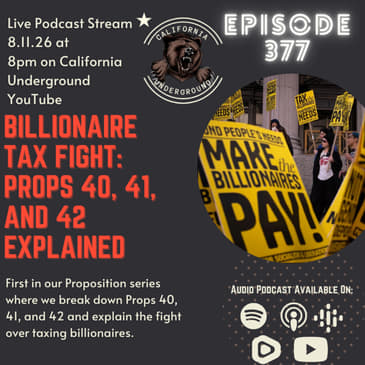
California's billionaire tax is on the ballot this fall — and almost nobody fighting over it is who you'd expect. The state's own nonpartisan analyst won't back the $100 billion revenue number the sponsors are citing. A 1979 law from the same tax revolt that gave California Prop 13 has been rewritten as a legal kill switch aimed squarely at this measure. And the single largest donor bankrolling the opposition moved his residency out of state months before the tax could ever touch him — then spent $82 million fighting it anyway.
This week, Phil and Camille pull the actual ballot language, the Legislative Analyst's fiscal review, and campaign finance filings to lay out what Propositions 40, 41, and 42 actually do, and who's really lined up on each side.
For more on the systems behind California's politics, Phil's book The Gilded State is available now.
If this show is useful to you, following and leaving a review helps more people find it.
🔗 The Gilded State: www.thegildedstate.com🔗 Full sourcing and documents: https://caunderground.substack.com/📸 Instagram: @californiaunderground🐦 X: @ca_underground
[00:00:00] Tonight you've heard about the Billionaire's Tax, but have you heard about the two propositions that are also set up to kill the Billionaire's Tax before it even gets started? We're going to be talking about those propositions and what it means to stop the Billionaire's Tax, even if it does pass. We're also going to be talking about how unions usually use these ballot propositions to bargain the way into what they want in the end anyway. We got that and much more on tonight's episode of our first of our Proposition Series Explainers happening right now in California Underground.
[00:00:46] Well, what's going on everybody? Thanks for tuning into another episode of California Underground. Tonight is our first in our Proposition Series where we explain what is happening with all these propositions. We go over them, give you more information so you can make an informed decision about them, including tonight we're gonna be talking about Props 40, 41 and 42 about how they all have to do with the Billionaire's Tax. Two are set to stop the Billionaire's Tax even before it gets off the ground if it gets voted in. It's a very important thing to do with the Billionaire's Tax.
[00:01:15] It's a little complicated, but we're gonna get through it. So without further ado, I want to bring in my trusty co-host, the best, the fastest researcher in the West, Camille. How are you doing tonight, Camille? Well, I would say that complicated is an understatement when it comes to these propositions because you gave me a brilliant show breakdown yesterday that I have read over and over and I'm like, well, I'm gonna be asking a lot of questions.
[00:01:39] So yeah, this was a little bit of a tricky one because even I kind of looked at it and was like, it took me a little bit. I had to look through the outline over and over again. I had to watch some videos. I had to look some explainers. There's something called the GAN limit, which we're gonna talk about in a little bit and what the heck that is. There's these two propositions that I just looked into, 41 and 42, what they are supposed to be all about.
[00:02:05] But first, we've talked a lot about the Billionaire's Tax already. So let's just jump into exactly what Prop 40 does. And we've already talked about it. We've talked about ad nauseum. We've had people on. It's one of the most important, I think. So here's what is Prop 40. So Prop 40 is the Billionaire's Tax. I'm just gonna read it to you.
[00:02:27] It would require the estimated 200 Californians whose net worth exceed $1 billion at the start of this year to pay a one-time 5% tax. Service Employees International, SEIU, Unite Healthcare Workers West. They're the group sponsoring the measure. And they would project it would raise roughly $100 billion over five years. So it would be earmarked primarily for healthcare with some reserve for food assistance and education.
[00:02:54] And just for clarification, those categories make up about, I don't know, 80% of our budget. So that's basically our entire budget is what they're planning on raising this money for. And they're expecting $100 billion. The LAO has the estimate much, much lower than that.
[00:03:13] I think they think it's gonna be closer to, I think, like $40 billion, if that. But they're also projecting that if it does pass, the long-term effects of this is that you're probably gonna lose about a billion dollars in revenue every year because you're, guess what? You're pushing a lot of these billionaires out.
[00:03:33] So you're gonna be losing revenue because that top 1% or even 0.1% or whatever that you wanna say that are the billionaires that they're going after, you're gonna push them out. They're gonna take their revenue with them. That's who California relies on for a lot of their taxes is this higher up kind of threshold of earners. So that's where we're at with this.
[00:04:00] Real quick question. Does that, that LAO estimate, did they factor in not only just the possibility of these billionaires leaving and then that revenue going, but their businesses as well as employees who would possibly leave with them who are obviously paying state taxes? Like, I'm wondering if that was even factored into all this probability. Probably. They didn't see that in the notes. Sorry.
[00:04:27] I mean, they're probably estimating just the billionaires themselves that are going to leave and their income tax revenue. I don't think they even, cause that's gonna be like a complicated estimate to say, okay, if these billionaires leave and all of their businesses leave and all that leaves, how much is that? I mean, so we're conservatively thinking if these billionaires leave, it's unexpected. LAO is pretty good with their numbers. They're a nonpartisan office in Sacramento.
[00:04:55] So they look at the numbers and everything and they say, okay, here's what the numbers actually are. Not what Gavin Newsom or the Democrats in the super majority say it's what they actually sit down. They're the bean counters who figure it out. So conservatively they're putting at a billion dollars is going to be lost every year from here on out. If they pass this billionaire's tax. And I guess you could extrapolate it to say, how much are we going to lose if these businesses leave?
[00:05:22] Because then that's even more income tax that you're losing because workers pay income tax. People pay state taxes. They don't have to be billionaires. So if all those people leave and all those jobs leave, that's more tax revenue that's going out the door. So just aside now, I want to thank everyone who's in the chat right now. I see everyone who's hanging out in the chat. Thank you very much for hanging out with us tonight. We got a lot to go into. So if you have any questions, make sure because there's probably going to be questions. I know Camille has questions.
[00:05:47] So we're going to do our best to get through all of this. So, all right. Going over a little bit more. There is something that I want to correct from before. Because last week we were talking about the billionaire's tax and we were talking about how like real estate in your house and could be in this. That was a hypothetical of they can amend this later on. And we've brought this up numerous times is that they can amend this.
[00:06:16] The legislature by a majority vote can go ahead and change what is the parameters of this and say, okay, it's no longer a billionaire's tax. Now it's a multimillionaire's tax and we're going to change what we're going to be taxing. So they can amend the whole thing whenever they want with a majority. And since Democrats have a super majority, it's not really hard to do. They're basically giving themselves a power to tax in perpetuity.
[00:06:42] Things that are going to be taxed are taxes, stocks, business interests, and investments. It excludes real estate pensions and retirement accounts. So it does exclude real estate because real estate can't leave the state. So I guess they're saying we're not going to tax you on your real estate holdings, which for a lot of people is a good part of their net worth is real estate, especially if you're rich in California. Real estate is a huge part of that. Retirement accounts and pensions. Because I know I ranted last week.
[00:07:12] I was like, just because I own a home in Orange County, like somehow, you know, but so my whole rant last week, disregard that, which no, that's a huge relief. I mean, as of right now, sure, but it doesn't mean that they can't change it later on. They can't amend it. So that's sort of what's going to happen, I think, is if this passes and it doesn't get prevented by these other two propositions we're going to talk about. It could just kind of filter down to people one way or another.
[00:07:39] So 90% of it is constitutionally earmarked for health care or the rest of education, as we talked about. So what makes this different from a normal tax height? So everyone pays income or spending. So basically, like we said before, everybody pays an income tax. You work in California, you're paying an income tax. You spend, you buy anything here in California, you're paying a sales tax. So those are the two taxes that we all pay for. You buy gas, you pay a tax. Those are things. Those are consumption taxes and income taxes.
[00:08:09] This is a wealth tax, which is assessed on what you own and not what you earned that year. And right now, there is no state in the entire United States. California would be the first one to ever enact a wealth tax like this. Of course. It says they tried to do this in 2023 with AB 2088, but it died in committee. I wonder why, probably because it was unpopular and politicians knew it was unpopular.
[00:08:40] So this is the first time this would have ever been done. And obviously, this is going to be fraught with like legal challenges. How do you do this? Retroactive taxes are usually unconstitutional. You can't go back in time because imagine if you set that precedent of now we can go back in time and say, oh, well, you were worth this much back then. So we're going to tax you back, you know, what you were worth that long ago. So it's going to be a unique tax never done before. And again, this is the SEIU.
[00:09:09] If you don't know anything about the SEIU, they are up there with the California Teachers Association in terms of unions that are, in my estimation, two unions that are absolutely ruining the state. The two of them push their own greedy policies that don't usually end up helping any of their union members. Again, California Teachers Association not saying anything about teachers. Teachers are wonderful people. They work very hard. It's the California Teachers Association that I have an issue with.
[00:09:37] And this is even a smaller chapter of SEIU. The national chapter is not completely on board with this at all. So SEIU is kind of going rogue on this. And it makes sense that SEIU, this Unite Healthcare Workers of West, is pushing this because 90% of it's going to go to healthcare. And how did we get in this position to begin with? Well, Medi-Cal went broke because Gavin Newsom signed an order that allowed every illegal immigrant, no matter of age, it was at over a certain age and under a certain age.
[00:10:07] Now it's regardless of age, any illegal immigrant can go on Medi-Cal. It broke the system in 11 months. And then now SEIU is turning around going, we need more money for Medi-Cal and for all these government healthcare programs. So we need to tax the billionaires. As opposed to maybe we shouldn't let everybody in the world come to California and use our government subsidized healthcare. So that's the background of it. I don't know if anyone in the chat has any questions or I'll, Camille, what are your initial
[00:10:37] thoughts or questions before we get into the nitty gritty of what's going on here? Well, my thoughts are still just like, why are we so, well, I know why, but when it comes to these taxes, why do we seemingly want to punish anybody for making a certain amount of money? I just, I don't understand that mindset. I understand Democrats broke California. I mean, like financially they broke California and now they're trying to fix it with overcorrection.
[00:11:04] But I still just don't understand this, like tax the rich, the rich, tax the rich. Like we forget that the rich do actually do a lot of stuff for the economy. And I mean, as we discussed, obviously these billionaires, they could leave their, they could take their businesses. And we forget like to acknowledge while we're so busy screaming, tax the rich, that they are quite literally providing so many jobs.
[00:11:29] While right now, California does have the highest unemployment rate in the entire country. And it's like, why do, why do we want to further this? I don't, why are we punishing anybody for, for what they're actually providing and making it harder for them to provide this? And so, so then what, so sorry, cause this is not the whole purpose of this podcast, but then when our unemployment goes up because these billionaires take their businesses and leave.
[00:11:55] And then now there's all these, like the people that decided to stay in California, because it's not so easy to just pick up and leave, you know, if they couldn't leave with the company, now they're just unemployed people who have to go on unemployment. And like, that's just what another system of the government that we're going to break and find somewhere else to tax somebody because we have to take care of now these unemployed, these additional unemployed people. It's just like never ending. And they never look at one year, five years, 10 years, 20 years down the road.
[00:12:22] They just are like, oh, this is such a great idea to fix this issue that we decided to create. Let's now break this and create another issue that we, you know, off of what we already created. I just, I wish that they would like think ahead. Well, I keep mentioning this book by Henry Hazlitt. It's the economics and one lesson. Definitely go check it out because government and politicians never think farther ahead. To your point, you're absolutely correct that politicians always make these decisions
[00:12:52] based on the here and now, and they don't think about this long term. And you're right. I, I a hundred percent agree with you that you give government. It's like, if you give a mouse a cookie, sooner or later, they're going to want a glass of milk. And then it just kind of progresses from there. So children's book, if many of you don't remember that book, there's a great book. Yeah. Maybe that one's easier for some, maybe we need to send that to all the Democrats. Maybe we need to send a whole bunch of them up to Sacramento and be like, here, if you give a mouse a cookie, here's what happens. You ask for more.
[00:13:19] And that's exactly what happens is the government asks for more money. They say, okay, well, we just need this much more money and then things will be great. Will they be great though? Because it seems like no matter how much money you give the government, it always runs out of money and it always overspends. And California is constantly in the red and they always have to balance the budget. And every year, basically, I think since COVID we've had a budget deficit.
[00:13:46] And the reason since COVID is because we were flush with all that federal stimulus money that they said was a surplus, that we had a hundred billion dollars surplus, but it was really just all that federal COVID money. It seems like no matter how much money you give this government particularly, or the government in general, they just keep spending and they keep asking for more. So your point's absolutely correct. Yeah, they keep pushing. And last week on the show, we watched this video of this Rodriguez Kennedy guy,
[00:14:15] who's the chair of the San Diego Democrats, kept pushing that this is a one-time tax. I don't know why you guys are so mad. This is a one-time tax for people who can just give a little bit more, just give more, you know, give a little bit more, 5% of your overall net worth. What was his point again? His point was- Save lives? It was save lives. And I don't think that people are, you know, billionaires aren't going to do it because it's really hard to move and billionaires don't want to move. It's really a pain in the butt for billionaires to move. So they're not going to do that.
[00:14:44] But yeah, you're absolutely right that they just keep asking for more and more money. And then what's the next thing that's going to happen when they overspend and use up all this money that they, in a hypothetical world that I hope doesn't happen, if they get this money and they spend it all, there's obviously going to be another tax. Like this isn't the one-time tax. It's never going to be a one-time tax. So it's kind of like the, I think some of these, was the gas tax supposed to be temporary to fix the roads or something like that?
[00:15:12] That was before my time, but it's always a promise. Yeah. So many, so many years ago. And then the thing is that they'll just expand the program. Like, well, we need this for healthcare. Okay. But then they're going to say, well, now we need this for, like, we need to expand healthcare. We need to include X, Y, and Z in healthcare. We need this for education. Okay. Well, now education needs to include this. And so they're just going to keep piling on the taxes because these things just get ballooned
[00:15:39] and ballooned until they're these like all-inclusive. Like, I just, we have given so much to the government and not financially, but like our freedom. And even, you know, there's, we don't tend to talk about Trump here a whole bunch or presidential issues, but there's in the, what was it just yesterday, today, Trump signing that, like the mandatory vaccine schedule, something about that where I forget exactly what it was.
[00:16:06] I homeschool, so I don't have to follow the rules, but something about like parents can sign exemption papers or something. And I'm like, why we're giving parents permission to parent? Why, why is this a government issue at all? Why did we ever hand over any, any of our parenting to the government? Again, not the point of the show, but that this is what we do. We, we allow the government to have control of this, that, that, that, you know, give a mouse cookie, give them an inch.
[00:16:36] They take a mile. And it's just like, why? Anywhere, any, how, how did adults, adults voted somehow give control of parenting to the government? And that baffles me beyond anything. Nobody should have to sign an exemption form to, to not like to opt their child out of vaccines or not following the government vaccine schedule or whatever. This is not an anti-vaccine argument.
[00:17:04] This is a pro parenting argument. This is an anti-government argument. This is an anti-mandate argument. If you want to go and vaccinate your children times 10 with all the vaccines, that is up to you. Those are your kids. You're doing the best you can. Again, hooray, go get your little punch card and, you know, get your free vaccine at the end of your 1500 vaccines. Do what you want. I don't care, but don't tell me what to do with my kids. Why? Like, again, the government just needs to take 65 steps back because this has gotten so
[00:17:34] ridiculous. Again, not the point of tonight's podcast, but this is my point. Here we are. Because we gave the government permission to be here. Somebody asked, is Prop 40 a Trojan horse? I think it is because they can change the tax. I think that's a perfect way to put it. It is a Trojan horse. That people are going to, they're going to sell it. It's a one-time tax on the billionaires. And with the popularity of the democratic socialists rising in America, I was just watching some
[00:18:00] of the primary results from around the country and like Wisconsin and stuff that I think there's more democratic socialists are winning their primaries. It will stick with a lot of people. Somebody said, I'll only vote yes on the tax if they remove state income tax. And I don't think they'll do that. Texas doesn't have state taxes. We only have federal taxes. Yeah. And Texas also has a part-time legislature. They only meet every other year. So good on Texas.
[00:18:28] I wholly think we don't need a full-time legislature, but we've discussed that before, that I don't think California needs a full-time legislature. It just makes them want to pass more stupid bills. I'm looking at some people checking in from Sacramento, San Diego taking a break from Reno for a while. So, all right. San Diego is a good place to do that. San Diego is a good place, although it's been humid down here. But I imagine compared to Reno, I bet San Diego feels like an absolute paradise down here.
[00:18:55] As opposed to us, San Diegans, us soft San Diegans who are like, oh, it's a little humid and it's 80 degrees. But all right. Going back to the revenue. So I was talking about SEIU, the sponsor, projects that the tax raises about $100 billion over five years. Because the way it's structured is if you are still a billionaire who is here at the time of January 1st, 2026, that's the deadline. So a lot of billionaires have moved out.
[00:19:24] Sergey Brin is one that we're going to talk about. But there's been a ton of billionaires who have left already because they're like, oh, I'm not going to risk this. So I'm going to get out and not have residency on January 1st, 2026. They will, you know, the legislature or not the legislature, I would say the proposition authors, SEIU, they're not all heartless. They will give you five years to pay this off. So you don't have to pay it all in one lump sum. It's very nice of them that. Interest free?
[00:19:52] It doesn't say anything about there will be interest, but it does say that they can pay it off in five years. So you don't have to pony up right away when it goes into effect, if it does go to an effect 2027. So it's very nice of them that they can do that. Do you think some of them will like, I don't, I mean, this is kind of a stretch, but do stuff to then start filing for bankruptcy? I don't think so.
[00:20:17] I think that's, it's too hard to file for bankruptcy with that many assets. You have to go to court and prove that like you don't have any assets or you, you're just so underwater, you can't pay stuff. So I think the smart thing that a lot of these people are doing is they're moving their residency, they're moving businesses, they're moving stuff out of state already, which a lot of billionaires have done. And if they're still here, I imagine they're probably going to sue the pants off the state if it does pass. Let's see. Somebody's checking in from Elk Grove. What's up?
[00:20:47] Elk Grove. A lot of Northern California people. Thanks for checking in NorCal to us, two SoCal people chatting. Let's see. Some of the other numbers. We talked about this, a loss of a billion dollar a year in income revenue. That's the LAO again. So again, they're saying it's a hundred billion dollars that they're going to bring in. That's SEIU that I think they're overselling it. LAO says it's going to be about tens of billions of dollars. So way off, not really close.
[00:21:14] And they're even saying very hard to predict because it depends on stock prices and billionaire behavior. So you have these two claims. You have the LAO, which is saying, eh, it's going to probably bring in about tens of billions of dollars. SEIU is overselling it at a hundred billion dollars. And we already said that it's going to lose probably a billion dollars in revenue every year. So the tax base is actually getting a little smaller every year. So good on you, SEIU. And we also talked about this excludes real estate because it's the one thing that can't leave California.
[00:21:43] So basically they're not taxing you on that because you can't take real estate with you from California. Probably there's also an implication with Prop 13 or something like that. They're probably trying to stay away from that in terms of taxes on property. That might be a whole thing. So that's basically Prop 40, 5% billionaires. You get five years to pay if you're still a billionaire here and that's what's being taxed. So that's the roundup on that.
[00:22:11] If anybody has any questions, the next step is I want to talk about, I was saying I said love your show, by the way. Thanks. Thanks, Andrew, for saying that. Love when people give us a comment and give us some nice compliments. Love to hear that. Any other final thoughts before we move on to the two props that are like poison pills to kill Prop 40? Let's get into those. All right. Let's get into these because these are complicated.
[00:22:38] Now, anybody in the chat, feel free to just let me know. Did you know about Prop 41 or Prop 42, which are essentially the anti-billionaires propositions? There are two propositions that opponents of the billionaire's tax got onto the ballot quietly. I didn't even know these were actually happening until I started to do research on this. So this is actually news to me as well.
[00:23:02] These two propositions are set to undo or nullify Prop 40 before it even goes into effect. So basically Prop 40 can pass, but if Prop 41 and 42 also pass, it not... Go ahead. Question. You said and, but this is or. Or was emphasized in the show notes. Correct? Yeah. Because, well, they do two separate things. So one attacks... Right, but it doesn't have to be...
[00:23:31] They don't both have to pass, right? No, no, no, no. No, no, no. I should... Yeah. Sorry. Good clarification. Yeah. They don't both have to pass, but passing 41 or 42 does help nullify Prop 40. Both of them together almost completely nullify Prop 40. So if you never heard about these and you want to oppose the billionaire's tax because you think that a bunch of California socialists are going to run out and vote for the billionaire's
[00:23:58] tax, please pay attention to this because this is really important that you should know Prop 41 and 42 so you can educate people who are out there what Prop 41 and 42 are. So if you go to... Another quick question. Yeah, go ahead. Do we have the wording on these yet? Because we're not talking about the voter ID tonight, but the voter ID has been like... That's all controversial right now with the way that it's being worded because we want 41 and 42 to pass. Is that a yes vote? Do you know?
[00:24:28] It says, let's see, prohibits new state taxes that exclude revenues from state spending limit requires audits for new state specials taxes initiative constitutional amendment. So that looks to be the title of Prop 41. And then there's Prop 42, which if you go down to the ballot text, prohibits new state personal property taxes and certain retroactive state taxes initiative constitutional amendment.
[00:24:55] So those sound like actually fair proposition titles. They're actually accurate as to what they do. They're not skewed one way or another of like, if you vote for this, you hate like immigrant children or something like that. And we're going to kill all the puppy dogs and not give you ice cream sort of proposition. All right, let's start with Prop 41. So Prop 41 requires audits of new tax programs. Basically, here's the summary from CalMatters.
[00:25:23] If you are not sure about any proposition, you can go to CalMatters. They're probably the most unbiased source of information for elections coming up. They have a whole thing. And actually, I was playing with it before on all the propositions. There's actually a fun little quiz. If you're unsure about it, it will quiz you on like certain statements and it'll tell you should you vote yes or no on something. So you can go check that out. CalMatters.org, not CalMatters.org.
[00:25:49] So basically, this proposition will make it harder to pass new special taxes by requiring the state auditor to review any special tax proposal before it goes to the voters. The auditor would assess whether the program that would receive funding could cut spending by at least 10% annually. So basically, right off the bat, a state auditor would look at it and say, before there's any special tax proposal before it goes to the voters, the state auditor would then look at
[00:26:18] the program and say, can you reduce it by 10% right off the bat? That sounds pretty good to me. Like, I think that's to your point. Like, before you ask for more money, should we know how much you're spending and wasting? Any new special tax approved by voters would count toward California's spending limit, potentially triggering automatic refunds that reduce funding for other state programs. If this proposition receives more votes than Prop 40, Prop 40 is nullified even if Prop 40 also passes.
[00:26:48] We need the round of applause. So Prop 41 is like the Prop 40 billionaire's tax killer. I think it's also good to have the state auditor look at this stuff before they put any other propositions out or any new taxes. But we need a new state auditor who actually looks at things right. Well, I think the state auditor is a nonpartisan. That's not a controller. Yeah, it's not the controller of anybody like that. State auditor is an independent nonpartisan position. All right, disregard. Disregard. All right, so that's Prop 41.
[00:27:18] This is where we get into the nitty gritty of laws that were passed about 40%. 40 or 50 years ago. And there's something called the GAN limit. And raise your hand if you knew what the GAN limit was before tonight. I'm not raising my hand because I learned about this tonight as well. I knew there was a constitutional provision that California, if we take in more taxes than we should take in, there should be a rebate to the voters.
[00:27:47] I knew about this because this happened not too long ago. And I want to watch this video real quick because it does a good job explaining what the GAN limit is. And we're going to talk about it a little bit more and how it's formulated and why this is important. And that has some bringing up a decades-old law and asking, isn't he required to give that money back to taxpayers? CBS 13 investigative reporter Julie Watts is getting answers. 99.9% of you have no idea what the GAN limit is.
[00:28:16] But there's been a lot of talk about the so-called GAN limit in line of the state's $75 billion budget surplus. The GAN limit is a spending cap passed by voters in the 70s, prohibiting the state from spending more tax revenue than it did back in 78, adjusted for inflation, population and voter-approved increases. It's likely we'll hit the GAN limit for only a second time since 1979. And that will be determined over the course of the next year.
[00:28:39] If the state exceeds the cap for two years, which looks likely according to the Legislative Analyst's Office, any tax revenue above that limit must be given back to taxpayers. Half goes to schools, half in the form of a tax rebate or reduced tax rates. But the Howard Jarvis Taxpayers Association believes rebates must be distributed equally to all California taxpayers. The governor's $8 billion stimulus proposal only cuts checks to people who make less than $75,000 a year.
[00:29:06] That represents 78, almost 80% of all tax filers in the state. The folks at Howard Jarvis say the stimulus checks don't qualify as GAN limit rebates and shouldn't offset the money the state will owe all taxpayers. This is above and beyond the statutory requirement. The governor didn't directly answer questions today about whether he believed the stimulus checks would qualify under the GAN requirement, but he made it clear. This is just the first of many announcements this week.
[00:29:36] All right. Did that help clear anything up? Or should we keep going? A little bit. Okay. So a little bit of history of what the GAN limit is. There was this individual, I think it was Patrick GAN. Let me see. The GAN limit is, I'm trying to see what his name was. His last name was GAN. So it was part of the 1978-1979 tax revolt around Prop 13. So that was Paul GAN. That was his name. He was the co-author of Prop 13.
[00:30:04] So another Howard Jarvis tax fighter, anti-tax fighter. They came up with this provision, the GAN limit, which basically says that if the state brings in more money than the formula of inflation plus the population, and it goes above that. So if they bring in a whole bunch of money, and this video is from like five years ago.
[00:30:34] So again, keep in mind, this is from five years ago when California was flush with money, probably because of COVID spending and COVID stimulus. If it's above that threshold, California can't hold on to it. That's what the GAN limit did was to say, okay, you're only going to get the amount of money that is required based on inflation and our population. You can't get a windfall.
[00:30:58] You can't just take all this money and all this tax revenue and just hold on to it. So you either have to give it back to 50% to schools or end 50% back in rebates to the citizens. It's been watered down a little bit in the 90s. It was watered down. The exemptions kind of grew a little bit, but regardless, what is happening here?
[00:31:22] The authors of Prop 40 figured this out, and they thought they could get around it and be smart and say that this money will not count against the spending limit that is under the California Constitution, which is this GAN limit. Prop 41 basically says, no, no, no, no, you're not getting away with it that quickly, so it has to count against the spending limit.
[00:31:45] So basically what would happen is, hypothetically, if it goes above the GAN limit, it wouldn't go to healthcare like they're saying it would, or it would greatly reduce other budget categories. Because if you drop $100 billion into our budget out of nowhere, and then that's counted against our spending limit, all that extra money for other programs either has to be rebated to the citizens or given to schools.
[00:32:16] That's where this gets really kind of complicated. So a simple hypothetical is kind of like, okay, you have a family and you have a budget and you say, okay, we're only going to spend this certain amount based on how many people are in our family and sort of the rate of inflation. All of a sudden you get a big bonus or you win like a small lottery or something and you get a whole bunch of money. You wouldn't be able to spend that money.
[00:32:40] You could put it in savings or you do something else, but you wouldn't be able to spend that money because that's basically going above your own limit of the spending to keep you basically so you don't run out of control. And the idea is that in good years where you have a ton of money, the government won't take a bunch of money and start all these programs that they then can't fund in lean years because the size of government is just going to continue to grow and grow. Like you said, if you keep giving government more and more money, they're going to figure out ways to spend it on dumb programs or something.
[00:33:11] But then the next year they're not going to have money for it. So that's sort of what the GAN limit is. Questions? I hope I explained that. And if everyone in the chat, if you have any questions. I think you explained it pretty well because I was going to say since the GAN limit exempted voter approved taxes and if Prop 40 would obviously have to be voter approved, but then you went on to explain it further. And so then it made more sense. I'm going to have to.
[00:33:40] It made more sense when you said it. And now I've already kind of forgotten exactly what you said. So I'm totally going to have to go rewatch this snippet so that I fully understand it. I mean, I understand how I want to vote, but I want to understand exactly what I'm voting for. So, yeah, I think you clarified it pretty well. Of course, anyone in the chat, if you have questions, please feel free to ask. If you're watching this later, please feel free to ask in the comments. Leslie said, I don't get it. Where did I lose you, Leslie?
[00:34:06] So anyone in the chat, if you don't get it, please ask because I think this is really important that people understand what the gain limit is and how Prop 41 is going to stop Prop 40 because of all this windfall of money that they're going to get or try to get should be counted towards the spending limit. So if you have any questions, fire away in the chat. That's the point of these episodes.
[00:34:31] That's why we do these kind of explainer roundtable episodes is we go through these propositions and we do the studies and all this stuff or we do the research and everything. We look through all this stuff. So that way you're well informed and hopefully maybe you can go tell other people what's going on with these propositions. And, you know, we all know what's going on with these propositions before we go and vote because there's a lot of them. And I know people always focus on like one or two, but all of them are important.
[00:34:59] And no shame, Leslie, because it's totally complicated. And like after Phil had sent me all the show notes and the breakdown and everything, I literally texted him back with like, wow. So I forget what I said, but I was basically like, that's a lot. That's really complicated. And I'm just going to basically be asking a bunch of questions because what? Yeah. Someone said, Corbin says, somehow I feel like I'm owed again. Let me check. Yeah. That sort of feel like they keep raising more and more money.
[00:35:27] But that's some of the exceptions that they brought in around the 90s that they can get around the gain limit. But all right. So that's Prop 41. So you have two prongs here, which is the state auditor, which is going to review any new special taxes like Prop 40 and then audit the programs and see if they can reduce it by 10 percent before it even goes to the voters, which I think is amazing. I think we should just definitely vote for something like that right on its face.
[00:35:56] Forget the billionaire's tax. Like, I think there should be accountability of before you come out and ask for more taxes or bonds or anything like that. I think you should absolutely look at every single program and go, are you wasting money? Are you spending money? I mean, imagine. If they did this for every time they ask for more taxes for homelessness, like every time that they go. Yeah, go ahead. I was going to ask if this just applies to state programs or if this applies to local as well.
[00:36:25] I'm assuming just state. I think it's just state. I think it's just state programs. It would be great if it's local. Maybe inspire like local elections to add these measures to their ballots in the coming years. That would be really interesting. Somebody asked, have we ever gotten GAN money back before? I think it's only happened twice since past. This past time five years ago with the COVID money, I think before that is the only two times it's ever happened.
[00:36:52] And so since California has lost two million people, did the spending limit get reduced? That's a good question. Yeah, I think if there's the population reduction based on the amount of people and inflation, but probably because inflation is off the charts. That's probably why our spending and our budget continues to go up is because inflation is just off the charts right now. So yeah, Prop 41 title prohibit excluding new state taxes. Yep. I don't think they distorted it. I think that's actually pretty accurate.
[00:37:21] Somebody asked, does prohibit excluding new state taxes from spending limit and required special tax audit? I don't think they distorted the title. I think that's actually pretty spot on. All right. So it's funny. And just something to consider here is this was not something 41 and 42 were put on the ballot because of billionaires who opposed the billionaires tax.
[00:37:45] So the irony here is that we could get a proposition that is one of the most aggressive accountability audit propositions in California history from billionaires. Not from politicians like politicians like politicians didn't think of this idea. It took billionaires thinking of ways to kill the billionaires tax to go in and get a proposition like this passed, which is why propositions are an incredibly useful tool here in California.
[00:38:14] And one reason I get really upset that all these billionaires and now Elon Musk, who's a trillionaire, they all sit around and complain about how California is going down the tubes and it's horrible. This is a mechanism.
[00:38:54] This is a mechanism.
[00:39:24] So what I've said is all that personal property, those investments, all that stuff. Stocks, personal money, personal property, it goes after that. And this would ban it straight up. So you would ban it. And then Prop 40 couldn't even go after any of this stuff. And the title for this is prohibits new state personal property taxes in certain retroactive state taxes. Again, I think that's a fair title. It's not, I don't think it's skewed at all.
[00:39:53] in one way or another. But that's basically what Prop 42 does. So combined the two of these together, I think Prop 41 is the more interesting one because of the state auditor and the 10% reduction and all of this in the GAN limit, all that stuff. Prop 42 is basically banning any special tax on personal property like the one that they're trying to go after with the billionaire tax.
[00:40:17] But together, they are poison pills to kill Prop 40 if it passes. All right. I want to hear your thoughts and comments because I've been talking for way too much. I want to check the chat as well. No, I like this. Like you, I hadn't heard of this until I started reading the show notes for this episode. And I love that finally somebody actually thought of a way to fight a possible,
[00:40:45] you know, in a good way because we, back in 24, I think we had talked to Bianco, Sheriff Bianco at the time when he was talking about the poison pills that were basically like, that they were trying to implement the bills. They weren't propositions, but if 36 should pass, they were going to implement these bills that would go into effect to basically make 36 obsolete. And then those bills didn't end up
[00:41:12] passing in the legislator, which is great because they were very, you know, would, even though they never really did anything with 36. But so I love to see this flipped on them now. It's like, well, two can play this game. And so to turn it on, like you, you want to run us out of California, you want to tax us to death. Well, we're just going to get these props on the ballot too. And, and it does seem like rather sneaky. So question, and I know you said it, but I want to go back and
[00:41:41] clarify for 41, 42, do they have to have more yes votes than votes against 40 or they just have to pass and then 40 becomes not totally nullified, but broken down into kind of nothing? That's an excellent question. It doesn't say on the summary, it just says it would nullify Prop 40 if it receives more votes. I'm assuming it just has to pass, which could be really good news because
[00:42:10] I think 40 and then 39 is that the voter ID one. I think that those are the two that people are most paying attention to and will vote for or against while kind of not knowing what 41 and 42 are and may ignore. And therefore, if we can really spread the word, which I'm sure the billionaires are to their people, like we can really spread the word to get these two passed while maybe a lot of voters will
[00:42:33] ignore them. We could be in really good shape here for that. Yeah. And sometimes that does happen with propositions is people get laser focused on one or two that are the, I guess, most controversial or sexy propositions and voter ID and the billionaire's tax are definitely the top two right now. But you're right because these are two that if you didn't know about, and it's fair to say I didn't know about them. I'm learning about these as well, just like everybody else. As we go through these, I learn
[00:42:59] about these. And if you don't know what the point of them is and you don't, I guess you could say like people don't vote for them or maybe they go in and they vote for governor and the billionaire's tax and the people who do pay attention do vote for these propositions. The question is if they receive more votes and that's going to be, I think the tough part is because prop 40 will definitely get a ton
[00:43:26] of votes one or another. So it's going to be tough to figure out how do they get more people to vote for 41 and 42 as well. But I think that brings us to a good segue into our last, I wish I could share my screen, but for some reason it's not letting me share my screen tonight. So one of the biggest
[00:43:45] opponents of prop 40 is the CEO, Sergey Brin, who I think he's Google. I think he's a Google CEO or a Google founder. He is one of the biggest people spending tons and tons of money on opposition to prop 40. And he's already gone. He's already fled California. He set up in Lake Tahoe, the Nevada
[00:44:10] side of Lake Tahoe. He went, bought a house, moved out there again, billionaires. It's easy for them to just go buy property and move somewhere else. It's not a big deal. He bought a $42 million mansion in Crystal Bay, which is the Nevada side of Lake Tahoe through a new LLC. And he did this 10 days before Christmas last year, because again, the deadline was if you were still here in January 1st, 2026, then the residency goes back to that and you will actually owe money. Right now, Brin has
[00:44:37] contributed roughly $82 million to building a better California, which funds prop 41 and 42. So he's dumping a ton of money into PACs for 41 and 42. So we haven't even really gotten started with this yet. And you think about these billionaires who are worth Lord knows how much, I mean, it's a fraction of their fortune and they're dumping a hundred million dollars, $82 million into this. And this is just the
[00:45:04] beginning. I don't think we've even gotten to full throttle mode for these propositions and these campaigns. And he's the leading donor. In this one article, I said, so numbers might be a little old. This one says he gave 66 million, but in reality, it's like 82 million he's already given based on open secrets. You can go look up all this stuff, the campaign filings and all that stuff.
[00:45:27] His net worth is $294 billion. Co-founder of Google, Chris Larson is the co-founder of Ripple gave $13 million. His net worth is $12.6 billion. And the list goes on and on and on about how much people have been giving millions and millions of dollars, all these different billionaires. So he's been given all this money, spent $82 million. And the other ironic thing is that there are two consultants
[00:45:56] who used to work for Gavin Newsom, started a PAC called No Wealth Tax California. And it's at nowealthtaxca.com. So they've started a PAC to stop the billionaires as well. And now keep in mind, Gavin Newsom has already come out and said he's not in favor of this specific billionaire's tax. He's in favor of a national billionaire's tax. So no one can escape or run away from it. But it's kind of ironic that you have two people who were within Newsom's circle as consultants,
[00:46:26] went out and started a PAC to stop this as well. That's the amount of money that is going into this. And I just, I'm, I'm interested to see. So if you think Tom Steyer ads were bad, buckle up for the ads that are going to be around prop 40, 41 and 42. Like there's going to be a ton of ads to stop prop 40 because these billionaires, they obviously don't want to pay
[00:46:50] it. And I don't, you know, taxing 5%. This is a crazy kind of initiative. The other thing that I want to get to tonight, before we log off tonight, a couple other little things, SCI. Let's go back to SEIU and unions. Before this actually made it to the ballot, SEIU tried to work out a deal with the legislature and Gavin Newsom. And they basically went to Sacramento and said, look, we'll poll prop 40. If you enact a law,
[00:47:20] basically the same thing, but only for 2%. We're not going to ask for 5%. You give us two. And it turns out since 2012, SEIU has sponsored 48 state and local ballot initiatives and spent $120 million. So it's not only billionaires who spend a lot of money, it's the unions as well. They have a ton of money. And most of those 48 were withdrawn or voted down. And why am I bringing this
[00:47:47] up is because what these unions basically do with all their power and their money, they'll come up with these radical propositions that are not popular politically. And this is certainly one that's not popular with the democratic brass. Xavier Becerra doesn't support it. Gavin Newsom doesn't support it. Maybe the grassroots support it, but they come up with these radical propositions, go to Sacramento
[00:48:12] and then use it as leverage as a bargaining chip. So it's like, maybe they don't even really want this one time 5% billionaire's tax. They just want more money for the healthcare. But it is interesting that they use these propositions as these bargaining chips. In fact, Dave Reagan, who was a union president, he called it the best bargain in American politics. For example,
[00:48:39] $1.6 million signature drive that ended up forcing the legislature to pass a 15 minimum wage. So think about that. They spent $1.6 million, which not a lot of money for these unions who are sitting on enormous war chests. They didn't have to go campaign for this at all. They basically said, we have the signatures for this proposition that will likely maybe pass. Go to the legislature,
[00:49:06] say, we're going to put this on the ballot. You're going to have to either defend it, stand by it, or do something with it. And then the legislature acquiesces to the unions, this is how much power unions have in California. They have to acquiesce and bend a knee to the unions and go, okay, fine, fine, fine. You can please take your proposition away. We'll agree to get a 15 minimum wage. They did the same thing again with $25 hour healthcare worker minimum wage.
[00:49:36] And they just do this over and over and over and over again. So it's interesting that unions do this, not necessarily because they want people to vote on this, because they know it's kind of like political pressure on their part to go to Sacramento and get deals that they want. And it's negotiation. They start with this radical position and then go to the legislature and say, okay,
[00:50:04] here's our radical position. I'll let the voters, you're going to roll the dice and let the voters decide and make it a constitutional amendment, or are you going to pass it as a law on your own? And we'll kind of scale back what we're asking for. So it's interesting that this is something that a lot of people don't even know that unions use this to kind of go and bludgeon and force the legislature to do what they want. So when people say the unions don't have a lot of power,
[00:50:32] it's just another example of how much power they have. Not to mention they fund all their campaigns and give them a ton of money on the back end. What are your thoughts on that? Well, I already hated unions. Now I'm just kind of angry at them or more angry at them. This is my angry face, apparently. No, I mean, this is like, I'm not surprised. It's not shocking at all. Of course they do stuff like that, but it is sick. I think, oh, part of my text back to you
[00:50:57] about tonight's episode was, I hate politics. I hate politics. It's gross. So gross. It's exhausting. Those are my thoughts. Sorry, I'm trying to, my back's in a lot of pain right now. You and me both. I, well, probably not as much pain. I pulled my back washing my wife's car, trying to do a nice thing. No good D goes unpunished. No, for sure. No, I'm sorry. I guess when you're over 40 bending over to, you know, wash a car, all of a sudden it hurts now.
[00:51:25] I'm going to deal with it all week. I got to sit on the heating pad. Yeah, you're over 40 club. Yes. Yeah. Anyway, that's, I guess I shouldn't be surprised, but unions really, they have way too much control and we need to, we really need to work on outlawing unions or at least they shouldn't have any, like, yeah, their power needs to be, in politics, it needs to not be a thing. It needs to go away because it's, it's pretty bad.
[00:51:53] Yeah. Well, I mean, if the, if this election shows anything and let's say hypothetically the pro billionaire side wins where we vote down the billionaire's tax and vote in prop 41 and 42. I mean, I think that sets a precedent of like, who's more powerful, the unions or the billionaires. And I think it's clear the billionaires are, have a lot more power than the unions because they have infinitely larger war chest to deal with. They can just cut huge checks to these
[00:52:23] super PACs. Someone asked, do people really not vote on all props? Even they fill out their ballot. Yeah. There's probably a lot of people, a lot more people than you think who actually don't vote on, don't vote on every single ballot proposition.
[00:52:38] Probably a lot of things. Like, they're just like, I don't want the MAGA, you know, the MAGA endorsed candidates. So I'm just going to go and make sure I vote for the other guy for governor and then ignore a lot of, you know, we vote for judges. A lot of people don't realize we vote for judges. And then when they look at their ballot, they're like, I don't know what this is and ignore it. Yeah.
[00:53:00] Yeah. I mean, you get those, you get your ballots in the mail early. If you're a political nerd, like me and Camille, Camille and I, I use that as an excuse to pour myself a little drink and sit down and read every single proposition and every single politician. And they give you a ballot. See, I think our audience is political nerds, which I really appreciate. I think everyone's here. Yeah. People are hanging out with us at nine o'clock on a Tuesday. These are not exciting topics, but you're here because you, you genuinely care and you want to learn about them. And, um, I mean, we know they're not exciting topics.
[00:53:31] Genuinely who wants to sit and, well, I mean, yeah, but who wants to really be like this week, I spent my time reading all about the X, Y, and Z propositions. Like, you know, there's so much, there's fun things out there that we could be doing with our time or just extra sleeping or watching a show or whatever. But I think, yeah, I really appreciate, you know, you guys that tune in because again, I know this isn't like the, the most fun thing.
[00:53:57] There's million streaming shows that are far more interesting than this, but this affects your life. And so I'm, you know, thank you for being here and caring because it affects your neighbor's life too. So Leslie said, I don't need an excuse to pour myself a drink. Make it a party. Have friends over, make it a little party. Tell everyone to bring their ballots over. I don't know, pop a bottle of wine, sit down, talk about it, argue about it. Why not? They give you everything ahead of time. They give you your book ahead of time. They give you your ballot way ahead of time. So you can see everything.
[00:54:27] It's not like it's not like you're walking into the voting booth blind. So, all right. Before we log off for the night, thanks everyone. If you have any other questions before we, this is going to be the first of several proposition explainers and deep dives that we're going to be doing leading up to the election. So keep an eye out for that. And obviously you can come back to them, send people to this episode. If they're like, I don't understand what Prop 40 is, send them to this episode.
[00:54:53] Another quote was USC's Dan Scherner said a ballot initiative is the ultimate blunt instrument. When he's talking about the fact that, yes, unions use this to go and negotiate with the legislature. Finally, last week we were talking about the California Democratic Party and their internal war. We talked a little bit about how Prop 40 and 45, we're not, 45 will be a different episode. California Democrats endorsed it, Prop 40.
[00:55:20] It was contested, but they did endorse it eventually. They also endorsed Xavier Becerra, who also opposes Prop 40. So there's a little bit of a Democratic civil war going on right now. And putting it in the broader kind of picture of Democratic socialism on the rise in America, it is kind of interesting to see how the establishment is going to have to hold Democratic socialists at bay.
[00:55:46] And just as a clarification, Dan Newman and Brian Bruckow, those are the two consultants who started the Stop the Squeeze, which is an anti-prop pack. Let's see. Last thing. Okay, so we talked about the opposition. Oh, this is the last thing I want to talk about. This is really interesting to me. So people who support it, we know SEIU, Bernie Sanders, shocker. Teamsters California, AFSCME California, another union, California Democratic Party.
[00:56:16] Those who oppose California Business Roundtable, California Medical Association, California Teachers Association, Planned Parenthood, California Professional Firefighters, State Building and Construction Trades, Crypto Executive Chris Larson, Venture Capitalist Ron Conway. Propositions sometimes make strange bedfellows because who would ever thought the California Teachers Association and billionaire venture capitalists would ever be on the same exact side of something.
[00:56:47] So it seems like SEIU is the one union that's kind of striking it out on its own. Even the other powerful unions in California are like, you're kind of on your own with this one. Crazy. That is crazy. Planned Parenthood, even Planned Parenthood's opposed to this. Planned Parenthood. Which is ironic because it's healthcare and don't they consider Planned Parenthood healthcare? So wouldn't Planned Parenthood also benefit from? I don't know.
[00:57:13] I guess California Teachers Association, maybe they oppose it because they're not getting a big enough slice from all of these billionaire taxes because most of it's going to go to healthcare and a little bit to education, but not a lot of it. All right. So that's our explainer video on props 40, 41, and 42. I'm just going to check the chat real quick to see if anyone has any other questions. Do you have any final thoughts before we log off for the night? I don't, but as always, chat, thank you for being with us.
[00:57:43] It's always fun. Yeah. Love everyone who kind of tunes, everyone who tunes in with us, hangs out. Let's see. Just kind of watching the chat, see if anybody has any lingering questions. I think we're always like a second behind. There's always that live lag. Yeah. I know. We'll see stuff like we like finish the, and then all of a sudden comments come through. People are kind of rolling in, so stuff like that. I don't know what the next one's going to be. The next one that we'll probably do is Prop 3 and 43, which is the tax threshold cluster,
[00:58:12] including why the Teachers Association is backing Prop 3 while opposing Prop 40. So that's a little teaser of our next proposition explainer. So we're going to go over that. And there's a lot more to get to. And obviously, we'll talk about voter ID and everything. We'll have roundtables. And we'll have our week before electoral night breakdown and everything. Probably have a big roundtable like usual. Are you going to be here for that? Because you do go out of town in October, right? I will be.
[00:58:38] Because it's, we come, you know, we come back the 20, yeah, we'll be back. It's the, yeah. Yeah, I'm going out of town. So for a week or so. We won't miss a lot of episodes. I know it's crazy for a political show to go on vacation, but it's my wife and I's five year anniversary trip. So we're very excited about it. But yeah, we're going to do all the props. We're going to hit every single one. We have it all planned out. So we're going to hit every single one.
[00:59:05] Maybe they're not all super exciting, like billionaire's tax or voter ID, but I think they're worth kind of talking about because people need to know about them. All right. With that said, thank you everyone for tuning in. Make sure you like, share, subscribe, review. Yep. Time flies. Thanks, Leslie. Yeah. It always seems like we are like, do we have enough to talk about? We always have more than enough to talk about on this show. For those who are listening on audio, thank you for tuning in on audio as well, wherever you are, Spotify, Google, Apple, all that stuff. Reviewing, leave a review in the comments, stuff like that helps.
[00:59:35] With more people finding us and stuff like that. We're always here on YouTube live every Tuesday at 8 p.m. And yeah, September 8th, Gilded State. Keep an eye out for it. The book is coming. Book cover is done. Basically, the formatter is putting the paperback together. It's very exciting that it's going to be a physical, like you can get a physical copy. I'm going to get a physical copy just because it's going to be fun to have around the house. But yeah, it is coming September 8th, right in time for elections.
[01:00:02] So with that said, make sure you like, share, subscribe, review. And the best thing you can do that can support this show is share it with someone who you think will find this useful. And with that, we will see you on the next one. Later.