
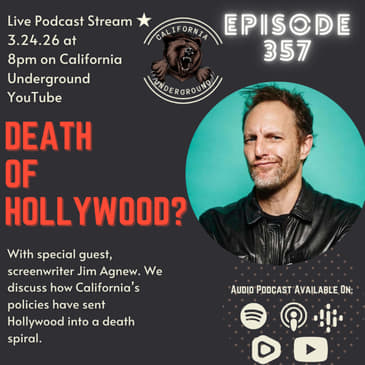
Hollywood’s Golden Era is not just fading — it’s decaying in front of our eyes. Once the shining jewel of California’s economy and culture, the film industry is now a ghost town, abandoned by studios that chase greener pastures elsewhere.
Production hubs have shifted out of state, and the iconic Hollywood lots sit eerily silent — relics of a once-thriving empire that now resembles a ghost town.
But what caused this collapse? And why is California so aggressively handing its Hollywood crown to other states and countries?
In this eye-opening episode, we sit down with veteran screenwriter and producer Jim Agnew — a behind-the-scenes insider who's seen Hollywood's decline firsthand. Jim shares shocking stories about how California’s outdated policies, suffocating union costs, and ridiculous bureaucratic hurdles are bleeding the industry dry.
He reveals how neighboring states like Georgia and Kentucky are swooping in with 30% cash rebates, making it cheaper to shoot blockbuster films out of state, even when you’re based in Los Angeles. Meanwhile, California’s own incentives are a patchwork system that discourages production, strangled by bureaucracy and bad policy.
You'll discover:
- The real reasons Hollywood’s glamor is disappearing — and how political correctness and cultural shifts accelerated the decline.
- Why even major stars and studios are fleeing California for business-friendly states with better tax breaks.
- How outdated incentives and union costs push production companies abroad, costing thousands of local jobs.
- The impact of streaming giants like Netflix and Disney+ on California’s once-booming industry — and how their shift to global locations leaves California in the dust.
- Why California’s tax incentives are a joke compared to other states’ models, and how that’s actively killing the industry here.
- The hidden consequences of Hollywood’s decline — from local economies suffering to California losing its cultural influence.
Are you a Californian who feels isolated and alone in your political views in a deep blue state? Feel like you can’t talk about insane taxes, an overbearing government, and radical social experiments without getting a side eye? Then join us on the California Underground Podcast, the most trusted podcast on all things California politics.
Original air date 3.24.26
*The California Underground Podcast is dedicated to discussing California politics from a place of sanity and rationality.*
Check out our full site for more information about the show at www.californiaunderground.live
Join the Members Only California Underground Telegram —> https://im.page/7c0306da
For more in depth California political news coverage, make sure to subscribe to our Substack at https://caunderground.substack.com
Check out our sponsor for this episode, StopBox, by going to www.stopbox.com/californiaunderground to get 10% off your order
Follow California Underground on Social Media
Instagram: www.instagram.com/californiaunderground
X: https://twitter.com/CAUndergound
Tik Tok: https://www.tiktok.com/@californiaunderground?_t=8o6HWHcJ1CM&_r=1
YouTube: https://www.youtube.com/channel/UCj8SabIcF4AKqEVFsLmo1jA
00:00:01
Hollywood was built in California. 100 years of it.
00:00:04
In the last two decades, quietly, steadily, California
00:00:08
has also helped to dismantle it. Productions left, jobs left in
00:00:11
the state that invented the movie business is now writing
00:00:14
billion dollar checks just to compete with New Jersey.
00:00:18
That's right. You've heard New Jersey, right?
00:00:20
Tonight, we've got someone who's been inside that machine for 30
00:00:23
years, screenwriter and producer Jim Agnew.
00:00:26
He will be on this episode of the California Underground
00:00:28
Podcast starting right now. What's going on, everybody?
00:00:51
Thanks for tuning in to another episode of the California
00:00:53
Underground. I am your host, Phil.
00:00:55
We have a very special guest tonight.
00:00:57
A little bit out of the norm for us, not completely political
00:01:01
really, but Hollywood is very important to California and
00:01:04
we've talked about it before and sort of the collapse of
00:01:07
California. What's going on?
00:01:08
So we want to bring him on. Jim Agnew, of course, as always,
00:01:12
I wanted to bring bring in my Co host, the best, fastest
00:01:15
researcher in the West, and then we'll bring in Jim.
00:01:18
Jim, welcome to the show. How are you?
00:01:20
Great. Thanks for having me.
00:01:22
Absolutely. So I mean, let's just jump right
00:01:25
into it. Why don't you tell everybody who
00:01:27
you are and why we're talking to you about Hollywood tonight?
00:01:31
Well, I've been a screenwriter and producer on films for about
00:01:36
25 years, maybe longer now, maybe 30.
00:01:38
Like you said, I've worked with everybody from Adrian Brody,
00:01:41
Anthony Hopkins, Nick Cage a couple of times, you know, lots
00:01:45
of, lots of real people and produced a lot of films that
00:01:48
have been on, you know, Netflix, Amazon, all over the place.
00:01:53
And I've produced over the years.
00:01:55
Probably about, I think I was trying to think 5 films in
00:01:58
California and about worked on another 10 or so outside of
00:02:02
California. And as I get older, I have a 2
00:02:05
year old child so I'd rather stay in California.
00:02:08
But unfortunately, you know, the way they've set everything up
00:02:11
and then tried to fix everything, it's, it's almost,
00:02:14
you can't even shoot in California anymore.
00:02:16
Make films. You know, there's something as
00:02:18
we're, as you just mentioned, production's gone all over the
00:02:21
world. It's left.
00:02:22
And you know, the, the, the government of California really
00:02:26
hasn't done anything to help it. They, they kind of say they
00:02:29
have. And so is the city of LA, but
00:02:30
it's like band aids on a gaping wound that you know, it's not
00:02:34
going to fix it. So unfortunately here we are
00:02:37
and, and I feel like I don't think it's going to come back.
00:02:40
It's going to, you know, there's going to be a steady work in
00:02:42
California, but it's not going to be how it used to be.
00:02:44
And there's like a multitude of reasons we can talk about.
00:02:48
I'm looking forward to getting into that.
00:02:51
But First off, you did just recently write a book.
00:02:54
So I want to make sure that we talk about you did just write a
00:02:57
book. So let's talk about that for a
00:03:00
second. What is What's your book about
00:03:03
for people who are turning? Let me hold it up here.
00:03:07
It's called To Live and Write in LA and it's about working as a
00:03:12
screenwriter in Hollywood. It's mostly focused on my screen
00:03:15
writing career and it's doesn't give you one page of advice how
00:03:18
to write a script. There's millions of books about
00:03:20
that. This is more like how to
00:03:21
navigate the business side, how to take your script and make it
00:03:25
more so it can get turned into a film, how to deal with actors,
00:03:29
producers, financiers, studios. And there's a lot of horror
00:03:32
stories. There's some grievances, there's
00:03:35
some tales of getting ripped off, lots of money, you know,
00:03:38
and things like that. But what I wanted to do, and
00:03:41
there's also actually a glossary in the back of the book.
00:03:43
It kind of explains things. Get it?
00:03:44
I get asked all the time, like, why won't an agent read my
00:03:47
script? What's chain of title?
00:03:49
How to kind of, you know, prepare yourself and protect
00:03:52
yourself with copyrights and things like that so you don't
00:03:54
get, so you don't go through the meat grinder like I did, you
00:03:58
know, I didn't have anybody teaching you this stuff.
00:04:00
And it's on Amazon and I'm basically giving the book away.
00:04:03
I didn't do it to make money. It's like $0.99 on for Kindle.
00:04:07
So, you know, if you want to read a little bit of some horror
00:04:11
stories of work in the film business, it's kind of written
00:04:13
like Kitchen Confidential, but from a screenwriter's
00:04:15
perspective, so. Yeah, I mean, I, I wanted you to
00:04:20
obviously, you know, talk about your book, but I wanted to show
00:04:25
the audience as well that you have experience here and that,
00:04:27
you know what you're talking about.
00:04:29
This isn't, you know, you, you've got your war wounds,
00:04:33
you've got your scars, you've been through the business.
00:04:36
But I want to go like all the way back.
00:04:39
What got you into saying, OK, I'm going to I'm going to go to
00:04:42
Hollywood and be a screenwriter or get into the movie business?
00:04:48
Well, I mean, we're on California underground, and I'm
00:04:52
a lifelong Californian, so that that's a big part of it is in my
00:04:57
book. I talk about my parents in the
00:04:59
60s were crazy, and they just got in a car one day and drove
00:05:02
from Kansas City to LA with no plan, nowhere to stay and moved
00:05:05
here. So, you know, it's like they're
00:05:08
pretty much the reason I end up in the film business, you know,
00:05:11
the first. Yeah, exactly.
00:05:14
When there was a dream back then, you know.
00:05:17
Yeah. The late 60s, they decide just
00:05:19
to hop in a car and come out here.
00:05:20
And the first job I ever had at six months old was I got
00:05:24
baptized by Anthony Quinn in a film as as an extra.
00:05:27
I was a little tiny baby and I think I got paid 50 bucks.
00:05:31
So, you know, just being around it, you know, as I grew up, it
00:05:37
was, I was very lucky that I had a lot of friends who had jobs in
00:05:39
the film business and, you know, they kind of helped me here and
00:05:43
there. And, you know, it just just it
00:05:46
didn't make it easy, but it was, it was a grind to get into it.
00:05:49
And I just growing up in the LA area really helped.
00:05:52
And I worked at a production company in the 90s that brought
00:05:55
a lot of animation out, anime from Japan over here.
00:05:58
We're the first company that did that made it really big in
00:06:00
America. It was called Streamlined
00:06:02
Pictures. And then from that I got to
00:06:03
produce a couple small films. I just completely, you know,
00:06:07
lied about my credentials to get those jobs.
00:06:10
But but it all worked out. You know, I just just was a kid
00:06:13
with like, you know, who just really had no, you know, didn't
00:06:17
have an attitude, but just was like, whatever, I'll just say
00:06:20
whatever to get the job. And it all worked out.
00:06:22
And then after about 5 or 6 years of producing films, I was
00:06:26
reading a lot of scripts and I was like, these are really bad.
00:06:28
I could probably write this as well as this.
00:06:31
And I wrote a script and I got a writing partner and it kind of
00:06:34
our career kind of took off. And we, we did pretty well.
00:06:36
And, you know, we did well for a really long time.
00:06:39
And I'm still working but not writing as much.
00:06:42
But I just had a movie last year that came out with Josh Duhamel
00:06:46
that's on Amazon that's doing really well.
00:06:48
So you know, so still doing it. Yeah, All right, let's get into
00:06:55
the nitty gritty. Let's get into the reality.
00:07:00
Hollywood is, would we, would we be exaggerating to say it's a
00:07:05
walking corpse of what it used to be in its glory days and the
00:07:09
glamour days? Because it feels like it's, it's
00:07:11
completely falling apart and it's basically just a, a museum
00:07:15
at this point to most people, right?
00:07:17
Yeah, you're 100% correct. Almost everyone I know who's
00:07:21
worked in the film business any amount of time, one of the
00:07:24
telltale signs is they say how depressing it is if you have for
00:07:29
some reason, a meeting or some reason to go to a film studio,
00:07:34
it's like basically empty. It's a graveyard.
00:07:36
If you go to Universal, Warner Brothers, those places are not
00:07:39
like they used to be. You know, I used to have a lot
00:07:41
of meetings there from probably 2008 to when COVID hit, you
00:07:45
know, you, I was going there all the time and it was just this
00:07:48
place that was full of energy and people were everywhere.
00:07:51
And they were shooting over here and, you know, it was hard to
00:07:54
get on the lot because there were so many cars and, you know,
00:07:58
security guards letting you in. And, and now it's like, it's
00:08:01
like a graveyard. It's exactly like you describe
00:08:03
it, like The Walking Dead. There's maybe like 3 people you
00:08:06
see you know, and there's there's no reason to even go
00:08:09
there anymore because barely anybody even works at the lots.
00:08:12
So it's really sad how much has changed.
00:08:16
And I mean, there's many reasons why, but it's it's nothing like
00:08:19
the glamour is completely gone. I mean, I'm, we're big old movie
00:08:25
buff fans. So I guess those, we're long
00:08:29
past those days of like real glamorous Hollywood that
00:08:32
everyone grew up thinking like this is Hollywood.
00:08:36
But even like back, you know, not that long ago, like 20-30
00:08:39
years ago when I was a kid, you still thought of Hollywood as
00:08:43
like that's where they filmed late night shows and that's
00:08:47
where they filmed sitcoms. And when they whenever they were
00:08:49
like this is this film in front of a live studio audience.
00:08:52
The live studio audience was here in Southern California.
00:08:55
It wasn't in Atlanta or New Jersey or Illinois, which we'll
00:08:59
get to talking about those states.
00:09:01
But it it just seems like the downfall happened almost maybe
00:09:07
it to me, but you've been on the inside maybe pretty rapidly in
00:09:10
like the past decade or maybe 20 years.
00:09:13
I don't know what. What's your timeline and
00:09:15
experience of how fast it's come down?
00:09:17
It really started the downfall happened around 2016, I think.
00:09:23
And the reason why is because of Netflix.
00:09:27
I'm not making Netflix like the big bad monster in the room that
00:09:30
ruined everything. But I remember I went, we
00:09:32
pitched ATV show. I had this producer who I was
00:09:35
working with. We went pitched to all the
00:09:36
different, you know, networks and studios.
00:09:39
And we had just gone to I think Universal and, and when you go
00:09:42
pitch on a studio a lot, they'll send you over.
00:09:45
At least they used to. They would go, OK, go to
00:09:46
Bungalows 27, you know, and go meet with Amblin.
00:09:49
We, I think we pitched Amblin who's Spielberg's company, not
00:09:52
Spielberg himself, but somebody worked there, this project and
00:09:55
you go this little tiny bungalow that's like from the 30s and
00:09:58
it's cool old school Hollywood. And then you would go somewhere
00:10:02
else, like another office. Like you go to Lionsgate and
00:10:04
then you'd go somewhere else. Cuz when you pitch TV, you go to
00:10:07
a lot of places that really fast, like in two week periods
00:10:10
so that you try to create competition.
00:10:12
But you know, we'd go to these places and then we went to
00:10:15
Netflix and it was the first time I'd been in their new
00:10:17
building, the one that's where the old KTTV lot or KTLA,
00:10:23
whatever it was, is. And because they'd had a much
00:10:26
smaller office before, I remember when Netflix was above
00:10:28
a, a Mercedes dealership in Beverly Hills, they used to have
00:10:31
their office above a Mercedes dealership.
00:10:34
That's how fast Netflix grew. But we went there and they had
00:10:39
this gigantic, amazing, the building's still there lobby
00:10:43
where you can get sandwiches and coffee and pretty much anything
00:10:46
you wanted. And I remember looking at the
00:10:50
producer and I said, this is weird because we were just in a
00:10:53
building that was like from the 30s.
00:10:55
And he goes, listen, don't think of them as entertainment
00:10:57
company. They are a tech company and
00:10:59
they're all about market share. They don't care.
00:11:01
They operate differently. And that was like the first time
00:11:03
it really like something clicked that something else is going on
00:11:07
here. And you know, Netflix just kept
00:11:11
spending and spending because market share.
00:11:13
They think like a tech company, they got bigger and bigger and
00:11:15
bigger. And then around that time is
00:11:17
when you saw Paramount Plus, you saw Disney Plus, you know, Hulu,
00:11:21
all these companies decided, well, instead of giving our
00:11:24
libraries to Netflix, let's just all have, you know, our own
00:11:29
version of that. And so they spent tons and tons
00:11:31
of money and it created this almost like streaming war
00:11:34
environment and Netflix won everybody else kind of, you
00:11:38
know, just, you know, blinked and, and bowed out or, or really
00:11:42
reduce the size of what they do. Even Apple TV isn't what they
00:11:46
intended it to be. So, you know, that's that's
00:11:49
pretty much where it really started to fall apart.
00:11:52
And of course, when you're dealing with a tech company,
00:11:54
they're all about money. So everybody started shooting in
00:11:58
Georgia and, you know, UK and all these other places where you
00:12:01
get better tax incentives and deal with and better union
00:12:04
rates. So that's really where it
00:12:06
started to fall apart. And then COVID happened.
00:12:08
You know, people like to blame the strikes, but I think
00:12:11
everything was going downhill before the strikes happened in
00:12:13
2023 with SAG and WJ. It was already going badly
00:12:17
before that. So that's how we got here.
00:12:20
That's how we got here. Yeah.
00:12:23
I going back to, I remember when my brother-in-law, I went to go
00:12:27
visit him and my sister and he was like, hey, there's this new
00:12:29
company called Netflix and we get these DVDs in the mail.
00:12:33
And I was like, oh, that's interesting.
00:12:35
And now they're like the biggest entertainment media company out
00:12:39
there now. But I think you can still get
00:12:41
DVDs mailed to you. But we we can talk about
00:12:46
streaming and sort of the effect of like it is on people in
00:12:49
general and the audience. But I was reading a lot about
00:12:52
how my home state where I grew up, New Jersey, and I was
00:12:57
shocked to read this. Even New Jersey is picking up
00:13:00
more of that studio share. Like Georgia's really big now,
00:13:07
you know, and now Marine New Jersey's really big.
00:13:10
Illinois is also getting bigger. Like all these states are taking
00:13:13
advantage of the fact that Hollywood has not been
00:13:17
hospitable and friendly to its own industry.
00:13:20
California hasn't been friendly to it.
00:13:22
So they're grabbing that from from there.
00:13:26
And Atlanta is now like the new Hollywood.
00:13:28
It's it's unbelievable to me that just happened like every
00:13:31
Marvel movies made in Atlanta now, like it's always Atlanta,
00:13:35
these big movies, right? Yeah.
00:13:37
And there's several reasons for that.
00:13:38
And the number one reason is because the state of California
00:13:41
basically just, you know, crapped itself in this in
00:13:44
regards this for last 1020 years.
00:13:46
If you go to Atlanta, well, if you go to Georgia, if you go to
00:13:50
Kentucky, if you go to Mississippi, if you go to any of
00:13:53
those rebate states, you can get 30% of your money back across
00:13:57
the board, 25 to 30. You know, I don't want to get in
00:13:59
the weeds and get all these numbers, but 25 to 30% of your
00:14:02
money back you can get in a rebate.
00:14:04
And that is where I just did a movie in Kentucky like 2-3 years
00:14:07
ago. And basically if you spend,
00:14:11
let's say to make the math easy, you spend $5 when you
00:14:14
turn in all your paperwork and at the end of the day they'll
00:14:17
give you a check for $1.5 million back for shooting there.
00:14:21
California doesn't work like that.
00:14:23
California is the only state that has.
00:14:26
You can't use above the line cost, which means you can't
00:14:29
apply the actor salaries, you can't apply director, you can't
00:14:32
apply writer, you can't apply producer.
00:14:34
Every other state for the the most part, there's some states
00:14:37
that have it capped. Like I said, I don't want to get
00:14:38
too in the weeds with this stuff, but most states like
00:14:41
Georgia and you go to Kentucky, Mississippi, Alabama, all these
00:14:45
other states, New York, you can apply those.
00:14:48
The above the line cost, the the cost for the actors, the cost
00:14:51
for the producers, the cut as part of your rebate.
00:14:54
So right there alone, that alone makes California not competitive
00:14:58
with any other state. OK, But yet they didn't fix
00:15:01
that. You know, recently, you know,
00:15:03
they had a dying system. And that's why I've been talking
00:15:06
a lot about this because it's, it's driving me crazy.
00:15:08
They had a dying system where they had $350 million they were
00:15:12
trying to give out. Every year they increase it to
00:15:15
7:50, but they didn't change any of the parameters.
00:15:19
They just dumped more money into a system that nobody wanted to
00:15:22
use. And, and you know, and also
00:15:25
there's a jobs formula in California that's nowhere else.
00:15:28
You have to fill out this weird formula.
00:15:30
Nobody really knows how, how it works to create jobs.
00:15:33
You have to apply maybe this month.
00:15:37
There's only small windows. You can apply.
00:15:39
Other states. You can apply any time of the
00:15:40
year. You can.
00:15:41
I could apply tomorrow in like 10 states.
00:15:42
But California, I have to wait a month.
00:15:44
So you apply. And then once you apply, then
00:15:47
you have to wait to see if you get to the next step.
00:15:49
Then you have to wait to see if you get to the next step.
00:15:53
Yeah. And there's like, I think from
00:15:55
what I've heard, because you can't get numbers on this,
00:15:57
there's about 30 people who work for the entire California Film
00:16:00
Commission giving out supposedly $750 million.
00:16:04
But, you know, it's just a system that, like, nobody in
00:16:08
their right mind would shoot here, you know, because it's not
00:16:11
competitive. That's just one of the reasons.
00:16:14
You know, there's there's a multitude of others.
00:16:16
And I say to people all the time, you know, look who's
00:16:19
running for Mayor Nathayaraman. What does her husband do?
00:16:23
He's ATV producer. Where does he shoot his TV shows
00:16:26
in New York? Wow.
00:16:29
That should tell you everything. Wow, I.
00:16:32
Just moved to the Valley and she was my my council person till
00:16:36
like last year. And it's like if she represents
00:16:39
Hollywood, she represents the film business and her husband's
00:16:42
going other places, so. Wow, there you go.
00:16:47
Yeah, that's part. Well, I, I mean, it just seems
00:16:52
like, Oh my gosh, there's so much to unpack.
00:16:55
We did a little bit of, I can't remember the episode.
00:16:57
Camille probably has a better idea.
00:16:58
We did a little bit of this. I forget why.
00:17:01
There was a clip about who was it, Adam Scott, and gosh, now I
00:17:08
can't remember his name. I know what you're talking
00:17:10
about. Oh my gosh, teen.
00:17:11
Heartthrob Rob Lowe. Rob Lowe.
00:17:13
Yeah, yeah. They were on the podcast.
00:17:14
Talking about yes. Yeah.
00:17:15
And it was, it was very viral. And they went on because they
00:17:18
were talking about like, hey, remember what we used to do
00:17:20
parks and recs and we walk around Burbank and stuff like
00:17:22
that. And now they're like, oh, the
00:17:23
studios are closed. And Adam Scott went into this
00:17:26
whole thing about like, well, it's so much cheaper to do it in
00:17:29
Georgia. It's so much cheaper.
00:17:31
You get better tax rebates. And they were like, they were
00:17:33
like, let's just be honest. It's just, it's not business
00:17:36
friendly to do it. It doesn't make business sense
00:17:39
to do anything here in California anymore.
00:17:42
And it's almost like it's not even throwing a bone to
00:17:46
Hollywood with this tax credit scheme that they've come up
00:17:50
with. Because even if you compare that
00:17:52
tax credit scheme to Georgia and these other places, I mean that
00:17:56
the, the rebates alone are just like, why would you not, like,
00:18:00
why would you not invest all of your money if you're a studio
00:18:05
into places like Georgia or Jersey or someplace like that or
00:18:08
out of the country? Like how many, you know, places
00:18:12
do I see that are like, we thank the proud country of Canada or
00:18:16
Australia. I'm like, Australia and Canada,
00:18:18
why are they, why are we filming movies halfway around the world
00:18:21
in Australia? Aren't they filmed here in
00:18:23
America? I'll tell you why and I'm.
00:18:25
Not. Advocating for anything but this
00:18:27
is just, this is just discussing it the way that the playing
00:18:30
field is in regards to business, just purely business.
00:18:34
UK and I don't know about Australia but I'm sure they do.
00:18:38
And many European countries have socialized medicine so you don't
00:18:42
have to pay pension health on employees.
00:18:44
You do, but it's a much smaller percentage even with actors like
00:18:48
in in America, if you hire anywhere in America, if you use
00:18:52
I Otzi crew, which is, you know, grips, gappers, cameramen, you
00:18:55
know, the people that make the injured run, you have to pay
00:18:58
almost up sometimes up to 30% of of what they make in pension and
00:19:03
health now and and SAG is like 21%.
00:19:07
So you know, so you go to Europe and it's like it's all baked in.
00:19:12
It's like maybe you're paying like, you know, on, on crew
00:19:15
maybe 10% and on actors maybe like 6 or 7% pension health.
00:19:20
So it's way lower and their standard of what you have to put
00:19:24
into their pensions and their, their health insurances.
00:19:26
It's, it's totally different. So it's so much cheaper.
00:19:30
And that's a big, big problem because right now, if you make
00:19:33
a, let's say you want to make a $2 indie film and you
00:19:37
want to shoot in LA and you want to do it all full union, you
00:19:40
could pay $400 out of $2 just in pension and
00:19:43
health payments and tax on your employees.
00:19:45
So that's literally almost a fourth of your movies not going
00:19:49
on the screen. Now, I'm not saying that people
00:19:51
shouldn't get paid that, but I'm just saying, you know, it
00:19:53
becomes so unbearable that that, you know, if you just do the
00:19:57
numbers with money. And also things are cheaper in
00:20:00
other countries too. They just are, you know, crews
00:20:03
work cheaper, they work longer, they don't.
00:20:05
They have different overtime rules.
00:20:08
So there's that too. So that's that's also causing
00:20:11
productions to go other places. I mean, it's just simple
00:20:15
business sense, that's for sure. Let I I touched upon this $750
00:20:22
million tax bet you can expand on this, but quick answer, yay
00:20:31
or nay? Did it make a dent or help I?
00:20:33
Don't think it. I don't think it's making much
00:20:35
of difference. They may be spending more money,
00:20:38
but here's The thing is studios get most of that money because
00:20:41
there's a jobs ratio. And here's The thing is, most
00:20:44
studios that are going to shoot something in California would
00:20:47
shoot it in California I think anyway if they have really had
00:20:50
to. Now, I think a lot of people
00:20:52
that are applying for the tax rebate, the TV shows that are in
00:20:56
California or TV shows that have to shoot here because the
00:20:58
actors, because I had a friend, I'm not going to say what show
00:21:01
it is or who the actor is. I can tell you off air, but they
00:21:05
were shooting California and he was the star.
00:21:07
He was one of the leads of the TV show and he would show up to
00:21:09
work at like 10:00 and he'd be like, okay, Get Me Out by 1.
00:21:13
I need to be on the golf course. So those and look, that guys
00:21:18
been around forever. He's on a TV show that's dopey,
00:21:20
so he doesn't have to act. But those shows, you know, that
00:21:24
cost $200 million to make 10 episodes, get that rebate
00:21:28
incentive. Now, they do put a lot of people
00:21:30
to work. So I don't know financially if
00:21:33
it's good or bad, but I think they could bring in a lot more
00:21:36
work if they restructured it. They could bring in tons more
00:21:39
productions here if they restructured it in a better way.
00:21:42
There's, you know, when you're trying to raise money for a film
00:21:45
or set something up that kind of like not knowing is not what
00:21:49
investors want to hear. I don't know if we're getting
00:21:51
the California tax credit. Georgia, you go shoot and you
00:21:53
apply. You put turn in your paperwork
00:21:55
when you're done and they give you the money back.
00:21:57
They just say go, you know, So it's completely, you know, user
00:22:01
friendly and business friendly where California, as we know, is
00:22:05
not a business friendly state. I hate to say it.
00:22:07
And that's that's not a spoiler alert.
00:22:09
Can we back up really fast and talk about what that tax
00:22:13
incentive exactly is? Because it's kind of new.
00:22:16
And just in case any of our listeners aren't familiar with
00:22:20
this tax incentive to try to bring, you know, bring Hollywood
00:22:24
back to life, if if you guys don't mind breaking it down.
00:22:28
Well, it works in regards to again, it excludes actors and
00:22:33
producers. Like I said that other States
00:22:36
and countries allow you to fold in.
00:22:38
So it's basically the below the line jobs, the, the, the crew
00:22:43
money you spend in post for editing and things like that.
00:22:46
You can apply and you get basically 30% back on, you know,
00:22:51
whatever you spend. If you work outside of LA, maybe
00:22:53
it's 35. There's different categories,
00:22:56
but it's still at the end of the day, that's not your, your heavy
00:23:00
lifting. If you do a $10 million movie
00:23:02
with, I've done a couple of these with Nick Cage and you
00:23:04
have a lot of producers and things like that.
00:23:06
You're spending like maybe $3 to actually make the
00:23:09
movie and $7 in actors that get the movie financed and
00:23:12
you know, get all the other stuff and the producers and the
00:23:15
finance fees and the bank fees. And you can't apply that.
00:23:18
So it just becomes not competitive with other states
00:23:22
when you could just go let's go to, you know, let's go to
00:23:26
Mississippi and get 30% back on 10 million as opposed to 3
00:23:29
million. So if I have a production
00:23:32
company in Lai can apply get my whatever percentage but I can
00:23:37
shoot the movie out of state but as long as like the editing and
00:23:41
additional stuff is done in LA with my production company based
00:23:46
in Lai can still get the incentive or?
00:23:49
Not really, you have to do it all here.
00:23:51
I mean you. In that case you might be able
00:23:54
to just get but you would only get the incentive on the post
00:23:56
money. But more than likely because
00:23:58
there's a jobs formula, they kicked you out, you know, you're
00:24:02
not even available to get it. So that's what kind of happens.
00:24:05
It doesn't happen in other states.
00:24:07
Other states, like I've done 2 movies in Alabama.
00:24:09
Alabama just keeps giving the money away till it runs out and
00:24:13
they reset it the next year. But they don't put any kind of
00:24:15
parameters on it. They're just like, OK, go shoot,
00:24:18
turn in your paperwork. Here's your chat.
00:24:19
Kentucky too. And you know, one of the funny
00:24:21
things and it's, it's weird that we've let our film industry just
00:24:26
kind of going the gutter is that, sorry, I'm stalking my I
00:24:30
cost a lot, so I'm trying. To That's fine.
00:24:32
We're. I'm a curtain machine.
00:24:36
So first thing we did a movie 2 years ago in Kentucky.
00:24:41
First thing the one of the kids who worked in, who's from
00:24:44
Kentucky, who is our account says to me he goes, you know
00:24:46
what? We have a new tax incentive here
00:24:48
because it's new in Kentucky. It's been around 2-3 years.
00:24:50
He goes because Bashir wants to run for president.
00:24:52
We're trying to just blow up our economy.
00:24:55
You know, I didn't know who Bashir was.
00:24:56
I'm like, it was Andy Beshear. So, you know, if done right, it
00:25:01
stimulates the economy. I I don't think it makes money
00:25:04
for states. I think it kind of breaks even
00:25:06
really in my philosophy. But I think it's good if it's
00:25:09
used correctly, you know, because you do employ a lot of
00:25:11
people. You know, you can, you can, you
00:25:13
know, we buy a lot of lunches, we buy a lot of things.
00:25:16
We put a lot of people in hotels.
00:25:17
You know that movie in Kentucky? Here's another thing that's kind
00:25:21
of funny. It was kind of cheaper for us to
00:25:23
fly everybody into Kentucky from LA than to shoot in LA and put
00:25:29
them up for 40 days, like 50 people up for 40 days.
00:25:33
It was still cheaper. So there you go.
00:25:36
Yeah. There's a question in the chat
00:25:40
and they're a, they're a regular viewer.
00:25:42
So I do want to address this and I'll give you, I'll give my
00:25:46
thoughts and then I want you to give your thoughts as well.
00:25:49
Somebody asked with all sincerity, how does Hollywood
00:25:53
affect my everyday life? Just asking.
00:25:57
My response is I think this is for people who are watching.
00:26:01
Like, what the hell do I care about Hollywood?
00:26:04
Like it's just a bunch of movie stars who lecture us about why
00:26:07
we're all stupid and should do better in life.
00:26:11
I think it's an indictment on California in terms of we're
00:26:15
talking about these tax credits and how unfriendly business
00:26:18
environment is that it's gotten so bad that it's pushing the
00:26:23
golden, one of the golden gooses of California.
00:26:25
I mean, it's Hollywood. You think California, you think
00:26:27
of Hollywood, San Francisco. Those are like the two top
00:26:30
things to think of and it's pushing it out.
00:26:33
So it's maybe to me, that's why if California's gotten so bad
00:26:38
business wise that it's pushing Hollywood out, one of its
00:26:42
namesakes, I mean, it'd be like going to New York and being like
00:26:45
the Empire State Building got up and moved because there's no
00:26:47
reason to be in New York anymore.
00:26:50
So that's, that's my take of why it does affect us overall.
00:26:53
Maybe it doesn't directly affect you, but I think the story of
00:26:56
what we're talking about today definitely effects all
00:26:59
Californians. Yeah.
00:27:01
Well. It does, and that's what makes
00:27:03
me upset about it is I know so many people out of work and so
00:27:06
many people that have left the state, you know, that have been
00:27:09
here forever, like me. It doesn't really affect me
00:27:11
because I'm a writer and producer.
00:27:13
So I, I've, you know, like I said, I've, the last a couple
00:27:16
films I produced, we did one in Mississippi, we did one in
00:27:18
Alabama, we did one in Kentucky. So I can go anywhere, you know,
00:27:21
and I got asked to go work on a movie in, in Italy that that's
00:27:25
cool. I did one movie in Italy before.
00:27:26
That's a good time. But crew, people who live here,
00:27:30
it doesn't make any sense to take a cameraman for the most
00:27:33
part, or a grip and fly them to, you know, Kentucky.
00:27:36
Our, our situation was a little bit different because the way
00:27:38
we'd structure the film, but for the most part, they're kind of
00:27:41
stuck, you know, so, and there's a people who put a lot of time
00:27:46
and energy into it. So I don't know where they go
00:27:48
from here, you know, because I don't see it getting it.
00:27:52
It, it could, it can stay alive, but I don't think it's going to
00:27:56
come back. It's not going to be like it was
00:27:57
like we're talking about 30 years ago.
00:27:58
No way. You know, nothing in California
00:28:01
is you know, I used to live, I live in Burbank now, but I used
00:28:04
to live right off Sunset Blvd. for like 20 years by where the
00:28:08
whiskey and all this the cool stuff is I lived up the hill
00:28:10
there and I drove by there a while ago and it's like dead.
00:28:14
Everything's closed. Literally everything.
00:28:17
Every other building is for lease.
00:28:18
You know, there's no bars open. There's nothing.
00:28:21
It's like this is not the, you know, the the city I grew up in.
00:28:25
It's it's completely like a ghost town, you.
00:28:28
Know. It's really sad, but yeah, I
00:28:30
think you know, and you're right.
00:28:32
It's like, who strangled the golden goose?
00:28:34
This is like our, our was our not only was Hollywood, you
00:28:38
know, what people worked in, but it was it, it drove tourism too,
00:28:42
right? I was going to say that.
00:28:44
And now if you go to Hollywood, I tell I've warned people all
00:28:46
the time. Don't come to LA and go to
00:28:48
Hollywood Blvd. You know, it's like if you want
00:28:51
to see a bunch of, you know, you know, crack zombies laying on
00:28:55
the street, then go. But it's just sad.
00:28:57
What it it what a mess it is, you know, and it's kind of an
00:29:01
indictment. You know, I had a friend who
00:29:03
works in the film business who he moved to another state for a
00:29:06
few years. He was still working here, but
00:29:08
he was going back and forth. He wasn't here a lot moved back
00:29:10
here. His base operations came back
00:29:11
here and he's from here. He's lived here whole life.
00:29:14
He just said it. He said it better than anybody.
00:29:16
He goes, there's such a malaise over LA.
00:29:19
He goes, I've never seen, you know, we're both, we both have
00:29:22
lived here our whole lives and we're like, Jesus, right.
00:29:24
Malaise is a good way to put it. So that's part of the film
00:29:27
business too. So I mean, yeah, the health of
00:29:31
everything would just be better with more business moves or some
00:29:34
business sense, which which this just, you know, when this
00:29:39
happened with this incentive, I was like, oh, great, they're
00:29:42
going to change all the parameters that I looked at.
00:29:43
I was like, they didn't change anything.
00:29:45
They just put more money into a failing system.
00:29:48
So, you know, and, and then I, you know, and don't even get me
00:29:51
started. There's also LA has done a, a
00:29:53
program to help bring back production that is like, almost
00:29:58
like a parody, like a, a Saturday Night Live skit.
00:30:00
It's so worthless and idiotic. And yet they go out there and
00:30:05
say, you know, I forget which Councilman brought it up.
00:30:08
And Karen Bass, they just do these interviews, say, look
00:30:10
what? We're doing this thing.
00:30:12
And it's like, literally, if you did a $2 movie in LA,
00:30:14
it'd save you maybe $2000. And they're bragging about how
00:30:17
it's gonna bring production back.
00:30:19
Every producer I know just thinks it's hilarious.
00:30:22
They think it's funny. Yeah, to kind of piggyback off
00:30:27
that someone in the chat. So when they filmed here in
00:30:29
Vallejo, CA, the film industry spent a lot on local small shops
00:30:33
and delis, etcetera. So yeah, I mean, there's a
00:30:36
downstream effect of filming here in California.
00:30:40
I know there's a, I'm kind of kind of proud of it.
00:30:43
There's a new Steve Carell show coming out that was filmed at my
00:30:47
alma mater, University of Pacific, and I think that's
00:30:50
pretty cool. And the story is that like
00:30:52
Stockton, which is, you know, not a big tourist destination,
00:30:55
that's for sure, but they brought in a whole bunch of
00:30:59
people and they spent a ton of money in Stockton, and that was
00:31:03
a little boost to the Stockton economy.
00:31:05
So there is a downstream effect of having movies filmed here in
00:31:10
California that helps local economies and helps local
00:31:13
businesses. So I think it does affect
00:31:16
people. And it is one of our biggest
00:31:19
industries, so pushing it out is not a good idea.
00:31:23
All right, I want to get into another topic.
00:31:26
Switching gears here and I want to get your opinion as a writer.
00:31:30
We got to talk about it, AI how scared is how much of A
00:31:38
catastrophic, like a cataclysmic earthquake as AI to Hollywood?
00:31:42
You know, yeah, it is. But I don't think, here's the
00:31:47
weird thing. I don't think it's as much for
00:31:50
writing. And I'm just, I'm not saying
00:31:51
that because I'm a writer. I think it's going to be a lot
00:31:54
more first of all, I think visual effects departments, you
00:31:57
know, when you watch a movie and you see 8000 people in a Marvel
00:31:59
movie, that's going to be like 12 with AI, you know, in, in the
00:32:04
next 2-3 years. I think that's what's going to
00:32:06
really make a lot of change fast and 1st.
00:32:10
The weird thing is I've used it. I've learned how to, I was
00:32:12
actually gonna make I think a YouTube video to show how a
00:32:14
professional screenwriter can use like ChatGPT because it's
00:32:17
very helpful. But I also explain and it to
00:32:21
people, it's very much like right now at least it's like a
00:32:26
pilot using autopilot. Like you still need the pilot to
00:32:29
put all the things in. If you just say give me a script
00:32:31
and do this and I got an idea and you don't know how to talk
00:32:34
to it, finesse it, kind of do everything right, you're just
00:32:36
gonna come up with garbage at the end of the day.
00:32:39
And I still think, I think AI movies are gonna be huge in the
00:32:42
next couple of years. But I still think what's gonna
00:32:44
make what makes an animated movie great is still the
00:32:47
writing, you know? So I think that that even though
00:32:50
writers were freaking out at first, I think now that they've
00:32:53
used it a lot more. And I got into the beginning.
00:32:56
I use it. I use it like an assistant.
00:32:58
You know, I'll be very honest. I tell people all the time, I
00:33:00
right now I'll say, OK, this is the scene.
00:33:03
This happens, this happens, this happens, this.
00:33:05
I'll give it a lot of detail and I'll say, OK, this guy says
00:33:09
this, and then this guy says this.
00:33:10
But this guy has some subtext here and he's doing this.
00:33:12
And then I'll just have it write the scene and it's almost like
00:33:15
having a writer's assistant where then I go back and edit
00:33:18
everything again. But that's no different than
00:33:20
like how John August and very successful writers work that can
00:33:24
afford to assistant. They just write things out on
00:33:26
yellow pads and go, OK, new work and then they edit it.
00:33:30
So, so I think it's great. You know, I do worry about AI in
00:33:35
general getting rid of like 2030% of the, you know,
00:33:39
workforce all at once. And you know, then we're in
00:33:41
French, French Revolution territory.
00:33:43
But you know, so, but I think it's, it's, it's actually, I
00:33:48
think a great tool right now. You know, so I think anybody who
00:33:52
I've had writer friends say it's not real writing and they're
00:33:55
very romantic about writing and stuff.
00:33:57
And I think they're already getting left behind because if
00:34:00
you use it right, you could write 4 scripts in the amount of
00:34:03
time it takes. You do 1.
00:34:05
So it's an efficiency tool, so. I, I, I personally agree.
00:34:09
I'm, I'm a fan of AI, but you're right, you have to, you still
00:34:14
have to be the driver. You still have to be the person
00:34:16
who like puts in the command and tells it exactly what you want.
00:34:21
It can't read your brain, so it can't read your mind.
00:34:23
So you still have to be very, very particular about what you
00:34:29
want it to do, and then it'll spit out something, but then you
00:34:31
still have to edit it. OK, maybe this is a look, you
00:34:36
know, we talked about before we hopped on how I'm a big fan of
00:34:40
like Nerd Roddick Daily and Critical Drinker and people like
00:34:42
that. This is my chance to cosplay as
00:34:45
them for a second. Can we talk about the fact that
00:34:49
regardless of AI or not, it just seems like movies, like the Mass
00:34:54
movies are just all shit now. Like it's just not exciting to
00:34:59
go see movies. Like I was talking to my wife
00:35:01
the other day ago, Honey, what was the last movie we went to go
00:35:05
see in theaters? And I think it was Top Gun
00:35:07
Maverick. And I don't know, was that two
00:35:10
or three years ago? At this point, they're already
00:35:12
working on a second one. It just seems like people aren't
00:35:17
enticed to go to movies. Maybe it's COVID, maybe the
00:35:20
writing got too, too much lecturing, too much finger
00:35:24
wagging. Like kids Movies Now have like
00:35:26
an agenda. I don't know.
00:35:29
It just feels like they're just not enjoyable to see.
00:35:32
I don't even like want to watch half the stuff that like Disney
00:35:34
puts out or Marvel puts out anymore.
00:35:36
I used to be a big Marvel fan. I'd go see every Marvel movie.
00:35:40
Spider Man maybe. Spider Man was the last Marvel
00:35:42
movie I saw in theaters. I don't even remember.
00:35:44
So. Yeah, I go to see all those
00:35:46
Marvel movies with all those, you know, those guys, the film
00:35:49
threat guys, that crew, because we all live, you know, in LA.
00:35:53
Yeah. And the last few have been
00:35:54
really bad. I think it's a it's a
00:35:56
combination of things. I think that it has the film
00:36:01
business has become, especially with the kind of big films in
00:36:04
theaters have become very corporate.
00:36:06
So there's a lot of people making decisions.
00:36:08
There are a lot of like, kind of like agenda things.
00:36:13
You know, I talk about a little bit in the book that about, you
00:36:17
know, about 20/16/2017. I don't know if it was because
00:36:21
Trump was elected or what, but suddenly I would go to tons of
00:36:25
meetings before those, that time period, the 10 years before
00:36:29
that, every meeting was about, hey, how do we, what's the story
00:36:33
about? Is it the hero's journey?
00:36:35
Is it about freedom? Is it about love?
00:36:37
And then, you know, there's always a theme to every
00:36:40
everything you pitch ATV show, you know, a film, everything you
00:36:43
pitched, you had a theme or storyline or what is it about?
00:36:46
And then it kind of turned into like, what can we say?
00:36:49
You know, it, let's let's say something, you know, we got to
00:36:52
say something. And that was a real drastic kind
00:36:55
of change that happened, you know, in in the film business
00:36:58
because I was like, wait, what? What are we trying to say?
00:37:01
I thought we were just talking about love, you know.
00:37:03
Yeah. And it really became, and look,
00:37:06
you know, I've, I've talked about other podcasts, I'm not
00:37:08
saying anything or, you know, YouTube things.
00:37:10
It's like, you know, they opened up the doors to a lot of people,
00:37:14
you know, in a period of time, especially in the writers.
00:37:17
I've been in the writers Guild like 15 years that weren't
00:37:20
qualified. And it was because they were
00:37:22
hired because of, you know, DEI and things like that.
00:37:24
You know, it's just facts. You know, they, if you look at
00:37:27
the hiring, because WJ has to put all that stuff out because
00:37:30
it's a union. Oh, it's technically a Guild,
00:37:33
but it has it's all public information.
00:37:35
And you can see that like different people, like in
00:37:40
certain periods of time all of a sudden just skyrocketed, you
00:37:43
know, and and it wasn't that they weren't deserving, but they
00:37:46
weren't ready or they didn't have the skill set.
00:37:49
You know, it's like you would think in writing, it's the one
00:37:52
thing you would hire people just based on their work.
00:37:54
You could just RIP the page off, not know who wrote it and read
00:37:56
it and go, hey, this is great. But yeah, that happened.
00:38:02
So I think, you know, I have a friend who's at a really big TV
00:38:04
show that's on the air right now.
00:38:05
You guys all know, We all know it.
00:38:07
I'm not going to say I'm not going to out him.
00:38:08
But he said they got ham fisted for, you know, probably from
00:38:13
2020 to 2022 with a lot of people who couldn't write on the
00:38:17
show. And the more veteran writers had
00:38:20
to like over weekends, write those people's scripts because
00:38:23
they turned in on Friday when they were due and they were just
00:38:26
not professional. And yet those people who turned
00:38:29
in the shitty scripts got paid and got the credit, even though
00:38:32
they were the more senior writers that had to make the
00:38:34
show run. You know, now, now that it's
00:38:37
2026 and he's on the same show, the dynamics have changed.
00:38:41
None of that matters anymore. So, you know, they're all back
00:38:44
to where they were so before, before all this started.
00:38:50
Yeah, it's just interesting. And I, I think they, I think I,
00:38:57
I think people just kind of like tuned out of a lot of what, what
00:39:02
Hollywood was putting out. And I say Hollywood in general.
00:39:06
I mean, I guess the movie industry, because as we've been
00:39:09
talking about, not everything's from Hollywood anymore, but the
00:39:11
movie industry in general has just become so lecturing.
00:39:16
And it's just like it's not as funny or it's not as endearing.
00:39:21
Like you look at the writing for, I don't know, I, I'm maybe
00:39:25
I'm dating myself. Like the original Toy Story.
00:39:27
You look at like the first Pixar movie and it had like a nice
00:39:30
story and it had about redemption.
00:39:32
And like Woody had like Woody had faults.
00:39:35
Like Woody was selfish and he was arrogant, but he like
00:39:39
learned along the way. There was character development.
00:39:43
And now it just seems like the characters are very much like
00:39:46
predictable. Like they're perfect.
00:39:49
They're perfect out the gate. They're, they never do anything
00:39:51
wrong and there's, there's no growth, there's no weakness or
00:39:57
anything that they have to overcome.
00:39:58
It's just this person's a powerful person and the world is
00:40:02
mean to them and they overcome the world being mean to them
00:40:04
because they're so perfect and awesome.
00:40:07
And the moral of the story is they're perfect and awesome and
00:40:10
they won and they can do whatever they want.
00:40:12
And it's like, I don't know that.
00:40:15
That story doesn't resonate with me as a viewer because I'm like,
00:40:18
I didn't get anything out of that.
00:40:20
There was no lesson to it. It just seems like you were
00:40:23
lecturing me that this character is amazing and perfect, and
00:40:27
Pixar's gotten a little bit of that.
00:40:28
Disney has definitely gotten into that.
00:40:31
Marvel has definitely gotten into that, which I think is why
00:40:33
Marvel has completely fallen off is because Marvel's just not
00:40:37
enjoyable to watch anymore. They're they're just shoving the
00:40:40
message down your throat for modern audiences.
00:40:44
It just seems like the writing has gotten really lazy.
00:40:49
And and to your point, it just seems like they're pushing what
00:40:52
can we say? And and that cultural backlash
00:40:56
is also hurt. And that's why people are tuning
00:40:58
out of movies. And it's it's not helping.
00:41:00
It's definitely not helping the movie business of people not
00:41:04
going to see. Expensive to go to a movie.
00:41:07
I mean, I have, you know, I'm married and then my husband have
00:41:10
4 kids and I feel like I don't even know because I haven't been
00:41:14
to a movie in so long. And but tickets are like 20 + a
00:41:19
person I think at this point. And so if we're going to go as
00:41:23
like a family night, we're spending 100 plus just on
00:41:26
tickets. And then of course everyone's
00:41:27
going to want to drink and popcorn and possibly, you know,
00:41:30
candy, whatever. And it it becomes like a $200.
00:41:34
Night it's better be a. Good movie to a not so great
00:41:38
mediocre movie and and that's crazy.
00:41:43
Well, I did see a good movie The other night.
00:41:44
I saw Project Hail Mary which was great.
00:41:47
I've heard great things. I think, I think you guys are
00:41:50
both like it. It's, it's just, it feels like a
00:41:52
movie from like 20 years ago or 30 years ago.
00:41:55
It's just fun and positive. And, you know, so yeah, it was,
00:41:59
it was, it was a great, great experience.
00:42:02
I was glad, you know, for once I was like, all right, you know?
00:42:05
OK, well, that was also I I've heard a lot of people recently
00:42:08
talking about how great the book is.
00:42:10
So they it helps when you have good source material.
00:42:15
I had another question that I, I lost my train of thought for.
00:42:18
Oh, on the terms of writing, this has been bugging me.
00:42:25
I feel like I'm glad we're. This is refreshing to have this
00:42:28
episode. It's not necessarily all
00:42:29
political, but This is why I was excited to have you on as we get
00:42:33
to take a break from the political.
00:42:36
I heard this idea about Netflix. I just finished watching
00:42:39
Stranger Things and this whole idea of the Second Screen Theory
00:42:44
now is a big deal. Do you know what I'm talking
00:42:48
about? What the site is that like it
00:42:50
has something to do with writing and why writing is not as great
00:42:53
as it used to be, especially for like Netflix shows like the
00:42:56
second Screen Theory. Have you heard of that?
00:42:59
No. What?
00:42:59
What's that? So the second screen theory is
00:43:05
most people. So if you.
00:43:06
I do know what you're talking about, yes.
00:43:08
Yeah, if if so, like this, they use this, OK, So that, as I
00:43:13
understand it, and I'm sure Jim can explain it better, is so
00:43:16
this recent season of Stranger Things, they explained way too
00:43:21
much like they were explaining everything like, oh, this is
00:43:24
what we're doing. And the idea and the theory is
00:43:27
that's permeating through the business is that too many people
00:43:31
are on their phones, like they're on their phones or on
00:43:34
their iPads. They're not paying attention to
00:43:36
the show. So you have to dumb down the
00:43:39
writing so that people don't get lost in what they're watching,
00:43:44
which is crazy that you have to dumb it down because people
00:43:46
aren't even paying attention to your show anyway.
00:43:50
That's what I've I've heard. So I don't know if you had any
00:43:53
comment on that. I.
00:43:53
Think it's true? I think not only is it true, but
00:43:57
you know, probably 10-15 years ago I, I started doing that in
00:44:01
scripts, especially ones that were bigger scripts that like
00:44:04
we're being read by. Because I've had, I've never had
00:44:06
a studio movie made, but I've had film set up at studios.
00:44:09
So I've had to deal with that whole process going through all
00:44:11
these development execs and things.
00:44:13
But I would put like twice in the script somebody basically
00:44:16
standing up and saying what the movies about because they would
00:44:20
almost forget the readers they did because they're so just kind
00:44:23
of like ADD and weird now that I think a lot of that too is them
00:44:27
just thinking people are dumb. If you just make more engaging
00:44:30
content, you don't have to worry about that, you know, And the
00:44:34
other problem is with TV especially, you know, sometimes
00:44:37
it's something will fit, like OK, we can tell this whole story
00:44:40
in 4 episodes, but but we want 8 to get the value, you know, so
00:44:44
they're just dragging things on and stuff.
00:44:46
So so I think that's also part of it.
00:44:49
But that goes back to what I was saying about a lot of execs and
00:44:52
cooks in the kitchen because I've had some just like
00:44:54
ridiculous conversations where it's like what, you know, I
00:44:58
remember what I'm an exec told me they had it was a big
00:45:01
company. They had gotten the rights to
00:45:03
Fahrenheit 451. And this exec is brilliant idea
00:45:06
was like, we're going to do it with no books.
00:45:09
We're going to have everything on the Internet and we're going
00:45:11
to have the Internet blank out. So there's no books.
00:45:13
And I'm sitting there going, you're a tool.
00:45:15
You're going to take Ray Bradbury's classic and redo it.
00:45:18
And this is like a 28 year old kid who doesn't know anything.
00:45:20
This is how we're going to do it at a studio, you know, and I'm
00:45:23
just like, oh God, no one. I mean, look, I've been guilty
00:45:26
of making a couple bad movies myself, but that's because
00:45:30
people just, you know, producers get involved.
00:45:32
Everybody gets involved, actor says something, this, that, and
00:45:34
you just have to kind of go with the blow.
00:45:36
Sometimes you don't have, the only way something can be great
00:45:40
is if you have Tom Cruise to go, no, we're not doing that, you
00:45:45
know, or you have Martin Scorsese to say, no, we're not
00:45:47
doing that, or Quentin Tarantino where they're afraid to give
00:45:50
them notes or tell them they don't like something.
00:45:53
That's the only way you can really nowadays do anything.
00:45:55
That's really because everybody wants to.
00:45:57
Be no books. I'm just still laughing.
00:46:00
Yeah. No books.
00:46:02
I've been in many. There's there's there's a story
00:46:06
in my book where I went to Universal where they like this
00:46:11
sci-fi script my writing partner and I had done and this big exec
00:46:15
who could green light the movie came in to talk to us to have
00:46:18
this big meeting. And he's talking about it and he
00:46:20
goes and then when they get to the meteor and we're looking
00:46:23
each other go, there's no meteor in the script.
00:46:25
And then he keeps going on and on.
00:46:28
You read the wrong script. And it's like, we're in the
00:46:30
meeting and I'm like, I'm not going to tell him.
00:46:33
He's talking about the wrong script, you know, and the execs
00:46:35
over there like twiddling his thumbs going, I don't know what
00:46:38
I should tell him. So the guy goes on for 10
00:46:40
minutes talking about a different script.
00:46:42
And then finally, you know, the guy goes, you're, you had the
00:46:45
wrong movie, a wrong script. And he yells at his assistant,
00:46:48
leaves And I'm like, that's over.
00:46:49
We're never we're never going to talk about that movie again.
00:46:53
Wow. So it's it's crazy.
00:46:56
I mean, I got a lot of stories like that where it's just crazy
00:46:58
how working the film business is pretty much insane.
00:47:02
So that. Was fun.
00:47:03
That was actually going to be like my Segway because we have
00:47:05
about 10 minutes left. I wanted to kind of bring it
00:47:07
back to your book. You probably have a ton of
00:47:11
stories in your book and in your personal life.
00:47:16
I I want you to talk about like what you think what, what was
00:47:21
survival in Hollywood? What did it look like back when
00:47:24
you were getting started? And what is survival look like
00:47:28
now in terms of? It's much different.
00:47:33
I, I, I started making a living at this around 2006.
00:47:38
I was producing films before and, and I saved money in 20 or
00:47:43
2004. I produced a movie and it
00:47:45
produced a couple music videos. It's like, OK, I'm saving up
00:47:47
money for like a year and a half and just work on writing.
00:47:50
And I did and I was lucky that I got an agent, sold some scripts
00:47:53
and, and since then I've made a living at it.
00:47:56
But there were so many different opportunities with with movies.
00:48:02
And back then there was a lot of money came from DVD's too.
00:48:05
Streamers have really screwed up the money flow because they
00:48:08
control so much about how you how movies are bought and sold
00:48:13
too. And, and even right now, you
00:48:15
know, it, there's a hefty appetite for movies and indie
00:48:20
films too, especially. But The thing is, unless you get
00:48:24
behind a studio behind you or something you try to sell to
00:48:26
Netflix, they want to pay like $0.50 on the dollar.
00:48:29
They want it, but they don't want to pay what the value is.
00:48:31
You know, they want to pay 1 bucks for $2
00:48:33
movies. So you just lost 1
00:48:35
bucks. So that's really messed up
00:48:37
things. Back then, there were just so
00:48:39
many more opportunities to indie films.
00:48:40
You could get into TV. You could, you know, work on TV
00:48:45
movies, you could, you could sell things.
00:48:47
They also bought spec scripts a lot more back then where you
00:48:50
could get hired. I've been hired a lot of times
00:48:52
to write things that never got made, you know, and and you
00:48:55
could sell scripts that you, you know, spec just means you just
00:48:58
write it and try to sell it with, you know, hope to sell it.
00:49:01
And it was just a more robust industry.
00:49:04
Now it's like, you know, Netflix, why is Netflix going to
00:49:08
hire, you know, somebody even with my credentials when they
00:49:12
can go get a pay tons of money for, you know, Ben Affleck and
00:49:15
and Matt Damon to do a move, you know, so, so that that's a lot
00:49:19
of what it is. And also too, Netflix and all
00:49:21
the other streamers want to keep you an algorithm.
00:49:23
So if somebody's hot in this movie, they want to do another
00:49:26
move with them or TV show so that when you get done watching,
00:49:29
it says, do you like that? Watch this, they don't want you
00:49:31
ever leave. So yeah, it's changed a lot.
00:49:35
I feel bad. There's a lot of young TV
00:49:37
writers, especially TV because TV you're kind of sitting around
00:49:39
waiting for a job. When you work on feature films,
00:49:43
you kind of go out, write a script, you try to put it
00:49:45
together, you talk to producers. It's more like starting your own
00:49:47
little business for each movie where when you work in TV,
00:49:50
you're kind of an employee, you're more corporate.
00:49:53
So a lot of TV people are going to be sitting.
00:49:55
There's a lot of TV people out of work.
00:49:57
I think there's only 1900 people in the WJ working right now.
00:50:01
So, and that's out of like 15 members.
00:50:05
So what's, what's the math on that?
00:50:06
You know, that's nothing. That's like less than 10% or 10%
00:50:10
basically are working. Wow, not good.
00:50:14
Someone did ask a question for you.
00:50:17
What's your favorite film? Well you know it's funny cuz
00:50:22
it's LA centric. My favorite movie of all time is
00:50:25
To Live and Die in LA. That's why I called my book to
00:50:27
Live and Write in LA even though my girlfriend can go with the
00:50:30
title. But yeah, if nobody's ever seen
00:50:32
To Live and Die in LA. Great film from the 80s about
00:50:35
Secret Service agents in LA chasing a counterfeiter played
00:50:39
by what's his name. He's in everything but Willem
00:50:44
Dafoe and William Peterson's in it.
00:50:46
Great movie. It's super because it was a
00:50:49
studio film where they didn't you spend a lot of money so it
00:50:52
shot like an indie film. Really cool film.
00:50:54
So that's probably my favorite movie.
00:50:55
I'll watch it 2 * a year. OK, before we sign off, I did
00:51:02
want to get a story and entertain maybe your favorite
00:51:07
most eye opening crazy. You mentioned the meteor story
00:51:10
doesn't have to be from your book, but a story that you can
00:51:14
share with the audience and the listeners.
00:51:15
That would be like, huh, that really happens in Hollywood.
00:51:19
OK, that's that's crazy. Well, I'll tell you the quick
00:51:23
short story of how I start my book off.
00:51:26
I worked on a movie in Italy. I wrote it, I put it together
00:51:30
and help bring the financing to the movie, but I wasn't a
00:51:33
producer on it. But part of my contract, I said
00:51:35
OK, I'd, I get to go to Italy for three months, 'cause I put
00:51:38
the movie together and I wrote it.
00:51:40
Adrian Brody starred in it. There's a guy named Dario Gento
00:51:43
who's a very famous Italian director, directed it.
00:51:46
And about halfway through the movie we realized one of the
00:51:49
investors fell apart, fell through.
00:51:51
So there was like 1 dollars missing.
00:51:53
So Adrian Brody was great about it.
00:51:55
He goes, you know what, I'll just cut my salary.
00:51:57
Let's get the movie done. We'll talk about it when it's
00:51:59
done. So he's a Mitch.
00:52:00
He's one of the coolest dudes in the film business.
00:52:02
So he's a great dude. But what happened is then at the
00:52:05
end of the shoot, there was an Italian crew and I was the only
00:52:09
American. The Italian crew got their hotel
00:52:11
rooms paid for and they didn't pay mine.
00:52:14
So, and that was for like 3 months.
00:52:15
So they're like, OK, now you owe like whatever, 5 or €6000.
00:52:19
And I hardly got paid anything in the movie to begin with.
00:52:22
And I was so mad. And I called the American
00:52:24
producers. They're like, sorry dude, we
00:52:26
don't have any more money. And this guy was a big fat
00:52:28
French guy who drove up and down sunset on in like a 56 Corvette,
00:52:32
you know, smoked $100 cigars And he, he sniffed me on my hotel
00:52:35
bill. So I'm like, OK, all right, you
00:52:38
want to screw me? So I bought a couple extra
00:52:42
suitcases, filled up my hotel room because I'm supposed to pay
00:52:46
on Monday morning with like stuff like I was still there.
00:52:50
And I got a flight out on Monday morning at 5:30 AM to Frankfurt
00:52:55
and I had a sneak out of the hotel and literally watching the
00:52:59
guy down the hallway, the front desk guy.
00:53:01
And then the second he went to the bathroom at like 515 AMI ran
00:53:05
out of there with a bag, got a taxi, got on the plane, got out
00:53:08
of the country. The first flight that left
00:53:09
Torino airport and I was gone. And you know, then they're like,
00:53:13
well, you're going to pay your your hotel bill.
00:53:16
I'm like an America sucker. So they actually had to pay it.
00:53:20
I think they paid it. I may still be a fugitive from
00:53:23
Italy, who knows, But that's what you.
00:53:25
Get. Together and getting Academy
00:53:27
Awards wing actor in it and you know getting making millions of
00:53:31
dollars for these producers is you you have to escape in the
00:53:34
middle of night like midnight express from a country.
00:53:38
Wow, that's a good story mate. You don't go back to Italy.
00:53:41
They might have a There's a lot. More in my book.
00:53:44
There might be there might be a bill with interest waiting for
00:53:47
you in Italy if you ever go back.
00:53:48
You know, we got invited to go there a few years ago.
00:53:51
I told my girlfriend I was like, well if I ever go again I'm
00:53:54
going to land in Nice or Switzerland and take a train
00:53:57
you. Know cross the border yeah,
00:54:01
yeah, not by plane. To the person who asked your
00:54:04
question about your favorite film, they said nice love that
00:54:07
film. They said theirs is probably
00:54:09
they live. I never heard of that movie.
00:54:12
Yeah. So that's John Carpenter movie.
00:54:13
Yeah, OK. There's AI have a whole story in
00:54:16
my book about working with John Carpenter.
00:54:18
So there you go. I mean, I think that's the
00:54:20
perfect segue to unless Camille has any more questions or
00:54:25
comments. I don't know.
00:54:26
I like the Hollywood T It's fun. Like like without naming actors
00:54:30
or actresses, like a diva that you worked with or something.
00:54:34
I don't know. Yeah, well, this is a great.
00:54:36
Kind of the diva. This is a nice breakthrough my
00:54:40
politics, I'll just. Tell you who, probably the the
00:54:42
meanest person I ever worked with that hated my guts and I
00:54:46
was stuck with him for three months was Wesley Snipes.
00:54:48
Wesley Snipes hated me really, because I challenged one of his
00:54:51
creative ideas and he, like, gave me the death stare and then
00:54:56
never talked to me again on set. Like, wow, yeah.
00:54:59
On a movie we worked on. And then yeah.
00:55:02
So he was. I've heard other people's
00:55:05
stories about he's not the best person in the world, so yeah,
00:55:08
yeah, I have no problem saying that.
00:55:15
Well, I mean, he talked about, you know, walking out on a bill.
00:55:18
I guess he had to worry more about his tax bill.
00:55:20
That might have been my connection.
00:55:23
Hold on a SEC. You're with us.
00:55:26
Let's. See, is that better?
00:55:29
Well, of course, we changed the Internet the other day, so you
00:55:31
know, it doesn't work in the whole house.
00:55:34
So is that better? Yeah, we're good.
00:55:39
Yeah, so with that, we got like a minute left.
00:55:42
So I do want to let people know where can they find you to
00:55:46
support you? Where can they find your book?
00:55:48
What's the name of your book so they can go grab the book?
00:55:52
Because people are asking what's the name of the book they want
00:55:53
to know so they can get more Hollywood tea.
00:55:56
Yeah, Jim Agnew is my name and to live in, To Live and Write in
00:56:00
LA is the book and it's on Amazon.
00:56:03
And right now I think of Kindle, it's $0.99.
00:56:05
So if you just look up my name, Jim Agnew, it pops up on Amazon,
00:56:09
so. Awesome.
00:56:11
Anywhere else people can find you and follow you or just go
00:56:14
grab the book my. Girlfriend is is a genius.
00:56:16
She set up a website for me called Jim agnew.com.
00:56:20
So if you want to. Send me a.
00:56:21
Question or talk to me. It's pretty easy to find me SO.
00:56:25
Cool. Well, Jim, thank you so much for
00:56:28
being on. This was like I said, this was a
00:56:30
nice break from the politics. It's nice to talk about the
00:56:34
industry, about Hollywood, what's going on.
00:56:36
It's it's enlightening. I always say this every episode
00:56:39
when I, we have guests that teach me about stuff that I
00:56:41
don't know anything about. I love it.
00:56:43
So I love when there's guests on here who tell me and teach me
00:56:46
stuff. So I I just want to thank you
00:56:49
for coming on. Well thanks so much cuz I watch
00:56:52
you guys all the time so that's how I knew about your.
00:56:54
Thank you. Awesome.
00:56:55
That's awesome. Great, I've got a young kid so
00:56:58
in the morning I put on the headphones and get them ready
00:57:00
for school and listen to YouTube channels so.
00:57:03
That's awesome. Well, we love to hear that as
00:57:05
well. Now I'm kind of blushing.
00:57:07
All right, well, with that, thanks again, Jim for being on
00:57:11
and everyone for who tuned in is listening.
00:57:13
Make sure you like, share, subscribe, review, all that
00:57:15
stuff. And the best thing you can do
00:57:16
that it's 100% free to support the show is share it with
00:57:20
someone who you think will find it enjoyable.
00:57:22
With that, we'll see it on the next one later.
00:57:25
Great.