
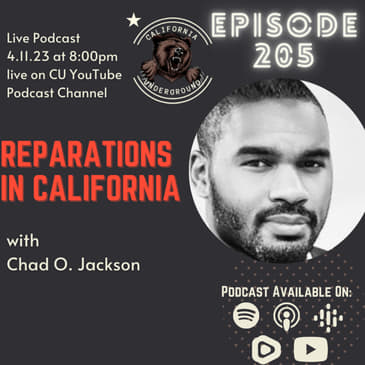
On this episode we are joined by Chad O. Jackson to discuss the idea of reparations in California, and how the idea is completely insane. We also discuss the larger cultural issues, and the history of the struggles of Black Americans from slavery up through the 1970's.
To follow Chad more you can find him on Instagram at @chadojackson
*The California Underground Podcast is dedicated to discussing California politics from a place of sanity and rationality.*
Support California Underground on Patreon at www.patreon.com/CaliforniaUnderground
Follow California Underground on Social Media Instagram: www.instagram.com/californiaunderground
YouTube: https://www.youtube.com/channel/UCj8SabIcF4AKqEVFsLmo1jA
Substack: https://substack.com/profile/72986149-ca_underground
Shop California Underground Merchandise: https://california-underground.creator-spring.com
Review the Anchor.Fm Privacy Policy: Anchor - The easiest way to make a podcast
00:00:06
What's going on everybody? Thanks for tuning in to another
00:00:08
episode of California underground podcast.
00:00:10
Tonight, we have a very special guest, Chad jocks.
00:00:12
And I've been a big fan of his following him and a lot of what
00:00:16
he has to say. I would call him a thought
00:00:18
leader. That's for sure.
00:00:19
There's a lot of stuff that he says, that when I watch our
00:00:22
scope, blows my mind. We're very lucky to have him
00:00:25
tonight. Chad, how are you doing tonight?
00:00:28
Thanks for coming on the show. I'm very good.
00:00:31
How are you? I'm doing great.
00:00:35
And as always the fastest and best researcher in the west
00:00:39
Camille, my co-host temporary Coast as of last week.
00:00:44
How are you doing tonight? I'm good.
00:00:47
I'm not sure how to handle just being the co-host though.
00:00:49
Gonna have to you know get you sick again or something?
00:00:52
Yeah. Well you know yeah you tasted.
00:00:55
It's like which Greek myth was that apparently or Perseus flew
00:01:00
too close to the Sun. So now you got to go back down
00:01:03
to be co-host for a little bit. As you can see, I'm good much
00:01:08
better than last week but we're not here to talk about whether
00:01:11
I'm feeling well or not. When you're right, yes?
00:01:15
Okay, both out of Southern California.
00:01:17
So, So the point of tonight's podcast and we've been going
00:01:25
back and forth and we're lucky to have chat on tonight, is this
00:01:29
issue of reparations in California and it's been sort of
00:01:34
a Hot Topic at 70. Been a hot button issue here in
00:01:37
California. There's been a lot of numbers
00:01:39
thrown around of what it's going to cost.
00:01:41
What they're trying to propose. There is a task force right now.
00:01:44
In Sacramento, there's another task force in San Francisco,
00:01:49
which is also, Opposing their own plan.
00:01:54
So, we want to kind of open it up, chili.
00:01:56
Guess we'll just start off the question.
00:01:58
Right off the bat. Have you heard about reparations
00:02:02
in California? And do you have any initial
00:02:04
thoughts about this? The topic at hand?
00:02:08
Yeah, I have heard about the task force, the various task
00:02:12
force that are popping up, not only in California, but around
00:02:14
the country, and you'll find that as we get closer and closer
00:02:19
to the 2024 election, more reparations, talk will come up
00:02:26
because the thing that happens ever so often, especially during
00:02:31
the time election, season rolls around, is these controversial
00:02:36
topics become all. More, you know all the rage.
00:02:40
And so as to Galvanize people for your votes in particularly
00:02:46
black people, the Democrat Party in particular.
00:02:49
Understands that one of their keys to success is that coveted
00:02:55
black vote. We as black folks, both 90-plus
00:02:58
percent for Democrats. And the reason blacks do that is
00:03:03
because blacks are conditioned to believe that the Democrat
00:03:07
Party is is on the side of the black, you know, person and so
00:03:13
There is a lot of talk and the black, you know, social media
00:03:18
sphere, over reparations. A lot of black people believe
00:03:23
that they are owed reparations because of the rhetoric coming
00:03:28
out of, you know, programs like The Breakfast Club was
00:03:31
Charlemagne. Also, you have black economists.
00:03:36
Like Claude Anderson you also have black kind of manosphere
00:03:42
Are influencers like to Rican the sheet.
00:03:46
And a lot of it is talked about in, you know, IG accounts like
00:03:51
the shade room and a lot of black people consume this kind
00:03:56
of content and so it's becoming all the more again.
00:04:00
It's one of those things that's all the rage.
00:04:01
And so, They understand the Democrats, they understand that
00:04:07
to the extent that black people care about this kind of thing,
00:04:11
they had better get ahead of it and put together some remnant of
00:04:16
a reparations package, that would help to kind of keep that
00:04:22
that loyal vote coming. And so again, it is my judgment
00:04:30
that as we We get closer and closer to the election.
00:04:34
You'll see a lot of it happening.
00:04:38
I think the whole idea of reparations is just completely
00:04:41
asinine. And the reason for that is
00:04:43
because as an independent researcher myself, I just know
00:04:46
too much about our history to believe that reparations is a
00:04:51
good idea. Namely that whenever slavery
00:04:55
ended Something that not a lot of people talk about.
00:04:59
In fact, hardly anyone talks about is the fact that a lot of
00:05:02
these slaves who are on the plantation who were you know set
00:05:07
free. A lot of them received monetary,
00:05:11
monetary resources and land from their former Masters,
00:05:18
notwithstanding like anything that was coming out of the
00:05:21
federal government or any kind of mandates or regulations that
00:05:24
the federal government we're imposing.
00:05:26
These Masters. And also, it's important to note
00:05:29
that a lot of the children of former slave owners and the late
00:05:35
1800s were going into their own pockets and donating money to
00:05:40
Black colleges and universities and black schools.
00:05:44
There were many quote-unquote reparations that were dispersed
00:05:48
at the, you know, private level and so again, when you look at
00:05:54
the trajectory Curry of Black America from the end of Slavery
00:05:58
to around about the 1960s, a blacks were trending upward and
00:06:03
literally every facet. And it was only after the 1960s
00:06:07
where blacks began to trickle downward and that's a different
00:06:10
story entirely. But again, this idea of
00:06:13
reparations is predicated on a revisionist history.
00:06:18
A lot of false history and just complete ignorance.
00:06:21
All together. So it's I feel like it's at this
00:06:26
point. It's been sort of a topic that
00:06:30
has been brought up occasionally every year.
00:06:33
Someone will bring it up, it seems to be a topic of
00:06:35
conversation. I think the the what has kind of
00:06:41
Taken people a back right now is that California is now actually
00:06:47
going through the process. There is a task force involved
00:06:52
and the Nature which is a super majority of democrat can now
00:06:57
determine whether or not this bill passes and whether
00:07:01
reparations in California does pass.
00:07:05
I feel like in this is sort of to your point that a lot of
00:07:09
Democrats are trying to woo the black bow.
00:07:14
And that reparations comes up every so often, why do you think
00:07:19
all of a sudden now out of nowhere, California goes we're
00:07:22
going to go for it. We're going to go Go for the
00:07:23
Gusto we're going to really actually have a legislative task
00:07:29
force, that's going to examine this make recommendations, and
00:07:33
the legislature is going to vote on it.
00:07:34
Because as far as, I know, maybe I'm wrong.
00:07:37
I can't remember a state legislature getting this far in
00:07:41
the process in California might be unique in that sense of why
00:07:44
it's doing it. So, any thoughts, as to, why
00:07:48
right now in 2023, California is trying to lead the way on that.
00:07:55
Well, if there's any truth and the notion that politics is
00:08:00
Downstream of culture, I think therein lies the answer because
00:08:04
you know as I said before, with all this reparations talk being,
00:08:10
you know, disseminated by the likes of Tariq Nasheed Umar
00:08:14
Johnson is another one of them. Claude Anderson a lot of these
00:08:18
people and black influencer spaces who are really beating
00:08:23
this. Drum of reparations and are
00:08:27
doing so well. At the same time, posing a
00:08:29
threat, to the Democrat Party and kind of holding their feet
00:08:32
to the fire in a way of saying, like, look, we are gaining
00:08:39
traction as far as being looked up to people, you know, people
00:08:44
who are looked up to within these kind of black spaces and
00:08:48
we can actually use that against you if you don't go our way in
00:08:52
terms of you know, pushing Seeing certain legislation.
00:08:55
And so again, the Democrat Party have for a long time.
00:09:00
I look at it again, I'm not, I'm not a partisan myself.
00:09:04
I don't have any loyalty to any political party, but one of the
00:09:09
things that can be said of the Democrat Party in a way that
00:09:13
they're different than the Republicans is that they have
00:09:16
kind of at their Reigns very crafty.
00:09:21
Strategists, in terms of figuring out, ways to appeal, to
00:09:27
the vice of humanity, appealing to the kind of entitlement of
00:09:33
humanity. In order to win certain votes to
00:09:38
take, or to maintain power. Whereas a Republican party, have
00:09:44
a lot of gullibility about them where they're constantly caught
00:09:48
off guard by the more crafts. Dear Democrat Party.
00:09:52
And so they're constantly. Like I believe that the
00:09:54
Republican party is just a shell of the Democrat Party from 10 or
00:10:00
15 years ago. Nobody stops to think about what
00:10:06
true republicanism is. Namely the belief in preserving
00:10:12
the Republic where as the Democrat Party are individuals
00:10:17
traditionally speaking, who believe in the preserving of a
00:10:20
democracy, So these are two different ideas that we're
00:10:23
talking about. But again, when you look at how
00:10:28
a lot of Democrat Party policies were crafted by influences from
00:10:36
the Frankfurt school and the middle middle part of the 20th
00:10:39
century, when you look at, a lot of the radicals in the 1960s who
00:10:45
under the chest of people like Saul Alinsky to encourage these
00:10:49
young long-haired hippies. To clean themselves up to cut
00:10:52
their hair and take, you know, positions of power and local
00:10:56
state and federal government, Hillary Clinton being one of his
00:11:00
disciples. Again, you begin to understand
00:11:04
the kind of crafty nature of the Democrat Party which includes
00:11:08
checking the pulse of culture and positioning yourself as a
00:11:13
party in such a way to appease that which the culture demands.
00:11:18
And right now to answer your Shannon.
00:11:21
This kind of long, long winded, way when you see people in the
00:11:26
culture, like these influencers who I mentioned before, who are
00:11:30
beating this drum, the Democrat Party far be it from them to be
00:11:35
on the wrong side of the culture, or the wrong side of
00:11:39
History, so to speak. And so rather than quelling Or
00:11:46
tampering the kind of rhetoric that's coming from these
00:11:50
influencers. They see it fit to try to in a
00:11:54
sense of peas or give them what they want and so again
00:11:58
reparations isn't anything new. It's just the drum is be is
00:12:03
being beaten more consistently and more louder.
00:12:07
And as such the Democrat Party is trying to find ways to to
00:12:11
appease the problem with these these groups and California and
00:12:19
across the country is that if they get what they want in terms
00:12:24
of legislation, in terms of regulation, in terms of, you
00:12:27
know, pushing these these reparations bills, it won't
00:12:30
really appease anything at all because the issue that black
00:12:35
culture has today in 2023, has nothing to do with money, it has
00:12:39
more to do with character as more to do with values.
00:12:43
And the story is that we Black's tell ourselves the black kind of
00:12:49
ethos is one that's rooted in again.
00:12:53
Revisionist history, rooted in slogans more so than reality.
00:12:59
You have a big problem with a lot of black children growing up
00:13:03
without fathers in the home and the importance of a father in
00:13:07
part is that when you have a dad in your life, he can counteract.
00:13:14
A lot of the Poisonous narrative that's, you know, being
00:13:19
disseminated and culture that's coming to you by way of music
00:13:23
and entertainment. This coming to you through the
00:13:26
education system. A lot of just nonsense a lot of
00:13:29
poisonous that's being poured into the minds of our youth.
00:13:33
If you have a dad in your life to counteract that with values
00:13:37
with truth with tough, love with discipline, then you will be
00:13:44
less likely to Go by the wayside as far as the cultures concern.
00:13:48
This is why the majority of people of men who are in prison
00:13:52
these days did not grow up with a father.
00:13:55
And so again, the issues that black culture has have nothing
00:13:59
to do with money, and has everything to do with values,
00:14:03
and with character, and there's no amount of quote-unquote
00:14:05
reparations that will fix it. It reminds me of the person who
00:14:10
wins the lottery and then five years later, they're dead broke
00:14:13
and they're even worse off then than they were before.
00:14:16
For they won that money and so money.
00:14:18
Throwing money at blacks is not going to fix the cultural issues
00:14:22
that that will stem from, you know, having or you know that
00:14:27
that blacks that black culture has and to make matters worse.
00:14:32
Once this money is thrown at the issue, you'll find that a lot of
00:14:37
blacks will be worse off and then we'll be begging once again
00:14:41
for even more reparations because the first time wasn't
00:14:43
enough and so will become this kind of thing.
00:14:46
Where it's doubled down triple down, quadruple down, so on and
00:14:48
so forth. Well, into the future.
00:14:52
I want to go back to your poignant statement, that
00:14:58
reparations are asinine because while there's the state as
00:15:06
California is proposing or going through their process with their
00:15:11
task force, there was a number that was floated around and they
00:15:14
are now trying to back off of this and it was around 800.
00:15:20
Billion. I think was the number that
00:15:23
would, it would cause California, which is more than
00:15:26
four times, our actual state budget would bankrupt the entire
00:15:29
state, but even crazier, if we're going to go down the road
00:15:32
of what is asinine, and that's not common sense.
00:15:35
San Francisco not to be outdone by Sacramento, has their own
00:15:41
task force, where they proposed five million dollars for every
00:15:44
black resident of San Francisco. It goes as far as to say, they
00:15:48
want a monthly stipend to kind of Of equal out incomes of black
00:15:54
residents. And I believe I'm believe what
00:15:58
they did say was that for, they want for 250 years, they want
00:16:02
these benefits to continue as sort of a way of saying, as for
00:16:06
the 250 years. There was slavery, here's 250
00:16:09
years in San Francisco that you're going to get reparations.
00:16:15
So, I guess to your point about how asinine it is expound on
00:16:20
that, and based on that information, why?
00:16:23
That that's not going to help and why, you know, it's you have
00:16:27
these task force are throwing out these crazy numbers.
00:16:31
And in the end, it does nothing to solve any issue.
00:16:36
Of whether it's racial inequality or any sort of social
00:16:40
justice or anything like that. Well, I think well, I know the
00:16:50
whole objective with this whole reparations, talk and just the
00:16:54
craziness that, you know, you just talked about with 5 million
00:16:57
dollars for 250 years. Just ridiculous obviously
00:17:01
doesn't work out economically, but I think that the engineers
00:17:06
of these kind of ideas know that I won't work out and they
00:17:09
understand to that, Black, the black quote-unquote struggle.
00:17:15
Be it, civil rights or what have you is.
00:17:18
Always the incision point for more to come.
00:17:22
Because the next thing is like, okay, and I think they're
00:17:25
already doing this and at least some parts of California where
00:17:28
if you are trans you get a check or something like that.
00:17:33
But the whole objective is to now, say, okay, well, now that
00:17:38
blacks are getting their reparations, this other group
00:17:41
was, you know, Had to suffer some kind of Oppression or some
00:17:45
kind of issue as well in the past.
00:17:47
And so, they are due for reparations.
00:17:50
And now, this other intersectional group is also due
00:17:52
for reparations and what tends to happen.
00:17:55
I think Tucker Carlson did a story on this a few months ago
00:17:59
with regard to homelessness and California where you had these
00:18:04
law firms, who were Who partook, and the kind of passing of laws,
00:18:12
Around the idea of Homeland of homelessness that seemed from
00:18:17
the surface to be 2 into B in which seemed from the surface to
00:18:25
intend to help with the homelessness situation.
00:18:28
But the net effect of it was who actually make the situation
00:18:32
worse because they understood that by making the situation
00:18:36
worse, it will create fodder or necessity to advocate for
00:18:41
housing. And to allocate funds for
00:18:45
housing and whenever you get those funds, you get individual,
00:18:49
you get these companies who get these contracts and then they
00:18:52
get money. And it's just, it just creates
00:18:55
this kind of way to kind of scream money into the pockets of
00:18:58
these law, firms into these pockets of these politicians and
00:19:01
so on and so forth. So these are the kind of long
00:19:03
game long game that they play. But When I look at reparations,
00:19:10
I see it as a kind of sophisticated way of getting to
00:19:15
a kind of socialist State. And what I mean by that is when
00:19:19
you look at the, this whole concept of you get a monthly or
00:19:26
annual stipend, which is supposed to take care of all
00:19:30
your needs, which is supposed to be a, see, some kind of payback,
00:19:34
or your past struggles, or the struggles of your ancestors.
00:19:38
what that does is that D incentivizes creativity that D
00:19:41
incentivizes, work that the incentivizes the conventional
00:19:46
means by which one provides for themselves and What that does at
00:19:54
the same time, is that expands the role of government in your
00:19:59
life? And so, when you look at
00:20:05
socialist ideology, Marxist communist ideology, the whole
00:20:09
concept is you don't own anything.
00:20:12
The state owns everything, the government owns everything, the
00:20:15
People by way, of the state owns everything, and everybody puts
00:20:21
in. And everybody gets out from each
00:20:22
according to their Already to each according to their need.
00:20:26
And there is still a large segment of the American
00:20:28
population who rejects Marxism on its face.
00:20:32
And you can never convince them to go for Marxism where
00:20:37
socialism you can. However, emotional eyes them to
00:20:41
go for certain other things that don't Smack of Socialism or
00:20:48
Marxism from the surface, however socialism Marxism.
00:20:53
Lies underneath the surface and a lot of people unfortunately,
00:20:57
because of our subpar education system, do not have the ability
00:21:04
to think critically. And to look thoroughly add these
00:21:07
different policies and see what the long-term effects on society
00:21:13
that these policies will pose. And as such, they go for it and
00:21:17
they put their hats in the ring. I mean I hear I see a lot of
00:21:19
white people right now who are saying things like.
00:21:22
Well, let's just give And reparation.
00:21:24
So that they'll be quiet, right? And so a lot of people just kind
00:21:27
of tired of the subject and are saying like, Okay, just give
00:21:30
just give them what they want. So we'll go away a little, do
00:21:33
they know it will never go away. You know what I mean?
00:21:36
You know I'm saying. And so again, it's to that
00:21:40
extent and more that I say, it's asinine because I see it as a
00:21:44
kind of, yet another step, and this long kind of drawn out,
00:21:54
Plan to create chaos and to use that chaos as fodder to use that
00:22:00
Fallout 2. Then a expand the role of
00:22:03
government and be pushed more regulation that will work.
00:22:09
More to the detriment of the people.
00:22:10
And to the benefit of those who are in power.
00:22:15
Sorry for these limited Answers by the way.
00:22:18
No, it's no problem. That's why we do a podcast so
00:22:21
that we can actually long-form discussions and not new-snippets
00:22:26
to your point that you just brought up it.
00:22:29
I think it does condition people to kind of ask different groups,
00:22:34
different, ethnicities to go. Okay, then, where's my payout?
00:22:40
For example, my wife is Mexican, and when she heard news of this
00:22:44
First response is well, where is the reparations?
00:22:50
If you're talking about reparations in California for
00:22:52
any group, it should be Mexican Americans because we were here
00:22:56
first. You stole the land from us.
00:22:59
Where's our reparations and it but I think that's a valid point
00:23:02
that all of a sudden there's going to be these groups that
00:23:04
then all of a sudden raise their hand and go, wait a second.
00:23:07
I was wronged so now where's my payout?
00:23:10
And then it does Usher in this idea of like the government
00:23:13
should be given you some sort of monetary compensation Engineers,
00:23:18
the engineers of these policies in these ideas and know that
00:23:21
they know that it's not as if you have these people who are
00:23:24
genuine and have this deep concern for the black struggle
00:23:27
in America. And once they get the
00:23:29
reparations for blacks, they're done, they'll go back to life.
00:23:32
As you know, they understand this kind of clamoring that will
00:23:36
ensue if such a bill were to pass.
00:23:41
So they know full well what they're doing, you don't have to
00:23:44
take my For it. You can just wait and see, but
00:23:47
I'm pretty sure that's how all this is.
00:23:49
All the stuff is going to unfold.
00:23:52
Yeah, and it's hard but and Democrats in the left are crafty
00:23:58
in the sense that they they know how to craft an argument and
00:24:02
begin the argument frame, it in such a way.
00:24:05
That if you are to push back on it, their defenses.
00:24:09
Well, then why you don't want? Why do you want out want
00:24:12
representations? Are you a racist?
00:24:14
Are you a bigot? You know, if you're white, you
00:24:18
can oppose reparations. Why?
00:24:20
Why would a white person oppose? Ins obviously it's because
00:24:24
you're racist and you don't want black Americans to get
00:24:26
reparations. So they've they figured out this
00:24:28
way to craft their argument so that you can't come at it from
00:24:33
these different angles and I mean they do that a lot with all
00:24:36
groups. I mean, transgenders anything,
00:24:38
they usually hide behind this victimhood mentality.
00:24:42
Where if you try to bring up a logical point or a common sense
00:24:45
point about the argument site way, I have actual common sense
00:24:49
or objectable points that I'd like to make they go, will you
00:24:52
Big at your racist, you can't talk about reparations and
00:24:57
meanwhile, they are ushering in this idea of Marxism and
00:25:01
socialism and payouts from the government and Reliance on the
00:25:04
government, even more more, while people into tractors,
00:25:08
can't really speak up about it. So that is to your point about
00:25:13
how crafty the Democrats are and how the left is is able to kind
00:25:16
of Steel, Man, their own arguments 100%.
00:25:21
That's a woman. I would like reparations for not
00:25:24
being allowed to vote. There you go.
00:25:26
Until I know I'm late. But like I said, DNA test and I
00:25:33
know my family would came over on the Mayflower on one side and
00:25:37
then others were here before the Civil War there, for the fact
00:25:39
that I'm 2% Nigerian means that I am definitely related to a
00:25:42
slave so I want my 2% chance as well as the fact that I'm a
00:25:48
woman. No but really like then you
00:25:50
know, the Japanese He's that we had in camps like, where's their
00:25:53
fair share, and I want to go way way back to the beginning when
00:25:56
we talked about California. And why are we pushing it now?
00:26:01
I believe Newsom. I mean, look, we just passed
00:26:05
proposition one. We're basically killing babies
00:26:08
up to birth. He's an extremist and he, we
00:26:11
know he wants to run for president.
00:26:13
I think he just trying to get whatever he can under his belt
00:26:15
to say, look what I did. Look what I did.
00:26:17
Would it look like? And so if he can be the first to
00:26:19
claim that he passed, Then that's one more little check box
00:26:23
for him. With the Democrats, just want to
00:26:26
throw that in there. Yeah.
00:26:29
I mean you're right and again like when it comes to the
00:26:33
political aspirations of these politicians, they check the
00:26:37
pulse of culture and some ways they influence.
00:26:42
Thought they invoke certain feeling and stimuli in culture
00:26:46
and then use that to their advantage during election
00:26:49
Cycles. Again, it's a power play and I
00:26:52
think people underestimate excuse me.
00:26:54
I think people underestimate The depth that these people are
00:27:00
willing to go to secure power for themselves.
00:27:03
And if that means taking advantage of the ignorance, the
00:27:11
lack of Education of how our government functions and their
00:27:15
role in society as a citizen. If that means taking advantage
00:27:19
of that, they will do it and they have done it again.
00:27:22
It's not it's not a conspiracy theory in the negative sense of
00:27:26
the word. Is literal well-documented
00:27:29
history of how this thing has played out reparations, is yet
00:27:33
another social justice movement and we look at the course of the
00:27:37
20th century and the way that social justice movements were
00:27:40
used to invoke feeling and the masses and to, you know, to
00:27:45
believe that they are part of something so much that they are
00:27:50
willing to support policies that they believe will bring about
00:27:54
Liberation and freedom and all the things.
00:27:57
Well, oftentimes what, what these policies yield once again,
00:28:01
is a more expansive government, who plays a larger role in your
00:28:07
life and less Freedom. So we're vesting our government
00:28:11
with more power than it's ever had on the back of these
00:28:15
so-called social justice movements.
00:28:17
And so when you look at different, you know, Programs
00:28:26
that when we study like political science and social
00:28:30
science and all these things, we think that these are just cool
00:28:34
things to think about and talk about what the reality is.
00:28:39
What these? What these studies and these
00:28:45
programs are yielding is a lot of people who are themselves
00:28:50
social Engineers who are trying to figure out ways to advance
00:28:53
power for themselves more so than use them for any kind of
00:28:58
greater good. So, I know that's kind of
00:29:00
getting off course, but just something worth considering
00:29:06
Sorry. You can go ahead.
00:29:08
No, you go ahead Camille. I've been asking a lot of
00:29:10
questions, Chad, a couple weeks ago.
00:29:12
That podcast. I mention I was watching when
00:29:14
you did on Sunday night with three other people regarding
00:29:17
reparations. You so eloquently talked about,
00:29:21
I'm going to totally butcher the wording.
00:29:22
You said something about basically the way that modern
00:29:26
day, we describe how slaves were is that they were basically
00:29:31
useless. Illiterate couldn't do anything.
00:29:33
But yet somehow they managed to populate and are still here.
00:29:37
And one thing I was reading was that when slavery ended right
00:29:41
away teachers and they said black and white teachers from
00:29:44
the north immediately came in and started, educating them how
00:29:47
to read how to write and even training them to get different
00:29:50
jobs and that's something that is not really talked about
00:29:54
because it does sound like we kind of just like, okay slavery
00:29:57
ended, we just dropped him in the middle of a field and was
00:29:59
like, you know, do what you will try to survive.
00:30:02
Good luck to you or whatever, but like, you They were, they
00:30:06
were given land and money at the time and were given.
00:30:09
And they, so we have this idea of like, they are so illiterate
00:30:12
and, and stupid and useless the way that being talked about, but
00:30:16
no, they were reading. They were writing, they were
00:30:19
starting businesses. And, and even you mentioned
00:30:21
earlier, they were thriving until the 60s.
00:30:23
And I was reading about, as they started to Head West, they were
00:30:26
like in Kansas City, I believe they had like thriving black
00:30:30
communities, and then even California.
00:30:31
They started to make their way out here eventually thriving.
00:30:35
These. And so then do you mind touching
00:30:37
upon kind of the 60s? I know that's a whole thing and
00:30:40
I did watch Uncle Tom but if you want to throw a few things out
00:30:43
there, Yeah, I mean, we look at Baldwin Hills, I don't know if
00:30:47
it's still this way today, but it was certainly this way for a
00:30:51
long time. Bald will Baldwin Hills was
00:30:54
like, the black Beverly Hills, for a long time, he had black
00:30:58
professionals Architects, doctors lawyers, Engineers,
00:31:02
things of that nature. But there are many such Baldwin
00:31:05
Hills is all across the South. And I think, you know, our
00:31:11
education system does a huge Injustice in terms of painting
00:31:16
this picture of what the South was like you had mentioned that
00:31:22
teachers came Educators came from the north to the South to
00:31:25
teach, you know, these former slaves.
00:31:27
And and while that is true, there are a great number of
00:31:30
those Educators who are already in the South.
00:31:33
The rhetoric that are the narrative that we believe
00:31:37
regarding what slavery was like, is that, oh, you weren't allowed
00:31:40
to read, you weren't allowed to learn, how to read and that was
00:31:43
true. On many plantations.
00:31:45
But it was also true of many plantations that slave holders
00:31:49
were educating their slaves. They wanted them to know how to
00:31:53
read because it was beneficial to them with regard to keeping
00:31:57
their Enterprises going. And so we have this kind of of
00:32:03
established idea this Narrative of what slavery was like.
00:32:09
You think of a white guy with a, you know, a hat on a back of a
00:32:14
horsewhipping, the Negroes in the field while they pick
00:32:19
cotton. That's the image that we have.
00:32:22
And the reality is though that may have been true on some
00:32:28
plantations, it certainly wasn't true on all and so I think that
00:32:34
it's easy to kind of dehumanize People who lived long ago when
00:32:40
you weren't there to kind of witness it yourself.
00:32:42
And so we're only left to do our own research.
00:32:45
I mean Camille Phil mention that you are a researcher for.
00:32:50
You know, for his podcast, I myself am an independent
00:32:53
researcher and so I spent a great deal of time poring over
00:32:58
archives and correspondence and you know reading and doing all
00:33:02
the things they have a better understanding of the past.
00:33:06
Because it's to that extent that I can begin to understand what
00:33:09
it was really like, and develop a solid conclusion versus just
00:33:15
going along with the narrative. And so again I mentioned earlier
00:33:19
the from end of Slavery to round about the 1960s.
00:33:24
If numbers count for anything, you know, if we can use numbers
00:33:28
as a good barometer or is it did you know pulse of what Black
00:33:32
America was like, again, trending upward in terms of
00:33:35
Entrepreneurship? In terms of black families who
00:33:39
are owning homes and terms of the kinds of careers that blacks
00:33:46
are taking up after being turned out of their high schools, which
00:33:51
again, were entirely black during the times of segregation.
00:33:56
If those come for anything, then you know, it's the narrative,
00:34:02
should be that blacks thrived despite the odds and I only
00:34:06
blacks, but if you look at the Irish who weren't exactly
00:34:09
welcomed everywhere, if you look at the Italians who weren't
00:34:12
exactly welcomed everywhere, if you look at the Hispanics who
00:34:15
weren't in the Asians who weren't, and I mean, again, we
00:34:19
have this narrative, that only black people have ever suffered
00:34:22
in America and is completely false it just on its face false.
00:34:27
But it's important to pay attention to, you know, Soviet
00:34:31
Union communist comintern who wrote in length about In which
00:34:37
to use racial animosity to bring the West to its knees.
00:34:42
This is well-documented specifically the 1928 communist
00:34:45
comintern that address the question of what do we do about
00:34:52
the fact that a lot of these Southern Negroes are beginning
00:34:56
to establish for themselves? Very comfortable lives, you
00:35:00
know, these negro workers they were in disarray over the fact
00:35:06
that These blacks were beginning to unite, with ordinary white
00:35:10
Americans. And they didn't want blacks to
00:35:13
unite, with ordinary white Americans.
00:35:15
They wanted them to, to fight against imperialism and unite
00:35:19
instead with the white Communists.
00:35:22
And so, they would go out of their way to try to create
00:35:26
animosity, between whites and black and blacks going so far as
00:35:31
to even Influence the KKK, the Communists.
00:35:38
And to burn down churches and to frame it as if to say, look,
00:35:41
these white Southerners did this because they don't want blacks
00:35:43
to be successful. Again, all this stuff is, is
00:35:46
very well documented. And so as you get into the
00:35:49
1960s, it's important to understand that the thing that
00:35:53
motivated and was the kind of engine to allow the black
00:35:58
success that we saw in America were men like Booker, T,
00:36:02
Washington, who preached, you know, cast down your bucket
00:36:04
Where You Are. An entrepreneur be productive.
00:36:08
Nobody's going to do it for you. Got to do it for yourself.
00:36:10
There were other. There are other such Booker T
00:36:12
Washington's, who were looked at as these are people to emulate
00:36:18
and it was having real net effects on black men in America.
00:36:22
Once the 60s came around and particularly Martin, Luther
00:36:25
King, who was popularized by the liberal mainstream media.
00:36:28
He was on the cover of Life magazine Time.
00:36:30
Magazine New York Times like they were just lauding this guy
00:36:34
as the new hero. Granted, he was rejected by most
00:36:39
black Southerners when he first came on the scene because he was
00:36:42
looked at as a radical the NAACP equally had a hard time or
00:36:48
similarly had a hard time really growing a following and the
00:36:54
Negro South and fact the National Baptist convention
00:36:58
which was a conservative you know black institution boasted
00:37:03
eight million members. As the NAACP at the same time,
00:37:08
both stood only 250 members and so that kind of gives you an
00:37:14
insight into where the black mindset was in terms of the way
00:37:19
in which to be successful. They didn't go the NAACP way,
00:37:23
which was rooted in socialism? They went instead, the National
00:37:25
Baptist Convention Way which was routed more and americanism and
00:37:30
Traditional Values. And so, when Martin Luther King
00:37:33
came on the scene, he challenged the The National Baptist
00:37:36
convention, which was headed by a man named Joseph H Jackson.
00:37:43
He tried to oust Jackson as the president of the National
00:37:47
Baptist convention, but the blacks overwhelmingly supported
00:37:50
Jackson over Martha King. And so in retaliation, King, by
00:37:56
way of Stanley levison, who was a communist advisor to King
00:38:00
started, something called the progressive, National Baptist
00:38:04
convention. And when that didn't do very
00:38:06
well, they started the southern Christian leadership conference.
00:38:09
So the SCLC was created because As blacks over overwhelmingly
00:38:15
rejected King in his program. But again, he was made popular,
00:38:18
he was popularized by the progressive media, and he was
00:38:21
made a hero artificially and then it took off organically
00:38:24
after the fact. But again, it's important to
00:38:29
like this. The reason I say all that is to
00:38:31
say that it was a breakaway, like, kings rhetoric was a
00:38:35
breakaway from Booker T Washington, where the vicar
00:38:37
we're Booker T, Washington's taught you to cast down your
00:38:40
bucket where you are be productive.
00:38:41
Nobody's going to do it for you. King on the other hand, in a
00:38:46
very Charming way, kind of invoke the spirit of bitterness.
00:38:50
For example I think of the to America speech where he said
00:38:53
that, you know, whites are living in this Land of Plenty.
00:38:56
Never mind. The fact that you have that
00:38:57
Malaysia, never mind. The fact he had poor whites who
00:39:00
were at the same time picking cotton while blacks were picking
00:39:02
cotton. There's pictures of, this is a
00:39:04
well-documented White's, not every white person had it so
00:39:07
easy. But according to King speech,
00:39:10
they did, they're leaving in a Land of Plenty.
00:39:12
They have all these privileges. Whereas blacks are living on a
00:39:15
Lonely. Island's.
00:39:16
Are they can't find jobs and so on the other and you know, the
00:39:20
speech was delivered perfectly Marley.
00:39:22
The King was a great orator, he was very easy on the eyes and so
00:39:28
it was convincing and a little too convincing because again,
00:39:34
what the civil rights movement did was it invoked this kind of
00:39:38
spirit of bitterness and spirit of entitlement we began as
00:39:42
blacks to not look to ourselves or our men to help to make our
00:39:48
situation better. We chose instead to look to what
00:39:50
the government is willing to do by way of legislation, by way
00:39:54
of, you know, the voting booth and you saw a lot of Rapid
00:40:02
decline after the 60s, it's important.
00:40:05
To also note that late 60s going to the 70s.
00:40:09
You had a lot of what I quote Liberation movements be at the
00:40:12
hippie movement the free Movement the, you know, Black
00:40:16
Panther Movement, a lot of black militancy movements in fact,
00:40:20
which were charging young people to rebel against the adult
00:40:25
Society. So the Baby Boomers were very
00:40:27
problematic in that regard, they decided to kind of go their own
00:40:32
way, into break from Traditional Values.
00:40:35
And so, this had a huge toll on Black.
00:40:39
America, of course, as you get into the 70s, you have
00:40:41
blaxploitation films Like the mac and others that glorify
00:40:45
pimping and hustling and other such degeneracy and vices going
00:40:49
into the 80s, you had in the 90s had the population of gangster
00:40:53
rap gangster hip-hop. While at the same time, you have
00:40:55
an influx of black women, having babies out of bed, out of
00:40:59
wedlock. And as I said earlier, we don't
00:41:01
have a father to counteract, what's going on in the culture,
00:41:05
of course, of course, it's going to have, you're going to see an
00:41:10
influx and crime and gang activity so on.
00:41:13
So forth which brings us to the present our so I know I said a
00:41:15
lot but again this is a vast history of what we're talking
00:41:19
about here and again, no reparation is want to fix that
00:41:24
because that's not the problem to begin with.
00:41:28
Is it too late at this point? Because you have detailed sort
00:41:33
of a long history. Is it too late at this point to
00:41:38
win, back the culture with good ideas and and speakers like
00:41:42
yourself to kind of talk about these issues.
00:41:45
Is it too late to win it back? Or can these can the culture
00:41:48
sort of be changed and I in one back I do believe it can be one
00:41:53
back. Yeah, I'm not pessimistic as far
00:41:56
as that's concerned. However it's not going to happen
00:42:02
overnight, Yuri BisMan off said that it takes 15 years.
00:42:07
They're about to demoralize and society and it takes equal
00:42:13
amount of time to to read moralize a society.
00:42:19
And the problem that we're up, Against is a lot of this
00:42:24
degeneracy. And a lot of this kind of
00:42:28
frivolous fluid reality is it's brought to us in a very
00:42:38
Innovative way. Again, it's brought to us
00:42:40
through our education system has brought through us to us, three
00:42:43
celebrities and entertainment, so they all kind of reinforce
00:42:46
it. And so we who stand on the side
00:42:50
of Truth Reason. Like, we had to be creative.
00:42:57
About the ways in which we engage in culture to basically
00:43:01
re popularize Traditional Values and ideals and for me the way
00:43:08
that I play my own role, my own part is to not even talk about
00:43:13
politics to just talk, you know, cut straight to the chase about
00:43:16
the values and the history. In fact, I was talking to a
00:43:19
black woman today I have a lot of stuff on my My property, you
00:43:28
know, out here in Texas and I needed to temporarily get a
00:43:31
storage unit to house, some of my property until I get a bigger
00:43:36
shed built. So, you know, I acquired this
00:43:40
this a storage space and you know, while I was doing the
00:43:44
paperwork, I got to talking to the woman.
00:43:47
She was a black woman and I learned that she is new to our
00:43:52
area. She moved here from Jackson
00:43:55
Jackson, Mississippi. And I got to talking to her
00:43:57
about that and, you know, because I'm familiar with
00:44:00
Jackson, Mississippi in the culture.
00:44:02
That's there. It's very much, a kind of Us
00:44:04
Versus Them culture. And, you know, we were having a
00:44:10
conversation just about like, hey, so what are some of this?
00:44:13
Like what are some of the things that you like about Cedar Hill
00:44:14
that you didn't quite like about Jackson, and she's talking about
00:44:18
the things that she likes versus the thing that she doesn't like
00:44:21
and somehow or another Tulsa came out Black Wall Street
00:44:25
because yeah, did you know that? They bombed Black Wall Street
00:44:28
and I said, yeah, yeah, I did know that.
00:44:30
But did you know that they built it back?
00:44:32
And she was like, her mind was blown and, you know, I was like
00:44:37
yeah they built it back. Not even a year or so after all
00:44:39
that happened and in fact it was more of a riot than it was a
00:44:42
massacre. You know, they tell you that
00:44:44
it's a massacre but the reality it was a riot.
00:44:46
You have black shooting at White's white shooting at blacks
00:44:49
and after the dust settled you know, the blacks they picked up
00:44:52
their tools and they rebuilt their, they rebuilt their
00:44:55
community And in fact, their Community thrived from 1922 to
00:45:00
1960 and a thing that actually killed, a lot of that black
00:45:05
success than 1960s, is the civil rights movement.
00:45:08
And like she was her mom's completely blown but again I
00:45:10
didn't start off with a republican.
00:45:12
I didn't start off with like I'm a conservative or anything like
00:45:14
that. It's just we were having a
00:45:16
conversation and she was receptive to what the things
00:45:19
that I was talking about and by the end of our conversation
00:45:24
because you know I also was talking to her about
00:45:25
homeschooling And all these different things.
00:45:27
Again, not in a way that I'm forcing it on her, but just
00:45:30
talking about it from an anecdotal perspective.
00:45:32
Like, yeah, we homeschool our kids, because, you know, X y&z.
00:45:35
I have a friend in Florida. Her name is Keisha King.
00:45:38
Her daughter was in and public school, till I think freshman
00:45:43
year and Keisha noticed that there was a lot of animosity
00:45:48
between her and her daughter and Keisha, dismissed it as well.
00:45:52
You know, she's just a teenager teenagers are rebellious but the
00:45:55
reality is After she took her her daughter out of the public
00:45:59
school and started homeschooling her over the course of a year,
00:46:04
their relationship got more Tighter and it's to the point
00:46:08
now where her daughter sees her mom as her best friend and she
00:46:12
comes to her for everything and she talks to her about
00:46:14
everything and ask her all kinds of questions and it's this
00:46:18
relationship that she never thought was even possible.
00:46:21
And while I'm explaining this to this woman that I just met
00:46:24
today, like it almost brought brought tears to her eyes
00:46:27
because she is struggling with the rebellion of her rebellious,
00:46:32
the rebellious kind of nature of spirit of her son, right now
00:46:35
who's also in high school. And by the end of our
00:46:38
conversation, she was asking for my number because she would like
00:46:42
to talk to my wife about possibly homeschooling her own
00:46:45
kids. And I mean, so again these are
00:46:48
how these conversations are made.
00:46:49
These are, this is how real change happens.
00:46:51
The problem is, We as conservatives or those of us
00:46:56
who, you know, are on this side of the culture, we struggle to
00:47:02
get the kind of platform that's needed to have our voices heard.
00:47:06
And so those are the things that we got to figure out.
00:47:08
How do we get creative enough to take positions of influence and
00:47:13
culture to where the commonsensical things that we
00:47:16
are saying can be heard by many to where others will begin to
00:47:20
follow suit without being without.
00:47:23
Losing people just with the whole political talk of it all.
00:47:27
But just bringing it back to the basics of what is practical,
00:47:31
what is approachable? I hope all that makes sense.
00:47:34
Now, I agree and that's sort of one of my kind of ways.
00:47:40
I like to approach is I don't like to approach it.
00:47:42
We talked about this before we hopped on from necessarily a
00:47:45
partisan standpoint. I think there's a lot of people
00:47:48
who start off their first foot is.
00:47:51
I'm a political cheerleader for For R&D or libertarian, or
00:47:55
whatever. And the problem with that is
00:47:58
that automatically you lose so many people who might not be
00:48:02
interested in go while you're a republican.
00:48:04
I'm not going to listen to you. You're a Democrat.
00:48:05
I'm not going to listen to you. When in reality, if you just sit
00:48:09
down with somebody. It's amazing if you just sit
00:48:11
down with somebody and talk to them about values and you talk
00:48:15
to them about normal everyday, things and issues, you find out,
00:48:19
you do have a lot more common ground and you do have a lot
00:48:22
more. Or to share with each other.
00:48:26
You know, I've talked to people who were far left Democrats
00:48:30
won't but when you take politics out of it you find out you have
00:48:34
way more in common and you have way more To talk about when
00:48:38
politics isn't necessarily dividing you and to your point
00:48:42
about their culture. I maybe it's me but it is
00:48:47
completely anecdotal, but I do feel like there is sort of a
00:48:50
trend back towards traditionalism.
00:48:53
I don't know if this is a larger Trend.
00:48:58
I mean, I went to Easter Vigil, this past Saturday and I was
00:49:04
amazed that it there were 11 baptism, he's into the Catholic
00:49:08
church and the vast majority of it was young men in their 20s.
00:49:14
And I thought to myself, that's really incredible that true.
00:49:17
These young men are getting baptized into the Catholic
00:49:21
Church. Like what point did they go?
00:49:23
I'm now going to officially join the Catholic church.
00:49:26
I'm going to go through all this stuff because I want to be a
00:49:30
part of this. You see, different podcasts that
00:49:33
are starting to pop up with talk of more traditional style.
00:49:36
Living and more, I guess a return to these ideas of
00:49:41
traditionalism. So I maybe it's just me
00:49:44
anecdotally. I don't know if you agree with
00:49:46
me or not, I feel like there's an undercurrent in our society
00:49:49
right now where there is sort of a return to traditional ISM and
00:49:53
maybe it's because we've swung so far in One Direction in terms
00:49:58
of consumerism instant gratification in terms of
00:50:04
Disposability of our lifestyles of Partners of Love interests
00:50:09
of. We can bounce a person to
00:50:11
person. You know, I'm done with this
00:50:13
person. I'll just go on my phone and
00:50:14
swipe right on somebody else. I'll get to the next person.
00:50:18
So maybe there is sort of that under current happening right
00:50:21
now. Thoughts about that.
00:50:24
I if you agree with me or if you see it as well, and it may be,
00:50:28
there is sort of a tide turning right now.
00:50:32
Now I agree with that 100%. I mean, I see a lot myself as
00:50:35
well part of me and it is encouraging to hear you say that
00:50:41
being in California because to the extent that I see it, I do
00:50:46
just kind of chop it up to, okay, I am in Texas and so, you
00:50:52
know, there, Our kind of regional values at play.
00:50:58
But yeah, I do see that in my own kind of anecdotal experience
00:51:01
where, you know, I think, I think that when it comes right
00:51:04
down to it, we have regardless of where we are on the political
00:51:09
Spectrum. I mean, of course, you have your
00:51:10
extremists and I think the social media element kind of
00:51:16
kind of, I think it is misleading in terms of the
00:51:20
impression that it leaves on us in terms of what if a person
00:51:25
calls himself a Democrat, for example, the kind of The kind of
00:51:33
things that we believe in terms of well, what, what they believe
00:51:35
when in reality, if you talk to these people more often than
00:51:39
not, you'll find that a lot of them do have common sense, but
00:51:43
the fact is where, the individual is smart, the group
00:51:49
or the crowd is very dumb. And what I mean by that is there
00:51:55
is a disconnect between how people think, when they think.
00:52:01
I think loan versus how they think when they're influenced by
00:52:04
the group because we hold ourselves to certain Unwritten
00:52:08
rules that. We believe are culturally
00:52:11
acceptable that deep down. We know are just wrong or
00:52:17
foolish, you know. And so again like I think there
00:52:23
is a like to the extent that I think that there is a trend
00:52:26
toward values. It has more to do with the fact
00:52:30
that people are aged or are influenced by certain
00:52:34
individuals who they see kind of unapologetically and unashamedly
00:52:40
standing on those values, particularly with the black
00:52:44
folks, there was the late, Kevin Samuels, who talked a lot about
00:52:49
relationships and talked a lot about You know, the traditional
00:52:56
woman versus the Modern Woman, the traditional Man versus the
00:52:58
modern man. And he had this, this, this kill
00:53:02
this way, of making the traditional woman, seemed more
00:53:07
desirable, and making the quote-unquote Modern Woman,
00:53:12
look, more like a kind of laughingstock with the, you
00:53:17
know, fake eyelashes and the fake everything and wanting to
00:53:25
appeal to men, just by way of eye candy versus, you know, what
00:53:31
they have above their shoulders, and And basically, bringing men
00:53:37
the task in terms of look, you know, you're busy trying to
00:53:41
score more so than find a wife. But in order to find a wife, you
00:53:45
have to make sure that you're a husband.
00:53:47
And so, he made these concept of Traditional Values, seem cool
00:53:51
and seem attractive. And there are a lot of like he
00:53:54
had a lot of tangible results from the kinds of things that he
00:53:57
talked about. There were things that I
00:53:59
disagreed with him on, but I can, you know, give honor to
00:54:02
whom honor is due in terms of, you know, So, the kind of things
00:54:07
that you talked about, and the reason I bring him up is because
00:54:10
I think before he passed away, he had close to 2 million
00:54:14
subscribers on YouTube and any time he went live yet, like,
00:54:17
30 people watching him at a time.
00:54:20
And so, for someone with that degree of stature and that
00:54:23
degree of influence, saying, those kinds of things that's
00:54:27
noteworthy for the culture because people are listening to
00:54:32
what he's saying, and it's causing them to Collect on
00:54:35
themselves and their own lives and terms of the things that
00:54:39
they take for granted versus the things that they.
00:54:43
Yeah. So anyway, but yeah, to answer
00:54:46
your question, a my own long-winded way is I do.
00:54:50
See a trend toward values, but my hope as a Christian, is that
00:54:57
those values are rooted in biblical principles and not just
00:55:01
well, let me you know, kind of re-subscribe if you will to
00:55:05
Traditional Values because I feel like I'm going to get
00:55:07
something out of it and I mean, like, yes, we We do things to
00:55:13
get something out of it, but we should also do something, you
00:55:16
know, do things because it's morally, right?
00:55:18
And I mean, and I feel like my understanding of scripture and
00:55:22
of the Bible is that as Christians, we are to have in
00:55:28
Christ, is kind of peace that surpasses understanding.
00:55:31
Well what does that mean? Peace that surpasses
00:55:33
understanding? Well what that means is
00:55:35
uncircumcised anshel piece. In other words even if life
00:55:40
isn't going great for you. Even if you're doing everything
00:55:43
right. But yet, you know, your wife
00:55:45
divorce, you your dog died, you lost your house, whatever in
00:55:48
Christ, you have a peace, that surpasses understanding.
00:55:51
And so your circumstances shouldn't defined you as much as
00:55:55
Christ. Defining you, and if Christ
00:55:57
defines you. If Christ is your lord, then
00:56:00
that means his word is supposed to shape how you live.
00:56:04
And so, regardless of your circumstances, it shouldn't take
00:56:07
away your integrity, it shouldn't take away your
00:56:10
steadfastness. Our perseverance, your dignity,
00:56:15
you shouldn't compromise your morals because your
00:56:18
circumstances change. So I know I'm rambling at this
00:56:23
point but yeah, I do see a trend toward values.
00:56:28
I try to with my own voice and with whatever platform I have
00:56:32
ensure that I'm supportive of those values being rooted and
00:56:37
biblical principles, and not just being rooted and practical
00:56:40
or pragmatism. If that makes sense.
00:56:44
Yeah, absolutely. So I mean, it's up to people
00:56:48
with platforms to kind of keep continuing to talk about it.
00:56:51
And I think when I, when I bop around to different podcasts and
00:56:55
different shows and stuff like that, and I start to see sort of
00:56:57
an underlying current of people saying the same thing or trendy
00:57:02
in a certain way that sort of triggers in my mind, a pattern
00:57:05
of what people are going after or what is trending in society.
00:57:11
So it may take a while to get there, but Maybe because I'm
00:57:15
keeping an eye out for it, it's different and maybe I see it a
00:57:19
little bit more. We are coming up on an hour and
00:57:22
I want to be cognizant of your time and respectful of your
00:57:25
time. So with that said are there any
00:57:28
final thoughts regarding? I mean we kind of meandered all
00:57:31
over the place which is fine by me on the topic or anything
00:57:35
you'd like to say before we sign off for the night.
00:57:39
Yeah, I mean, just to Echo what I said earlier that, I feel like
00:57:43
with this reparations, talk it, it sounds good, it offers for
00:57:51
many people, it kind of instant gratification and it's
00:57:56
predicated on revisionist history, on false history, and
00:58:01
false narratives. And You know with with critical
00:58:06
theory and all these things, which presumes that there is
00:58:12
systemic justices at play that keep black people behind.
00:58:15
And as such there is a kind of There are steps that can be made
00:58:23
monetarily to make a right, you know, that which is wrong.
00:58:30
Again, my biggest point is that well know that that will never
00:58:37
happen, you know, you know the government cutting you a check
00:58:40
will not make things right? Because again your premises are
00:58:44
wrong. And so again like my biggest
00:58:48
takeaway is that there's culture Issues at play.
00:58:52
And I can't beat that drum enough.
00:58:55
And unless and until we set on the journey set ourselves on the
00:59:00
Journey of addressing and at least talking about those
00:59:03
cultural issues without blaming racism.
00:59:06
Without blaming the white man without blaming someone else,
00:59:09
but looking at our own cells reflecting on our own selves,
00:59:12
unless and until we're willing to do that, we're never going to
00:59:14
see any kind of upward trajectory, because to the
00:59:18
extent that you blame someone else for your own problems.
00:59:22
The Source kind of goes. Unaddressed and so long as it's
00:59:28
horses and addressed the problems will fester and worsen
00:59:33
and so I'm only interested in real solutions to problems.
00:59:38
First of all, acknowledge in the real problems and then,
00:59:40
secondly, second of all, moving on to a solution.
00:59:43
I'm a very solutions-based thinker and as such I don't have
00:59:48
time to focus on racism, that's not there.
00:59:51
I don't have time to focus on, you know a problem that never
00:59:54
existed. But again, there's something to
00:59:59
say for the fact, once again that the majority of men who are
01:00:02
in prison are men who grew up without fathers and their lives
01:00:06
or something to say about the fact that again to the extent
01:00:11
that black youth, consume a lot of, you know, culture through
01:00:16
music and through entertainment that reinforces and glorifies
01:00:21
degeneracy, and Thuggin and gang banging to the extent that they
01:00:25
consume that and do. We have a dad and their lives to
01:00:28
counteract that with truth and wisdom.
01:00:32
The problem will only get worse. And again there's no amount of
01:00:35
reparations that will fix that and it's sad to see that.
01:00:39
There's not enough Scholars, there's not a lovely enough
01:00:42
academics, there's not enough celebrities who are addressing
01:00:44
the real issue but we can't wait on them to address the issues.
01:00:48
We have to use our own voices to do it.
01:00:51
If nobody else is willing to Excellent.
01:00:55
Well, thank you, Chad, so much for coming on working people.
01:00:58
Find and follow you and hear more from you.
01:01:03
I'm on Instagram and YouTube and Twitter all at Chad.
01:01:08
Oh Jackson. Excellent goal.
01:01:12
So, with that said, everyone who's been tuning in tonight,
01:01:17
best thing you can do? If you enjoyed this show to
01:01:19
support the show, is to share it with at least one person text
01:01:22
the to message them. I don't really care how you do
01:01:25
it, just send it to them. Like, share, subscribe review,
01:01:28
all of that stuff. We do this every Tuesday night
01:01:31
at 8 p.m. we got lots of stuff coming up, so make sure you hit
01:01:35
the notification Bell as well. I think I set the whole Spiel
01:01:39
and have a good night everybody. Thanks.