
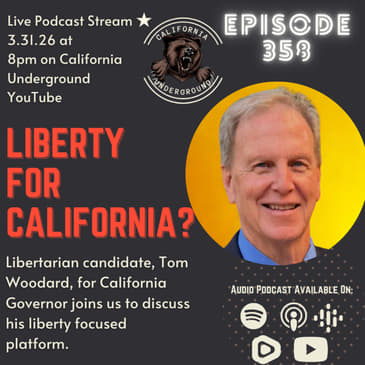
California has spent $24 billion on homelessness. It got worse. Gas prices are the highest in the country. And in 2026, nobody knows who's going to be the next Governor. Tonight we sit down with Libertarian candidate Tom Woodard — and ask the questions Sacramento won't.
---
This week on California Underground, Phil and Camille sit down with Tom Woodard — Libertarian candidate for California Governor 2026. Tom is an entrepreneur, conservationist, and business executive with 40+ years of experience building organizations, creating jobs, and solving complex problems across the U.S. and Mexico. He's also a father who lost a son to addiction and homelessness — and he's running on the belief that California's two-party system has had its chance and blown it.
In this episode:
🔹 The cost of living crisis — Why California gas prices and electricity rates are among the highest in the nation, what state mandates are driving the cost, and what a governor can actually do about it on Day 1.
🔹 Homelessness — $24 billion spent. The problem got worse. Tom shares his personal story, challenges the "Housing First" model, and lays out what a different approach looks like in practice.
🔹 The 2026 race — Newsom is term-limited, the Democratic field is fragmented, and for the first time in decades California's governor's race is genuinely uncertain. We ask Tom the hard questions: Is he running to win or running to move the conversation? And what's his pitch to voters who've never considered a third-party candidate?
---
📌 LINKS & RESOURCES MENTIONED
• Tom Woodard campaign site: https://www.woodardforgovernor2026.com/
• Tom on X: https://x.com/woodard2026
• Tom on Instagram: https://www.instagram.com/woodardforgovernor2026/
• Ballotpedia — 2026 California Governor's Race: https://ballotpedia.org/Tom_Woodard
• California State Auditor — Homelessness Spending Report: https://www.auditor.ca.gov/reports/2021-112/index.html
• CalMatters Homelessness Tracker: https://calmatters.org/housing/homelessness/
• California Air Resources Board — Cap and Trade Program: https://ww2.arb.ca.gov/our-work/programs/cap-and-trade-program
• 2026 California Gubernatorial Election Overview: https://en.wikipedia.org/wiki/2026_California_gubernatorial_election
---
📺 California Underground airs LIVE every Tuesday at 8PM PST on YouTube.
🔔 Subscribe and hit the bell so you never miss an episode.
💬 Drop your thoughts in the comments — we read them.
---
#CaliforniaUnderground #California #CaliforniaPolitics #Governor2026 #TomWoodard #Libertarian #CaliforniaHomelessness #CostOfLiving
00:00:00
California has spent $24 billion on homelessness.
00:00:03
The problem only got worse. Gas prices are the highest in
00:00:07
the country, and that's not an accident.
00:00:09
And in 2026, for the first time in decades, nobody really knows
00:00:13
who's going to be the next governor of the state.
00:00:15
So tonight, we're sitting down with a cat who says both parties
00:00:18
have built this mess together, and neither one has the will to
00:00:20
clean it up. And we're going to discuss that
00:00:22
all on tonight's episode of The California Underground, starting
00:00:25
right now. What's going on everybody?
00:00:43
Thanks for tuning in to a another episode of the
00:00:45
California Underground podcast. I am your host, Phil, and we
00:00:48
have a special guest with us tonight.
00:00:50
As always, we've been having a lot of candidates because it is
00:00:52
2026 and a lot of people are running for different types of
00:00:55
offices. So tonight we have Tom Woodard
00:00:57
who's on the show. He's a libertarian candidate and
00:01:00
we're going to bring him in right now.
00:01:01
And as always with me is my trusty Co host, the best, the
00:01:05
fastest researcher in the West. So Camille, welcome to the show
00:01:09
and Tom, also welcome to the show.
00:01:11
How are you tonight? I'm great.
00:01:13
Thank you very much for having me.
00:01:15
Absolutely. So let's just dive right in.
00:01:21
Why don't you give us a little bit about who you are and a
00:01:24
little bit of background, and then we'll get into the nitty
00:01:27
gritty about your platform and your run for governor.
00:01:31
OK, my name is Tom Woodard, born and raised in California, oldest
00:01:36
of five boys, have an older sister, went to San Diego State
00:01:40
University. Have lived over a third of my
00:01:42
life outside the country, living and working in the Dominican
00:01:45
Republic and Mexico. I'm bilingual in Spanish from
00:01:49
that experience, but I was I spoke pretty good Spanish before
00:01:52
I left. Fathers of four.
00:01:55
My son passed away 5 1/2 years ago.
00:01:58
That informs a lot about my campaign because he died
00:02:02
addicted and with mental illness that we fought for 17 years
00:02:06
before he passed. And that experience has given me
00:02:10
a lot of insight into those issues of homelessness and drugs
00:02:13
etcetera. So I've got a very interesting
00:02:16
life business wise. I've started a few businesses,
00:02:20
some have been successful, some have been not so successful,
00:02:26
been very entrepreneurial. I've had a lot of leadership
00:02:29
positions and I felt compelled to run as opposed to hang up my
00:02:35
cleats. I just turned 72 weeks ago and I
00:02:40
I'm so compelled by what I see and my concern for the situation
00:02:43
that our state is in and the lessons I've learned from my
00:02:46
son's out passing that I jumped in the race after starting to
00:02:51
write a book about the future of California and then realizing,
00:02:54
you know, this is a platform and maybe I should express it more
00:02:57
roundly. You know, look like you have a
00:03:00
question, you're you're ready to go, you're ready to jump off the
00:03:03
start off the conversation. I want to say happy birthday and
00:03:06
I'm so sorry to hear about your son.
00:03:08
I do love that this is personal for you because you know, so
00:03:11
often we have candidates that jump and it's kind of like it's
00:03:14
just, it's more just a platform for for them.
00:03:16
We've seen that happen so often. And so anyway, I don't actually
00:03:21
have a question yet, but do tell us more actually, actually I do
00:03:26
have a question. Tell me about your businesses.
00:03:28
Let's start there because I know that has something to do kind of
00:03:30
with where where you've gotten to this point as well.
00:03:32
So can you tell us a little bit more about your businesses?
00:03:34
Oh sure, I've been involved in everything from food processing,
00:03:39
amusement rides. I worked for 12 years for
00:03:42
Allergan, the the eye surgical and eye care company.
00:03:48
I was a top sales Rep in surgical devices for Allergan
00:03:51
for six years worldwide. I started a successful Mexican
00:03:57
restaurant in Park City, UT that was named best Mexican in Utah
00:04:00
for six years. I was a president of the North
00:04:03
American Bungee Association and franchise bungee jumping towers
00:04:07
to amusement parks back in the 90s.
00:04:10
Because of my, because of my Spanish, I've been a trainer for
00:04:13
Latin America for surgical devices and I've sold equipment
00:04:19
and food processing into Latin America and lived in the
00:04:24
Dominican Republic for four years.
00:04:27
Was a volunteer with Hurricane refugees in 1980, which led to
00:04:30
me founding A nonprofit which is 42 years old and working in 10
00:04:35
countries now going into an 11th this year.
00:04:39
They're involved in reforestation.
00:04:41
They loan money to small farmers so that they can convert to tree
00:04:44
cropping, which pretty much restores their land and saves
00:04:48
it. From what I saw, hurricane rains
00:04:50
that caused massive mud slides, etcetera, and they're working
00:04:55
now in Africa, Asia, the Caribbean and Mexico.
00:04:59
I founded a private nature preserve on the Sea of Cortez
00:05:01
and managed that through a lot of litigation in Mexico for 18
00:05:05
years, and that's going well. I was bought out by one of the
00:05:10
wealthy people in the world with the idea to conserve it in
00:05:13
perpetuity. A lot of life and a lot of
00:05:15
science going on. I'm pretty impressed actually,
00:05:22
Yeah. I'm, I'm kind of tired.
00:05:24
I'm exhausted listening to your accomplishments.
00:05:26
I, I'm trying to think of all the stuff I've done and like,
00:05:30
man, I, I haven't really scratched the surface.
00:05:34
Yeah. So we have the, the I, I think
00:05:37
that kind of probably leads into your stance is as a libertarian,
00:05:43
this, this idea of working so much in the private sector and
00:05:48
entrepreneurship and small businesses.
00:05:49
But seeing it from that angle, because I think a lot of people
00:05:53
when they do run businesses, they see politics through a
00:05:56
completely different lens than when they've never ran a
00:06:00
business. Was it always, I guess, not to
00:06:06
get in the weeds on your political party, but was that
00:06:09
something that shaped your politics, the private
00:06:12
entrepreneurship, the business ownership, did that have a way
00:06:15
in, in shaping your political philosophy that you have now?
00:06:19
Without a doubt. I mean, I for most of my life
00:06:22
was apolitical. I, I was not interested in the
00:06:25
process. I kind of detested it, you know,
00:06:28
it was, it was distasteful to me.
00:06:30
And I first registered and, and got involved in politics after
00:06:36
1984 in in 2016. So between 1984 and 2016, I had
00:06:43
my opinions, I had my preferences.
00:06:46
I didn't vote between 1984 and 2016 and I was mostly overseas.
00:06:52
I tried to vote and got scammed by a group that was supposedly
00:06:58
going to take care of everything if you were American overseas
00:07:00
and you wanted to vote. But because of my party
00:07:03
preference what I which I listened 2016 is libertarian.
00:07:07
I didn't get my documents from them.
00:07:09
Then I found out they were a Democratic group that was
00:07:12
trolling for people to register overseas unless they weren't
00:07:15
democratic. So it's kind of interesting now,
00:07:18
since then, I've been too concerned about the condition of
00:07:21
the country in general, California, now that I've moved
00:07:24
back and relocated here 18 months ago.
00:07:27
And so my basic philosophy is that man has several ways to
00:07:36
concoct governance and to control governance.
00:07:39
And, and yet the societies that are the most wealthy and the
00:07:43
most successful to me are the ones that capacitate individual
00:07:48
initiative. I think we're way smarter as
00:07:51
individuals that are motivated by our own motivations and
00:07:55
things that we really love to do and to work at than any
00:08:00
government ever was, any central planning ever was, any communal
00:08:04
ownership ever was. And I think that goes all the
00:08:07
way back to our history of thousands and 10s of thousands
00:08:11
of years ago. You know, that our individual
00:08:13
initiative is, is probably a, a, a driving force on human
00:08:18
ingenuity, creativity, success and survival, etcetera.
00:08:22
And I believe that today, and hence I'm a libertarian.
00:08:27
Yeah, I've always said one of my core philosophies and we're,
00:08:32
we're going to get into the policies in your, in your
00:08:34
platform, 'cause there's a lot I want to discuss there.
00:08:37
I I always find that especially with California, the ruling
00:08:41
class or the ruling elite right now, those in Sacramento, it's
00:08:44
almost like they have a lack of faith in humanity to the point
00:08:48
where they have to be this nanny state where they run every part
00:08:51
of your life because they don't believe you're smart enough or
00:08:54
capable to do anything. So it's almost like we've gotten
00:08:58
in this, at least California has gotten in this mindset of the
00:09:01
you can't operate without the government.
00:09:04
My whole political philosophy is flipped on its head where it's
00:09:07
AI think you get government out of the way because I have faith
00:09:11
in humanity. I think when you let humanity do
00:09:13
what it has to do, we are incredibly intelligent, we're
00:09:17
credibly innovative, we're incredibly entrepreneurial.
00:09:22
Like there is so much ability of mankind that needs to be
00:09:27
unleashed that the state right now in California, just the way
00:09:32
it's set up, kind of crushes that.
00:09:34
That's how it feels right here in California.
00:09:37
Absolutely. It's, you know, if you look at
00:09:42
take my parents generation, the incredible transformation of
00:09:46
technology during their generation, my parents were born
00:09:49
in the late 20s, you know, that they saw in their life.
00:09:53
And then you take what we, what I've seen in my life, you know,
00:09:56
I just completed 70, as I said, and, and the amazing technical
00:10:00
and technological transportation and the advances in all areas.
00:10:05
You can't mostly point to governments as the source of
00:10:09
that in of those innovations, it was all people in private
00:10:12
sectors and that's a stark example.
00:10:15
Governments are not visionary. Very, very seldom can
00:10:19
governments ever even pull off visionary.
00:10:23
They're more of a big pot that they try to mediate and mitigate
00:10:27
competing interests. But the true innovations that
00:10:31
have changed the world and changed our life and by the way,
00:10:35
lifted 2 billion people out of abject poverty in the last 40
00:10:39
years is private enterprise and private innovation.
00:10:43
And I believe in it very much. I think the government, when it
00:10:45
gets too big, it gets oppressive sometimes because they want to
00:10:49
stay in power. They become dominated by
00:10:52
ideologies and political ideologies that they want to
00:10:55
enforce, which often times are really just a reflection of
00:10:58
personal principles, but not something that should take place
00:11:02
among governance of everybody. It should be by the people and
00:11:06
for the people. So it's kind of turned on its
00:11:08
head. I agree with you.
00:11:09
It's upside down, and I'm making it a point not to attack people
00:11:16
in this, but to attack policies. We can easily see the policies
00:11:20
that are choking us and it's not hard.
00:11:23
You don't have to look too far. California is the highest cost
00:11:26
of living state in the country for very good reasons, as many
00:11:30
of those reasons can be undone if we have the will.
00:11:33
Well, that's a perfect segue into my first question about
00:11:37
your platform. You, you brought up the cost of
00:11:40
living. I mean, gas and energy are
00:11:43
probably the biggest drivers of cost of living here in
00:11:46
California, some of it, but probably the two biggest is gas
00:11:50
and energy. Everything stems from gas and
00:11:53
energy, and you have a pretty comprehensive platform about how
00:11:56
to tackle that. Walk us through your plan on how
00:12:02
to tackle gas prices and energy prices here in California.
00:12:05
OK, so what's happening? And in this year, I predicted in
00:12:10
an article I wrote in November that gas would be at 6:50 a
00:12:13
gallon. Of course it is right now and
00:12:16
it's higher than I have an $8.10 a gallon photo from Los Angeles
00:12:21
last week or two weeks ago. But my policy is, is this and
00:12:25
it's based on my life experience.
00:12:27
I founded a non profit that now this year is closing in on 100
00:12:31
million trees planted. On top of that, the nursery that
00:12:34
I founded that was owned by that non profit in the Dominican has
00:12:38
produced another 105 million seedlings for other groups and
00:12:41
other projects. And we had an an an assessment
00:12:48
by an outside group that's that did an assessment of two and a
00:12:52
year and a half I think it took and they determined that the
00:12:56
nonprofit that I founded had lifted over 900 people out
00:13:00
of poverty. Trees are good news.
00:13:02
You can make a lot more money farming them, especially the
00:13:05
rapid growing varieties that we focused on a lot of times,
00:13:08
although we use, we also have focused on fruit trees and
00:13:12
intercropping and things like that.
00:13:15
But farmers are able to restore their land and groundwater
00:13:20
sources and nutrient cycling and make a lot more money at it.
00:13:24
And so we've had a lot of success.
00:13:26
We're basically loan money to small farmers that are not
00:13:29
credit worthy. And we've had a very low rate of
00:13:33
of default. It turns out that when you give
00:13:37
poor people an opportunity and it's real, and you have
00:13:39
extension agents and you do soil studies and market studies and
00:13:43
you understand everything it takes to help them mount their
00:13:47
farms to get businesses up, that it works.
00:13:50
And now jumping to California today, there's 5 problems that
00:13:57
we have and I really like solving multiple problems at
00:13:59
once. A lot of times the problems the
00:14:01
state Labour's under are related.
00:14:04
You know, you think of homelessness, immigration, drug
00:14:07
use, all the things that have happened that have led to those
00:14:12
problems of housing costs, etcetera.
00:14:15
Well this is 1 where we have maybe 5 problems we can solve at
00:14:19
once, which you've asked. California has 15 acres
00:14:22
that are impacted by bark beetle infestation, by fires and by
00:14:27
over exploitation historically that have never been replanted.
00:14:31
Now you go to the fuel side, gasoline, diesel, energy costs.
00:14:36
The reason that California is the number one state as far as
00:14:40
cost of energy is because they have a narrative that they've
00:14:44
stuck to and that is that atmospheric CO2 creates global
00:14:47
runaway global warming. And so they've instituted a
00:14:51
series of laws, cap and trade, carbon recapture, excise taxes,
00:14:55
special fees on fuels, etcetera, etcetera.
00:15:00
That adds up to us being by far the most expensive place to
00:15:04
refine oil, to drill and produce oil and also to sell it and
00:15:10
market, you know, and there's just too many fees that they've
00:15:12
heaped on top of it. You are completely right.
00:15:16
And I agree with you that energy is crucial for everything in the
00:15:20
economy. We have transportation, we have
00:15:22
cold storage, we have manufactured, we have machinery,
00:15:26
we have our homes and everything else.
00:15:28
And energy is where it starts. So if energy goes up, the price
00:15:32
of everything goes up. And it's why we're probably the
00:15:35
highest cost of living. But let's look at it in a more
00:15:39
nuanced way. Even California has driven 35
00:15:42
refineries out of this close to closure in the state since 1991.
00:15:48
In December 15th, the San Pablo Bay pipeline stopped operations.
00:15:52
That was what took oil from the California oil fields to the
00:15:56
refineries in the Bay Area. Done.
00:15:59
We don't have anything to replace that.
00:16:01
It's sitting there not being used.
00:16:04
We also have 180 to 100 Gen. Z ers that are leaving the state
00:16:09
per year because they can't afford to live here.
00:16:12
They can't afford to start families, buy a home, pay for
00:16:15
you know they can. They can't find adequate
00:16:16
employment to cover the cost of living.
00:16:19
A lot of times they live 5 or 6 to an apartment and or say we're
00:16:24
living with their parents, etcetera.
00:16:25
That's why we have a a housing shortage, etcetera.
00:16:29
So all those costs, extra costs heaped on gasoline are
00:16:35
politically driven. What's happened now is we are
00:16:38
importing over 30% of our fuel from outside the country.
00:16:42
Now. Those refineries in China, India
00:16:45
and other places where we're getting fuel or any place that
00:16:48
we're getting crude oil don't have the same standards that we
00:16:52
do as far as production, as far as CO2 emissions, they're not as
00:16:57
clean. And then they put the fuel on
00:17:01
tanker ships and ship them across the Pacific using bunker
00:17:05
fuel. The net result is that they
00:17:07
produce 38% more CO2 then if we had used California oil, refined
00:17:14
it in California where we would be the lowest cost producer
00:17:16
because it's just the logistics are the easiest.
00:17:21
If we hired 100 youths in a program that I call the CCCA,
00:17:26
50 new recruits a year on a 2 year program, 50 graduate
00:17:31
every two years. That 75% of them were deployed
00:17:36
to plant 3 billion trees between now and 2051, which by the way
00:17:40
is roughly the same number that they planted under the CCC, the
00:17:44
Civilian Conservation Corps under Roosevelt.
00:17:48
Then we could restore that entire 15 acres.
00:17:51
What would that do? That would give us habitat.
00:17:54
It would give us more groundwater collection and easy
00:17:57
and equalized flow throughout the year of the Pacific.
00:18:01
It would fix three times the atmospheric CO2 is all of our
00:18:06
regulations put together and it would employ these youth that
00:18:10
would leave. They would get a $1600 a month
00:18:13
plus room, the board and insurance and a $30
00:18:20
scholarship or a grant at the end of their two years for
00:18:24
graduating from the program. The other 25% would be deployed
00:18:30
clearing brush, making fire breaks and dealing with the
00:18:35
places that fires are are are probably the most probable or
00:18:38
the most dangerous to break out affecting population centers,
00:18:41
etcetera. And they would restore wetlands,
00:18:45
which are critical right now if we're going to, if we're going
00:18:48
to have a coastal Biome at all. So here we can lower to below
00:18:54
$4.00 a gallon, we can plant 3 billion trees, we can fix
00:18:59
75 metric tons a year of CO2.
00:19:03
And we could employ youth that otherwise don't have an
00:19:06
opportunity to work outside or know California's wilderness or
00:19:09
be involved in something so constructive as to restore the
00:19:13
15 acres that are essentially destroyed from human
00:19:16
activity. So that's my policy on that.
00:19:20
And it's something I know something about.
00:19:22
I, I've been involved in tree planting for since I was 27 when
00:19:26
I founded that organization. And I believe that this is
00:19:31
doable and I have financial models to prove it.
00:19:34
I think this is a. It's a very creative solution in
00:19:40
terms of thinking more in terms of what can we do and what can
00:19:43
we not do kind of an abundance mindset of we can fix these
00:19:49
things by proactively planting more trees, creating more,
00:19:54
helping with the CO2 helping here.
00:19:57
And I, I, I'm a fan of that. I'm always we, if you listen to
00:20:00
show, we've always talked about an abundance mindset here in
00:20:04
California rather than this restrictive mindset that the
00:20:06
state has put on us. So we're we're talking about
00:20:10
both the the ecological solution.
00:20:15
I want to drive down a little bit more on what you could do as
00:20:18
governor in terms of suspending these cap and trade rules in
00:20:21
these regulations and unleashing our oil industry and bringing
00:20:25
back refineries and producing oil here that adheres to our
00:20:31
standards, provides good jobs, creates A booming economy for
00:20:36
middle class and blue collar workers.
00:20:38
Is that something that if you were governor you would do on on
00:20:43
day one using your governor powers to?
00:20:45
To day one, the governor possesses emergency powers and
00:20:50
could declare an emergency for three years, for 36 months and
00:20:54
then redeclare the emergency. Still at the end of 36 months.
00:20:59
We could circumvent those particular charges immediately
00:21:03
driving down gasoline and incenting the industries that
00:21:08
exist, the refineries that are shut down but still in operating
00:21:11
condition, or surely would be the San Pablo Bay pipeline and
00:21:16
the oil fields of Kern and Bakersfield.
00:21:19
By the way, the one thing I might have, I'd not, I might
00:21:22
have omitted or not added was all of the planting would be
00:21:25
done by private groups. Municipalities could engage NGOs
00:21:30
and private companies to do the planting.
00:21:32
It would not be state managed. It would be designed and funded
00:21:37
and that's it. I actually had that question, so
00:21:39
thank you. The state is not.
00:21:42
The state should not be managing functions that can be managed in
00:21:46
the private sector with more with more efficiency and greater
00:21:51
results. My opinion is we're just not
00:21:53
good at it and it's OK. It's the nature of the animal
00:21:56
and not throwing stones. But governments with central
00:21:59
planning do not have the efficiency of the private
00:22:01
sector, period. Well, it's also we we're, we're
00:22:05
such a big state that 58 counties, we're kind of like our
00:22:08
own little mini United States here.
00:22:10
And the more you try and run through Sacramento, the more it
00:22:13
doesn't work because California's just so different
00:22:16
from, you know, all the way up to the, I call it the state of
00:22:20
Jefferson all the way down here to San Diego.
00:22:22
It's it's such a huge state. You have to decentralize and
00:22:25
localize these solutions. And usually people on the ground
00:22:29
know better than Sacramento, who's hundreds of miles away.
00:22:33
We have our first question for you from the chat.
00:22:36
Somebody said Bill O'Reilly called California the most
00:22:38
corrupt state in America. Do you agree?
00:22:42
And what would be your plans to eliminate fraud and corruption
00:22:45
in California? Well, that's a big that is first
00:22:49
of all, I agree based on what I know right now, I think that all
00:22:53
of us including the person who asked the question, most
00:22:55
probably we only are getting a tip of the iceberg right now
00:22:58
about possibly what's happened in the state.
00:23:02
It's looking pretty dire between the loans that were made during
00:23:05
COVID, some of the Medicare fraud that's going on with the
00:23:10
Hospice and with senior healthcare and transportation
00:23:14
and all that. First of all, it has to be
00:23:17
completely and utterly investigated and exposed.
00:23:22
But it's a very difficult thing to do with our current system.
00:23:26
It would, it would take a lot of work just to get in and expose
00:23:29
it and understand it. But one of the things that I'm
00:23:33
proposing is that we do a rapid assimilation of AI and
00:23:37
government functions that can be tendered to AI so that we can
00:23:42
cut the payroll of government. We've grown enormously.
00:23:45
We, we are way bloated as far as our payroll.
00:23:48
And when you talk about a very expensive state, all you have to
00:23:51
do is look at the amount of growth.
00:23:53
For example, we've had an administration of the university
00:23:56
system. We have three times the
00:23:58
administrator since the Internet came online.
00:24:00
And we should have had this revolution of of, of efficiency
00:24:06
that we haven't had yet. And we cannot stand in the way
00:24:10
and block what's coming. It's a technological revolution
00:24:13
that whether we like it or not, it's going to be here.
00:24:15
If California wants to be a leader in the technical
00:24:18
technical revolution that's coming in robotics and AI and
00:24:23
EVTOLS and housing in Desalina tion and fusion power in the
00:24:29
future in autonomous transport etcetera, then we need cannot be
00:24:37
the highest cost state in the country.
00:24:39
We have to be a lower cost state.
00:24:40
We have to have a we can't lose our entrepreneurial class to out
00:24:44
migration because they can't afford to live here.
00:24:47
So what I would do on to answer his question is with AI.
00:24:51
The one good thing about AI is auditing.
00:24:54
You have immediate audit of money that's spent and the fact
00:24:58
that we have had audits turned down and and we're not auditing
00:25:03
certain programs, it's ridiculous.
00:25:05
We need to know where our money's going and why so much is
00:25:08
necessary that we have to now institute taxes that people
00:25:11
can't afford. It's crazy in today's with all
00:25:14
the technology we have that we can't track every single.
00:25:18
We had a Herb Morgan on a couple weeks ago and he had this same
00:25:22
kind of idea of implementing AI to track as the Comptroller to
00:25:27
look at every single expenditure in the state and see where
00:25:30
money's going and kind of audit in real time.
00:25:34
And with AI, you, you could do that it.
00:25:38
And it's surprising we haven't even even before AII think we
00:25:41
could have done that. But with AI now that could be
00:25:43
done almost automatically 24/7. They could just be running the
00:25:47
numbers and double checking if something doesn't hit a certain
00:25:51
parameter, it could be notified to the governor or to the
00:25:54
legislature. So it it's crazy, they don't.
00:25:58
It's almost like they, it's a, what do they call that it it's
00:26:01
not a bug, it's a feature. They want it to be ensconced in
00:26:04
darkness and, and behind all these all these hard places to
00:26:09
find so. That question, that question is
00:26:12
paramount and that's why I say I don't want to throw any stones.
00:26:16
But it wouldn't have been that hard to understand where our
00:26:19
money's going and a lot of money's being wasted.
00:26:24
If you think about the monopoly and governance that one party
00:26:27
has had in the state, it actually goes back to 1959.
00:26:30
Yes, we've had a few Republican governors, but the control of
00:26:34
the legislature and the state Senate has been largely one
00:26:38
party. And whenever you have a
00:26:41
concentration of power over human history and one group at
00:26:45
the expense of everybody else, corruption flourishes.
00:26:49
We have to have open books. We have to understand that we
00:26:52
have to live within our means and what I've designed is
00:26:57
actually something that goes completely the other way that we
00:27:00
implement AI across a broad spectrum of government services
00:27:04
that are easily converted to that.
00:27:07
I think we could reduce the payroll of the state down to
00:27:09
80 non university employees. The universities are a
00:27:13
particular other mess that I would like to talk about with
00:27:16
another on another on another thread because that's where a
00:27:23
lot of money is also being wasted.
00:27:24
But back to the point, we have all this money we've spent on
00:27:28
homelessness, on Medicare and Medicaid and all the things that
00:27:34
we've been hearing in the news lately, etcetera, that it
00:27:37
doesn't make sense that we have a $39 billion budget deficit
00:27:41
this year. It doesn't make sense that we
00:27:44
owe $1.25 trillion of account unfunded liabilities.
00:27:49
But if we, if we follow by plan, by 2038, we would have paid all
00:27:54
the debt down and all the unfunded liabilities.
00:27:58
And I am proposing that we would take 25% of the savings that we
00:28:02
would realize from several programs that I'm offering and
00:28:06
we would start what's called a Commonwealth fund.
00:28:10
And a Commonwealth fund is like a California picture.
00:28:14
It is a California opportunity endowment fund where only
00:28:19
private firms in California that are investment firms are
00:28:22
managing capital. This pair with private capital
00:28:25
sometimes etcetera and invested in new California businesses to
00:28:29
attract businesses to the state, to attract industry and job
00:28:33
creations. And by the way, these businesses
00:28:35
in robotics and in AI and in modular home building and a lot
00:28:41
of the things that are coming online, EBTOLSI think would be a
00:28:44
great technology for our state and to reopen our oil industry.
00:28:52
You're talking about millions of jobs we would create.
00:28:55
And at the same time, we would be saving money so fast.
00:29:00
The only would be building it so fast.
00:29:03
That fund could have $5 trillion in it by 2051235 trillion dollar
00:29:11
fund. The Californians own could fund
00:29:15
government. We would be endowed.
00:29:17
We wouldn't have any taxes. And yet at the same time,
00:29:21
instead of just taxing and trying to pay back these
00:29:24
enormous debts that we've incurred, we're actually
00:29:27
investing a small part of the savings in growing businesses in
00:29:31
California that helps us outgrow that much faster.
00:29:35
And so that's my proposal. I'm kind of not understanding
00:29:38
that would that be a tax or because you're saying
00:29:44
investment, but would that be then a tax on these businesses?
00:29:47
And when you say Commonwealth, I'm not going to lie, I hear
00:29:50
share the wealth. So will you, will you tell me
00:29:54
more, a little more about that, maybe everyone else?
00:29:56
Understands. I'll tell you, here's a, here's
00:29:58
a better word for it than Commonwealth is a sovereign
00:30:00
wealth fund. And so it's owned by everybody
00:30:02
in California, but it's not managed by the state or dictated
00:30:06
by the state. It the politics don't affect
00:30:09
where it's invested, etcetera. It's done by private firms.
00:30:12
Now where would the money come from?
00:30:13
From the savings that we would get from the programs that I
00:30:17
would implement. The, the programs would be a
00:30:20
modular educational system which costs not $30 per student,
00:30:25
but $12 per student per year, K through 12.
00:30:28
That is the savings is enormous. The lowering to 80 employees
00:30:35
in state-run institutions is that's fivefold.
00:30:39
The savings is enormous. By taking a 25% of what we say,
00:30:44
yes, it would still come from taxes and originally and
00:30:47
investing it. It's like, let's use a personal
00:30:51
example. Let's say you owed $100 and
00:30:54
you were making $3000 a month and your costs were two.
00:30:59
Oh, you need a hundred, a hundred months to pay that back,
00:31:02
right? But if you paid it back at $500
00:31:05
a month, it would take 200 months unless that other 500 was
00:31:10
being invested, which which is what I'm proposing now, it might
00:31:15
take you 20 months because the investment grows, it's involved
00:31:19
in growth, and it's not being paid to anybody.
00:31:22
And your money grows, your interest grows, the interest the
00:31:24
next year grows, etcetera. And yet everybody owns this.
00:31:28
Now what is the, what is that money being doing, doing for us?
00:31:32
It's being invested in fomenting industry and in and business
00:31:37
development in California by private firms.
00:31:41
They would be rated on how much returns they're getting on the
00:31:44
money etcetera. That's how we would determine
00:31:46
with a private board of directors how that how those
00:31:49
funds are dispersed every year. If it gets just a modicum of
00:31:54
interest, if it was just 5% a year would be a $5 trillion fund
00:31:57
by the early 22000 fifties. That's more than enough to
00:32:01
generate interest to pay the entire cost of the state.
00:32:05
It's a it's a fairly radical idea, but at the same time it's
00:32:09
a doable idea and I have financial models to show that.
00:32:12
So there's been a couple questions in a row about, I
00:32:16
guess we can tackle both of them, sort of the issue of
00:32:19
immigration in California being a sanctuary state.
00:32:22
So there's a couple questions about that in the chat if you
00:32:24
want to address that. OK, now first of all, let me
00:32:28
say, let me give a nod to libertarian theory, which would,
00:32:31
you know, not have borders around the world.
00:32:33
Everybody had a free flow of human beings everywhere and all
00:32:35
that. Now the problem is that we live
00:32:38
in a world where there are ideologies to want to completely
00:32:41
do away with us and destroy the US.
00:32:44
There are also criminal and subversive.
00:32:47
Aside from subversive ideologies, there are criminal
00:32:50
criminals that come to the country to exploit Americans.
00:32:56
I believe that we need immigration laws so that those
00:32:59
people are not welcome in the country, and we need to have
00:33:02
enforcement. The only internal enforcement we
00:33:05
have of those laws right now is ICE, but they've overstepped
00:33:08
because of precisely, in my opinion, because of, quote,
00:33:13
sanctuary laws. What it does is it stacks one
00:33:16
group of people up against another group of people among
00:33:19
our own citizens. It doesn't have to be that way.
00:33:22
So my proposal is that state police, Highway Patrol, any
00:33:27
state law enforcement agencies would round up, would
00:33:33
investigate, round up and capture and arrest criminal and
00:33:37
subversive elements that are immigrants that shouldn't be in
00:33:41
the country. And then within their own
00:33:44
confines, turn them over to federal agents, whatever they're
00:33:47
called, whatever agency comes out of this, so that they can be
00:33:51
deported successfully under our immigration laws.
00:33:55
But the immigrants that were enticed to be here by the last
00:33:58
four years of the administration of Washington, DC, they were
00:34:02
incented to come here, come help, help mail.
00:34:04
Now, it's a lot of nuanced points about how they got here
00:34:08
and why they got here and who was in charge of that.
00:34:10
I don't need to go there. What I can say is that if you
00:34:13
take any of the numbers, by far most of the people that have
00:34:17
come here are looking for a new life.
00:34:18
They're looking for a better life and they're escaping
00:34:20
circumstances, sometimes circumstances that are owned.
00:34:24
Demand for illegal drugs have caused even there are a lot of
00:34:28
drug war refugees in Latin America, especially in Mexico.
00:34:33
From 2006 when Felipe Calderon was elected president of Mexico
00:34:39
and did a deal with George Bush as president, they tried to do a
00:34:43
capture and extradite the drug kingpin leaders to the US just
00:34:47
like they had done in Colombia successfully.
00:34:49
The problem is Mexico is not Colombia.
00:34:52
It has a 2000 mile border with US and it is the world's 10th
00:34:56
largest economy, has 112 million people and we're super related
00:35:01
to them. That's the largest demographic
00:35:03
group, immigrant group in the country.
00:35:05
And in California. Our history is integrally
00:35:09
related now. I see.
00:35:11
I lived outside California for 20 years in Mexico, but I lived
00:35:14
where California started in Loretto, First Capital of
00:35:17
California, first colony, European colony in California,
00:35:22
first church, and where the expeditions left from to found
00:35:25
the first of many missions in North in Alta, CA, where we live
00:35:30
now. I believe that California needs
00:35:32
immigration and it needs to find a pathway to citizenship for the
00:35:36
people that are here that are only looking to better their
00:35:39
lives, of themselves and their families.
00:35:40
They were intended to be here under false pretenses, maybe
00:35:44
under ludicrous circumstances that shouldn't have happened,
00:35:47
but they're here and it will cost enormous amounts to get rid
00:35:51
of them. It's incredibly disrupted that
00:35:53
caused some of these passions that are fueling the street
00:35:57
demonstrations and violence and things.
00:36:00
And at the same time, nobody wants hardened criminals or
00:36:04
subversives that want to blow buildings up here.
00:36:06
And so I think a real a rational way to handle this is to lobby
00:36:11
Washington, offer our support for with our own law enforcement
00:36:15
in California in exchange for finding a new pathway to
00:36:19
citizenship for the people that are non criminal immigrants that
00:36:23
are looking to better their lives and have families and and
00:36:27
be here. And secondly, frankly,
00:36:29
California is not reproducing with native Californians to
00:36:33
Reaper to replacement level and we need immigration and we
00:36:37
should have a for the future, a controlled, patterned, well
00:36:41
thought out immigration system. But in the meantime, we have up
00:36:45
to 3 illegal immigrants in California right now,
00:36:48
undocumented immigrants in California.
00:36:51
And if you take that, the together with the Latino
00:36:55
population, Latino Hispanic descent population of 43 percent
00:37:00
is closer to 46% of the population.
00:37:04
Oh, I think a a smart and sensitive and human
00:37:09
compassionate way to handle this is to lobby for a new
00:37:12
dispensation for California, a guest worker program leading to
00:37:17
citizenship eventually and opportunities a special
00:37:22
insurance funds privately made not state-run for immigrants
00:37:27
that are here that aren't citizens.
00:37:28
Yes, so that health insurance is available them and they have to
00:37:31
have it if they're going to be an immigrant in the state.
00:37:35
But those kind of nuances I think California can pull off,
00:37:38
and that's what I'm proposing. I did want to pivot a little bit
00:37:42
to talk about one of the most prevalent and probably visible
00:37:46
issues here in California, which is homelessness.
00:37:49
We we've thrown a ton of money at it.
00:37:51
We all know the numbers, 24 billion, 34 billion, 50 billion.
00:37:55
I don't know at this point, Prop 1 is going to be worth 10
00:37:57
billion by the time we pay it back.
00:38:01
Homelessness hasn't gone down and it's, it's just state
00:38:04
failure after state failure after state failure.
00:38:06
And it seems like no matter how much money California throws at
00:38:10
homelessness, it doesn't it doesn't move the needle at all.
00:38:15
And this is 1 issue where I think if someone were out on the
00:38:20
outside looking in, how does a libertarian address homelessness
00:38:26
by, you know, using the government?
00:38:29
But also how? How does it with someone like a
00:38:32
libertarian wrap their head around that, I guess is the
00:38:34
question. Well, this libertarian, this
00:38:38
libertarian, I I'm the father of four children, but my son died 5
00:38:43
1/2 years ago, my only son, and he was my oldest.
00:38:46
At the age of 20, he developed schizophrenia, schizoaffective
00:38:51
disorder. He became homeless, at times,
00:38:54
addicted to opiates, in and out of rehab, halfway homes,
00:38:58
hospitals, doctors, lawyers, minor infractions, etcetera, for
00:39:04
17 1/2 years. And then he died in my arms in
00:39:07
Mexico, where I bought him a little house.
00:39:10
I've walked through cities with thousands of homeless trying to
00:39:13
find him. And I found him every time.
00:39:14
Three different cities, Tijuana, San Diego and Salt Lake City.
00:39:19
And my, I, I, I, I hired consultants.
00:39:23
I went to NAMI meetings, I went to parent meetings.
00:39:26
I went to everything I could do to get help.
00:39:30
The laws are stacked against families that have addicted
00:39:32
members and that have what's called a dual diagnosis and
00:39:36
underlying mental illness. If you switch over now to
00:39:40
homelessness, it was going down between 2004 and 2011 and then
00:39:45
took a sharp turn and went up. That was the advent of a lot of
00:39:49
artificial opiates, pill form, etcetera.
00:39:52
And then really cheap crystal meth, which has been around for
00:39:56
40 years. As addiction went up,
00:39:58
homelessness has gone up. If you depending on the study
00:40:02
and by the way I I have a hard time trusting studies from the
00:40:05
state but if you look at private studies.
00:40:07
They estimate between 75 and 80% of the people on the street are
00:40:11
or have been recently addicted to or to heavy drugs.
00:40:16
And heavy drug use is a major part of why they end up on the
00:40:19
street homeless with all their family and friends exhausted or
00:40:23
or or dead or broke from trying to help them and they're out of
00:40:28
gas. And yet they want to, they're
00:40:30
addicted and they want to live out their addiction.
00:40:32
None of the money that you're mentioning that California has
00:40:35
spent goes to helping them overcome their situation, which
00:40:39
is basically addiction. One of the hardest things I ever
00:40:43
had to deal with were the laws in the United States where
00:40:47
unless you're a danger to yourself or others and it's an
00:40:49
imminent danger and that needle is moved a lot as we've had a
00:40:52
lot of homeless, you have to have a major psychotic event or
00:40:55
something. Nobody can hold you or force you
00:40:58
into treatment. I would institute, and yes this
00:41:02
is somewhat a non libertarian, but here's what I would do based
00:41:06
on my experience. I call it Joshua's law that
00:41:09
anybody found intoxicated or high and camping on a city
00:41:13
street or sidewalk or park or facility where they don't have a
00:41:16
home, they don't have a place to go would be mandated to a 90 day
00:41:21
detox and analysis program done in the private sector.
00:41:26
Depending on the problem that we're dealing with.
00:41:29
Some of those people will cannot get better their, their physical
00:41:32
ailments, they have mental ailments.
00:41:34
They're not going to be able to get out in the workforce.
00:41:36
They're not going to be able to be productive, but a lot of them
00:41:40
can be. And so when we talk about
00:41:43
housing, I'll talk to you about my housing ideas.
00:41:47
But once they're detoxed and once they're medically analyzed,
00:41:53
then you can design exactly what that individual needs.
00:41:57
And that's helping them. It's helping them get from here
00:41:59
to there. Maybe, maybe it's a modular
00:42:02
home. Modular homes are certainly way
00:42:05
cheaper than what we've been spending per homeless at
00:42:09
sometimes $300 a night in California for hotel rooms,
00:42:12
which doesn't do anything except wreck the hotel room when people
00:42:15
are just shooting up all day in them and having the people that
00:42:19
don't have the hotel, it's really, it doesn't help
00:42:21
anything. So we're spending all this money
00:42:23
and throwing at it. And by the way, I think there's
00:42:25
enormous fraud in that industry as well.
00:42:28
The homeless industrial complex is a big business and it's not
00:42:33
affecting anything. It's not reducing homelessness.
00:42:35
It's grown under this administration.
00:42:37
The current administration has been growing since 2011.
00:42:41
We have 1/3 of the homeless in the country.
00:42:44
Part of that is because of the largesse that we heap on them.
00:42:46
And part of it is climate and all that you know, we have.
00:42:49
We have more welcoming places for homeless to to be, to
00:42:54
survive without facing the elements.
00:42:57
We need to be smart about this. California streets and sidewalks
00:43:00
and cities are not designed to house human beings living where
00:43:04
they shouldn't be living. It's not hygienic.
00:43:08
It's fueled a lot of times by crime.
00:43:11
It destroys businesses and business traffic, which is how
00:43:14
cities were designed. And I would say 0.
00:43:18
Homelessness is the goal zero in California.
00:43:21
If you're found on a city street in California intoxicated, you
00:43:25
need to go in a program and find out what the issue is and then
00:43:28
see how that private program can help you.
00:43:32
The second thing is that this this housing situation, we can
00:43:40
provide much cheaper kind of product now with technology that
00:43:44
would circumvent the cost of housing and the cost of living.
00:43:47
So that some of the people that aren't ever going to be able to
00:43:51
do anything except live out their years and whatever piece
00:43:53
they can are not going to be able to make money.
00:43:57
But their cost, the cost of sustaining them by society,
00:44:00
would be not even close to what we're paying today.
00:44:04
It's, well, it's, it's interesting.
00:44:09
This is sort of like if anybody knows anything about
00:44:12
libertarians as they're such, they're, they're so worried
00:44:15
about being like pure libertarians that it's almost
00:44:18
like reality doesn't meet, like they're pure ideology.
00:44:22
And what you're proposing on homelessness would totally not
00:44:26
be libertarian. It would be the idea of this
00:44:29
people coming in and telling you what you can and cannot do And,
00:44:32
and mandating you to do something.
00:44:35
But it is reality and it is something that has to be done.
00:44:39
Because we're talking about the, the pour over effect, like
00:44:42
you're saying, is obviously there's a human cost.
00:44:46
There's a human cost that these these individuals are suffering
00:44:49
on the street and we need to do something about it.
00:44:51
We need to help these people. And just throwing money at the
00:44:54
situation doesn't seem to be helping.
00:44:56
And drugs and substance abuse are a huge part of it.
00:45:00
It's also an issue for safety. It's a public safety issue for
00:45:04
those who are walking around these city streets.
00:45:05
It's also a business issue. And it's an economic issue of,
00:45:09
OK, well, if downtown San Diego is littered with homeless people
00:45:13
or full of homeless people, I shouldn't say littered, that's
00:45:16
offensive, but it was full of homeless people.
00:45:18
People aren't going to go to downtown San Diego.
00:45:21
They're not going to frequent the restaurants or the bars or
00:45:23
they're going to not going to go to a Padres game or something
00:45:25
like that because they don't like it.
00:45:27
It it's it, it composes these all these things.
00:45:30
So you have to kind of have to take this reality and look at it
00:45:33
and go, we have to get tough on this.
00:45:36
Otherwise it's not benefiting anybody.
00:45:38
It it's just you're almost feeding the problem and and
00:45:42
making it worse by. We absolutely, we absolutely are
00:45:46
making it worse because we're not dealing with it.
00:45:48
But to my libertarian friends, I I am a libertarian idealist.
00:45:53
At the same time, the way to preserve personal freedom and
00:45:58
personal responsibility, to capacitate a population so that
00:46:01
they can flourish means they have to be safe.
00:46:05
Having people living on our streets that were designed for
00:46:08
that, that are surviving a lot of times by largess from the
00:46:11
government and by crime is not safe.
00:46:15
And so you have to draw a line in the sand, say, OK, this is
00:46:20
not OK for the rest of the population.
00:46:22
The function of government is to protect that population.
00:46:25
I don't propose that the state-run any of those programs.
00:46:29
I propose that they'd be tendered out to private sector
00:46:33
of providers of these services like detoxification, analysis,
00:46:38
etcetera. And possibly the state
00:46:42
contributes facilities that they have for developments for
00:46:44
modular homes, etcetera, for communities like that.
00:46:47
Maybe there's many ways we can get involved.
00:46:50
We control, we can, we can attract the private sector also
00:46:54
to get involved in this etcetera with volunteerism, which I
00:46:57
really believe in. But we cannot tolerate 185
00:47:03
homeless that we have in California right now.
00:47:05
Yeah, we have a couple minutes left here.
00:47:09
I did want to touch on a couple more things really quickly
00:47:12
before we let you go for the night.
00:47:15
People in the chat always ask, we have sort of a pro Second
00:47:19
Amendment audience. I myself am pro Second Amendment
00:47:22
as well. A lot of people asking what is
00:47:25
your stance on 2nd amendment in California because California is
00:47:28
notoriously not friendly to the Second Amendment here in
00:47:31
California. Well, I'm a libertarian and I
00:47:36
believe that people have the right to defend themselves and,
00:47:40
and by whatever means necessary. You cannot be subjected to a
00:47:45
culture or a society where only the criminals have arms.
00:47:51
And I'm very much, I like the Bill of Rights.
00:47:57
To me is is one of the most important documents ever written
00:48:01
and it's embodies some of the most important freedoms that man
00:48:05
should enjoy. And I think trying to control
00:48:10
that is a another overreach by government, by government.
00:48:14
I understand the issue of violence.
00:48:17
I reject the argument that guns cause violence.
00:48:20
I think people do. And so I'm pro Second Amendment
00:48:25
as well. I I have some rapid fire
00:48:28
questions I want to ask, but I want to let Camille follow up
00:48:30
with any questions. Well, I had kind of, I feel like
00:48:33
this conversation just got so deep and I, my questions were
00:48:37
lighthearted, but you're, you're clearly a very well read man.
00:48:40
And I like to ask this question to some of our guests.
00:48:45
A few of your favorite books that you would recommend people
00:48:47
read. How old are people?
00:48:51
What's that? How old would the people be?
00:48:54
18 and above. Because there's there's
00:48:57
different, I think for young people.
00:48:59
I would read Atlas Shrugged and I would read some of Rand Paul's
00:49:03
articles and writings. I would read a libertarian
00:49:06
manifesto. I would read books by by my
00:49:11
friend Lawrence Samuels. And there's some fantastic
00:49:16
libertarian authors. Again, though, to Phil's point,
00:49:19
libertarianism, as opposed to the other two parties, which if
00:49:22
you look at their history, are fairly pragmatic over time, is
00:49:26
more of an operative philosophy of governance.
00:49:29
And it's very idealistic. The ideals have to be modified
00:49:35
sometimes because of the nuances of what we're dealing with.
00:49:38
But at the same time, I hold those ideals to be really
00:49:41
important. So there's a plethora of great
00:49:44
books, and those are some of the ones that I would recommend just
00:49:49
right off the bat. OK, so rapid fire couple last
00:49:54
quest. So like real quickly quick
00:49:55
answers, first one one thing about California that still
00:50:01
makes you proud. It's incredible diversity and
00:50:04
it's incredible natural wildlife and environments, both coastal,
00:50:11
inland, mountain, deserts, Redwood forests, the northern
00:50:16
part of the state. It's an incredible place.
00:50:22
The diversity of people here. We have great Persian cultures
00:50:27
and, and we have Filipino communities that are fantastic
00:50:32
and Asian cultures and we have Latin cultures and we have
00:50:36
actually, it's kind of an interesting esoteric thing that
00:50:39
the blood of all the people that have struggled to control
00:50:41
California over the last 400 years, it's all here.
00:50:46
It's all here in the state right now.
00:50:48
It's embodied a lot of times even in the immigrants, which
00:50:50
are all, they're European mestizo, indigenous, Hispanic
00:50:56
mix. Here we are and we have a chance
00:50:59
to do the right thing with this state.
00:51:01
We're smart enough, we know enough now.
00:51:03
We're not going to make the mistakes in the past if we get
00:51:05
busy. And I think the thing I'm most
00:51:10
proud about, and the thing that gives me the most hope is the
00:51:13
future. OK, the single most wasteful
00:51:18
line item in a state budget that nobody talks about.
00:51:21
The single most wasteful one. That's a hard one for me, but.
00:51:25
There's a lot to narrow down, I know.
00:51:27
That's that's a lot. You know, it's just a wasteful
00:51:30
spending in general. I'm sorry that's not a single
00:51:32
line item, but if I hit categories we'd be here a lot
00:51:35
longer than we have left a quick.
00:51:37
Little answer. Yeah. 11 California politician
00:51:42
either party, any party who you think is actually doing their
00:51:46
job. Carlo de Mayo.
00:51:49
Carlo de Mayo, OK. Yeah, Carl de Mayo, I think that
00:51:53
he's a, he's a Republican and I think his energy and his
00:51:56
initiative and, and the things that he's sponsoring, I think
00:51:59
he's he's really impressive. His energy is quite impressive.
00:52:04
OK, what does winning look like for this campaign, even if you
00:52:10
don't become governor? I think getting my ideas out and
00:52:14
painting a picture of what California could be and focusing
00:52:18
on the future and focusing on losing the polarity between us
00:52:23
in favor of us joining together to craft the best future for all
00:52:26
of us that we can. I.
00:52:28
Have a question of all the qualified gubernatorial
00:52:31
candidates? If it's not going to be you for
00:52:34
for governor, who would you? Choose That's a tough one.
00:52:39
I don't know yet. I don't know yet.
00:52:41
I, there's, you know, there's I, I think that the Democrat Party
00:52:49
has a problem. They've been in power since 1959
00:52:52
in the, in the state. And I think that a lot of times
00:52:57
they're locked into certain policies they can't get rid of
00:52:59
because the party wouldn't let them get rid of it.
00:53:02
So I'm very leery of them, although there's some really
00:53:05
good people running. It seems like this McMahon of
00:53:08
the mayor of San Jose, it seems like a sharp young guy and
00:53:13
knowledgeable and I like the way he presents himself, etcetera.
00:53:17
But I don't have a favorite right now.
00:53:19
And yet I ultimately will have to make that choice possibly.
00:53:24
But as much as it sounds like a climbing a Cliff straight up,
00:53:29
we're in this to win and we're going to keep going.
00:53:32
OK, All right. It's been a we want, we don't
00:53:37
want to keep you all night. It's been coming up on the hour.
00:53:41
So I did want to give you a chance to let people know where
00:53:45
they could find you, support you social media, website, stuff
00:53:48
like that. And they can learn more about
00:53:50
you and your, your policy position because there's a lot
00:53:52
on your website. Like I said at the beginning of
00:53:54
the show, we didn't touch upon everything.
00:53:55
I think we touched on maybe less than 1/3 if 1/4 of your entire
00:54:00
platform. So where can people?
00:54:03
Talk too much. No, no, no, like we told you
00:54:06
before, we opt on. I said this is your time to talk
00:54:09
and and expand your ideas. We like people who expand their
00:54:12
ideas and not do the the little news hits because we're not, you
00:54:16
know, we're not the local news asking you for 30 seconds.
00:54:18
So where can people find you and support you or learn more about
00:54:22
your platform? My website is
00:54:25
www.woodardforgovernor2026.com. So what are for
00:54:33
governor22026.com, if you go on there, you can find my history,
00:54:40
my policies, a lot of talks I've given, etcetera and my platforms
00:54:46
and also a way to get in touch with us if they have questions
00:54:49
or would like to volunteer or there's a donate button which we
00:54:53
could always use, etcetera. So our website pretty much
00:54:56
contains that. Well, Tom, thank you so much for
00:55:00
coming on and, and talking about your platform and everything
00:55:03
that you stand for and everything you're doing.
00:55:05
Well, not everything, like I said, there's still a lot more,
00:55:08
but being a voice in this race and, and presenting us with
00:55:12
creative and unique and innovative ideas.
00:55:15
So thank you for coming on tonight and to everybody who
00:55:19
tuned in tonight, thank you for tuning in live or listening on
00:55:22
the audio wherever you listened. Make sure you like share,
00:55:25
subscribe, review, all of that stuff helps with the algorithm,
00:55:29
helps more people find us. And the best way that you can
00:55:31
help this show that is 100% free is you can share it with someone
00:55:35
else. So with that, we'll see you on
00:55:37
the next one. Good night everybody.
00:55:39
Later. Thank you, Camille.
00:55:41
Thank you, Phil.