
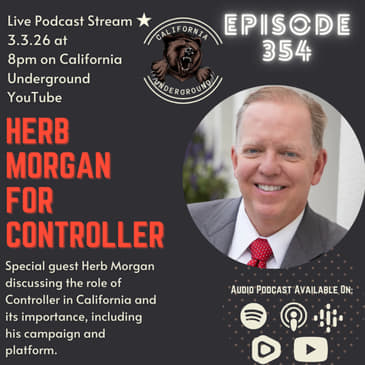
Understanding the Power and Responsibility of California's State Controller with Herb Morgan
In this episode, Herb Morgan, a candidate for California state controller, breaks down the often-overlooked yet critically important role of the controller and how it holds more power than many realize. We explore California's financial challenges, transparency innovations, and the potential for reform in government spending and accountability.
Key Topics
- The true role and influence of the California State Controller
- How a single office can impact statewide fiscal health and trust
- The flaws in current financial reporting and transparency
- Innovations like blockchain and AI to revolutionize government accountability
- The scandals and inefficiencies within NGOs and public sector spending
- Strategies for Republican victory in a predominantly blue state
- The "Golden Ticket" coalition and its plan to change California politics
- Day-one priorities if Herb Morgan is elected: implementing radical transparency and reforming financial systems
- The importance of restoring trust in government and institutions
- How effective oversight can reduce waste, fraud, and abuse
Timestamps
- (0:00) – Introduction to the importance of the California State Controller
- (1:35) – Meet Herb Morgan and his background
- (4:02) – Explaining the power and duties of the controller
- (6:00) – Examples of fiscal oversight and impact
- (8:34) – California’s dismal metrics despite high revenue
- (11:09) – The trust deficit in government and elections
- (14:27) – Critique of current officeholders and their qualifications
- (20:24) – The fight against fraud and waste in government
- (24:14) – The innovative use of AI and blockchain for transparency
- (33:13) – Why transparency scares those in power
- (36:42) – Exposure of NGO and public sector fraud scandals
- (43:43) – The criminal enterprise in public spending
- (49:24) – How the "Golden Ticket" coalition can win in California’s political landscape
- (56:05) – Immediate actions upon taking office
- (62:39) – Final thoughts and support information
Resources
- Herb Morgan for California Controller
- Herb Morgan’s Campaign Website
- California Doge Platform
- Herb Morgan on Social Media
- Additional campaigns & investigations
Connect with Herb
Note: This episode provides an in-depth look at how reform-minded individuals can leverage the power of fiscal oversight to rebuild trust and eliminate corruption in California government. Don’t miss the innovative ideas for transparency and accountability that could shape the future of governance.
00:00:02
Most people I know have never heard of what the California
00:00:05
State controller actually does, and that might be a huge problem
00:00:09
with the budget of over $300 billion.
00:00:12
It's important who the controller is and who's looking
00:00:15
over those those books. And tonight's guest is running
00:00:18
for that position. We're going to be joined by him
00:00:20
and we're going to discuss all about the position, everything
00:00:22
that he's playing to do to fix it all, on tonight's episode of
00:00:25
the California Underground, starting right now.
00:00:46
What's going on everybody? Thanks for tuning in to another
00:00:48
episode of the California Underground.
00:00:49
I am your host, Phil. Tonight we have a special guest
00:00:52
joining me and as always, my trusty Co host, the best,
00:00:54
fastest researcher in the West. So let me bring them on.
00:00:57
His name is Herb Morgan. He is running for state
00:01:01
controller. Herb, welcome to the program.
00:01:04
Well, thank you for having me. It's great to be here.
00:01:06
Looking forward to it. Yeah.
00:01:08
So as I said in the intro, I mean, state controller, that's
00:01:14
what you're running for. It's a statewide office.
00:01:18
It's a big job. And to be completely honest,
00:01:21
Camille and I even follow a lot of California politics and I bet
00:01:24
if they caught us at the wrong time and said what is a state
00:01:28
controller, we'll probably fumble with the guests.
00:01:31
But I we'll get into that in a second.
00:01:33
Why don't you introduce everyone to yourself 1st and then we'll
00:01:36
go into what the job entails. Sure, let's do it.
00:01:39
So I'm Herb Morgan, I am an almost native Californian.
00:01:44
Had my first birthday in the back of a 67 Chevy as we drove
00:01:48
from the East Coast. Settled in Southern California,
00:01:52
product of what were at the time the number one public school
00:01:56
system in the country. California public schools, if
00:01:58
you can believe that. I grew up in Oceanside, just up
00:02:02
the road from where I am now. A proud product of California's
00:02:06
public university system, which cost $463 per quarter for four
00:02:13
straight years. Never went up a penny.
00:02:15
Got to graduate by working at a gas station.
00:02:18
Didn't have to take out $150 in debt.
00:02:23
Married, live in San Diego, married 34 years, 2 grown kids.
00:02:26
Hoping to be a grandpa one of these days real soon.
00:02:30
Oh and then of course there's the financial aspect of my life.
00:02:33
I have been. I've been working in finance
00:02:36
since getting out of college. So almost 40 years in in finance
00:02:41
and different roles. Started a company back in 2004.
00:02:46
Had the good fortune to receive a phone call one day from a guy
00:02:49
named Howard Lutnick. Howard Lutnick was the chairman
00:02:53
and managing partner at Cantor Fitzgerald back then before he
00:02:57
began the secretary of Commerce. And he, he ended up acquiring my
00:03:00
firm. So I went to work with Howard,
00:03:03
or for Howard, I should say, for about the last nine years.
00:03:08
I'm getting ready to retire here very soon.
00:03:11
Next phase is to try to get back, trying to help the great
00:03:14
state of California return to being, you know, golden, I
00:03:18
suppose. Well, that's what we're all
00:03:22
hoping for. All right, state controller
00:03:27
again. I, I think if you caught Camille
00:03:30
or I at the wrong time and we weren't really paying attention
00:03:32
and someone said filler Camille, what's the state controller do?
00:03:35
I'd my answer would probably be some gobbledygook about I think
00:03:39
they have something to do with the money of the state, but I
00:03:44
think that's probably too broad of a way to paint what the
00:03:48
controller does and also how important the controller is.
00:03:53
So why don't you explain to us what is the controller position
00:03:57
and and why is it so important and why should people care about
00:04:00
it so much? Yeah.
00:04:02
So the state controller is 1 of the 8 executive offices,
00:04:07
constitutional offices of the state of California, elected to
00:04:11
a four year term by the citizens.
00:04:15
The state controller, maybe nobody knows what that person
00:04:18
does, but it's actually constitutionally the most
00:04:22
powerful job of the 8th. In many ways, it's more powerful
00:04:27
and consequential than the governor.
00:04:30
And today, because we are in such a fiscal situation that is,
00:04:35
shall we say, untenable, undesirable, it just moves it up
00:04:39
the ladder even more in importance.
00:04:41
And if people are serious about, you know, fixing the fiscal
00:04:46
issues, the place you start without a a doubt, is the
00:04:51
controller's office. The controller is responsible
00:04:55
for the outflow of money. And as you mentioned, a budget,
00:05:00
it's actually $325 billion this year.
00:05:05
But the state controller is not only responsible for the state's
00:05:09
fiscal reporting and fiscal measurement and spending, the
00:05:15
controller is in charge of all of its subsidiaries as well.
00:05:20
So 58 counties, 183 cities, school districts, universities,
00:05:27
prisons, parks, all of those entities from a financial
00:05:32
reporting perspective, are underneath the authority of the
00:05:36
state controller. And so you say it's could be
00:05:41
more powerful than the governor. Is it kind of like that old
00:05:43
saying of like he who controls the purse strings, how it holds
00:05:47
the power? It is, but let me give you an
00:05:49
example that'll just bring it home.
00:05:53
If Governor Newsom were to call tomorrow the CEO of the High
00:06:01
Speed Rail Authority and say, send me your last six months
00:06:07
bank statements, the CEO of the High Speed Rail Authority could
00:06:14
legally say no. Think about that, right?
00:06:19
I saw a press conference. I saw several press.
00:06:22
One of them was Senator Brian Jones, who's from San Diego, and
00:06:25
he had demanded an audit of the High Speed Rail Authority and he
00:06:29
wanted to see the books and records.
00:06:31
He's a sitting senator. He's the Senate Minority Leader.
00:06:35
And they refused. They refused because they
00:06:37
legally can't. There's only one person in state
00:06:41
government who cannot be refused access to the books, and that is
00:06:46
the state controller. Upon learning that I, I was
00:06:49
pretty good at civics and stuff as a kid, but when you, I was
00:06:52
starting to dig into it and go, why is our state so ineffective?
00:06:56
Why, why do we have the most wealth yet we're near the
00:07:00
bottom? And, you know, math and reading
00:07:02
and all this stuff going through it, I'm like, well, it has to do
00:07:05
with the money. Well, no, wait, we spend more
00:07:07
money than anybody. We tax more than anybody.
00:07:10
Then what? And you figured out the money's
00:07:13
not getting where it's supposed to go.
00:07:16
And there's too many hands taking a piece of the pie as it
00:07:20
moves through this system that we call the business model of
00:07:25
California politics. It's a, you know, Tony Soprano
00:07:27
would be proud. I can go chapter and verse, you
00:07:31
know, examples for you, But the but the bottom line is $325
00:07:37
billion. So we'll put it in perspective.
00:07:40
If a dollar were one second, 125 billion seconds would be 10
00:07:49
years, right? So you can go, oh, there's
00:07:54
literally nothing we can't provide.
00:07:56
So it doesn't matter if you're more conservative and you want
00:07:59
less government spending, or you're more liberal and you
00:08:02
might want more government spending.
00:08:04
The point is, we can afford the most liberal programs, the most
00:08:09
generous programs. We could build them to operate
00:08:12
at the highest level of deliverability and efficiency
00:08:15
for that amount of money. But for some reason we we have
00:08:20
all the funding we could ever possibly need, and yet we
00:08:23
completely fail at just about every metric of state
00:08:27
governmental operations. That wow that it put.
00:08:33
It like that. Yeah.
00:08:36
I, I don't know a little bit of put it because it's just so
00:08:38
accurate, right? I mean, we're, we're 44th in
00:08:44
reading proficiency, 43rd in public school performance, 49th
00:08:49
in educational health, we're 48th in school bus safety.
00:08:54
Like who even knew there was a metric that measured school bus
00:08:56
safety? 45th in wildfire vulnerability,
00:09:02
46th in air quality, right? The strictest regulations of any
00:09:07
state in the union on air quality and carb and resources,
00:09:11
yet we're 46th in air quality. We spend more and get less on
00:09:17
every possible category. Absolutely.
00:09:23
I, I, I just want to say I love guests who educate me because I,
00:09:26
I didn't know that there was that much of a discrepancy in
00:09:32
power between the controller and the governor.
00:09:35
And man, it just makes you wonder, what have controllers
00:09:39
been doing in these positions all these years?
00:09:43
Because if they have the power to see where all this money is
00:09:46
going and, and let's be honest, fraud, waste and abuse has been
00:09:50
a hot topic early on in 2026. I, I mean, it really makes you
00:09:57
wonder like what, what have they been doing with their job since
00:10:01
they could find out where all the money's going?
00:10:03
And it seems we spend a lot of money, but they kind of just
00:10:06
shrug their shoulders and we don't know where any of the
00:10:08
money's going. Like does that I I mean.
00:10:12
You're not probably. So what I I've learned some
00:10:15
things, right? I'm a private sector guy.
00:10:17
I spent 39 years in finance and I'm running for the first public
00:10:21
office and probably the last. I'm going to win.
00:10:24
We're going to fix the state and then I'm gone, right?
00:10:26
I'm going to go actually be retired and have fun.
00:10:29
And what I've learned about people in public office, There
00:10:35
are some highly talented, very smart, very capable people, but
00:10:42
there aren't very many of them. And the the class and the
00:10:47
quality of whether it's skill, skill mismatch, intellect
00:10:52
mismatch, the ability to do the job is very rarely something we
00:10:58
look at in our political debate, right.
00:11:01
In our political debate. We want to know so and so did
00:11:04
this or so and so did that. And there's a video from 10
00:11:07
years ago where they did the other thing.
00:11:09
But nobody sits there and says, OK, now exactly how do you do
00:11:14
you scale up a, a, a financial system that issues 39 million
00:11:19
payments a year? Like how do you do that?
00:11:23
And how do you report on that? And how do you do the audits and
00:11:26
the financial reporting on an entity?
00:11:29
Forget about what my politics are, right?
00:11:32
This is a job of it's about control and it's about the
00:11:35
restoration of trust, right? There's there's two things right
00:11:40
now that I think are a threat to our democracy, our Republic, and
00:11:45
they are that people don't trust the money as it's comes out of
00:11:52
our state and they don't trust the voting.
00:11:56
Doesn't matter if they're right or wrong.
00:11:59
It could be, you could be sitting there saying no, the the
00:12:01
voting is perfectly fine. Well, fine, maybe it is, but
00:12:04
it's on us as people in with these jobs and power, these
00:12:08
elected people. It's on us to restore the trust
00:12:11
no matter what, even if the trust is unfounded, because if
00:12:15
you don't have trust, you don't have a Republic.
00:12:19
Just like in my world of finance and stock trading.
00:12:22
And you might get on the phone and I might do a $30 million
00:12:26
bond trade with somebody I've never met, right?
00:12:29
But I trust him that we'll settle that trade.
00:12:32
As soon as the trust goes away, the whole system falls apart.
00:12:36
And so the big, big issue we have, we have to get people to
00:12:40
trust the financial reporting #1 and then #2 we have to get
00:12:45
people to trust that our elections are fair and honest.
00:12:49
And I'm not an expert on elections.
00:12:51
That's for Secretary of State when hit, when you get him or
00:12:53
her on. But it doesn't matter if they're
00:12:56
which side they're on, they have to recognize that people don't
00:13:00
trust it. And that alone is reason to do
00:13:02
something. Yeah, I I think trust in
00:13:06
institutions is probably at an all time low, whether it's
00:13:10
nationally, especially here in the state, I think in California
00:13:13
it's definitely at an all time low because it it just seems
00:13:17
like everybody who is in a position of power when rubber
00:13:24
meets the road. Yeah, I'm not using the the more
00:13:27
politically incorrect or, you know, when the S hits the fan,
00:13:32
it it seems like a lot of these politicians, they just can't
00:13:35
step up and do their like they're wholly unequipped or
00:13:39
just unskilled or let's just be honest, they're not bright
00:13:42
enough to handle these positions.
00:13:44
You're talking about the state controller, The current state
00:13:47
controller? Well, I.
00:13:47
We could talk about her. I was going to reference her
00:13:49
like Karen Bass or Gavin Newsom. But let's let's talk about the
00:13:52
current state controller, Malia Cohen, right?
00:13:55
That's the incumbent right now. Let's talk about her.
00:13:59
Your your opponent that you're running against.
00:14:02
Sure. I mean, look, I, I, I have not
00:14:04
met her, but I, you know, everybody that has tells me
00:14:07
she's an absolutely wonderful person.
00:14:10
Like, oh, her, you would, you would love to have dinner with
00:14:12
with her. She's a great, likable, amiable
00:14:17
human being. OK, great.
00:14:20
We don't need a amiable, likable person in the state controller's
00:14:25
job. And she, she really does the
00:14:28
ceremonies well and does the speeches well.
00:14:30
And all that's fine. But that's not the job, right?
00:14:33
So the job is you got to understand this stuff #1 and #2
00:14:37
you got to stop waste and fraud. So as you see all these arrests
00:14:41
that keep coming in California, what you'll notice is whether
00:14:45
it's the homeless funding scandals or any of them, the
00:14:49
source of the information should have been the state controller's
00:14:52
office. That's literally the job.
00:14:55
Find the bad actors, walk it down the hall to the attorney
00:14:59
general, tee it up on a platter to the attorney general and say
00:15:03
get the bad guys so that I can make sure the money gets where
00:15:06
the Legislature wants to go. If you don't understand complex
00:15:12
financial instruments, balance sheets, income statements,
00:15:15
audits, audit committees, if you don't know how that all works,
00:15:20
you can't do that job. And I think that's where she is.
00:15:23
I know she had a couple of degrees in politics.
00:15:28
She worked in Mayor Newsom's office in an administrative
00:15:31
capacity. I think she she ended up on a
00:15:34
supervisor, county soups, appointed to board of
00:15:38
Equalization and then elected state controller.
00:15:41
You imagine like electing somebody to, I don't know, chief
00:15:46
of surgery at a hospital who had never done surgery, like it
00:15:50
doesn't make any sense. But she's still a very nice
00:15:54
person. Phil and I were actually having
00:15:56
a discussion about this earlier about a a completely different
00:16:02
office, but we were saying while the person currently holding the
00:16:07
office is a mess, the person challenging them, are they even
00:16:12
qualified for that position? Even if they have, you know, the
00:16:15
right party next to their name or all the good intentions at
00:16:19
all, you know, all the wonderful things and they're a wonderful
00:16:21
person, just that doesn't make them qualified for the job.
00:16:26
So you but you raised an excellent point.
00:16:30
You know, if you've never done surgery, why are you the chief
00:16:34
surgeon? Why are you I had AI had a
00:16:37
different .0. I'm I was actually surprised to
00:16:40
learn that the state controller is is a partisan office.
00:16:46
I thought it would be because because why does an R or AD or
00:16:50
an L or independent next to your name?
00:16:53
What does that have anything to do with running the books?
00:16:57
It's so I just that that was surprising to me.
00:17:01
It is it's, you're right to be surprised.
00:17:04
It's, it's crazy that it's partisan, but it is.
00:17:11
Look, if you look at the registration, if you go to
00:17:14
Californians, right, who are we really?
00:17:17
If you were to sum us up to somebody, I talked to a guy in
00:17:20
Philadelphia today. He goes, I don't understand why
00:17:23
California has the politicians and stuff it does.
00:17:27
Because every time I'm out there on business and conferences and
00:17:30
seeing friends and everybody seems so, well, kind of normal
00:17:33
like the rest of the country, I said is I said, well, we are
00:17:38
normal like the rest of the country.
00:17:39
And if you ask 100 Californians the following question, tell me
00:17:44
about your politics socially and fiscally, and just use one word
00:17:52
for each one. Everybody, everybody says
00:17:56
they're fiscally conservative. And almost everybody says
00:18:00
they're socially pretty liberal. That's who we are.
00:18:02
I don't like the rest of the country it for that matter, but
00:18:06
for some reason we're like way left and way right.
00:18:10
We're doing all this crazy stuff and it's just, it's simple.
00:18:15
The state controller has nothing to do with where the money's
00:18:18
spent. The state controller has nothing
00:18:20
to do with how it's spent. No vote in the legislature, no
00:18:24
ability to do anything other than be the centurion at the
00:18:28
gate, be the fiduciary that protects the money, have a great
00:18:33
plan to do it. I'm very convinced that the
00:18:39
level of waste, fraud and abuse in California is multiples of
00:18:43
what it is in any other state. Due to the fact that we've had
00:18:47
supermajority one party control. We have an attorney general
00:18:51
who's not going to prosecute people from his own party.
00:18:53
When you have one party with every single office, no checks
00:18:57
and balances, you have this recipe that would probably be
00:19:01
the same if it was my party. Let's be honest, right?
00:19:04
Like find a state that's as red as we are blue, and they
00:19:06
probably have the same problem. Absolute power corrupts
00:19:10
absolutely. Go back to checks and balances.
00:19:15
So I did all this research. I came up with this number of
00:19:17
$430 billion, five years waste, fraud and abuse.
00:19:22
I put in a memo. We sent it to President Trump.
00:19:25
My friend Steve Hilton was able to get it in his hand because he
00:19:27
has a direct relationship. And then but it was 430 billion
00:19:32
when Steve and I looked at each other said there's no way
00:19:34
anybody's going to believe this number.
00:19:35
And I'm the I have the research. I did the research and we're
00:19:40
like, OK, let's take it to 250. Let's just cut out a bunch of
00:19:42
categories. We cut out pension spiking as an
00:19:45
example. And I know all about the state
00:19:47
controllers on both pension boards, Cal stores and CalPERS.
00:19:51
And so we sent the amendment to President Trump.
00:19:53
The next morning he tweeted, we're investigating California
00:19:57
for fraud. Then he appointed JD Vance.
00:20:00
Then on State of the Union, he said the war on fraud has begun.
00:20:05
There's been 4 arrests so far. And I think it's very much just
00:20:10
the beginning. Imagine how much it would be if
00:20:13
we actually had an Attorney General in the state of
00:20:16
California. Who was interested in
00:20:18
prosecuting financial fraud by members of his own party?
00:20:22
That's where you need you. Look, I've talked to Michael
00:20:25
Gates about this, who's on our ticket, our golden ticket, and
00:20:28
he and I have said the same thing.
00:20:30
We don't care if you have an R after your name and you're
00:20:33
stealing the money, you're going to jail.
00:20:36
And Michael is the one that could put him there.
00:20:37
I just give him the information and the data.
00:20:42
It's almost like it's, it's kind of Doge before Doge was a thing.
00:20:48
It's sort of like you guys look at the numbers and figure out
00:20:50
where all the money's going and then take that information,
00:20:53
provide it to the right people and then they're supposed to do
00:20:56
something about it. Isn't that sort of?
00:20:58
That's exactly what it is in fact, thanks for reminding me.
00:21:02
Steve Hilton and I launched a site, Cala Fraud, where people
00:21:06
can make submissions. We then it was so such such
00:21:10
volume. It was so voluminous.
00:21:12
We went and we put together a group that we, we didn't put a
00:21:15
lot of marketing time in. It was a, well, let's just call
00:21:17
it California Doge. We did.
00:21:21
Sorry for people sorry. Jenny Ray LaRue.
00:21:25
She's yes. So I called Jenny Ray LaRue,
00:21:27
who's my new BFF. Love her to death.
00:21:30
We were up at her winery last weekend.
00:21:33
I mean she treated us all. The nice glass of wine was
00:21:35
really great. And I called Jenny and I said I,
00:21:39
you got to run this. And she said it took her 5
00:21:42
seconds to say yes. She said yes.
00:21:45
We've got multiple investigators, including retired
00:21:49
FBI fraud investigator. They are doing this.
00:21:52
We brought in an AI team. They are uncovering and we've
00:21:57
only announced 2 of the findings so far.
00:22:00
And Jenny's done that. There are many more.
00:22:03
There are many more to come. It sickens me to tell you this,
00:22:09
but California has become a giant money laundering
00:22:15
operation. It is a criminal enterprise at a
00:22:18
high level. It's more than I ever thought.
00:22:22
Like, OK, I'm biased. I'm Republican.
00:22:24
I think, you know, they're, they're doing bad spending, but
00:22:27
they're not really stealing. They're really stealing.
00:22:31
It is, you know, this guy Cody Holmes, it got arrested for
00:22:37
Project Home Key. He got.
00:22:40
Yeah. Thank you for putting that up.
00:22:41
He put. He took a 2826 million dollar
00:22:45
grant to help the homeless the next day wired $2 to
00:22:48
American Express to pay his bill.
00:22:51
Have you ever had a $2 American Express bill?
00:22:54
Ever. I don't know if I've done that.
00:22:58
I'm 16 years old. I don't think I've cumulatively
00:23:01
spent $2 on American Express.
00:23:04
You got Steven Taylor up in LA also project Home key.
00:23:08
He got a 27, $1 grant to help the homeless.
00:23:13
He bought a building for $27 million, but he had it under
00:23:18
contract for 11. Yeah.
00:23:21
He double escrow and it puts $16 in his pocket.
00:23:24
So yes, they're stealing. We've got, I mean we've got the
00:23:29
schools right, 40% has to go to education.
00:23:35
That sounds great to me. Why are teachers still
00:23:38
underpaid? Why are they still buying
00:23:40
supplies for their classroom? Because all the money's going to
00:23:43
like, seminars on gender equity. And like what?
00:23:49
Like my mother taught me values. I didn't need the school to
00:23:53
teach me values. Right?
00:23:55
And they're wasting the money. That could be teaching math like
00:24:01
critical thinking, science and our I got this plan called
00:24:05
radical transparency that I am convinced we'll solve the debate
00:24:10
and end this once and for all. I definitely want to hop into
00:24:16
that as a perfect segue. I do want to just quickly say if
00:24:21
I can nominate someone to help out with California Doge, I
00:24:24
would nominate my own Co host Camille who is amazing at
00:24:27
research and loves uncovering fraud.
00:24:29
She's exposed a ton of politicians who are now out of
00:24:34
politics because of her research.
00:24:36
So just throwing it out there. You are you are welcome.
00:24:40
Let's let's talk offline, but we'd I'd like to get you hooked
00:24:42
up with the team and then obviously California Doge like
00:24:48
we were Steve was like, well, what you know, we were talking
00:24:50
what what office do we put it in?
00:24:51
I go it was you have no choice. The only office with the
00:24:54
authority to look at the books is the controller's office.
00:24:57
So the plan is to offer these people are all volunteers right
00:25:01
now, but the plan is to once we are in office offer them to
00:25:05
bring the group in. Hopefully as employees of the
00:25:08
state whose job is 2 verticals 1 find the find the theft that's
00:25:15
vertical one and then vertical 2 is drive vast improvement in our
00:25:21
government services like way better services at a lower cost,
00:25:26
like something you would do in any business.
00:25:29
How do I improve my let's implement AI.
00:25:31
You know, this is how we do it and there's there's just no will
00:25:36
in Sacramento right now to do anything like either of those
00:25:39
two verticals. I've.
00:25:41
Been begging to be brought up to Sacramento to literally,
00:25:43
literally look at the books begging for years.
00:25:47
Like I, I wish I understand that that's the more than a one
00:25:51
person job, but I'm just like, please let me come sit down and
00:25:54
just start somewhere. Yeah, you know, you think about
00:25:57
it, right? So let's say, let's just say I
00:26:00
want to go into lottery, just the lottery, right?
00:26:05
How long would that take? Oh, so and you know, you don't
00:26:11
have the employees, you don't have the staff.
00:26:13
All of that's changed with our new friend artificial
00:26:16
intelligence. So this the solution, right?
00:26:19
We have to modernize the financial reporting system of
00:26:22
the state. By the way, the current state
00:26:24
controller, Malia Cohen, has never put out her one main job,
00:26:29
put out the annual financial report of the state.
00:26:32
It's an audited financial report.
00:26:33
It's called the Kafir Consolidated Annual Financial
00:26:36
report. Not been on time.
00:26:38
It's prescribed by law when it's supposed to be out.
00:26:41
Hasn't been on time once in the entire time she's been in
00:26:44
office. Not once because she doesn't
00:26:48
know how. Like, that's not acceptable.
00:26:52
You can't run for an office if you can't do it.
00:26:55
Interesting. I don't know.
00:26:58
Yeah. This is not a, this is not a
00:27:00
participation trophy. This is a very serious job
00:27:03
talking about hundreds of billions of dollars.
00:27:05
So let's let's touch upon this radical transparency which is
00:27:09
part of your platform. You brought up AI.
00:27:13
You're kind of very forward thinking.
00:27:14
The fact that you talk about using AI and then also
00:27:17
blockchain to say, walk us through that.
00:27:21
I I feel like I'm learning a lot between what the controller does
00:27:24
and how you can use blockchain, which I still don't really
00:27:28
completely understand, but I will let you explain what your
00:27:33
plans are. This is this is the real fun
00:27:35
part, right? Like I wouldn't, I don't want to
00:27:37
run to run for an office. I don't want to run because I
00:27:41
just can't wait to fly up on Southwest Airlines in the middle
00:27:44
seat to Sacramento. I live in San Diego, right?
00:27:46
I I want to run because I know I can fix it.
00:27:51
Like just let just put me in coach, right?
00:27:53
That's you voters are the coach. Just put me in.
00:27:56
I'll fix it. I'll be gone.
00:27:58
So what's the plan? Radical transparency starts.
00:28:00
The best example I give is this thing your little iPhone, right?
00:28:03
We all have one Samsung or whatever.
00:28:06
If you go to Nordstrom today and you buy a new shirt or a new
00:28:10
dress and you're at the counter and you charge it, within like 6
00:28:15
seconds, your credit card company sends you a transaction
00:28:20
report on your phone, right? What does it cost you to have
00:28:24
that transaction report on your phone?
00:28:28
Nothing. Why then do the credit card
00:28:31
companies do it? You do it because it minimizes
00:28:35
fraud, right? You see a transaction, you can
00:28:38
call right away. Hey, I'm not at Nordstrom, you
00:28:40
know, I'm in Texas. I'm doing something in Texas by
00:28:46
by putting transaction level reporting onto a blockchain
00:28:52
Ledger. And you know, OK, we got to go.
00:28:54
We got to go, what is blockchain, right?
00:28:55
You got to do that. But before we do that, if every
00:28:59
transaction is collected every day from every agency that
00:29:04
touches our money, including the nonprofits that get grants,
00:29:08
including the high speed rail authorities, including every
00:29:11
city, every county, every school district, every park, every
00:29:15
prison, every library, all of them have a checking account.
00:29:20
And that checking account issues checks and they have credit
00:29:23
cards. All of that data can be
00:29:25
collected at near 0 value, near 0 cost.
00:29:29
Excuse me? So if we can collect the data
00:29:33
and then we deposit a data in a blockchain Ledger, why a
00:29:37
blockchain Ledger? Let's go back to cave person
00:29:40
days when we were in caves together.
00:29:43
We stored information by scratching it on a wall.
00:29:47
That wasn't very good. The earthquake came.
00:29:49
We couldn't, right? And then we, we, we figured out
00:29:53
we could do it on animal skins and we could write, we could
00:29:55
roll them up. And then we did sheepskin and
00:29:57
parched paper. And over time we had file
00:30:00
cabinets. We stored information in these
00:30:02
metal boxes. And then we started storing
00:30:04
information on electronically right in the 1950s.
00:30:09
And then we got to client server, which was better because
00:30:12
it could be backed up in a remote location.
00:30:15
Well, the a blockchain Ledger is a place where you store
00:30:18
information that is multiple times more secure than any other
00:30:24
technology known to humankind. Meaning it's not just backed up
00:30:29
once or twice like what you think of as traditional
00:30:32
financial records. It's backed up so many times
00:30:35
that it's in capable of being hacked or altered.
00:30:40
So I want our data to be so secure.
00:30:44
It may not be the most secure form 10 years from now there'll
00:30:47
be something new. But right now it's a blockchain
00:30:50
Ledger is the most secure method of storing data.
00:30:53
So by storing the data there, it's now available for anybody
00:30:58
in the public to access at any time.
00:31:00
If I'm a mom and I want, I see my school spending money on
00:31:04
things. Huh.
00:31:05
How much are they spending? What did they do?
00:31:06
They put a new sport court for the kids.
00:31:09
I can look it up and I could see how much they spent on the sport
00:31:13
court. Was it market priced?
00:31:16
Who got awarded the contract? Did that person who got the
00:31:19
contract have a relationship with the poorest person who
00:31:22
awarded the contract? We can use AI to tell you.
00:31:25
By the way, Phil got the contract and he went to college
00:31:29
with Herb and they're fraternity brothers.
00:31:32
Oh, wow. I wonder why he got the
00:31:34
contract, right. That kind of information is
00:31:37
missing today. And it's one of the things that
00:31:39
drives massive inefficiencies in government spend.
00:31:43
So what it does is it forces the people that are awarding the
00:31:47
contracts for spending the money to get competitive pricing, to
00:31:52
get the best deal for the taxpayers because they know
00:31:54
everybody's watching. So that alone starts driving the
00:31:59
cost down of everything, increasing the efficiency of
00:32:02
everything, and then by making it available to the public.
00:32:08
Step one. I'll come in every morning and
00:32:10
I'll have dashboards in the controller's office all over.
00:32:13
Hey, look at Del Mar, CA, they spent $1 on pencils.
00:32:17
They only have 1000 kids. OK, let's go investigate that
00:32:20
one or whatever. That's that's number one.
00:32:24
But #2 any citizen can do this. And all the sudden we are the
00:32:29
financial reporting model of the world.
00:32:33
The only person, only person in state government who can make
00:32:38
that happen, who can mandate it, and nobody can stop her or him.
00:32:43
That's the state controller. When I realized that was the
00:32:46
power of the office, I'm like, well, that's the solution to our
00:32:48
problem, but you got to get it. And then so I was like, when I
00:32:53
first announced, I said, how about we do this?
00:32:55
I'll teach her how to do it, and then I don't have to run for
00:32:59
office. I really thought like they would
00:33:02
be open to the idea because I was such a great idea, right?
00:33:05
I'm like, they're not open to the idea.
00:33:09
And then you start going, well, why aren't you open to the idea?
00:33:13
Why don't you want total radical transparency in government
00:33:18
spending? Because you want to hide what
00:33:23
you're spending. Right.
00:33:24
Or, or you want to hide what your friends are spending,
00:33:27
right. And it's all the sort of, you
00:33:30
know, La Cosa Nostra, right? It's, it's, it's like I'm, I'm
00:33:34
in this office for four years and I'll make sure I never mess
00:33:37
with my friends because at the end of that four years, I'm
00:33:40
going to run for that office. Like politics is not a business.
00:33:44
You don't go to politics. I don't think so.
00:33:48
You should not go to politics to get to accumulate wealth, right?
00:33:54
You should work hard in the private sector, accumulate
00:33:56
wealth if that's important to you, and then if you want to
00:33:59
serve, right? This all came about because I
00:34:03
was sitting with a buddy of mine who's a retired Navy SEAL and we
00:34:06
played golf and we're having a beer and we were talking about
00:34:10
service. We're just having this deep
00:34:11
conversation about service. And I said all I regret that I
00:34:14
will never, ever, ever do anything remotely close to the
00:34:18
level of service you've given to us.
00:34:21
And he says, well, it's not too late.
00:34:23
And I said, I'm almost 60. I can't be a Navy SEAL.
00:34:26
He said. He said, no, you would never
00:34:28
qualify to begin with her, but you do have a set of skills and
00:34:33
the skills are needed. And, and my friend, he's the one
00:34:36
that convinced me to do this. It's meant to be an act of of
00:34:40
service. As it should be.
00:34:43
Exactly. And then you go home and you do
00:34:45
your job or you're retired or whatever it is.
00:34:49
And we've got to get away from this, you know, people getting
00:34:54
wealthy in service. That makes no sense.
00:34:58
And that actually brings me to our, you know, the way we
00:35:01
deliver a lot of our programs of compassion in California, not
00:35:05
suggesting we shouldn't have programs of compassion.
00:35:07
I believe we should. I guess I'm just a big bleeding
00:35:10
heart. I want to help people, right?
00:35:12
But I just want to make sure that the people that run those
00:35:15
programs are not stealing the money.
00:35:17
And all of the evidence I've seen so far suggests that at a
00:35:21
very, very high rate, at an unacceptable rate, they are
00:35:25
stealing the money at the in the NGO sector.
00:35:29
It's it's you think about, I mean, wow, you're stealing from
00:35:33
people who are drug and alcohol addicted, homeless mothers with
00:35:37
children living in their cars. Like our state has prioritized
00:35:41
helping those people taking my taxes, your taxes 24 billion.
00:35:48
And we trusted these nonprofits to do that service, to provide
00:35:54
the program of compassion, and they take the money and line
00:35:58
their pockets. Was the guy the other the other
00:36:01
day? He got arrested.
00:36:02
I can't forget his name, $200 Range Rover private jet
00:36:05
flights to Hawaii, $7 house in Brentwood.
00:36:09
But he did buy the instant ramen noodles and had them delivered
00:36:14
to a homeless group of homeless people.
00:36:18
Alexander Suefer. Yeah, I've forgotten the name.
00:36:20
Thank you. So because there's so many of
00:36:23
these things that I keep finding them, there's the there's the
00:36:26
Hospice fraud, right? Like you're literally profiting
00:36:29
off of faith death. Like, how low can you possibly
00:36:34
get? And so when I'm on the trail, I
00:36:38
get, I get fired up about this. I never knew I was going to give
00:36:41
speeches and be a politician, but I get really fired up about
00:36:45
we Republicans are the party of compassion.
00:36:50
If we didn't care, I wouldn't, I wouldn't be here.
00:36:53
But somehow they flip this narrative and go, no, no, we're
00:36:55
the real compassionate people. We really care.
00:36:58
And you guys are just mean. Mean because we want to help the
00:37:01
homeless. Mean because we want to have a
00:37:04
Rape Crisis center that actually has funding and can serve our
00:37:08
community. We lack compassion.
00:37:11
That's that. Like now I'm mad right now.
00:37:14
I'm going to run for office and I'm going to win.
00:37:18
No IA, 100% agree with you. I get mad whenever people are
00:37:23
wasting money because it's it's. We've said this on the program
00:37:27
so many times of how, how is it compassionate for us to sit here
00:37:31
and just continue to throw money at these problems and they never
00:37:35
get better. And you know, I, I live in San
00:37:38
Diego just like you. And I walk down the streets of
00:37:42
downtown and I, my heart breaks to see how many people are out
00:37:45
on the streets and we're spending billions of dollars and
00:37:48
it doesn't look like it's going anywhere.
00:37:50
And and there was another story that just broke last week of
00:37:54
this lady in San Francisco who stole $1.2 million through her
00:37:58
nonprofit. She was the head of the
00:38:00
nonprofit all here, and it was spent on luxury goods, trips, a
00:38:06
trunk full of luxury jewelry. Like this was taxpayer money
00:38:11
that went into this nonprofit and she stole it.
00:38:15
And she had a history of stealing money and being
00:38:18
dishonest with money. Somehow California didn't pick
00:38:21
up on it, and no one picked up on it until just last week.
00:38:25
But now that the compassion is, is making sure, yeah, we can
00:38:28
spend the money until we run out of money.
00:38:32
But if it doesn't get to who it's supposed to get to, we're
00:38:35
not solving the problem. You're just making all your
00:38:37
friends rich, which is that that then it's like La Cosa Nostra,
00:38:41
and then it's like the mafia. Then it's then it's really a
00:38:44
criminal enterprise. And I'm going to call it that.
00:38:46
It's a criminal enterprise, sees billions of dollars and what we
00:38:50
promise we'll give it to the homeless or Hospice care or
00:38:53
something like that. And then you see these people
00:38:55
driving around with Range Rovers and, you know, multi $1
00:38:58
houses in Brentwood or San Francisco.
00:39:00
It's it, it boggles my mind that people can't see that.
00:39:03
They just think let's throw more money at the problem and then
00:39:07
that'll fix it. Let's just throw more and more
00:39:08
money. That always seems to be other,
00:39:10
other sides, Yeah. And I and I think I think.
00:39:13
One of the reasons people, some people don't see it, some people
00:39:16
do right. I'm I'm like the reception I'm
00:39:18
getting out there is amazing. My website,
00:39:21
whichisherbmorgan.com, there's a nice donate button there on my
00:39:26
socials at Herb, the number 4 controller.
00:39:28
Please follow like the well that stuff.
00:39:31
But people are getting it and I think the people that aren't
00:39:35
like it's up to us, right. It's my job to evangelize this
00:39:38
to them and explain it like. We lose, you know, we, we've
00:39:43
lost a lot of. Elections in California fine
00:39:46
well, it's up to us to win one right we we we just can't blame
00:39:49
anybody but ourselves I'm stepping up there's a lot of
00:39:52
really good people stepping up the credibility of the team
00:39:56
that's coming together on our side I'm I'm pretty pretty
00:40:01
pretty excited about you know we're.
00:40:06
Radical transparency solves the problem.
00:40:08
I mean, it's just, it's just solved.
00:40:11
Imagine if we didn't, if Nick Shirley didn't want to.
00:40:14
So I'm not going to come to California because it's fixed.
00:40:16
It's fine. You know, what's the guy?
00:40:19
That Benny Johnson guy, we went up to LA and we went around with
00:40:22
him and we went to all these places where people took the
00:40:25
funds and then pocketed them. And they're still under
00:40:27
construction. They're still dilapidated.
00:40:29
We went to a couple places where multiple people were registered
00:40:33
to vote. One of them was was literally a
00:40:35
parking lot with an outhouse they had a porta potty with 29
00:40:38
people registered to vote. Wow, right.
00:40:44
So yeah, we got that voter ID thing.
00:40:46
That's big, that's a big thing. So it.
00:40:49
It I just want to touch on this one and then talk about a couple
00:40:52
other things. Do you see that this black hole
00:40:55
of NGOs and nonprofits as probably one of the biggest
00:40:58
money drains and sucks on our finances is it's just, it seems
00:41:03
like it goes in there, it gets divvied out into these
00:41:07
nonprofits and then it just disappears and we don't really
00:41:09
know where it goes after that. Do you see that as one of the
00:41:12
biggest problems of what we're spending?
00:41:13
Well, it is big in terms of. The percentage of the spend
00:41:17
that's lost, but it's not our biggest program.
00:41:21
So our biggest program is medical and I estimate that's
00:41:25
100 billion over the last five years.
00:41:27
That's just using the their own auditors error rates and some
00:41:31
other assumptions that we came up with.
00:41:32
It's probably more quite a bit more than 100 billion.
00:41:35
But specifically in the NGO sector, let me again, we're
00:41:39
compassionate people. The way California has chosen to
00:41:44
serve the very unfortunate and very needy members of our
00:41:49
population is rather than build a whole government agency to do
00:41:53
it, we thought it would be better to partner with nonprofit
00:41:58
agencies, grant them the money. OK, that's fine.
00:42:03
That model can work. But you then have to verify the
00:42:06
spending, right? So for example, I talked to an
00:42:11
aunt, there are some good NGOs, right?
00:42:13
People who it's their life, passion and work to serve
00:42:16
humanity. And they're down there, you
00:42:18
know, in the soup lines or at the crisis centers and you're,
00:42:21
they're literally helping for no money or minimal salary.
00:42:25
And God bless those people. But I asked some of them, when
00:42:30
you get the money, how hard is the reporting?
00:42:33
Like how hard is it to maintain compliance with the state and
00:42:36
the county that gives you the money?
00:42:39
And to a person, They all told me there's no accountability.
00:42:43
They're surprised. They were expecting to have to
00:42:46
be held accountable for the spend.
00:42:48
Like prove right. Like if I give my kid, you know,
00:42:51
my kids are grown now, but when they were little, if I gave them
00:42:53
money, like how did you spend it?
00:42:54
What did you do? Did you buy candy?
00:42:58
I'm. Told In many cases they're.
00:42:59
Never audited ever to get an e-mail with an attestation like
00:43:05
APDF that they print out and sign and say, I spent all the
00:43:09
money you gave me last year and I spent it to help the homeless.
00:43:13
And they send it in and they never hear from anybody.
00:43:16
No auditor, nothing. So it doesn't take very many
00:43:20
years of that happening before somebody gets tempted to put
00:43:24
their hand in the cookie jar. And then it gets easier.
00:43:28
If Camille sees me putting my hand in the cookie jar every
00:43:32
year, eventually Camille says, well, I guess that's what we're
00:43:34
all supposed to do. That's how it works, is what I
00:43:37
hear people say. That's just how it works.
00:43:39
That's how it goes. You kind of get them a salary
00:43:42
here. You take money from a campaign
00:43:44
account there. And, you know, you accept, you
00:43:47
know, rounds of golf at Pebble Beach over here.
00:43:50
And it just, and it just feeds on itself.
00:43:52
And it's gotten so bad and snowballed so much in California
00:43:57
that it's hurting the legitimacy of the good NGOs, the ones that
00:44:01
are actually like good people that want to help society.
00:44:05
And then it becomes a business for couples.
00:44:08
It's really big for for couples, right?
00:44:10
So spouse A gets elected. Mayor or county?
00:44:15
Supervisor or whatever Spouse B runs non profits that is
00:44:20
throughout California politics. Grants are made.
00:44:24
Spouse A is getting a salary. Spouse A helps get the grant.
00:44:28
We saw this in LA with Lhasa LA homeless services.
00:44:32
This is a big deal. Karen Bass, she's got ACEO in
00:44:35
there that CEO is now resigned in disgrace, but her husband's
00:44:38
getting grants and it's nonprofit and and of course
00:44:42
taking a big salary and the whole it's a whole Tony Soprano
00:44:47
would love this business model like this is perfect Soprano
00:44:51
stuff. It's it's so.
00:44:54
Wrong. We also joke.
00:44:55
All this show that we're in the wrong.
00:44:57
Business, we really should just be in the nonprofit sector.
00:45:00
Yeah, I should have been almost. Nonprofit CEO that.
00:45:04
That would have been a lot more lucrative.
00:45:06
It seems like it it would and like I've served on a lot of.
00:45:08
Nonprofit boards over the years, always as a volunteer, never
00:45:11
received any compensation and and please you know again, there
00:45:16
are great nonprofits there are right and it it's like anything
00:45:21
else a couple of bad actors spoil it.
00:45:25
I don't know how you could sleep.
00:45:27
Like how could you sleep at night having given ramen to
00:45:32
people who are in desperate need of assistance and and flying a
00:45:36
private jet to Hawaii? Like how is that?
00:45:40
How could you possibly conceive of that as a human?
00:45:46
Yeah, like I, I. Wouldn't be able to come up with
00:45:48
that. Scheme like what it we've talked
00:45:51
about like you mentioned the LA homeless with the the Lasha
00:45:56
Lasha yeah the. What the L?
00:45:59
AHSU whatever We've we've covered LAHS Yeah, yeah.
00:46:04
LAH. S.
00:46:05
A It's always hard to say it's a tongue.
00:46:07
Yeah, we've we've. Covered those.
00:46:09
Stories we didn't even get into this this the.
00:46:13
The fraud that and I'm always shocked because I could never.
00:46:16
My mind could never come up with that scheme right, but.
00:46:20
But it's happening. And and, you know, we were, we
00:46:23
were just talking about the nonprofits.
00:46:25
You can go through Hospice services in home health care
00:46:28
services, school districts. You know, last week it barely
00:46:32
made news. I was shocked by this.
00:46:34
But the FBI raided LA Unified School District last week,
00:46:40
raided the home of Mr. Carvalho, the the Superintendent of the
00:46:45
second largest school district in the country, raided his
00:46:48
former offices in Miami. Like this is real and it's like
00:46:55
the bottom of the first in it. And I'm really excited that the
00:46:59
federal government has has suddenly got interested in this.
00:47:03
And by the way, my radical transparency plan, we're not
00:47:07
only going to publish every transaction going forward, and
00:47:10
that includes the Ng OS, the cities, the counties and
00:47:12
everything else. But I want to go backwards
00:47:15
retrospect. I want to go back eight years
00:47:18
and get all of that data so that we have a baseline to determine
00:47:22
where we need to look for the worst fraud to get the low lying
00:47:25
fruit that may that may prove to have other benefits like in
00:47:31
national races and different things.
00:47:33
But I'm only doing it to get the baseline to determine where we
00:47:38
can find the best, the most amount of of fraud.
00:47:44
Well, I like. The the transfer the idea.
00:47:46
Sounds, I'm not saying we're taking credit for it, but it on
00:47:50
our Cala Publican caucus platform, we've said that
00:47:54
there's no reason with our technology that we shouldn't be
00:47:57
able to show voters where the money's going all the time.
00:48:01
Like, there's no reason why we voters should.
00:48:03
Not be able to look. Where every single dollar is
00:48:05
being spent and it's 100% non. Partisan.
00:48:09
So there's a guy in Los Angeles, he's the city controller.
00:48:13
Like I've never discussed politics with them, but he's
00:48:16
kind of left of Democrat, right? But he's ACPA.
00:48:20
His name's Ken Mania and he's 100% honest.
00:48:24
That's all that's needed to be the controller because he
00:48:27
doesn't set policy. And so he keeps trying to say, I
00:48:31
want to put all the transactions online.
00:48:33
I want to do this. What herds saying.
00:48:35
And he wanted to audit the homeless spending because he
00:48:39
heard his citizens say we don't trust you.
00:48:42
So Karen Bass. The mayor of LA.
00:48:45
Said no, he goes, what do you mean though?
00:48:47
I'm elected. I'm the city controller.
00:48:48
He had to go to a judge to get access to do his own job.
00:48:54
And the judge was so incensed he ordered a third party to come in
00:48:58
and audit it. Like you people in LA, what is
00:49:02
wrong with you? And then the, and then the
00:49:04
council there, they just keep trying to take away the power of
00:49:08
the office. Like what?
00:49:12
Like. Yeah.
00:49:12
That's I want you to be my CFO. But don't.
00:49:15
Ever look at the checkbook? Ever.
00:49:18
His story is. Insane.
00:49:19
I've been following how. They're trying to get rid of
00:49:21
him. Yeah, guys, couple minutes.
00:49:24
We got a couple minutes left and and I want to I have a couple
00:49:27
more points I want to make that you can make to the listeners.
00:49:31
You brought up this idea of the golden ticket that you're on.
00:49:35
You kind of alluded to it, what the golden ticket is.
00:49:37
And, and my follow up question is obviously it's the the
00:49:42
elephant in the room is it's a blue state and Republicans
00:49:46
winning statewide office is pretty darn hard.
00:49:50
So explain to listeners how a Republican wins statewide office
00:49:56
and how this golden ticket is approaching that you know how
00:50:00
that works together with you. And I think it's Steve Ellen
00:50:03
right together on this. Yeah, well, I'm with any
00:50:06
Republican, but yes. I'm on the gold ticket with
00:50:08
Steve, with Steve Hilton. I'm impressed by him for a lot
00:50:11
of different reasons. We that's a whole another show.
00:50:13
How do Republicans win in this state?
00:50:16
First of all, we always get 4243 forty, 4243% of the vote in the
00:50:22
statewide election. The one office where we always
00:50:25
get more than that is the state controllers race.
00:50:29
Back back to my earlier comment. People say I'm socially liberal
00:50:32
and fiscally conservative. Most people say that.
00:50:35
So a lot of people do split and they go, you know what, I'll
00:50:38
take a Republican on the checkbook.
00:50:40
So we got 45% last time in 22. So that's number one.
00:50:47
We're at 45. That's baseline.
00:50:49
The bump we're going to get, the first bump is it's a midterm
00:50:52
turn out goes down. It goes down more for Democrats
00:50:55
as it does for Republicans. Republicans skew a little older.
00:50:58
I think would gets us to 45 and a half, 46 just based on that.
00:51:03
The next thing is we have to have something on the ballot
00:51:05
that's compelling to drive Republicans to want to vote.
00:51:11
And it's called voter ID, called de Mayo turned in the signatures
00:51:15
yesterday. He knows they're going to
00:51:17
disqualify signatures and they're going to try to hurt his
00:51:21
his efforts. So he did way more than he
00:51:23
needed to do. If that's on the ballot, it's a
00:51:26
90%, it's 100% Republican issue that will drive turn out more.
00:51:31
That gets me. I think it gets me to 47 and a
00:51:34
half. 48 lastly. I think the thing that.
00:51:38
Gets me over the 50 is just results.
00:51:41
Where are we? You think nobody can make the
00:51:45
argument we're better off 4 years than four years ago?
00:51:49
That's cliche, but it's true. San Jolino's in particular have
00:51:53
the most to complain about from the one party system.
00:51:57
I don't think anybody has argued that the fire response, the fire
00:52:00
preparation has been good. I don't think anybody can argue
00:52:04
that their homeowners insurance if they could get it went down
00:52:09
right. I didn't get cancelled this
00:52:10
year, 57% increase winner on my block.
00:52:14
I was the winner on my block, 57%.
00:52:18
So the just the fact that we are where we are in terms of
00:52:22
operational results, operational integrity of the state, I think
00:52:26
that gets us to 50 + 1. Lastly, for all those people
00:52:31
that are naysayers, like one of my heroes in life is a guy named
00:52:34
Barry Goldwater. Barry Goldwater ran for Congress
00:52:37
in 1953 with an 8 to 1 registration disadvantage.
00:52:41
We're nowhere close to that 8 to 1.
00:52:44
And he won. He won because he had a message
00:52:46
that made sense. So here I am.
00:52:49
If somebody doesn't believe in my message of radical
00:52:52
transparency, like it won't work, like there's a reason, an
00:52:55
empirical, operational, functional reason it won't work,
00:52:59
please let me know. Like I actually can solve the
00:53:02
problem. I think that appeals to every
00:53:06
voting demographic. L and then the ticket.
00:53:13
You know when I. Got into this.
00:53:15
The first person to call me was Steve Hilton.
00:53:19
And he said, hey, I've researched you, you seem really
00:53:22
smart. Whatever you know about pension
00:53:24
because I used to serve as San Diego City Pension Board
00:53:26
president. We're part of the reform team
00:53:27
that was in there. And he says, let's get together
00:53:30
and talk. And I could tell that he could
00:53:33
tell that I didn't know anything about politics, right?
00:53:36
I just didn't. It's not my world.
00:53:37
I'm a finance guy. And he said, OK, her here's
00:53:41
here's, I'm going to text you 5 phone numbers.
00:53:43
He texted me people and said, this is my comms guys, this is
00:53:46
my campaign manager. This is this person he goes if
00:53:49
you raised any money yet I said no I just filed 2 weeks ago.
00:53:52
He says look use my people for anything you want.
00:53:55
He'd call him advice, call me media.
00:53:58
He just was like this man who's. Passionate about.
00:54:02
California and wants to help, but he wanted to identify people
00:54:06
that he thought were capable policy.
00:54:10
Not like he's got the. Policy knowledge.
00:54:12
The man's brilliant. Oxford coalition government took
00:54:16
over in the UK, came here. Wife is super successful.
00:54:19
He's super successful, loves America, renounces British
00:54:22
citizenship, he said. I want to do this thing.
00:54:26
Called the Golden Ticket I. Said let's go.
00:54:28
That's how that's how we got there, all right.
00:54:32
Who else has all that? So.
00:54:34
Michael Gates running for attorney.
00:54:36
General, He was city attorney at Huntington Beach, went off to
00:54:40
work in the Trump administration, work for Pam
00:54:42
Bondi, came back to run, to run here for state attorney general.
00:54:47
And Gloria Romero, fantastic new friend, she was the Senate
00:54:52
Majority Leader. She was a Democrat.
00:54:54
The highest ranking Democrat in the Senate couldn't get
00:54:59
anywhere. On education an.
00:55:00
Issue that she's very passionate about.
00:55:03
We can go on and on about how we rank an education, Gloria said.
00:55:08
She pulled the Ronald Reagan and said I'm out, I'm becoming a
00:55:11
Republican and I know how to get all of your appointments through
00:55:15
and approved and I will help. So I see her coming in and
00:55:18
saying, OK, I can navigate the Senate, get Steve or Chad fine,
00:55:23
get their appointments approved and through and taking care of.
00:55:27
Has good relationships with her former Democratic colleagues.
00:55:32
Her number one issue is education and fixing it, and the
00:55:35
boy is that needed. So the four of us are currently
00:55:39
the golden ticket and then we have some great strong people
00:55:41
running for some of the other positions as well.
00:55:46
Awesome, So we're. Coming up on a couple more
00:55:50
minutes. I, I always ask this of
00:55:52
candidates who are running day one her Morgan sworn in as
00:55:58
controller. What are we doing day one?
00:56:01
When we walk into. That office, great question.
00:56:03
Day one we. We we change the method of
00:56:08
financial reporting instead of set of consolidated financial
00:56:14
reports, annual financial reports with audits 3 years down
00:56:18
the road, if they happen at all, I'm going to require daily
00:56:21
transaction level reporting. Now the system won't be built.
00:56:26
It's just so you know, I built a prototype of the system myself.
00:56:29
It's on my website, Hurd Morgan dot com and you can actually see
00:56:34
every transaction from my campaign checking account.
00:56:37
You can see it online. It's pretty cool.
00:56:39
First campaign in U.S. history to ever do it.
00:56:42
So we're going to issue the memo to everybody that this is
00:56:46
coming, that you will not receive disbursements from me
00:56:51
unless you comply. That's number one.
00:56:54
And then the second thing we do on day one is we let everybody
00:56:58
know, thank you. Oh, you do have it.
00:56:59
Look at that. There's what it is.
00:57:01
Yeah, we built that. Just a proof of concept.
00:57:03
It's not the fanciest yet, but, you know, me and a kid with a
00:57:07
computer did that. The second thing is, if you have
00:57:11
a failed audit in the private sector, when you fail an audit,
00:57:16
it's like it's the end of the world.
00:57:17
The public sector, you fail an audit, you put it in the drawer,
00:57:19
you get your budget goes up 5% and then five years later you
00:57:23
might get audited again if you have.
00:57:26
Failed an audit or have. Deficiencies listed in your
00:57:30
audit, any agency or entity, I will withhold disbursement until
00:57:34
such time as you rectify the audit deficiencies that will
00:57:40
force them into some compliance while we build out our bigger,
00:57:44
better, faster system. Question just came in.
00:57:52
How do you think your campaign can help grow the GOP voter
00:57:55
base? I love that question.
00:57:58
Look, when I first looked at this, I look at things as an
00:58:04
analyst. I spent 40 years picking stocks
00:58:06
and markets and industries and sectors and countries and
00:58:09
regions. And you don't always get it
00:58:11
right, but sometimes you just fall upon an asset.
00:58:14
You go, the market doesn't understand what I just figured
00:58:18
out. Like if you get one of those
00:58:20
every five years of my business, you're you're crushing it.
00:58:22
Like you, you identified the next Amazon or whatever it is.
00:58:27
And what I realized is that the greatest potential for a turn
00:58:31
around is the GOP of California. No.
00:58:35
Are we super well funded? No, we're not.
00:58:38
Are we? Are we flush with all the
00:58:41
volunteers we need? No, but we got some really great
00:58:43
ones. Do we agree on everything?
00:58:46
Like I learned on the campaign trail, there's a lot we did.
00:58:49
I didn't even know how much we disagree on some stuff.
00:58:53
But the way you grow it is you got to get good people to run,
00:58:59
right? And you get good people to run
00:59:01
by convincing them that there's a reason to, that it's winnable.
00:59:05
And then all of a sudden it becomes cool and it becomes
00:59:08
popular. It becomes interesting and
00:59:09
people then more people want to give and more people want to get
00:59:12
involved. And I'm seeing that happening
00:59:15
right now. It's I'm seeing the enthusiasm.
00:59:19
You know, LA County, right, didn't even have a functional
00:59:21
GOPA few years back. Now they do this woman Roxanne
00:59:25
Hoe runs it and she's got energy, like 6 cups of coffee
00:59:30
kind of energy. And she's recruiting people and
00:59:32
she's recruiting candidates and she's doing get out the vote
00:59:34
events, candidate forums. And so does that mean we're
00:59:38
going to win LA County? No, but we're definitely going
00:59:42
to do better than we did last time and we're going to keep
00:59:44
progressing. We don't need that much more
00:59:47
improvement in LA County to sweep the whole state red, by
00:59:49
the way, which is a whole another conversation we can
00:59:53
have. Yeah, we we've always.
00:59:57
Said it's, it's incremental change and then it's a domino
01:00:00
effect. It's, you know, a lot of these
01:00:03
races, especially local races. Are not won by huge landslides
01:00:08
they're usually won by small margins and it's just that
01:00:11
little margin more can change and flip a seat and then change
01:00:16
the attitude of oh OK we can win here OK we can take this seat
01:00:21
back here we can do XY and Z so all right we're we're at the
01:00:28
hour I want to thank everyone who had tuned in or thank you
01:00:33
again for a very enlightening conversation I because I learned
01:00:37
a lot about the controller's office tonight now I can
01:00:40
honestly say if someone catches me at a cocktail party and says
01:00:44
what does the state controller do I have a whole bunch of stuff
01:00:46
that I can explain to him and I hope I I think every one of the
01:00:49
listeners can as well so before we log off why where can people
01:00:53
find you support you stuff like that thank you yeah thank you
01:00:57
for the opportunity to. Be here.
01:00:58
It's a pleasure to meet you both.
01:01:00
See you both. I've followed the podcast for a
01:01:02
while, Morgan. Dot com that is my.
01:01:06
Website there should be a little place where you click donate.
01:01:09
That's the third from the left. There it is, because it costs.
01:01:14
A lot of money. To run a campaign in this state,
01:01:17
any amount helps. The maximum is 9800 per person.
01:01:21
There's two cycles. Primary in general if you're
01:01:23
inclined on the bigger side, but if you're inclined on the
01:01:26
smaller side, that helps as well.
01:01:28
Follow me on every social media repost, retweet, comment,
01:01:33
commenting is I'm learning the value of social media, the
01:01:36
monetary value, which I didn't know a year ago.
01:01:39
It's quite large. So if you if you can't afford to
01:01:42
give cash, say I want to help get on that computer and be a be
01:01:46
a warrior, evangelize, sign up on the website to volunteer and
01:01:49
we'll contact you. We're going to need a lot of
01:01:51
phone calling coming up here in, in in November or before
01:01:56
November. Well before and a primary on
01:01:58
June 2nd. Yeah, that's coming up real
01:02:01
quick. All right.
01:02:03
Yeah, ballots. Will be mailed in May, which is
01:02:06
very soon. Yes, Yeah, it's coming up very.
01:02:09
Very. Quickly, so thank you very much
01:02:11
for coming on. Want to thank everyone for
01:02:14
tuning in. As always, make sure you
01:02:16
subscribe like share review and the best thing you can do to
01:02:18
help this show that is 100% free is you can share it with someone
01:02:23
else and share it with someone who honestly doesn't know what a
01:02:26
state controller does. And you can tell them, listen to
01:02:29
this podcast, you'll get a better idea of what a state
01:02:31
controller does and how powerful the position is.
01:02:33
So thanks everyone for tuning in tonight and we'll see you on the
01:02:36
next one later.