
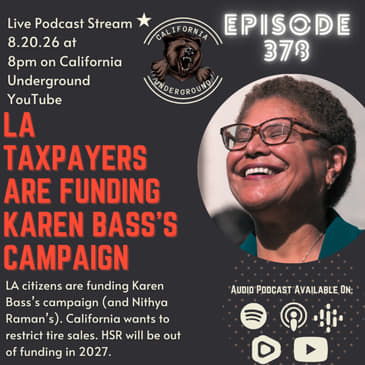
Los Angeles pays a qualifying mayoral candidate six dollars in public money for every one dollar an individual donates — and in the current mayor's race, challenger Nithya Raman has drawn more of that taxpayer match than Karen Bass.
Phil and Camille break down how the public matching-funds program actually works, why the "isn't it a First Amendment violation to fund a candidate I oppose?" objection reached the Supreme Court twice and lost both times, and why California has banned public campaign financing everywhere except a handful of charter cities.
Then: the California Energy Commission has used a 2003 law that sat dormant for two decades to rewrite which replacement tires can be sold in the state — and the "70% of tires banned" figure is being used to argue two opposite things at once. There's also a second, completely unrelated tire crackdown most coverage misses.
Finally, the California High-Speed Rail Authority is on course to run out of money by December 2027, according to its own inspector general — while the project's own CEO says the state's regulatory process is what's strangling the railroad he's trying to build.
No team. Just receipts.
Read more from Phil at The Gilded State: www.thegildedstate.comFull sourcing and show notes: caunderground.substack.com
[00:00:00] Karen Bass wants you to know that if you donate to her campaign, the City of Los Angeles will use taxpayer funds to match it six to one. But what she also doesn't tell you is that her opponent, Nithya Raman, also benefited more from this matching program. Also, a dormant 2020 or 2003 law has been revived to get rid of two thirds of tire sales here in California because of climate change as usual.
[00:00:24] As well as the fact that the high speed rail shocker is drowning in regulation here in California and they are going to run out of money by 2027. All that and more on this episode of the California Underground starting right now.
[00:00:51] Welcome to the show. We got a lot to get to though, but first, if you haven't already, make sure you subscribe, share, review, all that stuff helps with the algorithm. And I want to welcome in my co-host, the best and fastest researcher in the West, Camille. How are you doing tonight, Camille? I'm good. Something I just remembered that I didn't say to you before we hopped on. So we technically met four years ago today in person. Oh, wow.
[00:01:19] You know, we met online, not in a weird way or anybody. Like I found him when I was researching some political stuff and then ended up hiring him for a lawsuit. He totally won the lawsuit for us without me ever meeting him. And then him and his wife and me and my husband all got together at, of course, the steakhouse. And that was four years ago today. Wow. Here we are.
[00:01:41] I'm good not to correct you, but something you said at the beginning was Karen Bass wants you to know that tax dollars are, you know, can be matched to fund political campaign donations. But no, she doesn't want you to know their tax dollars. She just wants you to know that the city of LA will kick in, you know, if you donate. But yeah, I know we're going to get to that horrendous, amazing, wonderful legal, but horrible story. So. Yeah, we're going to get into that. How are you? I'm good.
[00:02:08] Funny story, just a public service announcement for everybody. If you get email bombed with a whole bunch of verification codes in your email that say like, hey, all of a sudden you're signing up for all these things for verification codes. Double check before you start deleting everything, because there's probably going to try and scam you out of airline miles, which is what happened to me today. I was getting email bombed for all these verification codes. And your natural reaction is to just delete all of them. And it was probably about 200 of them.
[00:02:37] And then all of a sudden, one snuck in there. It said someone had used and redeemed all of my Alaska airline points. Someone in India. So Alaska was very nice. They were like, yeah, no problem. We'll put your points back and make sure you change your password and put on two point authentication. So just a little PSA for people out there. It also happened to my wife. My wife also checked her account and found that 30,000 miles were missing from her Alaska account. Somebody had fraudulently done so.
[00:03:02] So if you're an Alaska user, make sure you go in, double check any airline miles. In fact, Southwest, Alaska, all that stuff. So fun story. Yeah, that's fun. Karen Bess has nothing to do with that, though. And Kevin Newsom probably doesn't need work. No, there's no California political angle to that. I just want to give a PSA to everybody out there that make sure when you get email bombed or something like that, double check to make sure that no one's stealing your airline miles. All right. Let's get into this first story, which is blowing up all over the place.
[00:03:31] And you had sent it to me. And my first reaction was, how the heck is this even constitutional? And we're going to get into the nitty gritty of it. And we're going to get a little technical and wonky because that's what we do here on this show is we dig down a little bit deeper than the headlines and explain what the heck's going on here. But first, here's the video of Karen Bass bragging about the fact that the city of L.A. will match your donation. Not just match it.
[00:03:56] They'll do a six to one match with Los Angeles City funds if you give to her campaign. So here's what she posted on X. Your donation to our campaign is more critical right now than ever before. Thanks to L.A.'s Super Match Program, every qualified donation from Los Angeles residents is matched six to one by the city. But after the primary, we had to start over from scratch.
[00:04:24] So we need you to rush your matching donation right now to help fuel this campaign. Chip in five dollars right now and the city turns it into thirty five. Chip in twenty five dollars right now and the city turns it into one hundred and seventy five dollars. Make your matching donation today. Thank you so much. All right.
[00:04:45] So here's the story is that this is a program that has been around for a while now. And this is just one article that went over and this is just a bunch of people reacting to it. So the story is, is that this is an actual program called L.A.'s Public Matching Funds Program.
[00:05:06] It pays a qualified mayoral candidate six dollars in public money for every one dollar qualifying individual contribution, which is what she is referring to. So this is the actual law. So when people are wondering, how is this even legal? It is legal in the city of Los Angeles. It's actually a city ordinance.
[00:05:27] It says in a primary election, qualified participant candidates will be paid six dollars in matching funds for each dollar in a qualified contribution up to the following maximum per contributor. One seventh of the per person city campaign contribution applicable, blah, blah, blah. In a general election, qualified participant candidates will receive a grant of one fifth of the amount in section within 10 days after being certified. So you can request it. Here is the actual code. You can go look it up. Section 49.7.27.
[00:05:54] This is the matching funds program here in Los Angeles. It is absolutely legal by their standards. We're going to get into why it's dubiously legal. But yes, it is a program that is actually going on in Los Angeles. So if you fund a campaign and Karen Bass is telling you that if you donate to her campaign, the city of Los Angeles will do six to one.
[00:06:23] Camille, you sent this to me. So I imagine you had a earlier reaction to this than I did. What was your first reaction when you saw Karen Bass saying that the city of Los Angeles will match, not even match, six to one match your one dollar donation? Well, my initial thoughts were, how is this legal and why is this legal? Which is basically what we're going to get into. But I think that's what I probably said to you. How is this even legal?
[00:06:50] And of course, I looked it up right away because I can have all my thoughts and feelings about Karen Bass, but she's not an idiot. She might be a horrible mayor, but she's not an idiot, you guys. Like, she's a smart woman. And so, of course, I'm looking at this going, she's not, she's certainly not here on social media bragging about something illegal. Like, she's not, no, she's not stupid. So I did look it up, but I didn't go into the research that you did. You did that for us. Thanks.
[00:07:17] But, you know, I found out why it was legal and was just like, okay, well, local elections matter. Local elections matter, you guys. Huge time. Yeah. Someone asked already in the comment section, how can this be real? Unfortunately, yes, it is real. If you're not paying attention to local city elections, this is something that happens. And then they pass these ordinances and they pass the city local measures and you're not paying attention because you're more focused on something else, whether it's presidential or Congress or something like that.
[00:07:46] Then this stuff happens. And then you find out later that the city of Los Angeles is using your tax dollars to fund both Karen Bass and Nithya Raman. So when I said that Raman's actually doing better under this than Karen Bass. So independent expenditure committees are really the imbalance in this race. Those have backed Bass 36 to 1 over Raman per the LAS data. So this is LAS. They do a great job.
[00:08:12] And it turns out that she's actually getting more money than Karen Bass is. Like she's been a bigger beneficiary of this than Karen Bass was. And so she's actually getting more money. So they're funding both of them. So your tax dollars in L.A. are funding both Karen Bass and Nithya Raman. And they are a multiplier effect of campaign donations as if Los Angeles doesn't have enough problems on its hands with everything else that's going on.
[00:08:41] They're taking the money and putting it right into their campaign accounts. I just want to remind everybody in March of 2025, Karen Bass went to Sacramento requesting $2 billion because of the L.A. city, not county, city budget deficit. $2 billion. And yet, yes, there is a separate fund, which Phil will get into that. But regardless, she requested $2 billion because they don't have any money.
[00:09:05] But yet, this program is somehow alive, well, and thriving and being used. Well, plenty of people are still living on the streets. And plenty of people lost their homes in fires. And as we've reported on and talked about, you know, there's like under-equipped firehouses and some of them are falling apart. Firemen don't have proper, like all the things. I mean, just, you know, L.A. didn't have water for fires last year.
[00:09:35] Their reservoir wasn't full. And then we find out that their drains, like their 100-year-old drainage systems are all malfunctioning right now. And yet, you would think that a mayor would be like, hey, this city has a problem. And this program is not the priority. The people are the priority. And regardless of who gets elected, we need to solve problems. So this fund should not be going to our campaign funds.
[00:10:02] This fund should be going to actually help the people that had to pay the taxes for this anyway. We need to add water to the reservoir. And we need to fix the drains. We need to get the people off the streets. And we need to equip the firehouses and the firemen and the EMTs. And we need to, like, there is, like, I don't even live in the city of L.A. or the county of L.A., and yet I could list 100 problems that they need to fix. And it's like, hey, let's use tax dollars to fund our campaigns. Guys, that's like, I bring no knowledge to this podcast. I just rant.
[00:10:33] That's why people got so upset about it. That's why when you sent it to me, I was like, whoa, wait, what? The government is funding their campaigns. So my first question to you, being the legal nerd, is how is this not a violation of the First Amendment? Because the First Amendment has freedom of association, meaning you're free to choose who to associate with and who not to associate with. So compelled association is generally unconstitutional.
[00:11:00] You can't force people to associate, and that means with votes or support or tax dollars. That's something that you can't do under the First Amendment. And so I did my research, and it turns out there's an old Supreme Court case back in 1976. It was Buckley v. Vallejo.
[00:11:19] And when Congress created public financing for presidential campaigns, challengers argued that any scheme of public financing of election campaigns is inconsistent with the First Amendment because it's forced, it's compelled association. It's a violation of your freedom of speech. I can choose to speak on behalf of a political candidate. I can choose to speak out against a political candidate. And I can also choose not to speak out at all.
[00:11:45] That's my right as an American is I can choose to speak, to not speak, to protest speech. And the Supreme Court back in 1976, now keep in mind this was a long time ago. It's a whole different court than we have today. And this is the reason is that the court treated public financing as a government appropriation, not compelled association, and noted that essentially every appropriation Congress makes uses public money in a manner to which some taxpayers object, which I would agree with. I think there's plenty of things.
[00:12:14] We could probably spend a whole show going over stuff that the government uses with our tax dollars that I object to. So basically their argument is that, I mean, you already fund wars, subsidies, and programs you may personally oppose, and the First Amendment doesn't give anyone a lie down a veto. And here's where the Freedom Association argument fails according to the 1976 Buckley Court. It's different than a union where you're forced to join or bankroll a private group.
[00:12:42] It's a court case called Janus, which basically said that you can't force people to pay union dues to the union if you don't want to. It's compelled speech. It's compelled association. That came out of the Supreme Court recently and basically allowed all union members to say, well, I don't want to, I'm not going to be forced to join a union just because I work in a certain profession, which was a big issue. So it's different. That was sort of their delineation is it's not a private group.
[00:13:08] So I'm not crazy about that, but in 2011, the Supreme Court struck down a similar program in Arizona, whereas a public matching funds program five to four. And the reason for it is because the specific mechanism is a trigger match where publicly funded candidate automatically got extra taxpayer money the moment their privately funded opponent out raised or out spent them.
[00:13:33] And this is what Chief Justice Roberts says that he penalized the private candidates own speech, spend a dollar and you literally fund your rival. So what they're saying in that speech was because in Arizona, the public campaign finance matching was if someone pulled ahead because people were giving them a lot of private money, then the government would then take money from the public fund and help the other candidate catch up.
[00:14:02] Kind of like to even the playing field. And then Justice Roberts said, no, because that's not fair. Because if sure of that. Yeah, go ahead. No, just share the wealth. That's what it sounds like. Yeah. I mean, if that's the case, if you're going to even it out and make it that neither candidate can really pull ahead at a certain point in fundraising, then I guess you just either go all in on public financing, which is OK. You both start with $100,000 and that's it.
[00:14:30] You just have to figure out how to campaign on $100,000. That would be the fair way to do it if you're going to use public funds. But this idea of like you're raising private money and then your opponent catches up because Arizona then gives you more taxpayer money. I don't know. I think it's all crazy. I think this kind of idea of matching campaign contributions is insane and a violation of your First Amendment rights.
[00:14:53] It's maybe something that somebody should bring up to this Supreme Court, which is a lot more conservative in the sense that they don't look at this stuff very favorably. So the difference is here and why it's different than L.A. is because L.A. is not a trigger match in terms of, OK, if Karen Bass pulls away with privately funded donations, Nithya Raman catches up. So she's essentially funding her opponent through this public fund matching.
[00:15:22] So that's why they get away with it. And it's not the same as Arizona. Is everyone following me? If anybody has any questions in the chat, please ask. But I think it's important we get wonky because in my opinion, this is why Camille and I do this show is because we dive deep into this stuff. And we're not just giving you the headlines. There's 100 shows that you can go to right now that will sit here and just tell you the headlines. But we want to really like dive in and give you the scoop as to like why this stuff is happening.
[00:15:51] So you go away from this show and go, wow, I actually really learned something from this, not just a regurgitation of the headlines. So any comments about that stuff before I get into why L.A. is different than other cities and why even California doesn't approve of this statewide? I don't have any comments. I mean, it is right. I'm following, but it is crazy. It's a lot. It is a lot. All right.
[00:16:21] So why is it here in California statewide there? It's not allowed. Why is L.A. different than any other city? Public campaign financing is illegal for most of California. Prop 373 authored by former state senator Quinton Kopp amended the Political Reform Act to ban public funding of campaigns statewide. In 2016, the legislature passed SB 1107 to repeal that ban. The Howard Jarvis Taxpayers Association and Kopp himself sued.
[00:16:49] In 2019, the third quarter of appeal actually struck down SB 1107, ruling the legislature can't override a voter initiative that way. So because it was a prop and it was passed by us, the legislature can't do it. They've been asked to repeal it. It keeps getting voted down by large margins. And why is it different, even though the state has a ban on public fund matching? It's because L.A. is a charter city.
[00:17:16] I really want to, like, break this down because it's infuriating and it's crazy that this exists. But I think people need to understand the mechanics of why it exists. Because L.A. is a charter city and under California's constitution of their home rule doctrine, charter cities control their own municipal elections. And courts have held that Prop 73 ban doesn't reach them. So there's only six charter cities in California. I'm sorry. This is maddening.
[00:17:44] So there's six charter cities. All of them are incredibly loose cities. So what does a charter city mean? How does one become a charter city? Oh, gosh. Now you're getting a real nitty gritty. How do you get into, what's the difference between a charter city and, like, a city like San Diego? Is it, you're incorporated into the county? Is that what it is? Because it's a charter city as opposed to a incorporated? Because there's unincorporated and there's incorporated in the county.
[00:18:14] I don't know. But, like, we're all supposed to be a part of the state of California. And then, of course, within the being part of the state of California, we're in the union. We're in the United States of America. We should not have, like, this is where it's so important. It's so weird. Okay. As much as I hate to bring up COVID, this is what's so bizarre to me. It's like, okay, so LA is this charter city, whatever that means. They've got their own kind of rules and games that they play.
[00:18:44] But yet, when COVID hit and people were like, we shouldn't be opening by, like, state, whatever it should be, you know, counties or areas, depending on how the areas are doing, that's what we should be following. And so it's, like, weird how it didn't matter that LA was a charter city then, just six years ago during COVID. They still played by all the rules or we all had to follow the same rules that they were following, despite the fact that they're allegedly different and have their own rules.
[00:19:14] And so it's so weird to me that they have these weird rules, guidelines, whatever you want to call them, laws. But when it's convenient for them, but, like, when it's not convenient for them or whatever, then it's like everyone still has to play by these rules. And so that's what I'm kind of getting at, which is a really, really dumb example.
[00:19:35] But it's like, why did Orange County, which is where I am, and we didn't have the high COVID rates, like, not that COVID didn't exist here, but we didn't have what was going on in the county, LA City. And yet we had to follow the same rules that they had to follow. And they're apparently a charter city. So why weren't they just having their own guidelines at the time? Why were we all mixed into this pool?
[00:19:57] And so now, once again, they get to have their little weird campaign fund that the taxpayers of LA City have to fund. How is this right? Even if it's legal, how is this right? And you don't have the answer to that, I understand, and I'm not asking for the answer. Well, I did pull up a charter city as a city that has its own charter, which is a legal document that grants extensive authority over local governance, including its form of government and election procedure.
[00:20:24] Unlike general law cities, which follow state law. In LA? Yeah, different. I'm going to try to, my rants are taking up too much time and not getting us anywhere. I'm sorry. I'll be quiet for a bit. So that's basically the whole story. It's frustrating. I'm sure people in the chat are saying this is disturbing. They can't believe this is actually happening in Los Angeles. And the scary thing is, is it's legal. And it's been in effect. And it's happening.
[00:20:53] And this is why when Camille says stuff like local elections matter, and we continually say this like ad nauseum here on this show, local elections absolutely matter because this is one who's writing your city charter, who's in charge of your city charter, local proposition, local measure, city measures, stuff like that. And this is stuff that you need to be paying attention to because all of a sudden, yes, it's inferior.
[00:21:21] And Karen Bass comes out with this video and then everybody reacts to it. And I had the initial reaction, which is, how is this even constitutional? And then when you dive into it, you go, it actually is pseudo. I still don't think it's really constitutional. There could be an argument made that it's not constitutional, but it's it is what it is.
[00:21:40] And I think that's the issue here in California is there's been a lot of stuff that has slid under the radar because people get depressed or they get downtrodden or they get beat down and they go, there's no point in voting. It all just sucks anyway, so who cares? And then this stuff passes or these charters get written or amended and people aren't paying attention to this stuff and they only pay attention. And I'm not saying this to the people who are here right now.
[00:22:08] Obviously, if you're hanging out with us on a Thursday night listening about California politics, you guys really care about California politics. But local elections do matter. And that's why propositions are very important. And who runs your city, I think, is almost more important than anything. Like, who's the mayor of your city? Who's on your city council is so important. There's city measures. I mean, how many times has San Diego tried to raise sales tax here in San Diego?
[00:22:34] And if people aren't paying attention, then they probably would have just kept raising sale tax and just kept taxing the heck out of us. So you have to pay attention to this stuff. And yeah, it's infuriating. It's not technically illegal. It is legal under the way our government is set up with the charter cities here in California and because of past Supreme Court decisions on the First Amendment. So, yes, it is legal. It's frustrating, but that means you got to pay attention.
[00:23:03] It's crazy. I think that this is actually happening, but it's the reality of it. And I know a lot of people are going to immediately go to it's, you know, fraud or it's a scandal or it's money laundering. It's our taxpayer dollars being money laundering into our campaign. That's not the case. I'm not here to defend Karen Bass, but it is the case that this is how this came about. And I think it's important that people know that. Any final thoughts before we move on to our next story?
[00:23:32] Local elections matter. Also, I forgot to mention at the top of the show, a really big update. If you see right here, this QR code, my book, The Gilded State is available for pre-order on Amazon. So if you go to Amazon, if you use that QR link that's on your screen right now, you can go to Amazon pre-order. It is right now at a hell of a deal introductory price for Kindle right now.
[00:23:59] It's $2.99 for Kindle. So if you pre-order now, you're going to lock in that $2.99 rate. It'll be dropped into your Kindle on September 8th. So if you are interested in getting The Gilded State, pre-ordering it, prices are going to go up after it gets published. So if you want to get it, get in now. Go check it out. Are you going to have a paperback or hardcover edition? There will be a paperback. Amazon takes a while to review just the formatting because they have to be the ones who print it.
[00:24:28] So there will be a paperback edition. If it's not available when you go to the site, if you just keep checking, I'm sure you'll be allowed to pre-order the paperback once it's available. So if you're waiting on that paperback, you can keep checking. But for those who just want to get a Kindle or e-book version, you can go get it now for $2.99. It'd be great. Support the show. It took two years, about two years to write. It's over 300 pages, about 600 citations.
[00:24:57] Well-researched, if I do say so myself. All right. It's true. I've read it. I have my own digital edition. But I am going to have to order a few when the paperback or hardcover comes out. I'm going to have to order a few and just have them sent straight to you so you can sign them and send them back to me. And then I can keep one for myself. I know my aunt, like, she may be watching this. Shout out to her, Aunt Jenny. She really respects you. She really enjoys watching the show. It really likes what you have to say. And so I think she would love it if I were able to give her a signed copy.
[00:25:27] So I'm definitely going to have to, when that paperback comes out, I'm going to have to order some straight to your house so that you can then send them to me. Signed. Sign them and send them back. All right. Next story. This story was wild for the sake that it's just, this is California. And they think of every new reason to regulate the heck out of you. If you haven't heard, they want to, well, they did already.
[00:25:53] They introduced a new rule for tires. You're in powerful. New tire rules. So let me pull up this video right now. So this is Nancy Skinner, who was a Bay Area state senator. She was termed out. And as is the case with all politicians, they don't ever leave politics. They just go find another job. So here's her as the head of the Energy Commission. I believe it is. Yeah.
[00:26:23] The California Energy Commission. So here's her explanation. Amy 844 was passed more than 20 years ago. The California Energy Commission has never regulated tires until this moment, essentially. What happened? Was it like, how did. We're already like three seconds into this video.
[00:26:46] And the fact that this lady is licking her chops at the question about tires is terrifying. She's doing a weird. No, she's just making the weirdest faces. And she is like you said, they licking her chops. So she's literally like chomping at the bit. Like literally there's something we're going. I never want to judge anybody by their looks. You know, before we hopped on, we're using this one particular tech program, this studio.
[00:27:14] And the one that we used last week, they now have these like filters and lighting options. And I said to Phil, oh, I can't do my filter tonight. And I did less makeup based on that. So, I mean, I was joking around that like last week I looked like I had work done and I don't have work done. And I'm not opposed to work getting done. And, you know, work takes money. I'm not going to get into what I would do to my face. So I don't ever want to judge anybody by their looks. But when you don't take care of yourself, that already shows a few screws loose.
[00:27:43] Because it would be one thing if like, oh, I wish that my eyelids weren't so droopy or whatever. But because of that, I'm going to stop wearing makeup and stop washing and brushing my hair. Like that's where I feel like she's at. It's weird. And that's not healthy and that's not okay. It's just like, well, I'm not going to look good anyway. Therefore, I'm not going to try. And so if I came on here and yeah, everyone has their like weird facial expressions, but I'm not sitting here going.
[00:28:13] She, it's almost like she got a little too excited at the idea of regulation. Yeah. She was like, mm, regulation. Mm, more regulation. Yeah, like she doesn't keep when the word regulation comes up and she's like, my brain is not what's going on. Oh my gosh, I'm so excited about regulation. I'm so excited I came up with this idea. So let's keep watching. This happened. Well, we regulate hair dryers, TVs, refrigerators, all kinds of appliances, right?
[00:28:41] And tires are really not much different. So I think we've got some pretty good experience within our shop that does that. And the tires, you know, it's like if I'd been on the commission those 20 years ago, maybe we wouldn't have taken so long. But at least we're doing it today. So did you push it? You were the one who said what? The chair and the rest of us especially. Look at the gas prices everyone's experiencing. Look at how much we're paying for gas.
[00:29:07] If we can drink each California's cost down just a little bit, then why wouldn't we? She's not helping herself when she makes the argument, well, we regulate everything from microwaves to TVs. What are you regulating with TVs? What's the big regulation with TVs? Do you see how she smiled and her face lit up too? She's like, we regulate everything. We're regulating and regulating. Now we get to anyone else tired from the tire talk. Sorry.
[00:29:38] Let's keep going. Do you know why it's that dormant for so long? Well, there may not have been those kind of pressures, cost pressures, right? And, you know, obviously whatever type of standard we do is going to cost the manufacturer a little bit to meet it. We want to make sure that that delta of the increased cost of the product is small enough that the consumer still reaps a huge savings. So that's really what we're trying to achieve.
[00:30:08] Huge, huge savings. We're going to make you pay $100 or more for tires so that you could save about $50 a year on gasoline here in California. There might be another way to save Californians money on gasoline. Oh, please, Phil. You have no idea what you're talking about. There's this cost that's already associated with gasoline here in California. I wonder if we could just get rid of that or maybe pause that for a little bit. That might be a good idea instead of making people pay more for tires.
[00:30:39] This is why I always say progressive policies are actually the most regressive policies. Because the people who can afford the new tires, it may hurt a little bit. They may be like, oh, man, my tires are much more expensive. People who can't afford new tires, who don't have that money saved away, what do they do? What do they do when they have to go out and buy really expensive tires because you regulated the heck out of tires?
[00:31:08] That's why I never get this idea of like statists and leftists act like they're helping the poor in low income, but they're actually making it worse. And the same thing with the gas tax is the gas tax doesn't discriminate based on income. If you are struggling to make ends meet and you have to figure out whether you can fill up your gas tank or put food on the table, gas doesn't care who you are. The person from La Jolla who drives their Ferrari down to fill up the gas tank doesn't care.
[00:31:38] They just throw in their Amex black card and pay for it. But the person who has to figure out how they're going to both fill their gas tank to make it to work, to make money, to put food on the table and can't afford it. They're in a real struggle here. So all of these policies end up being incredibly regressive. Yet these politicians somehow have brainwashed enough people to believe that they stand up for lower income and poor Californians when their policies directly hurt.
[00:32:07] I think I wrote an article on this a long time ago before the show. I think it was before California Underground. And the crux of the article was basically is that California liberals don't care about the poor. And it was basically this argument of like they're fine with sipping champagne overlooking the ocean in Newport or La Jolla or wherever. Nothing against those areas. Although those areas are conservative. Well, those are pretty conservative. Those are pretty conservative areas. All right. I'm trying to say Santa Monica.
[00:32:36] Let's just say like Santa Monica, areas like that, Santa Barbara, any place like that. San Francisco, sure. They're fine with voting for these policies because they believe it helps when in reality it costs and forces the lower income and poor in California to make hard decisions. I'm going to see if I can find that article. Maybe I'll repost it on our website. And then Justin Skinner, former state senator, right? Yes. And that's why I brought up this article. A little bit of history about Nancy Skinner.
[00:33:05] So you have an idea of what kind of lawmaker Nancy Skinner was. Nancy Skinner is the same lawmaker who tried to ban, quote, bullets. It's the very thing that make guns deadly, she said in a hearing in 2013. When she couldn't ban guns, she tried to ban bullets. Do we see a trend here? So they couldn't ban gas cars. So now they're trying to ban. Let's ban the tires. In 2013, Assembly Bill 48 by then Assemblywoman Nancy Skinner.
[00:33:35] So just keep in mind, she got termed out of being a state senator, but she was an assemblywoman and you can move over to state senate and your clock kind of restarts for the term limits. She passed the assembly bill by 46 to 26 vote and moved over to the state senate. Her bill would have banned the sale of magazine park kits that could hold more than 10 cartridges and require mandatory reporting of law-abiding citizens who purchased more than 3,000 rounds of ammunition within a five-day period.
[00:34:03] So you, the feds or the state would know. Not the non-law-abiding citizens, just the law-abiding ones. If the cartel picks up 3,000 rounds of ammunition, that's completely fine. But if you're a law-abiding citizen, you want to buy 3,000 rounds of ammunition for the bugaboo, we're going to have to report you. All right.
[00:34:19] She goes on to say in 2024 when Senate Democrats rejected a bill to make purchasing a child for sex a felony, Nancy Skinner actually attempted to offer cover to perps by buying and selling sex, for buying and selling sex. She said, quote, selling sex has been within human cultures for millennia, Skinner said. That is a difficult area of law to get into.
[00:34:45] Skinner even authored SB 345, which provides legal protections for medication, abortions, and gender-affirming care. So that's just some of the history. I wanted to add something real quick. Because I did a deep dive, I think before I was on the podcast. I had read this article. I know I've talked about it here a little bit. And it's actually a highlight on my Instagram page.
[00:35:11] Where I was reading an article about Oakland and how global warming and environmental stuff was like, had to do with justice of like Black people. And basically, like, I had seen the article, like I was browsing Twitter. And I was like, what does global warming have to do with this? Like, I was very confused when I read the article. And whether or not I agree with that, it made sense. They talked about how they were having this in Oakland.
[00:35:38] There was a specific area where they had once a thriving community. And then the housing market came in and shoved them into this little pocket and built freeways around them. And they were stuck in this little area. And now the soil that was contaminated and now they're living in that. And it's not healthy. It's not the best air quality for them and soil quality. It all made sense. But here's the thing is that that was the district that she, Nancy Skinner, was the assemblywoman for and then later state senator.
[00:36:06] And she quite literally wrote books on saving the environment. And yet she couldn't save her own district. That's how these people are is that they'll go and they'll write these books like if they're the authority on the subject. And yet when it comes to their own district, they quite literally neglect. And what's funny is that my deep dive does go into, I mean, I really went into tons of history and a year, like what was happening this year, this year, this year to come to this conclusion and the policies and who was in charge when these policies happened.
[00:36:34] And it was all Democrat policies that put these people in the situation that they're currently in. All Democrat policies. My Instagram is public. My name is on here. I'm not telling you to go follow me somewhere. There's a highlight on it. Like it's like Oakland or it's something like that. It's a fascinating story of just saying, if you want to go read it, you don't have to follow me. You can just find it if you want, if you're on Instagram.
[00:36:56] Nancy Skinner was quite literally one of the people that I mentioned because she just is always proposing these crazy things, but she's truly neglected her district. And yet here she is with just another idea, not thinking about the actual ramifications and the consequences of it.
[00:37:14] So the last one I wanted to bring up was SBX12, which was this supposed way to crack down on oil and gas companies, which has never been used. So they made this big deal. And Gavin Newsom had a nice little press conference about how they were going to crack down on the oil companies. And then they never actually ended up using it. So that's the idea of who Nancy Skinner is.
[00:37:44] I want to give it that little bit of idea. Now more about actual tires. You keep talking. I'm going to be right back. My apologies. Okay. All right. So going on right now, let's see. The California Energy Commission. So this is the rule that they adopted. The Replacement Tire Efficiency Program, Monday, August 17th, the first regulation of its kind.
[00:38:09] What it would do, it's going to cap a tire's pressure, rolling resistance, and how much energy it takes to roll in two phases. And phase one adds about $6 to a set of tires, saves drivers about $85 in gas over a tire's life. Now this is the California Energy Commission's own number. So take that with a grain salt. Phase two adds about $26, saves about $179. So imagine that. It's $26 and you're going to save about $179.
[00:38:38] So that's where that's coming in. What they were talking about is AB844 was passed in 2003. So it's been over 20 years. This was something that the federal government actually started and they never actually really got around to. It was kind of abandoned. So here's where it really gets the rubber meets the road. Every outlet that is repeated at the rule will eliminate 70% of tires currently sold in California by 2033.
[00:39:04] But Commissioner Skinner says that 70% of tires available today already comply with the less stringent 2029 standards. So basically you have two different numbers here, which is Nancy Skinner. And you have tire companies and the tire industry who are saying if this goes into effect, 70% of tires that are on the market will not be available anymore.
[00:39:27] If anyone in the chair or anyone listening is a proud gun owner, you know that when gun regulations happen here in California, they restrict what you can buy and they make it harder and harder. So what they do is they add all these different regulations onto certain guns. They try and change what a Glock can do, stuff like that. And then pretty soon they just add these little regulations to the point where then all of a sudden the industry collapses because it's impossible to make it.
[00:39:56] And these companies just aren't going to make California specific products. So they're just going to pull their entire product. That's what I think the economic issue is here. So while Nancy Skinner is going to say, well, 70% will comply with this 2029 figure, that's not really the issue is that tire companies are not going to make a specific California tire. It's just too much work and probably not enough profit. You know, that's how businesses are incentivized is by profit.
[00:40:23] So what happens is going to restrict the amount of tires that are actually out there, lessen competition. And then what happens when you lessen competition is prices are going to go up because there's just not enough tires. Not that there's not going to be enough tires, but when there's only a few companies that actually make the tires and there's no competition, guess what? You can start to charge whatever you want for that. So there's another thing I wanted to bring up.
[00:40:48] This was interesting to me is that this isn't the only tire rule that came out recently. There's two tire rules. If you were angry at one, you can be even angrier at the fact that there's two of them. So there's the rolling resistance gas mileage. There is a parallel rule, which is targeting what's called 6 PPD, which is a chemical in nearly every tire that breaks down into 6 PPD quinine.
[00:41:18] I'll say that again. 6 PPD quinine, which is shown to kill endangered coho salmon in California streams. 6 PPD quinine, which kills these things. Salmon. I mean, I love salmon. Salmon is delicious. It's really healthy for you. Omega, healthy omega-3 acids.
[00:41:46] But we're all going to be driving different tires because it kills, it supposedly kills these fish right here, these salmon right here. I imagine because some people throw their trash into the rivers. That's how this happens. Or is it the air that gets into the water? Like, how does this kill the salmon? Because I guess it breaks down and as it, you know, it runs off, if there's rain or something, it gets into the groundwater.
[00:42:14] And then the groundwater then is contaminated with this 6 PPD quinine, which then kills the salmon. Okay. So I don't want to laugh at that because I genuinely actually care about real food. And, like, on my Instagram today, I was going off about how nothing is safe to eat. And I don't know what's going on there. And, like, we're not discussing that on the podcast. But I genuinely, like, I'm not even, like, conspiracy theorists, you guys.
[00:42:41] But, like, today, I was just, like, is the media pushing that real food is bad so that they can push all this lab-grown food? Or is America, like, really poisoning the food? Because I don't know if you guys know right now, like, they're saying eggs are even worse than they thought. And there's, like, a huge recall and they're causing all this really bad salmonella. And then the ground beef is being recalled because that's really bad. Obviously, we know about the dangerous lettuce.
[00:43:09] And then there was the majority of strawberries grown in America are causing cancer. Like, it's this whole thing with, like, real food is allegedly really bad for us. And I don't know what's going on there. And I believe that we have poisoned our way into growing bad food. And I'm very opposed to lab-grown meat and eggs, of course. But it is weird. It's very weird. So, no, I'm not, like, I was laughing.
[00:43:35] I am not in favor of poisoning the salmon because I do believe, I personally don't like fish. But, like, I believe in eating real food. I'm all for eating real whole foods. But. Yeah. I was watching a show. It's an entertaining show called Billy and Dom Eat the World. The two guys who played Merry and Pippin from Lord of the Rings. They're still friends after all these years. And they're doing a food travel show. And one of the episodes was California. And they went to San Francisco.
[00:44:05] And they visited a lab that is growing meat. Not, like, beyond meat kind of stuff. Like, they are actually growing meat. And they were telling the process of how they would take a biopsy from a cow. And then they put it in this vat. And then the vat would create cells that would then become meat, like ground beef, over time. And that sounds absolutely disgusting. I'm just going to say that. I don't want it.
[00:44:35] That sounds scary. And then they actually ate, like, a fake chicken breast. And they were like, oh, this actually tastes really good. I'm like, that looks horrible. This is very dystopian. I don't like this. We got one more story I want to get to tonight. Any other comments about the tires? This is why, you know, people will just start leasing cars so they never have to replace their tires ever again. They'll just drive them and then lease and then bring their car back in. All right. Final story of the night.
[00:45:04] Tonight sounds like it's on repeat over and over again. Like, we keep saying the same thing, deja vu. Guess what? The high-speed rail is going to run out of money. What? Which I know many people might be shocked that the high-speed rail is going to run out of money because it seems like we have all the money in the world to keep throwing at it. But that was the report from the independent inspector general in California. So let's watch this video real quick and we'll comment on it. Did you ever hear of Gavin Newsom?
[00:45:31] That train is the worst cost overrun I've ever seen. How about missing disinformation? Remember when President Trump pulled $4 billion in federal funding from California's high-speed rail and Governor Newsom said it was a political attack? Well, it turns out there's more to the story. Records reveal California high-speed rail failed to do the one thing it promised the feds, a federal judge, and taxpayers it would do. Buy the trains. This is the federal funding agreement.
[00:46:00] California agreed to buy the trains by December 31, 2024. It didn't. And there were warning signs. There's been some discussion about perhaps redesigning or reconfiguring the train sense. Less than two months before the deadline, board members raised concerns about the new CEO's plan to change the train designs in the middle of the bidding process. We may have to cancel that procurement or rewrite a new specification. Sorry, I'm going to have to interrupt. We are in active procurement.
[00:46:28] A lawyer for high-speed rail shut down the conversation. So I'm just going to ask that we not discuss it here. I would highly recommend conversations with the CEO. Weeks later, they missed that deadline. I would request and recommend that we don't talk about how we haven't done our job in a public forum. Please do not bring this up. I request that you do this behind closed doors so the taxpayers have no idea what's going on. Please and thank you. Which the Trump administration pointed to when they pulled the federal funding about six months later.
[00:46:58] So California sued, promising a federal judge in sworn court filings it would buy the trains by December 1st, 2025. High-speed rail missed that deadline too, canceling the board meeting where they were supposed to approve the contract. Then just two days before Christmas, California quietly dropped the lawsuit. This time, no press release. Just a couple sentences buried on the high-speed rail website saying the Trump administration was not a reliable partner. Why did we pull the lawsuit?
[00:47:27] That was a client matter. It was appropriate for us to pull the lawsuit. That's California attorney. It was a client matter. Well, you're the attorney general. You represent the state. So your state as the client, that was a client matter. They probably had to tell them, well, yeah, you didn't do what you were supposed to do under a federal grant. So you're dead to rights. Sorry.
[00:47:52] General Rob Bonta at the governor's state of the state a couple weeks after he dropped the lawsuit. Meanwhile, this is what the governor had to say that day about the status of high-speed rail. We're also laying tracks. Laying tracks in the nation's first high-speed rail system. Except they weren't. To be clear, there are no high-speed rail tracks laid as of today. Not yet, no. That is the high-speed rail inspector general, six months after the governor's state of the state address.
[00:48:18] And this is not high-speed rail track that Newsom and the CEO are. Newsom and his cosplaying is something to be studied in politics of how much he cosplays as something he's not. Let me put on this button down and show him hammering. Is he, like, going to sing that song? I've been working on the railroad all to live long day. I mean, don't forget when he picked up trash.
[00:48:47] He's got all these different costumes. Look at that. That's a great picture right there. I did not plan to stop it right there. That is a good snapshot of Gavin Newsom. Like, you believe in this? Yeah? You believe in this? Because hopefully people believe this when I run for president. Nails into. It's a prop. As for the trains. Wait, Mike, how do I use this? What is this? Wait. I didn't notice that the first time around. The rail that he's actually. That's not even an actual rail. That's a prop. That's not the actual.
[00:49:17] So they built this prop so that he could look like he's building the high-speed rail or helping out with the high-speed rail. And it's actually fake. Nothing could be more. Next week it's going to be. Sorry, go ahead. Go ahead. I was going to say nothing could be more symbolic of the entire high-speed rail. So then building a prop that's not real high-speed rail tracks and pretending you're building it and not really building it.
[00:49:41] Next week he's going to use that same image to promote how they're bringing movies back to Hollywood and see here he is working on a set. He's going to be painting a set or something or sitting in a director's chair. He's just going to use that same image. Literally just the same image recycled for like, see, we're building a movie set here. Here we are. Getting my hands dirty. Officially listed as TBD. Trains that are expected to take at least four years to manufacture and at least another two to test.
[00:50:08] A countdown that was supposed to begin back in 2024. I would highly recommend conversations with the CEO. Governor Newsom and high-speed rail didn't answer our questions about the reason for the delays. They did send us a copy of a Biden-era federal review that found no fraud, waste or abuse. But that was before these missed deadlines under the new CEO. For CBS California Investigates. I'm Julie Watts. Need to have her on the show. She's a great reporter along with Ashley Zavala and others like Joey Safnick down here in San Diego.
[00:50:38] They really get to the bottom of it. All right. So a couple minutes left in the hour. Thanks, everyone, for tuning in and keeping up with us and hanging out with us tonight. Make sure you like, share, subscribe, or review. If you're listening on audio as well, make sure you comment. That also helps more people find us. So make sure you comment. We respond to the comments on audio wherever you are. All right. So we went through the whole story, how it happened.
[00:51:01] And the Inspector General, Benjamin Belknap, his review of the authority's 2026 business plan current funding will, quote, exhaust its current funding resources as soon as December 2027. Without any new financing. So the gap is $9.5 billion over the next five years with $2.2 billion needed in fiscal year 2728 alone just to keep the construction on schedule.
[00:51:28] And borrowing against future cap and investment revenue could add another $3.6, $6.6 billion in interest costs. Well, they're going to be able to come up with this when they tax us more for it because they saved us money on tires. Yeah. They'll be like, hey, remember that $179 we saved you on making you pay more for tires? Guess what? Yeah. You're going to have to pay more to the high-speed rail because of it.
[00:51:53] The Inspector General also found the schedule quietly slipped from a 2032-33 completion window to as late as 2034. So as you can see, it continues to slide back and back. So that's the Inspector General that he is the independent watchdog telling everybody that they're going to run out of money in 2027 based on his review. The authority's business plan also says it remains optimistic federal funds will become available in the future. Sounds ominous.
[00:52:22] Sounds like they know something we might not know. Now, here's the real issue. We all know that they're running out of money, but this is the biggest piece of irony of all of this. The CEO, Ian Chaudry, of December 2025 said this in an interview. Quote, we're at the bottom of a reverse pyramid performing the work while seven departments hover above us, each needing to review and approve every step.
[00:52:50] What he's describing is the fact that the high-speed rail is being held up in California by regulations, environmental regulations. So he's talking about CEQA and NEPA, which is the federal, and then CEQA is here in the state. Because every time they do something, they have to be running along the same path. So CEQA and NEPA are looking at the same thing. So there's all these different reviews. So every time that they have to do something, they have to get an environmental review.
[00:53:19] So the irony was not lost on people who are probably watching this or listening to this show. It certainly was not lost on me when I saw that the CEO of the high-speed rail is blaming California regulations, specifically environmental regulations, for slowing down the project. Well, welcome to the entire economy here in California. Everything is over-regulated to the point that it's slowing down. So housing, homelessness, let's see, roadways, all of it is being slogged down by regulations,
[00:53:49] and specifically environmental regulations. And here's another big piece of irony is that in 2020... Gas crisis. We refuse to get our gas from our own state, the oils we have. Electricity. We have very expensive electricity because of the environment. In June 2025, Newsom signed the biggest CEQA overhaul in a generation, but buried in SB131 was the CEQA exemption for high-speed rail.
[00:54:17] But it was only for maintenance facilities and station modifications under specified conditions. And what he's saying is that the mainline route and the power grid were left out. So, yes, when we talked about this last time on the episode, what they were talking about with the high-speed rail was, yeah, they have built tracks for station maintenance for those areas, but they haven't built any mainline tracks because they're, again, stuck in regulation.
[00:54:46] So even though they crafted this legislation and Newsom crafted an exemption in CEQA, he forgot or they just neglected to actually exempt the actual train tracks. So that's the irony of this is California's own policies are killing the one project that they really, really, really want to be successful so they can brag to the rest of the world and the country about how they built a high-speed rail.
[00:55:16] What are your thoughts, Camille? Well, yeah, I mean, it is, like you said, just the irony of all of it is that they get in their own way. They come up with what they think is this brilliant plan. They can't afford the plan. They keep changing the plan. And then when they finally are like, no, really, this time we're going to do it right, then they're like, oh, but our own policies and regulations are in the way of us doing this. And so I guess this is where the change orders come in, and the change orders are what have been driving up the cost.
[00:55:43] And so it turns out that they're just going to have to add more change orders, which, like you said, it's just now the cost is another whatever billion over the next few years. And it's like, that's real money. And we don't have, the state doesn't have the country's 40 trillion in debt or something like that. And, you know, nobody has the money. We're all broke. We're all exhausted and broke. Yeah. Buy new tires to save the coho salmon.
[00:56:12] Yeah. I just thought that was a terrible update because we keep throwing money at this project. No, it's information. Well, it's important because it's just more incompetence. It's more delay. It's more dragging this out, a project that should have been done years and years ago. I got in an argument with someone on Reddit in the California politics subreddit. I go there because of the show and I want to, you know, for research purposes. This is where I found the story was it said that, yeah, California,
[00:56:42] high-speed rail is running out of money. It will be out of money by 2027. And I had replied something like, you know, there is a solution that no one really wants to talk about is you can just stop funding it and just give up on it. And I know that there's the sunken cost fallacy and people are going to say, well, we spent all this money anyway. We should. Okay. But that doesn't mean you should keep doing it. We're not even close to any sort of train system. We don't even have tracks yet. We don't even have any cities connected to it.
[00:57:11] It's not like we're at the point where there's a high-speed rail between Merced and Bakersfield. And we're like, look, it works so well. We just need to expand it to San Francisco and L.A. It'll be great. Like, it's not like we're that close to. We're like, okay, we just need these two more branches. It's like we haven't even laid actual high-speed rail tracks. And people just keep saying, well, yeah, just keep throwing more and more billions at it. They haven't ordered the trains. They haven't ordered the trains. It just seems like it just will never end. Those trains are just sitting somewhere in a warehouse. I'm pretty sure that's a custom order.
[00:57:40] That's, I don't know. I'm not any sort of train or high-speed rail expert. You don't think people just walk down to the train shop and pick out trains and take them home? Like, they're just like, I'll take this train, that train. Like, no, they have to custom build all these trains. We have to add cool tanks. Like, no, I don't think that's how it works. Yeah, I figure if you're going to order trains. One thing, which is okay, this is, sorry, different story, but it's actually California-related and has to do with regulations and stuff. There's this beach in La Jolla, this cove of all the sea lions go there.
[00:58:09] And I have been there numerous times. It used to be fun to take my kids to stand on the rocks or they had this, like, kind of, like, little ramp that you could walk on and look at the sea lions and their babies. And they're, like, coming out of the water and then they're, like, flopping on the sand, making their way up. And it was, like, fun and cute. And, well, now it's obviously a huge tourist attraction, but the sea lions are getting kind of aggressive. And they're protecting themselves and their babies and stuff. And they're going after people. And then, of course, people can never just look and enjoy.
[00:58:37] There's always that one or ten people that feel the need to, oh, let me see how close on the sand I can get and terrorize these sea lions so they react and we get this viral video kind of moment and stuff. And so I saw that on Instagram there was a post about how the California Coastal Commission is thinking about closing that beach. Basically, like, somehow you could only enjoy it from a distance so that the sea lions can have it. Okay. I was looking at that. And having been there, I was, like, yeah, I agree with this.
[00:59:01] I don't like that people go and terrorize these sea lions and they are a part of the environment and should have a place to thrive and everything. And this is one small beach in a strip of numerous beaches in San Diego County. And so, like, I was, like, yeah, I'm for that. I didn't comment. But then I'm, like, but I'm also not for all these regulations and this commission that I don't even believe. Like, did we talk about it's not an actual government regulation? It's just sort of this commission that just developed at some point and started making all these rules.
[00:59:28] And I'm, like, I don't want to give them any more authority than what they have because who are they and what do they do? So even though I agree with this one decision, I was just, like, I didn't comment because I'm, like, I don't need to argue with the internet. But I do plenty of that anyway. But anyway, it was just, like, no, because you give them this and then soon enough my future grandkids won't even be able to go on to a beach in California because we've given it all to the wildlife. You know, no people get to enjoy it anymore. And I'm just, like, no, I'm not going to give them this. You give them this. You keep giving them this.
[00:59:57] And then they just keep taking and overregulate. And then we see all these regulations that get in the way of everything else that's necessary for us for living. Yeah. Yeah, it's just once a regulation is born into existence, it's almost impossible to get rid of it. So that's why you have to stop them before they even get started. I completely agree with that. There was a senator a long time ago. He passed away. Senator, I think it's a senator, not Cotton. He's in the Senate right now.
[01:00:21] But he said something about how in the federal government, a tax, once you write and create a tax, it never dies. And he's right. Yeah, it's almost impossible, it's true, to get rid of tax. And when people say tax cutting, like what they did under the one big beautiful bill, they didn't cut taxes. They shifted taxes. That's what it's really called is, yeah, we lowered this rate, but we're going to get you at a different tax somewhere else.
[01:00:50] So it's never a tax cut. They never eliminate taxes. Just like regulations. They never eliminate, especially here in California, they never eliminate regulations. But I thought that was completely ironic that the California high-speed rail CEO was complaining that there's way too many regulations and it's making the train go slow. And they're running out of money. And they haven't ordered any trains. And they haven't built any actual high-speed rail tracks. But they did build a prop so Gavin Newsom could go out there and play railroad worker for a little bit. So any other thoughts on the high-speed rail?
[01:01:20] I think we've covered the high-speed rail a lot. Yeah, no, we've got, I mean, of course, any important updates. We'll certainly bring you guys. Somebody in the comments did say Hilton will dump the train if he's elected, which he probably will. What reason to vote for Hilton. Yep. Gina Murray said Hilton will dump the train. Yep. And Governor could get in there and maybe get rid of some of those regulations. Again, we don't endorse anybody. Someone asked, is Phil's book out yet? Really looking forward to it, said Andrews.
[01:01:47] Actually, Andrews, if you look at the QR code on the screen right now, you can pre-order the book. It's coming out September 8th. It's already done. It's ready. The formatter did an amazing job with the cover and the book and everything. It's crazy to look at it and be like, this is an actual book. Like I look at it on Amazon. I'm like, that's my book. It's a very proud moment for myself. I was very excited. Big deal. It's a very big deal to be a publisher. You had this idea and then you actually did it.
[01:02:14] And even though it took you a couple years, which was standard for a well-researched book, sticking to that, that's a big accomplishment. So you should be proud. So before we log off again, if you are interested in the Gilded State book, it's a big comprehensive history.
[01:02:31] I did my best to kind of go from like the gold rush through the 20th century when California exploded with economic activity and really became like the American dream, prosperous, full of wealth, great for the middle class, stuff like that. And then the slow decline from like the 70s onward to today. So, and I go through basically it's like two halves book. The first half is how we got to like be such a prosperous state.
[01:02:59] And then the second half is basically issue based as to why we slid into the position we are now, which is taxes, homelessness, crime, housing. I mean, there's just so much, but yeah, pretty proud of it. So if you want to pre-order it, like I said, $2.99 right now, the introductory price, if you pre-order it, that's a really great deal for a book that's 300 pages. So go check it out, go to this QR code, or I think you can just go to Amazon and look up the Gilded State and you'll find it. All right.
[01:03:27] Any other final comments before we log off for the night? Nope. Thanks, Chuck. But we'll be back Tuesday, 8 p.m. Always love people who tune in at 8 p.m. Also people who listen on audio, make sure you review, follow, subscribe, all that stuff. House with more people find us. And the best thing you can do to support the show that is 100% free outside of, you know, if you want to pay $2.99 to pre-order the book, which is not free, but you can do that. It's close enough to being free.
[01:03:51] You can support this show by sharing it with somebody who you think will get something out of this or a Californian who is frustrated with what's going on in California and they want to hear some answers or some information. That's why people tune in to us. So with that, we'll see you on the next one. Later, everybody.